
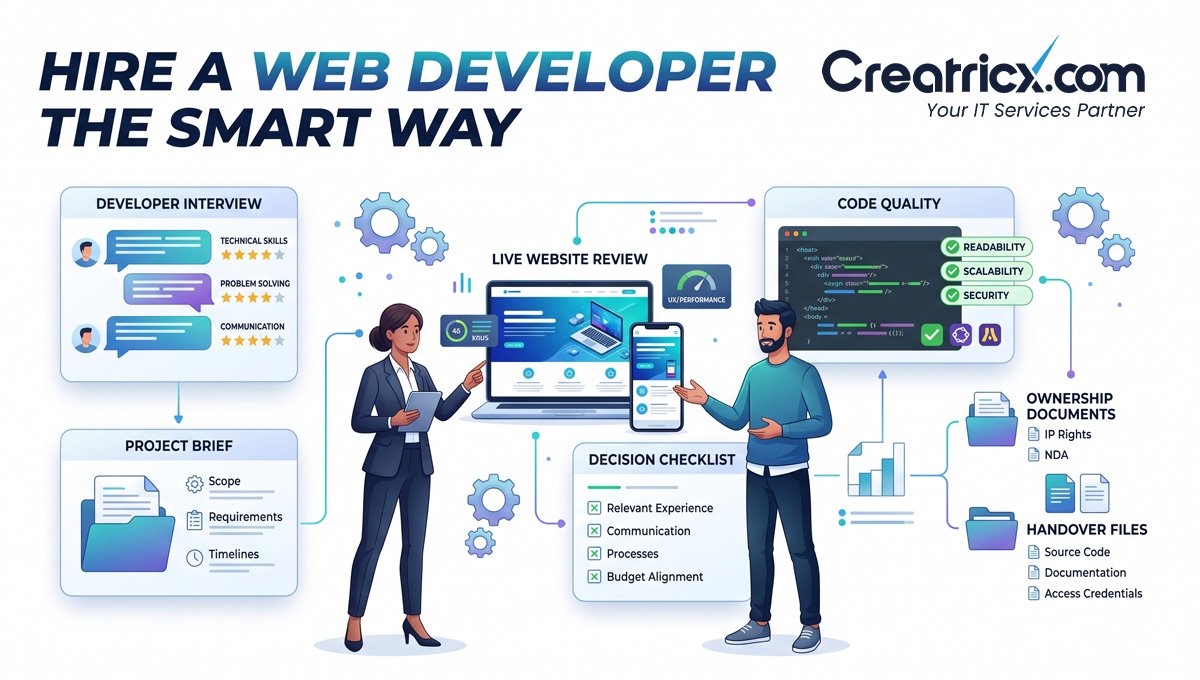
When hiring a web developer, look at how they reason, not just what they have built. Portfolios show finished artifacts that may have been inherited, team-produced, or cherry-picked. The reliable predictors are comprehension of your actual problem, the quality of their decision-making, what happens to the code after they leave, and only then their technical craft. At Creatricx, that is the order we assess in, and it is deliberately the reverse of how most businesses hire.
Key Takeaways
- Portfolios are the weakest reliable signal in hiring, because finished work rarely reveals who made which decision, or why
- A failed technical hire costs roughly 30% of first-year salary as a conservative floor, per long-standing SHRM and US Department of Labor guidance, and industry analyses commonly place the true figure far higher once rework and delay are counted
- Web developer rates in 2026 span roughly $20 to $45 per hour in South Asia and Eastern Europe up to $150 to $220 for senior specialists in the US and Western Europe, a spread of around 10x
- Agency rates typically run 20% to 40% above equivalent freelance rates, which buys process, oversight, and continuity rather than simply a higher bill
- AI coding tools have not compressed developer rates; they have widened the gap at the senior end, because the scarce skill is now reviewing and architecting AI-generated code rather than producing code at all
Table of Contents
Why Most Hiring Advice Points You At The Wrong Evidence
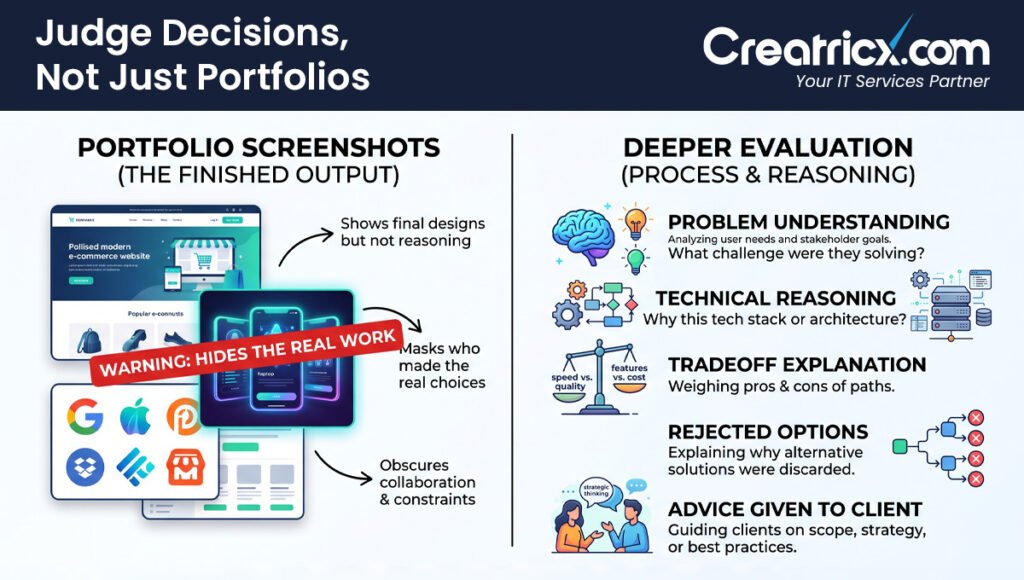
Nearly every guide on this subject tells you to start with the portfolio. Look at their previous sites, check the reviews, ask for references. That advice is not wrong exactly, but our view at Creatricx is that it is badly ordered, and the ordering is what causes expensive hiring mistakes.
Here is the problem with portfolios as primary evidence. A finished website is an artifact, and an artifact hides its own history. You can’t tell from looking at it who chose the architecture, who wrote the difficult parts, how many people touched it, how much the client dictated, or how much of the work was salvaged on somebody else's foundation.
A developer can present genuinely impressive work they contributed comparatively little to, without technically lying about anything. Meanwhile the developer who rescued a disastrous legacy project and made it merely stable has nothing photogenic to show for the hardest work of their career.
What you actually need to predict is not what someone has built. It is how they will behave when your project hits the first problem nobody anticipated, which it will. That is a question about reasoning, and reasoning is invisible in a portfolio.
The reframe we would offer: stop auditing artifacts and start auditing decisions. A candidate who can walk you through why they chose one approach over another, what they rejected, and what they got wrong last time is showing you the exact faculty your project will depend on. A candidate who can only show you screenshots is showing you the residue of decisions somebody made, without proving it was them.
The Four Layers We Assess, Deliberately Out Of Order
Most businesses evaluate developers in this sequence: portfolio, price, technical skills, and then, if there is time, how well the person communicates. Our position at Creatricx is that this sequence is close to exactly backwards, because it front-loads the easiest things to fake and leaves the hardest things to verify until the decision is effectively already made.
The order we would recommend inverts it. Comprehension first, reasoning second, continuity third, craft fourth. Price is not a layer at all; it is a constraint you apply across all four.
The most expensive hiring mistake we see is treating a fast, confident quote as evidence of competence. A developer who quotes a fixed price and timeline within an hour of a vague brief has not scoped anything. They have guessed, and you will pay for the difference between their guess and reality through change requests, or they will absorb it by cutting quality somewhere you cannot see until later.
Layer One: Comprehension, Or Do They Understand The Problem
Do they understand the business problem, users, success criteria, growth needs, and assumptions behind the brief?
Layer Two: Reasoning, And The Question Almost Nobody Asks
Can they explain why they chose an approach, what alternatives they rejected, and when they advised a client against a request?
Layer Three: Continuity, Or What Survives After They Leave
Will documentation, code structure, hosting access, repositories, design files, and ownership survive after the engagement ends?
Layer Four: Craft, Assessed Last For A Reason
Do live projects load properly, work on mobile, use sensible navigation, handle forms reliably, and follow disciplined testing and security practices?
Layer One: Comprehension, Or Do They Understand The Problem
Before any technical assessment, establish that the person actually understands what you are trying to achieve, as opposed to what you literally asked for. These are frequently different things, and the gap between them is where most project disappointment lives.
The test is simple and takes ten minutes.
Describe your project, then stop talking and see what happens. A developer worth hiring will ask questions, and the questions will be about your business rather than your technology. Who is this for. What does success look like six months after launch. What happens to this if the business grows three times. What are you currently doing manually that this should replace. Someone who responds to a project brief by immediately proposing a tech stack has skipped comprehension entirely and jumped to the part they find interesting.
We would go further. If a developer never once challenges anything in your brief, treat that as a warning rather than a convenience. Client briefs frequently contain assumptions that will not survive contact with implementation. A developer who spots one and says so before you sign is demonstrating precisely the judgement you are paying for.
Layer Two: Reasoning, And The Question Almost Nobody Asks
This is the layer we consider most predictive, and it is the one standard hiring processes skip almost entirely.
Ask about decisions, not outcomes. Pick something from their portfolio and ask why it was built that way. Then ask what else they considered, and why they rejected it. The specific question we would put at the centre of any developer interview is this: tell me about something a client asked you to build that you advised against, and what happened next.
That single question does a remarkable amount of work. It reveals if they have opinions at all, if they can hold a position under commercial pressure, if they think past the immediate request to consequences, and if they can disagree without being difficult. A developer who has never advised a client against anything has either never been trusted with a real decision, or lacks the confidence to raise problems, and both are risks you will inherit.
Pay close attention to how they handle the limits of their knowledge. In our assessment, a candidate who says plainly that they do not know something, followed by how they would find out, is more valuable than one who improvises an answer to everything. Web development in 2026 is far too broad for anyone to genuinely know it all, and pretending otherwise is a habit that produces confident wrong answers on your project later.
Layer Three: Continuity, Or What Survives After They Leave
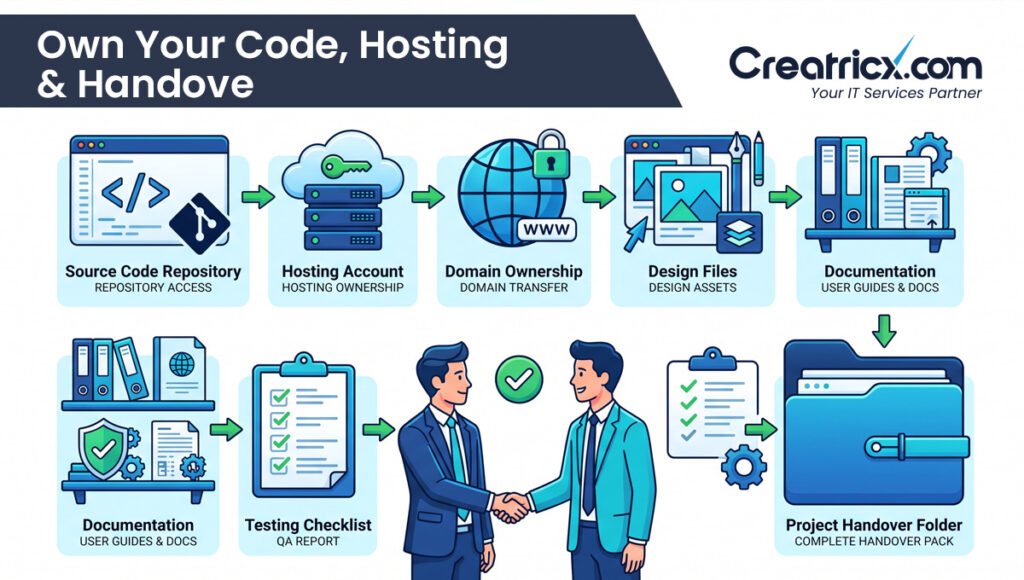
Every developer relationship ends eventually. The engagement finishes, priorities shift, someone moves on. The question that decides how expensive that ending is: could another competent developer pick this up and continue without a costly archaeology phase?
We would call this the orphan test, and it is worth applying before you hire rather than after. Ask directly what documentation they produce as standard, how they name and structure things, if they follow a recognised convention or invent their own, and what handover looks like at the end of a project. Ask who owns the code, the design files, the hosting account, and the domain, and get the answer in writing rather than in conversation.
The failure mode here is quiet and common. A developer builds something that works, using conventions only they understand, hosted on an account only they can access, with no documentation because they never needed any. Nothing is wrong until the day you need someone else to touch it, at which point you discover that your website is effectively hostage to one person's availability and goodwill. We regard this as the single most underweighted risk in web development hiring, precisely because it produces no symptoms at all until it produces a crisis.
Layer Four: Craft, Assessed Last For A Reason
Technical skill matters enormously. We put it fourth not because it is unimportant but because it is the layer most people over-index on, and the one where a strong performance masks weakness everywhere else.
Assess craft by looking at live sites rather than screenshots. Open two or three of their actual production projects and check the things that reveal discipline: does it load quickly, does it behave properly on a phone, does the navigation make sense to someone seeing it for the first time, do the forms work. Then ask about the parts you cannot see. How do they handle security updates. What is their approach to testing. What happens when something breaks at an inconvenient hour.
For the stack itself, our advice is to care less about which technologies they use and more about their ability to justify the choice against your specific situation. A developer who defaults to the same stack for every project regardless of context is applying a habit, not a judgement.
What Looks Like A Signal But Is Not
| Looks Like Evidence | What It Actually Tells You | What To Look At Instead |
|---|---|---|
| Impressive client logos | Someone at that company hired someone at their company, once | Their specific role on that project, in detail |
| Years of experience | Time passed | Range of problems solved and lessons drawn from them |
| A fast, confident fixed quote | They are comfortable guessing | The questions they asked before quoting anything |
| A large portfolio | Volume of work, not quality of decisions | Two projects examined deeply, with reasoning explained |
| Fluent technical vocabulary | Familiarity with terminology | Ability to explain a tradeoff in plain language |
| Five-star reviews | Clients were satisfied enough to say so | What the reviews say specifically, and what negative reviews exist |
Rates alone tell you very little in 2026. Web developer pricing spans roughly 10x globally, from around $20 to $45 an hour in South Asia and parts of Eastern Europe up to $150 to $220 for senior specialists in the US and Western Europe, and industry analysis suggests geography and seniority explain more of that spread than tech stack does. Two quotes differing by three or four times are more likely reflecting region and experience than one party overcharging.
What Changed In 2026, And Why It Affects Who You Should Hire
There is a common assumption that AI coding assistants have made developers cheaper and more interchangeable. The market data points the other way. Rather than compressing rates, AI tooling has widened the gap between mid-level and senior pricing, because businesses now pay a premium for engineers who can architect systems and review AI-generated code rather than simply produce code.
Our reading of this shift is that it changes what you are actually hiring for. Writing a functioning page has become substantially easier. Knowing which of four plausible AI-suggested approaches will still be maintainable in two years has not. The scarce and valuable skill has moved up a level, from production to judgement, which is another reason we assess reasoning before craft.
Practically, this means one specific question is worth asking every candidate in 2026: how do you use AI tools in your workflow, and how do you check their output? The answers separate people meaningfully. Someone who says they do not use AI at all may be slower than necessary. Someone who cannot describe any verification step is shipping code they have not fully evaluated. The answer you want describes AI as an accelerator with a review process attached.
Four Sentences That Should End The Conversation
Some responses are informative enough to be decisive on their own. In our experience these four are worth treating as disqualifying rather than as points for negotiation.
"I can start tomorrow."
On a quality developer's calendar, immediate availability at short notice is unusual. It is not automatically damning, since gaps happen legitimately, but it deserves a direct follow-up question rather than relief.
"You don't need to worry about the technical details."
A developer who declines to explain their work in terms you can follow is either unable to, which is a competence problem, or unwilling to, which is a control problem. Both end badly.
"We'll figure out the scope as we go."
Discovery is a phase, not an absence of one. This sentence usually means the scoping conversation has been deferred to a point where you have less leverage and more sunk cost.
"I'll host it on my account, it's easier."
Convenient at the start, expensive at the end. Hosting, domain, and repository access should sit with you from day one, regardless of who administers it day to day.
The pattern we observe among clients who hire well is consistent: they spend more time before signing and less time firefighting afterwards. An extra two hours spent asking about decisions, ownership, and handover routinely prevents the kind of failure that costs a conservative 30% of the engagement value to unwind, and often considerably more once delay and rework are included.
Hiring For A Project Is Not Hiring For A Product
One distinction we would add that most guides collapse: the criteria change depending on what you are actually building.
Hiring for a Project
A project has an end. A brochure site, a landing page, a defined rebuild. Here you can weight craft and price more heavily, because the relationship is bounded and the handover is the deliverable. A freelancer often suits this well, and industry data puts freelance pricing at roughly half of comparable agency pricing for defined work.
Hiring for a Product
A product does not have an end. An application that will keep evolving, a platform your business runs on, anything where next year's version depends on this year's decisions. Here continuity and reasoning dominate, because you are not buying a finished thing, you are buying a stream of future decisions. This is where agency or dedicated team models earn their 20% to 40% premium over freelance rates, since that premium buys process, cover for absence, and the institutional memory that stops every handover resetting your project to zero.
Getting this distinction wrong in either direction is costly. Hiring an agency for a one-page site is overpaying for continuity you do not need. Hiring the cheapest available freelancer for a platform your revenue depends on is underpaying for judgement you very much do.
A Sequence That Actually Works
Step 1: Write Down What Success Looks Like First
Before contacting anyone, define what the finished thing must do and how you will know it worked. Vague briefs produce vague quotes, and vague quotes are where scope disputes begin.
Step 2: Have a Conversation Before Requesting a Quote
Use the first conversation purely to assess comprehension. Describe the problem, then listen to the questions. Quote requests can wait until you know who understands the brief.
Step 3: Interrogate Two Projects, Not Twenty
Pick two things they have built and go deep on the decisions behind them. Depth on two reveals far more than a skim across a whole portfolio.
Step 4: Get Ownership in Writing
Confirm in the contract who owns the code, design files, hosting, domain, and repository at completion. Do this before work starts, not at handover.
Step 5: Agree How Change Is Priced
Establish before development begins how additional requests will be scoped and charged. Nearly every budget dispute in web development traces back to this being left unspoken.
How Creatricx Approaches This
Everything above describes how we assess developers internally, which is also how we structure client engagements at Creatricx. Projects begin with a discovery conversation aimed at comprehension rather than a rapid quote, because we would rather challenge a brief before it becomes a contract than discover the mismatch during build. Teams are assigned consistently rather than rotated, so the reasoning behind early decisions stays with the people making later ones. Documentation and handover are standard deliverables rather than paid extras, and clients own their code, repositories, hosting, and domains from the outset without needing to negotiate it.
We would say the same thing to a business evaluating us as to one evaluating anyone else: ask the difficult questions early. Ask what we advised a client against. Ask what happens if the assigned developer becomes unavailable. Ask what you would receive on the last day of the engagement. A provider confident in its process has no reason to avoid any of those answers, and a provider that dodges them has told you something useful for free.
Frequently Asked Questions
What is the most important thing to look for when hiring a web developer?
How they reason, not what they have built. Portfolios hide who made which decision. Ask why they chose an approach, what they rejected, and what they advised a client against, since that reveals the judgement your project will actually depend on.
How much should hiring a web developer cost in 2026?
Rates span roughly $20 to $45 an hour in South Asia and parts of Eastern Europe, up to $150 to $220 for senior specialists in the US and Western Europe. Agency rates typically run 20% to 40% above equivalent freelance rates, reflecting process and oversight rather than simply a markup.
Should I hire a freelancer or an agency?
It depends on if you are commissioning a project or a product. Bounded work with a clear end often suits a freelancer, at roughly half typical agency pricing. Evolving platforms favour agencies or dedicated teams, since continuity and institutional memory matter more than hourly rate.
What are the biggest red flags when hiring a web developer?
Immediate availability without explanation, refusal to explain technical decisions in plain language, deferring scope until after work begins, and insisting on hosting under their own account rather than yours.
How do I evaluate a developer's portfolio properly?
Open the live sites rather than reviewing screenshots, and check load speed, mobile behaviour, and navigation clarity. Then pick two projects and ask detailed questions about the decisions behind them rather than skimming the full portfolio.
Does it matter which technologies a developer uses?
Less than their ability to justify the choice for your specific situation. A developer applying the same stack to every project regardless of context is following habit rather than exercising judgement.
How has AI changed what to look for in a web developer in 2026?
The valuable skill has shifted from writing code to reviewing and architecting it. Market data shows AI tooling widening the senior pay gap rather than compressing rates, so ask candidates how they use AI tools and, more importantly, how they verify the output.
What should I confirm in writing before work begins?
Ownership of code, design files, hosting, domain, and repository access, plus how scope changes will be priced. Both are routine to agree upfront and difficult to renegotiate once a project is underway.
Disclaimer
This article reflects hiring cost benchmarks and developer rate data current at the time of writing, drawn from multiple independent 2026 industry sources including SHRM and US Department of Labor guidance on failed-hire costs, alongside Creatricx's own assessment approach. Rates and outcomes vary by region, seniority, and project complexity. Always confirm current terms directly with any provider before engaging.
In Summary
The reason web development hiring goes wrong is rarely that businesses failed to check a portfolio. It is that the portfolio was the only thing they checked, and a portfolio cannot tell you how somebody thinks. Our argument at Creatricx is to invert the usual order: establish comprehension before assessing craft, interrogate decisions before admiring outputs, and settle ownership and handover before anyone writes a line of code. Two extra hours of the right questions early costs nothing compared to unwinding a failed engagement, which conservative industry guidance places at around 30% of first-year cost as a floor and considerably more in practice. Ask what they advised against. Ask what happens when they leave. The answers to those two questions will tell you more than any portfolio ever will.