
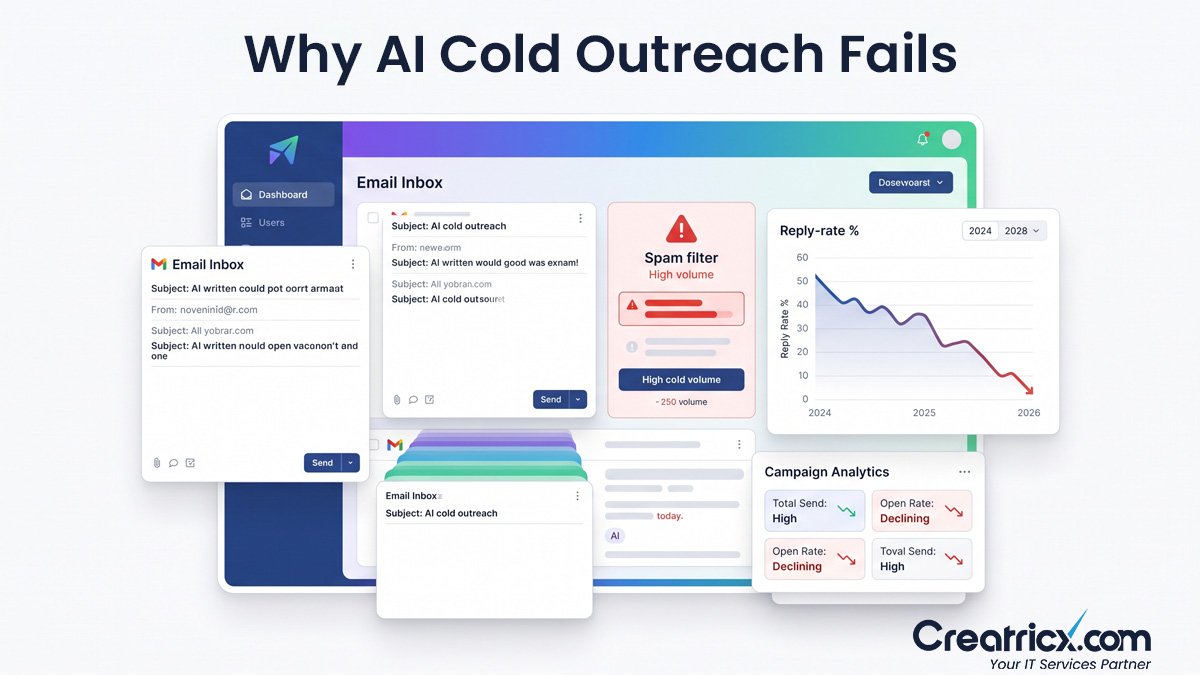
Benchmark Reality Check
Backlinko’s 8.5% figure comes from a 2019 study of 12 million outreach emails. Instantly’s 3.43% figure comes from a different 2026 platform dataset. The comparison shows a harder, noisier market, but it is not a clean longitudinal time series. Different platforms, audiences and reply definitions make false precision very easy, which is humanity’s favourite way to make dashboards feel certain.
Key Takeaways
The average is low, but precision still wins
Instantly reports a 3.43% average reply rate in 2026, while its top 10% of campaigns exceed 10.7%. The gap is mainly a targeting, relevance and execution gap.
Volume is not a safety strategy
Hunter found 20–49 daily emails per account associated with a 5.7% reply rate versus a 4.5% overall average. That is an observed correlation, not a universal deliverability limit.
Manual judgement still improves automated output
Hunter reports manually edited emails outperforming fully automated emails, 5.2% versus 4.4%, which supports a human-review layer rather than unattended generation.
Authentication is now basic infrastructure
Google, Yahoo and Microsoft all impose stronger requirements on high-volume senders, including SPF, DKIM and DMARC, with filtering or rejection for non-compliance.
There is no published blanket penalty for AI-written copy
Official sender guidance focuses on authentication, reputation, complaints, volume patterns, unsubscribe support and user engagement. Generic AI copy fails because it behaves like spam, not because a provider publishes an anti-AI rule.
Table of Contents
The Short Answer, Then the Detail
Here is the honest, direct answer before the breakdown: AI automation agency cold outreach fails in 2026 because automation removed the friction that used to keep outreach volume in check, and in doing so it flooded every inbox with messages that all sound the same.
When the barrier to sending 10,000 personalized-looking emails drops to almost nothing, everyone does it, and the result is that no single message stands out. Buyers adapted by ignoring the entire category. Filters adapted by getting harder to pass. And the agencies that treated AI as a replacement for thinking, rather than a tool to think faster, got caught on the wrong side of both shifts.
The rest of this article breaks down exactly how that happened, and what actually still works.
The Useful Reframe
A useful reframe: the failure isn't that AI outreach stopped working. It's that AI made a specific kind of outreach, high-volume and low-relevance, stop working, because it let everyone do it at once. The underlying skill, reaching the right person with a genuinely relevant message, works as well as it ever did. There's just far more noise to cut through now.
How the Failure Chain Actually Works
Automation removes effort
Research, copy and sequencing become cheap enough to run at industrial volume.
Messages converge
Shared tools and prompts produce the same structure, tone and fake-personal opener.
Buyers learn the pattern
The email is classified mentally before the offer is understood.
Complaints and weak engagement rise
Reputation signals worsen while providers tighten enforcement.
Teams compensate with more volume
The response makes the infrastructure and buyer-fatigue problem even worse.
Reason One: Everyone Has The Same Tools, So Everyone Sounds The Same
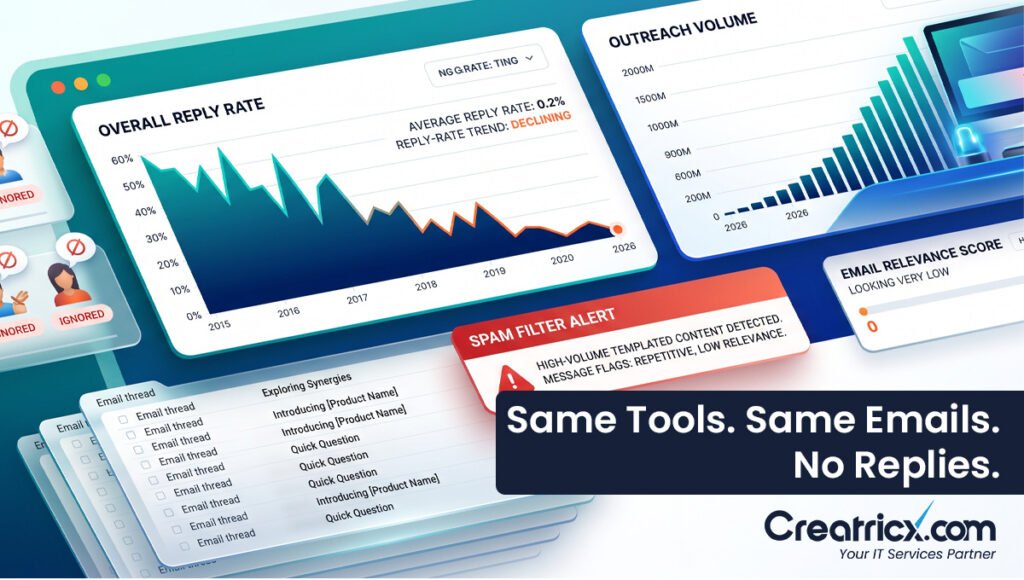
The single biggest driver is deceptively simple. New agencies can now launch outreach campaigns with almost no experience, because AI handles the research, the copywriting, the lead sourcing, and the follow-up sequencing. That accessibility is genuinely useful, but it has a side effect: prospects receive strikingly similar messages from countless providers, because those providers are all using comparable tools trained to produce comparable output.
When every agency's "personalised" opener references the same scraped LinkedIn detail in the same upbeat tone, personalisation stops signalling effort and starts signalling automation. Buyers have developed near-perfect pattern recognition for this, and the moment a message pattern-matches to "AI sales template," it gets deleted in about a second.
Shallow Personalisation Is Not Relevance
The trap most struggling agencies fall into is shallow personalisation: inserting a first name, a company name, and one scraped fact, then assuming that counts as relevance. In 2026 it doesn't. Prospects have seen that exact structure thousands of times. Genuine personalisation means demonstrating you understand their specific situation, which a scraper and a template cannot fake at scale.
Reason Two: The Inbox Got Harder To Reach, By Design
Even a well-written email is worthless if it never lands in front of a human. This is where a lot of agencies quietly fail without realising it, because they measure replies without measuring if their emails arrived at all. The rules changed materially in 2024 and tightened further since.
Gmail’s current rules count messages at the primary-domain level. A sender that reaches roughly 5,000 messages to personal Gmail accounts within 24 hours can be classified as a bulk sender, and Google says that status does not expire. Bulk senders must meet stronger authentication, alignment, unsubscribe and spam-rate requirements. Since November 2025, Google has increased enforcement through temporary and permanent rejections.
Infrastructure Before Copy
Deliverability should be diagnosed before copy. Confirm SPF, DKIM and DMARC alignment, DNS, complaint rates, bounces, reputation, sending patterns and inbox placement before rewriting a subject line for the seventeenth time.
What Google, Yahoo and Microsoft Actually Require
| Provider | Who It Applies To | Core Requirements | What Happens If You Ignore It |
|---|---|---|---|
| Gmail | 5,000+ messages in 24 hours to personal Gmail accounts, counted at the primary-domain level | SPF, DKIM, DMARC alignment, TLS, low spam rate, one-click unsubscribe for marketing mail | From November 2025, non-compliant traffic can face temporary or permanent rejection |
| Yahoo / AOL | Bulk senders | SPF, DKIM, DMARC, aligned From domain, one-click unsubscribe, spam rate below 0.3% | Mail can be sent to spam or rejected |
| Outlook.com | Domains sending more than 5,000 messages daily to consumer Outlook addresses | SPF, DKIM and DMARC | Non-compliant mail may be routed to Junk and later rejected |
Official requirements change, so the operational source of truth should remain the Google sender guidelines, Yahoo Sender Hub and Microsoft’s high-volume sender notice.
Reason Three: Filters Now Read The Writing, Not Just The Headers
A common claim is that mailbox providers automatically punish text because an AI model wrote it. The public guidance from Google, Yahoo and Microsoft does not describe a blanket AI-content penalty. Their published rules focus on authentication, alignment, reputation, complaint rates, unsubscribe support, message quality and sending behaviour.
That does not make AI-generated copy harmless. Generic, near-identical messages sent in volume create the same signals as poor spam operations: low engagement, complaints, repetitive content and weak sender reputation. The practical distinction matters. The fix is not to hide AI use. The fix is to stop using AI without evidence, variation, review and restraint.
This is the crux of the whole problem. AI is not the liability. Lazy AI usage is. The agencies failing are the ones who let the tool produce forgettable, formulaic copy and then sent it at volume from cold infrastructure. The agencies succeeding use AI to draft faster, then make the output specific, varied, and genuinely relevant before it goes anywhere.
The Automation Boundary
Treat AI as a drafting and analysis component inside a controlled workflow. Do not let it decide who deserves a message, manufacture evidence, approve its own output and press Send. That is not automation engineering. It is a chain of unverified assumptions wearing a dashboard.
What Actually Still Works In 2026
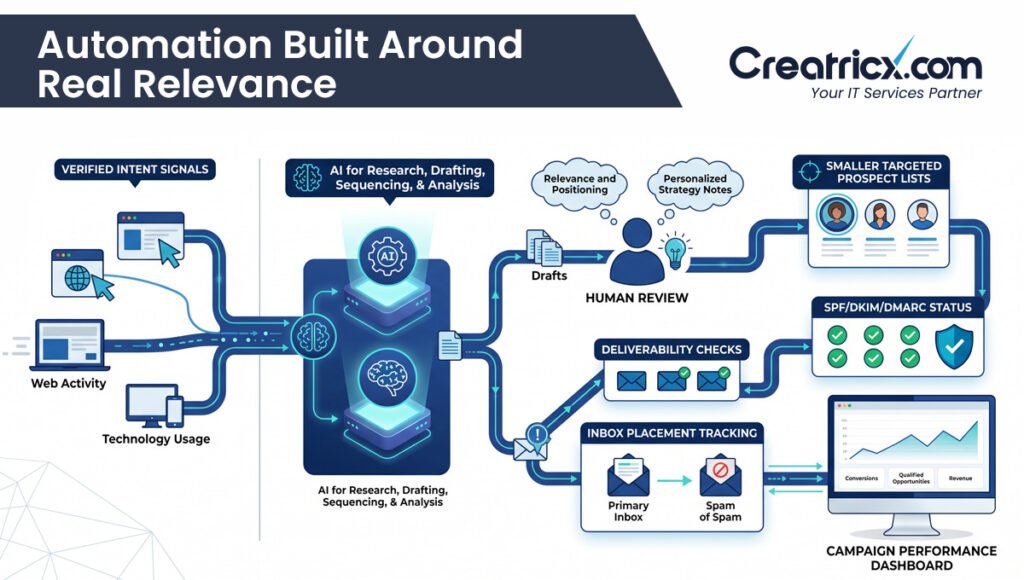
| The Failing Approach | What Works Instead |
|---|---|
| Volume-first: blast 10,000 generic emails | Signal-first: reach fewer people at the moment they show buying intent |
| Shallow personalisation (name + one scraped fact) | Deep relevance that shows real understanding of their situation |
| Ignoring deliverability, tracking only replies | Measuring inbox placement, bounce rate, and complaint rate first |
| AI as a replacement for strategy | AI as leverage for research and drafting, with human judgement on top |
| Same tools, same templates as everyone else | Specialised positioning and a genuinely differentiated offer |
The Tool Is Not the Differentiator
Instantly reports a 3.43% average reply rate and a 10.7%+ top-decile threshold. Hunter reports manually edited emails at 5.2% versus 4.4% for fully automated messages. The consistent lesson is not that one template wins. Better campaigns apply tighter selection, more relevant evidence, disciplined sending and human review.
The Benchmark Numbers Need Context
Cold-email benchmarks are vendor datasets, not a universal census. Different reports include different audiences, industries, follow-up sequences, auto-replies, bounces and definitions of a reply. A 3.43% platform average, a 5.8% agency benchmark and an 8.5% historical outreach study can all be accurate within their own methodology.
Use benchmarks to set a rough diagnostic range, not to forecast revenue with fake precision. The better operating question is whether your own positive reply rate, qualified-meeting rate and opportunity rate improve after a controlled change.
The Strategic Shift Underneath All Of This
Step back from the tactics and a bigger pattern emerges. Cold outreach used to reward activity: more emails meant more replies, roughly linearly. AI broke that relationship by making activity free, which collapsed its value.
The channel-preference evidence has also moved. An earlier Hunter report was widely cited for saying 61% of decision-makers preferred cold email. Hunter’s current report now says LinkedIn is preferred by 50.5% of surveyed decision-makers, compared with 25% for email. Cold email is not dead, but it no longer receives automatic permission to interrupt. It has to earn attention through relevance and restraint.
For AI automation agencies specifically, there's an uncomfortable irony here. An agency that sells automation, yet reaches prospects through obviously automated, low-effort outreach, undermines its own pitch. The medium contradicts the message. The agencies that thrive demonstrate their competence through the quality of their own outreach, using automation intelligently enough that the prospect never feels processed.
What Practitioners Are Reporting
These are public forum observations, not controlled benchmarks. They are useful as operational signals, not as proof that one workflow will reproduce another person’s results.
Sales practitioners use AI most confidently for preparation and administration
A recent r/sales discussion repeatedly described AI as useful for account research, meeting notes, CRM updates and tailored follow-ups, while keeping the relationship and final judgement with the salesperson.
Automation communities question “lead gen” systems that are only email blasters
In an r/AiAutomations thread, practitioners noted that many products marketed as lead-generation automation are simply cold-email workflows, and that data sources and scoring logic determine whether the system creates value or merely creates requests.
AI Automation Engineer’s Field Notes
Build the Workflow So Bad Data Cannot Quietly Become Bad Outreach
The strongest outreach automation is not the system that sends fastest. It is the system that can explain why a prospect entered the workflow, which evidence shaped the message, who approved it and what condition will stop the sequence.
Separate the stages
Keep enrichment, scoring, drafting, review, sending and reply routing as separate steps. One giant prompt is easy to launch and miserable to debug.
Store the evidence
For every prospect, save the source URL, the observed signal, its timestamp and why it matters. If the evidence is missing or stale, the workflow should fail closed and not send.
Use confidence thresholds
AI should be allowed to draft only when the data clears a minimum confidence score. Low-confidence records belong in a review queue, not an inbox.
Protect variation
Segment prompts by problem, role and trigger. Random synonyms are not variation. Different reasoning and evidence are.
Measure positive outcomes
Track inbox placement, positive reply rate, qualified meetings, opportunities and revenue. Total replies can look healthy while consisting mainly of unsubscribe requests and irritated humans.
Build stop conditions
Suppress bounced, opted-out, irrelevant and already-contacted records immediately. A competent automation knows when not to act.
A Practical Diagnostic Order
When a campaign stops producing, diagnose it in a fixed order. Otherwise infrastructure teams rewrite copy, copywriters blame domains, and everyone buys another platform. A splendid little circle of invoices.
1. Identity & authentication
Check SPF, DKIM, DMARC, alignment, DNS, TLS and provider compliance before touching copy.
2. Reputation & placement
Review complaint rate, bounces, sending consistency, domain reputation and actual inbox placement.
3. Data & intent
Verify addresses, ICP fit, role relevance, buying signals and the freshness of every trigger.
4. Message & offer
Check whether the email proves real context, explains a specific problem and makes a low-pressure next step.
5. Workflow & handoff
Confirm human review, suppression rules, reply classification, CRM routing and follow-up ownership.
6. Commercial outcome
Measure positive replies, qualified meetings, opportunities and revenue instead of celebrating send volume.
How Creatricx Approaches Ai Automation Differently
Creatricx treats AI automation as a way to make genuine work faster, not as a substitute for it. Rather than defaulting clients into high-volume, low-relevance campaigns that the 2026 landscape actively punishes, Creatricx starts by mapping what a business is actually trying to achieve, then applies automation where it creates real leverage: research, drafting, sequencing, and analysis, while keeping human judgement on positioning, relevance, and strategy.
For agencies and businesses whose outreach or automation has quietly stopped delivering, engagements begin with a diagnostic that separates the infrastructure problems from the strategy problems, because the two need very different fixes and are constantly mistaken for each other.
The diagnostic can also connect outreach with broader digital marketing operations, privacy-aware workflows and documented delivery evidence in the Creatricx portfolio.
Frequently Asked Questions
Why is AI automation agency cold outreach failing in 2026?
Because AI made high-volume outreach cheap and easy, thousands of senders now produce similar messages. The result is saturated inboxes, faster buyer pattern-recognition and stricter sender enforcement. Instantly reports a 3.43% average reply rate in 2026, while top-decile campaigns still exceed 10.7%, showing that precision still works.
Do spam filters automatically block AI-written emails?
No official Google, Yahoo or Microsoft sender rule says an email is blocked merely because AI drafted it. Providers focus on authentication, alignment, reputation, complaints, unsubscribe support and sending behaviour. Generic AI messages fail because they create poor engagement and spam-like patterns.
What are the 2026 email authentication requirements?
For high-volume sending, Gmail, Yahoo and Outlook.com require stronger authentication. That commonly includes SPF, DKIM and DMARC, with aligned sender domains, low complaint rates and working unsubscribe mechanisms for marketing mail. Gmail increased rejection enforcement in November 2025.
Is cold email dead in 2026?
No. The channel is harder, not dead. Hunter’s current report says LinkedIn is preferred by 50.5% of surveyed decision-makers and email by 25%, so email has to justify the interruption. Targeted campaigns with strong deliverability and relevant evidence can still perform well.
What's the difference between a failing and a succeeding cold outreach campaign now?
Failing campaigns chase volume, use shallow personalisation and measure sends or total replies. Stronger campaigns target smaller segments, document a real reason to contact each prospect, use human review and measure inbox placement, positive replies, qualified meetings and revenue.
How many cold emails can I safely send per inbox per day?
There is no universal safe number. Gmail’s 5,000-message threshold is a primary-domain bulk-sender classification, not a recommended per-inbox target. Hunter observed better replies at 20–49 daily emails per account, but that is a study finding, not a guarantee. Follow your provider’s limits, keep complaint rates low and do not engineer around thresholds to force unwanted volume.
Should AI automation agencies stop using AI for outreach?
No. AI is useful for research, summarisation, drafting, sequencing support and analysis. It should not replace ICP judgement, evidence validation, positioning, final review or the decision to stop contacting someone.
How does Creatricx help with AI automation that isn't working?
Creatricx starts with a diagnostic that separates authentication, reputation and placement issues from targeting, messaging and workflow problems. Automation is then rebuilt around verified data, human review, suppression rules and commercial outcomes rather than activity alone.
Sources and Evidence Quality
- Google Email Sender Guidelines Authentication, alignment, spam-rate and unsubscribe requirements.
- Google Sender Guidelines FAQ Bulk-sender definition, permanent classification and November 2025 enforcement.
- Yahoo Sender Best Practices SPF, DKIM, DMARC, unsubscribe and complaint-rate requirements.
- Microsoft High-Volume Sender Requirements Outlook.com authentication and enforcement for high-volume domains.
- Instantly 2026 Benchmark Report 3.43% average and 10.7%+ top-decile reply benchmarks.
- Hunter State of Cold Email Manual editing, sending-volume, contact-count and buyer-preference findings.
- Backlinko Outreach Study Historical 2019 benchmark across 12 million outreach emails.
Disclaimer
This article uses current provider guidance and vendor benchmark data available in August 2026. Cold-email benchmarks vary by industry, geography, audience quality, measurement method and infrastructure. Provider requirements can change. Forum observations are explicitly labelled as anecdotal. This is operational guidance, not legal advice; organisations must also follow the privacy, marketing and anti-spam laws that apply to their recipients and jurisdictions.
In Summary
AI automation agency cold outreach fails in 2026 not because AI stopped working, but because it made competent-looking activity almost free. That flooded inboxes with interchangeable messages, raised the cost of attention and exposed weak infrastructure more quickly.
The agencies still winning use AI inside a controlled system. They target fewer, better prospects; store the evidence behind each message; separate research from drafting; require human judgement; measure placement and positive outcomes; and stop sequences when the data says stop. Volume is no longer scarce. Relevance, trust and operational discipline are.