
Getting Started
Not sure which framework your project actually needs, or being pushed toward one that suits the agency more than you? Creatricx will give you a straight, framework-agnostic recommendation. Book a free consultation: creatricx.com/contact/
Table of Contents
Key Takeaways
No framework is universally best; the right choice depends on your project type, team skills, hiring plans, and how long the product must live
React remains the usage leader by a wide margin, used by roughly 47% of professional developers in the Stack Overflow 2025 survey, and about 78% of new React apps now use Next.js
Svelte holds the highest developer satisfaction, with over 90% retention in State of JS 2025, but sits at only around 7% real-world usage
Developer communities are increasingly vocal about framework fatigue, and a growing camp openly advocates for boring, proven technology over the framework of the month
Our practical view at Creatricx: pick for hiring pool and maintainability first, performance second, and personal enthusiasm last, because the framework you can staff and maintain beats the one that benchmarks best
Why "What Is The Best Framework" Is The Wrong Question, Honestly
Let us be straight from the start, because this is a question that attracts a lot of confident, misleading answers.
There is no best web development framework in any absolute sense, and the people insisting otherwise usually have something to sell, a course, a consultancy specialising in one stack, or an identity tied to a particular tool. After enough projects, you stop believing in a single right answer and start seeing the question the way an experienced team does: best for what, for whom, and for how long?
A framework that is perfect for a ten-person startup shipping fast is often wrong for a bank building a system that must run for fifteen years.
A framework a solo developer loves can be a hiring nightmare for a company that needs to replace them. The useful version of this question is not "what is the best framework," it is "what is the best framework for my specific situation," and answering that well requires understanding both what the tools actually do and what the people who use them really think. We will cover both, with real data and real developer voices, then tell you plainly what we would recommend and why.
What The Data Actually Says In 2026
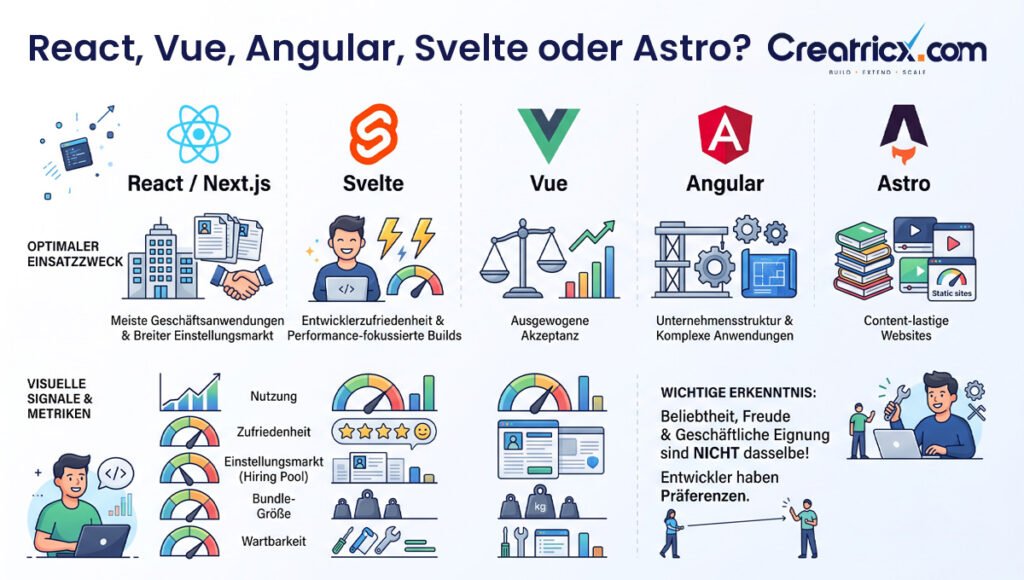
Before opinion, facts. The most reliable pictures of the framework landscape come from the Stack Overflow 2025 Developer Survey (over 49,000 responses) and the State of JS 2025 survey, and they tell a consistent story.
React is the clear usage leader. In the Stack Overflow 2025 survey, React was used by roughly 47% of professional developers, ahead of Angular at about 20%, Vue at 18%, and Svelte at around 7%, with Next.js on its own reaching about 22%. React's npm downloads run roughly three times its nearest competitor, and it powers more than half of all framework-built websites. The meta-framework has also become the default entry point: around 78% of new React projects now start on Next.js, which is why for most teams, choosing React really means choosing Next.js.
But usage is only half the picture, and this is where it gets interesting. Svelte leads decisively on satisfaction. In State of JS 2025 it holds the highest developer admiration, around 62%, and a retention rate above 90%, meaning the developers who use it overwhelmingly want to keep using it.
It ships astonishingly small bundles, roughly 1.6 KB gzipped against React's 42 KB or so, yet its real-world usage sits at only 7 to 8%. That gap between how much developers love Svelte and how little they actually deploy it is the single most revealing fact in the whole landscape, and we will come back to what it means for you.
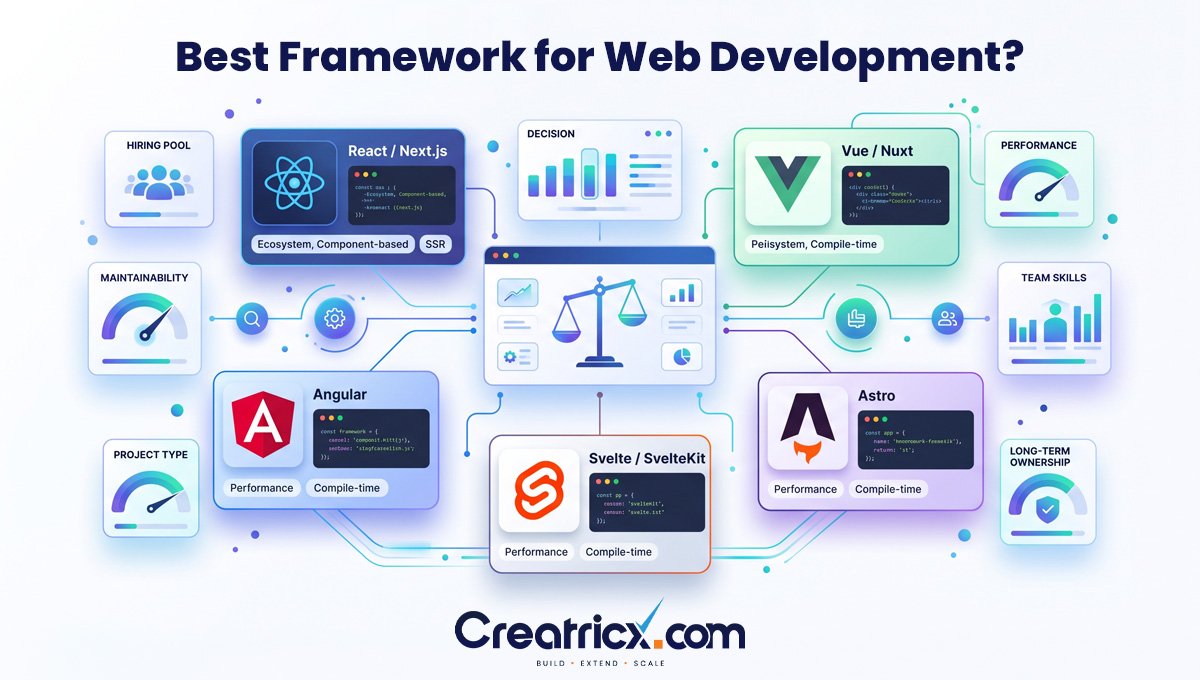
| Framework | Pro Usage (Stack Overflow 2025) | Developer Satisfaction | Best Fit |
|---|---|---|---|
| React (with Next.js) | ~47% (Next.js ~22%) | High usage, flattening enthusiasm | Most business apps, large teams, broad hiring |
| Vue (with Nuxt) | ~18% | Consistently high | Approachable projects, gentler learning curve |
| Angular | ~20% | Stable, structured | Enterprise, regulated, large formal teams |
| Svelte (with SvelteKit) | ~7% | Highest (90%+ retention) | Performance-critical, smaller teams, speed |
| Astro | ~4.5% | High and growing | Content sites, marketing, minimal JavaScript |
What Developers Actually Say: Voices From The Community
Survey numbers tell you what people use. They do not tell you how people feel, and on frameworks, feeling drives a surprising amount of real-world decision-making. So we went looking for genuine developer sentiment in the places these debates actually happen, and the themes are remarkably consistent.
The first theme is that React's dominance is increasingly seen as a default rather than a preference. As one developer put it bluntly in a widely-discussed DEV Community thread, React has become the "default" because of its ecosystem and corporate backing, not because it is the most productive choice anymore, comparing it to jQuery in its late days, still widely used and fine for many cases, but no longer the most elegant option (dev.to/shiva_shanker_k, in the comments on "Why I stopped using React"). That sentiment, React is the safe institutional choice rather than the joyful one, comes up again and again.
The second theme is genuine, almost evangelical love for Svelte among those who try it. In another DEV thread, a developer described how using Svelte "quickly ruined my experience working with React," and noted that React developers introduced to Svelte often have "that priceless look of shock and disbelief at the fact that front-end development can actually be beautiful" (dev.to/somedood, comments on a Svelte review). The recurring phrase is relief at "not worrying about hooks anymore." This is the emotional engine behind Svelte's satisfaction scores.
The third theme, and the most important for a business, is a growing weariness the community calls framework fatigue. A much-upvoted sentiment on Hacker News captured the cycle precisely: a new thing gets traction, gets hailed as the next big thing, everyone piles on, then fatigue sets in as its flaws surface, and everyone moves to the next new thing, a tedious cycle to watch repeat. The commenter, thirty years into "doing web stuff," said it was exactly why they stick with boring PHP, HTML, CSS, and a sprinkling of JavaScript (news.ycombinator.com, on the "Framework Fatigue" discussion). One widely-shared figure in these discussions claims around 71% of developers report experiencing framework fatigue.
The Camp That Says Stop Chasing Frameworks Entirely
There is a serious, growing argument in the community that deserves real weight, because it is often right: much of the time, the best framework is the boring one you already know.
The "boring technology" camp points out that most websites and business applications do not have performance problems a framework can solve. They have delivery problems, maintenance problems, and hiring problems, all of which are made worse, not better, by adopting the newest tool.
A significant share of developers, as one popular piece noted, feel that this generation is "running in circles, reinventing what PHP or JSP could do 15 years ago." That is an exaggeration, modern frameworks genuinely solve real problems around interactivity and developer productivity, but the underlying caution is sound. If your team knows React and your project is a standard business web app, switching to Svelte because it benchmarks faster is very often solving a problem you do not have while creating several you do.
We have a lot of sympathy for this view, with one caveat: "boring and proven" should mean the right proven tool, not simply the oldest one. React with Next.js is itself now boring technology in the best sense, mature, battle-tested, endlessly documented, and that is a point in its favour, not against it.
Talk to Us Midway
Want a framework decision made on evidence rather than hype, by a team that builds in all of them? Creatricx gives you exactly that: creatricx.com/website-development/
How Creatricx Chooses A Web Development Framework
Having looked at the data and the sentiment, here is where we plant a flag, because you came for a recommendation and vague neutrality helps nobody. This is genuinely how we approach the decision at Creatricx, and the order matters.
We choose the hiring pool and maintainability first. The most expensive part of any web project isn’t building it, it is maintaining and extending it over years, usually by people who did not write the original code.
We choose for performance and product fit second. Where a project genuinely lives or dies on load speed and interactivity, a content-heavy marketing site, a performance-critical dashboard, a lightweight mobile-first experience, we will recommend and build in Svelte or Astro without hesitation, because there the technical advantage is real and worth the smaller talent pool. Matching the tool to the actual constraint is the whole game.
We choose for developer enthusiasm last, not never. A team that loves its tools does better work, so enthusiasm counts, but it is the tiebreaker, not the deciding factor. Choosing a framework primarily because it is beloved on social media, ahead of the question of hiring for it or maintaining it, is how businesses end up with elegant code nobody left in the building understands.
A Simple Way To Decide For Your Own Project
You do not need to resolve the industry's framework wars to make a sound choice for one project. You need to answer a few honest questions in the right order.
Start with the team.
What do the people who will build and maintain this already know well? If they are fluent in one stack and the project is standard, that fluency usually outweighs any benchmark.
Then consider longevity. A throwaway prototype and a fifteen-year platform justify completely different choices; the longer the life, the more the hiring pool and stability should dominate.
Then consider the product's real constraint. If raw load performance is genuinely make-or-break, weight that heavily toward Svelte or Astro; if it is a standard interactive app,
React or Vue serve fine. Only after those three should you let preference and enthusiasm break any remaining tie. Answer them in that order and the right framework tends to select itself, without a single argument about virtual DOMs.
How Creatricx Helps, Whatever The Answer
Our position is framework-agnostic by design, because we aren’t in the business of selling you a stack we happen to specialise in.
We build across React and Next.js, Vue and Nuxt, Svelte and SvelteKit, Angular, and Astro, which means our recommendation is driven by what fits your project rather than what fits our comfort zone. That independence is the whole point: advice is only worth having when the adviser does not need you to pick a particular answer.
In practice, that shows up in two ways. If you want a project built, our web development service starts by pinning down your real constraints, team, timeline, longevity, performance needs, before a framework is ever named, so the technology follows the requirement rather than leading it.
If your need is ongoing rather than one-off, hiring a dedicated developer through our staff augmentation model gives you a specialist in exactly the framework your project calls for, working within your team and under your direction, while we handle sourcing and continuity behind the scenes.
Where you need a full multi-skill unit, that scales naturally into a dedicated remote team. Either way, the framework decision is made on your behalf the way we would make it for ourselves: hiring pool and maintainability first, performance second, fashion last.
Frequently Asked Questions
What is the best framework for web development in 2026?
There is no single best framework. React with Next.js is the safest default for most business applications thanks to its ecosystem and hiring pool, Svelte is the most loved by developers and best for performance-critical work, Vue is the balanced middle option, and Angular suits large enterprise systems. The best choice depends on your team, timeline, and project type.
Is React still the most popular framework in 2026?
Yes, by a comfortable margin. The Stack Overflow 2025 Developer Survey put React at roughly 47% usage among professional developers, well ahead of Angular, Vue, and Svelte, with Next.js reaching about 22% on its own. React also has the largest hiring pool and ecosystem, which is why it remains the default for most teams.
Should I use Svelte instead of React?
Use Svelte when performance, small bundle size, and developer experience are your priorities, and your team is comfortable with a smaller talent pool. Svelte has the highest developer satisfaction (90%+ retention in State of JS 2025) but only around 7% real-world usage, which makes hiring harder. For most standard business apps needing a broad talent pool, React remains the safer choice.
Is React a framework or a library?
Technically React is a library, not a framework, while Next.js, Angular, Vue, and Svelte are closer to full frameworks. In practice most teams use React through Next.js, which provides the routing, rendering, and structure of a framework, so for a business choosing a stack the distinction is largely academic.
What is framework fatigue?
Framework fatigue is the exhaustion developers feel from the constant stream of new JavaScript frameworks and the pressure to keep learning them. Community surveys suggest a large majority of developers experience it, and it has fuelled a "boring technology" movement that favours proven, well-understood tools over the newest option, which is often the sounder business choice.
Does the choice of framework really matter for my business?
It matters, but usually less than people think, and rarely in the way they expect. For most business applications, hiring pool and maintainability matter far more than raw performance differences between frameworks. The biggest risk is not choosing a slightly slower framework, it is choosing one you cannot easily staff or maintain over the life of the product.
Which framework is best for a content-heavy or marketing website?
Astro is often the strongest choice for content-heavy and marketing sites, because it ships minimal JavaScript and prioritises fast load times and SEO. Next.js is also a solid option with its static generation capabilities. For these sites, shipping less JavaScript usually matters more than framework flexibility.
How does Creatricx choose a framework for a project?
Creatricx chooses framework-agnostically, prioritising hiring pool and maintainability first, performance and product fit second, and developer preference last. We build across React, Next.js, Vue, Svelte, Angular, and Astro, and pin down your team, timeline, and real constraints before naming any technology, so the framework follows the requirement rather than the reverse.
Disclaimer
Ready When You Are
Get a framework recommendation based on your project, not our preference, and the team to build it. Explore web development with Creatricx: creatricx.com/website-development/
In Summary
The best framework for web development is not a name, it is a decision, and the businesses that get it right are the ones that ask "best for what" rather than chasing whatever tops the rankings or trends on social media. The data is clear: React with Next.js dominates usage and hiring, Svelte wins hearts but not market share, Vue and Angular hold steady in their lanes, and a wise, weary corner of the community rightly reminds everyone that the boring proven tool usually wins.
Our recommendation, honestly held, is to choose for hiring pool and maintainability first, performance second, and enthusiasm last, because the framework you can staff and sustain will always beat the one that merely benchmarks well. Answer the questions about your team, your timeline, and your real constraints in that order, and the right framework stops being a debate and becomes obvious.