
Getting Started
Not sure if you need a freelancer, an agency, or a specialist embedded in your own team? Creatricx will help you pick the model that fits, then provide the people to deliver it. Book a free consultation: creatricx.com/contact/
Table of Contents
Key Takeaways
ROUTE 01
Most UK and US small businesses spend between $2,000 and $8,000 on a professional website in 2026, with more complex builds reaching $15,000 or higher, according to multiple 2026 pricing guides
ROUTE 02
Freelance web developers average around $85 an hour in the US, but the same brief quoted by a junior and a senior can differ threefold, so the rate alone tells you very little
ROUTE 03
Design and performance are the same decision: a one-second delay in page load can cut conversions by roughly 7%, which means a beautiful site that loads slowly is still a broken one
ROUTE 04
The strongest single predictor of a good hire is being given two or three past clients you can actually contact, not a portfolio screenshot you cannot verify
ROUTE 05
For a growing business that needs ongoing work rather than a one-off site, a dedicated designer or developer embedded in your team, the staff augmentation model, often fits better than either a freelancer or a full agency
The Decision Underneath The Decision
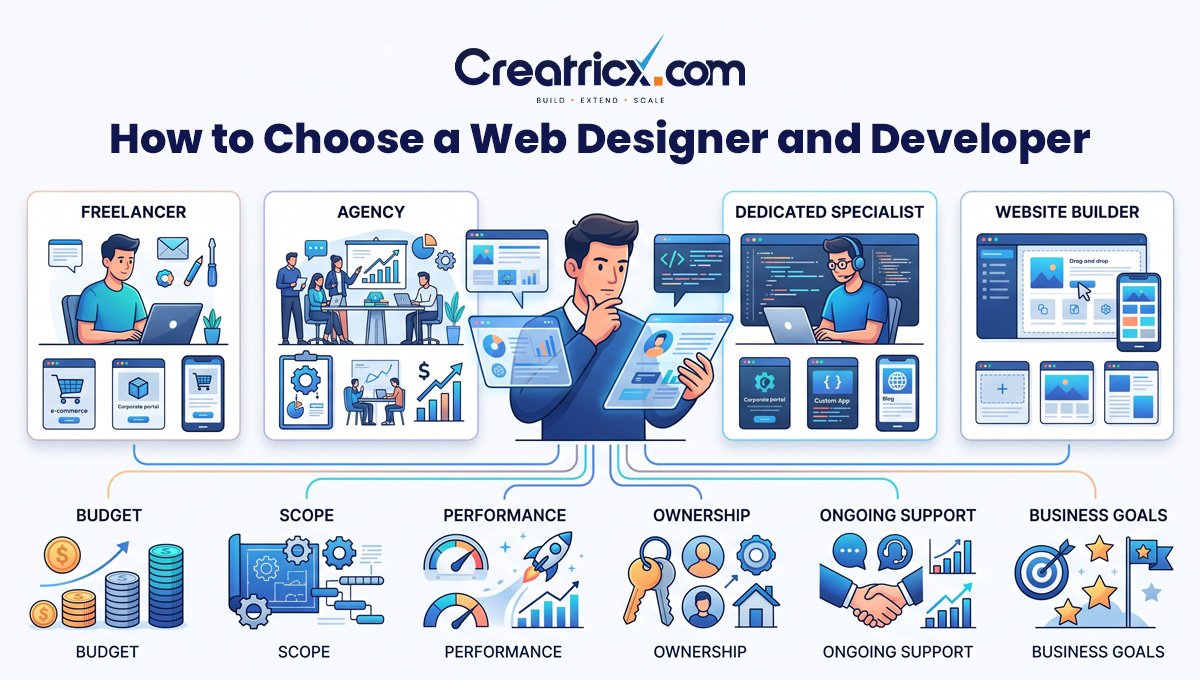
Most small business owners frame this as "who should I hire," and reach for the same three options everyone lists: a freelancer, an agency, or a website builder. That framing is not wrong, but it skips the question that actually determines the right answer, which is what you are genuinely building and how long you will need someone to look after it.
A one-page site to test a new offer and a revenue-generating platform your business depends on aren’t the same purchase, even though both get filed under "website."
The first is a bounded task with a clear end.
The second is an ongoing relationship with no natural finish line, because next year's version depends on this year's decisions.
Choosing the type of person or team before you have answered that question is how small businesses end up either overpaying an agency for a simple job or handing a business-critical build to the cheapest freelancer they could find.
Both are expensive mistakes in opposite directions.
The Mistake That Costs Small Businesses The Most: Separating Design From Development
Here is the trap we see most often, and it is worth stating plainly before anything else. Design and development get treated as two separate hires with two separate goals: one person to make it look good, another to make it work. In reality they are a single decision, and splitting them is where a lot of small business websites quietly fail.
The reason is measurable. A one-second delay in page load can cut conversions by around 7%, according to widely cited performance research. That means a visually stunning site built without regard for speed and technical structure is not a design success with a technical problem attached. It is a failed website, because it loses the customers the design was meant to win. The reverse is just as true: a fast, technically clean site that looks untrustworthy loses people before they ever reach the checkout.
For a small business, this has a direct practical implication. A freelancer who is genuinely strong at design but weak at development, or the other way round, will build you half a good website. On a small marketing site that gap might not surface for months, until the day the site needs to do something more than display content and the missing half becomes obvious, usually alongside an unplanned bill for the second specialist.
What It Actually Costs In 2026
Cost ranges for small business websites are wide because "website" covers everything from a template configuration to a custom-built platform. These figures are drawn from multiple independent 2026 pricing guides and line up closely across them.
| Path | Typical Cost | Best Suited To |
|---|---|---|
| DIY website builder | $10 to $50 a month, plus $500 to $5,000 for customisation | Genuinely standard needs, tightest budgets, willing to trade time for money |
| Freelancer | $500 to $8,000 for a custom site; around $85 an hour on average in the US | Bounded, clearly scoped sites where you can oversee the work yourself |
| Small agency | $5,000 to $25,000 and up | Complex, revenue-critical builds needing design, development, and strategy together |
| Dedicated specialist (embedded) | Ongoing monthly engagement rather than a project fee | Growing businesses needing continuous work without full agency overhead |
The Vetting Step That Matters More Than The Portfolio
A portfolio tells you what someone can produce when everything goes right and they get to choose what to show you. It cannot tell you what they are like to work with when something goes wrong, which is the part that actually determines how your project goes.
This is why the single most useful vetting step, cited consistently across serious 2026 hiring guides, is to ask for two or three past clients you can actually contact and speak to. Not a logo wall. Not a screenshot. Real people who worked with this designer or developer can tell you if deadlines were held, if communication stayed clear, and if the person stood behind the work after launch. Anyone confident in how they work will provide these readily. Reluctance is itself an answer.
Two more checks worth running before you commit.
First, open their actual live sites rather than the case-study images, and on your own phone, test how fast they load and how they behave on mobile.
Second, confirm in writing who owns the domain, hosting, code, and content when the work is done, because some providers retain control of these as a lock-in mechanism, and discovering that at the end of a relationship is a genuinely bad day.
Talk to Us Midway
Creatricx provides pre-vetted dedicated designers and developers you can add straight to your team: creatricx.com/staff-augmentation/
Freelancer, Agency, Or Something In Between
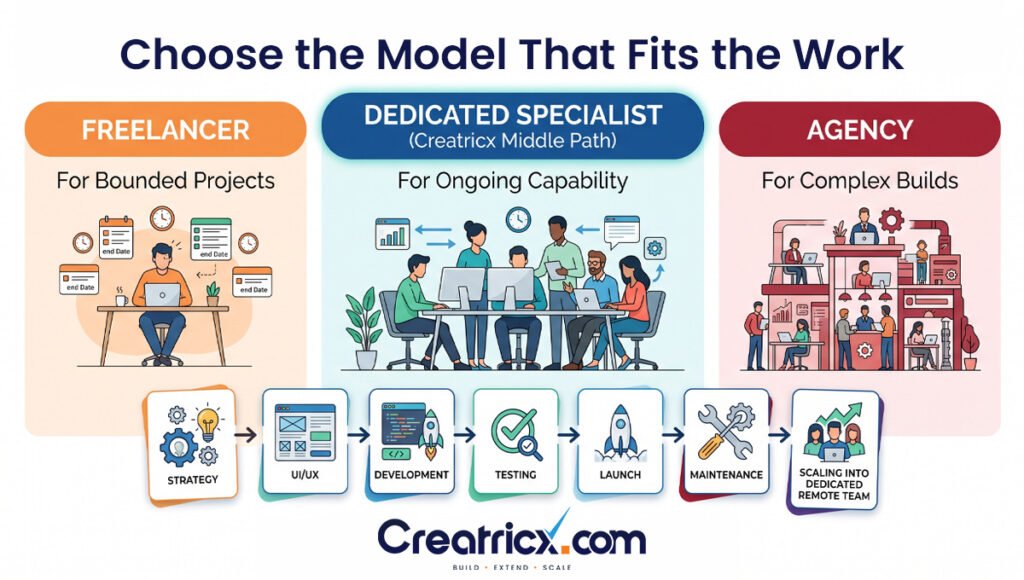
The conventional advice stops at two options, freelancer or agency, and for a lot of small businesses neither is quite right. It is worth understanding all three honestly, including the middle path most guides leave out.
Freelancer
A freelancer is usually the most affordable and flexible choice, and a strong one can absolutely deliver a great small business site. The trade-offs are real, though: you are typically hiring one person who leans toward either design or development, you carry the project management yourself, and that person is a single point of failure if they get ill, busy, or simply stop replying.
Agency
An agency gives you breadth and continuity, a team covering design, development, and often strategy, with cover when one person is unavailable. You pay more for that, and there is a specific small-business trap: paying agency prices for what turns out to be template work handled by junior staff, with the senior people you met during the pitch nowhere near your actual project.
Dedicated Specialist
The middle path, and the one that fits a lot of growing businesses better than either, is bringing a dedicated specialist onto your own team, a model usually called staff augmentation. Instead of commissioning a one-off project or handing everything to an agency, you add an individual designer or developer who works as part of your team, on your priorities, while someone else handles the sourcing, onboarding, and continuity. You get senior capability and ongoing availability without agency overhead or the single-point-of-failure risk of a lone freelancer. For a business that has moved past needing just one site and now needs continuous design or development capacity, this is frequently the model that actually fits.
How Creatricx Bridges the Gap Between Freelancers and Agencies
At Creatricx, our honest view is that most small businesses are not really choosing between a freelancer and an agency. They are trying to get reliable design and development capability without overpaying for structure they do not need or inheriting the risk of a single freelancer. That is precisely the gap our engagement models are built for.
Through staff augmentation, you can add a dedicated designer or a dedicated developer directly to your existing team, working on your priorities and within your tools, while we handle sourcing, onboarding, HR, and continuity. You keep day-to-day control; you simply gain the specialist you needed without the recruitment cycle or the agency markup. If your need is broader, a dedicated remote team can combine design, development, and other specialists into one integrated unit aligned to your roadmap. And when what you want is simply a finished website rather than headcount, our website design and development service can take a defined project from planning through launch, with the design-and-development-as-one-decision discipline this article argues for built in from the start.
We would give a small business the same advice regardless of if they work with us: decide what you are building and how long you will need someone, get real client references you can call, confirm ownership in writing, and never treat how a site looks and how it performs as two separate purchases. Where an embedded specialist is the right answer, that is a model worth knowing exists, because a lot of guides never mention it.
Frequently Asked Questions
How do I choose a web designer and developer for a small business?
Start by deciding what you are actually building and how long you will need support, then match the hire to that. A freelancer suits a bounded, simple site; an agency suits a complex, revenue-critical build; and an embedded dedicated specialist suits a growing business needing ongoing capability. Always get real client references and confirm ownership in writing.
How much does a small business website cost in 2026?
Most small businesses spend between $2,000 and $8,000 for a professional site, with complex builds reaching $15,000 or more. DIY builders run $10 to $50 a month, and freelance developers average around $85 an hour in the US, though rates vary widely by experience.
Should I hire a freelancer or an agency for my small business website?
It is contingent upon the scope and how much you can do yourself. Freelancers tend to be either design or development, are cheaper and more flexible, but are a single point of failure. Agencies offer breadth and continuity but at a higher cost. For ongoing work, an embedded specialist through staff augmentation often fits better than either.
What is the most common mistake small businesses make when hiring for a website?
Treating design and development as two separate decisions. A beautiful site that loads slowly still loses customers, since a one-second delay can cut conversions by around 7%. Design quality and technical performance are one decision, not two.
How do I verify a web designer or developer is any good?
Ask for two or three past clients you can actually contact and speak to, not just a portfolio. Open their live sites on your own phone to check speed and mobile behaviour, and confirm in writing who owns the domain, hosting, code, and content when the work is finished.
What is staff augmentation, and is it right for a small business?
Staff augmentation is when you add a dedicated specialist, e.g. a designer or a developer, to your existing team, and the provider takes care of sourcing, onboarding, and continuity. You keep daily control. It suits growing small businesses that need ongoing design or development capacity without full agency overhead or the risk of relying on one freelancer.
Should I use a website builder instead of hiring someone?
A DIY builder is a legitimate choice when your needs are genuinely standard and your budget is tight. The risk is building DIY intending to replace it later, then keeping it far longer than planned because replacing it feels like admitting the first spend was wasted. If your business depends on the outcome, start with the right foundation.
What should I confirm before paying a deposit?
Confirm if you are getting a custom build or a template configuration, in writing; who owns the domain, hosting, code, and content at the end; what post-launch support is included; and real client references. Clarifying these upfront prevents the most common and expensive surprises.
Ready When You Are
Tell us what you are building and we will recommend the right model, then provide the designer, developer, or team to deliver it. Book a free consultation with Creatricx: creatricx.com/staff-augmentation/
In Summary
Choosing a web designer and developer for a small business comes down to honesty about two things: what you are actually building, and how long you will need someone to look after it. Answer those, and the right path usually becomes clear, a freelancer for a bounded job, an agency for a complex revenue-critical build, or a dedicated specialist embedded in your team for ongoing work without agency overhead. No matter which you choose, treat design and development as one decision rather than two, get client references you can genuinely call, and settle ownership in writing before you pay anything. The businesses that get this right are not the ones who spent the most or found the cheapest option. They are the ones who matched the hire to the job and refused to separate how a website looks from how well it actually works.