
Planning a React web application?
Creatricx can help choose the React architecture, framework, rendering strategy, backend integration and team model around your product instead of forcing every project into the same frontend template.
Original Creatricx React Product Fit Lab graphic.
Table of Contents
The Short Answer: React Is Good, but React Alone Is Not the Whole Web Stack
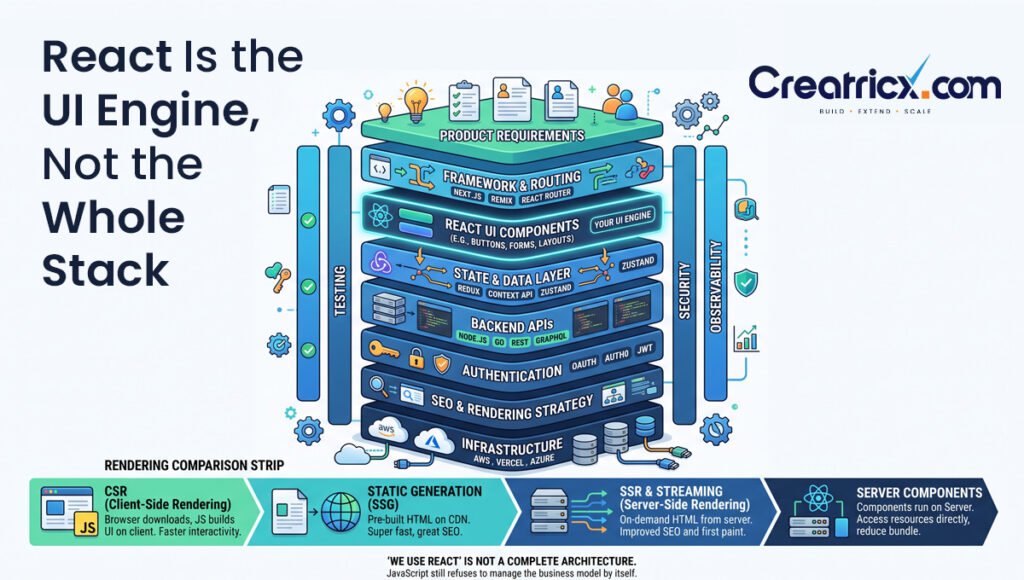
React is a JavaScript library for building user interfaces. It gives developers components, state, rendering behavior, hooks and an architecture for interactive UI. It does not, by itself, make every decision about routing, data loading, authentication, caching, backend services, deployment or SEO.
That distinction matters because many weak React projects are not really React failures. They are architecture failures around React.
Original Creatricx React architecture stack.
Why React Is Still a Strong Web Development Choice in 2026
1. Component architecture maps well to product interfaces
React breaks interfaces into components with their own logic and appearance. That is valuable when the same buttons, forms, tables, cards, filters, navigation and state patterns appear repeatedly across a product.
The practical benefit is not 'reuse' in the abstract. It is that design, behavior, accessibility fixes and product changes can be applied through a controlled component system instead of being reimplemented across dozens of screens.
2. React handles stateful interfaces naturally
Dashboards, product builders, chat interfaces, marketplaces and SaaS tools are constantly reacting to user input and changing data. React’s declarative model lets developers describe what the UI should look like for each state, rather than manually coordinating every DOM update.
3. The ecosystem is unusually deep
React has mature options for routing, frameworks, forms, testing, design systems, data fetching and native application development. That depth reduces the chance that a product becomes blocked because one unusual requirement has no practical implementation path.
State of JavaScript 2025 reported React experience among 83.6% of its respondents in the libraries dataset. W3Techs, which measures deployed websites rather than developer experience, detected React on about 6.1% of all websites in late August 2026. Those numbers measure different things, but both reinforce that React is a mainstream technology rather than a niche bet.
4. React now spans client, server and static rendering
React DOM includes client, server and static APIs. Frameworks can render React on the server, generate HTML at build time, stream content, and combine server-side and interactive components.
That flexibility is one reason the old 'React is bad for SEO because it is client-side' statement is now too simplistic. A client-only SPA can create SEO and first-load challenges. A properly server-rendered or statically generated React application can provide useful HTML immediately.
5. React Compiler reduces some manual performance work
React Compiler is now stable and can automatically memoize components and values at build time. The React team still recommends profiling before adding unnecessary complexity, but the compiler reduces the amount of manual memoization teams previously added with useMemo, useCallback and React.memo.
6. React has stronger long-term governance than it did a year ago
In February 2026 the React Foundation officially launched under the Linux Foundation. React, React Native and JSX moved to the independent foundation, with founding members including Amazon, Meta, Microsoft, Vercel, Expo and others.
That does not guarantee every technical decision will be perfect. It does reduce the concern that React's future belongs entirely to one company.
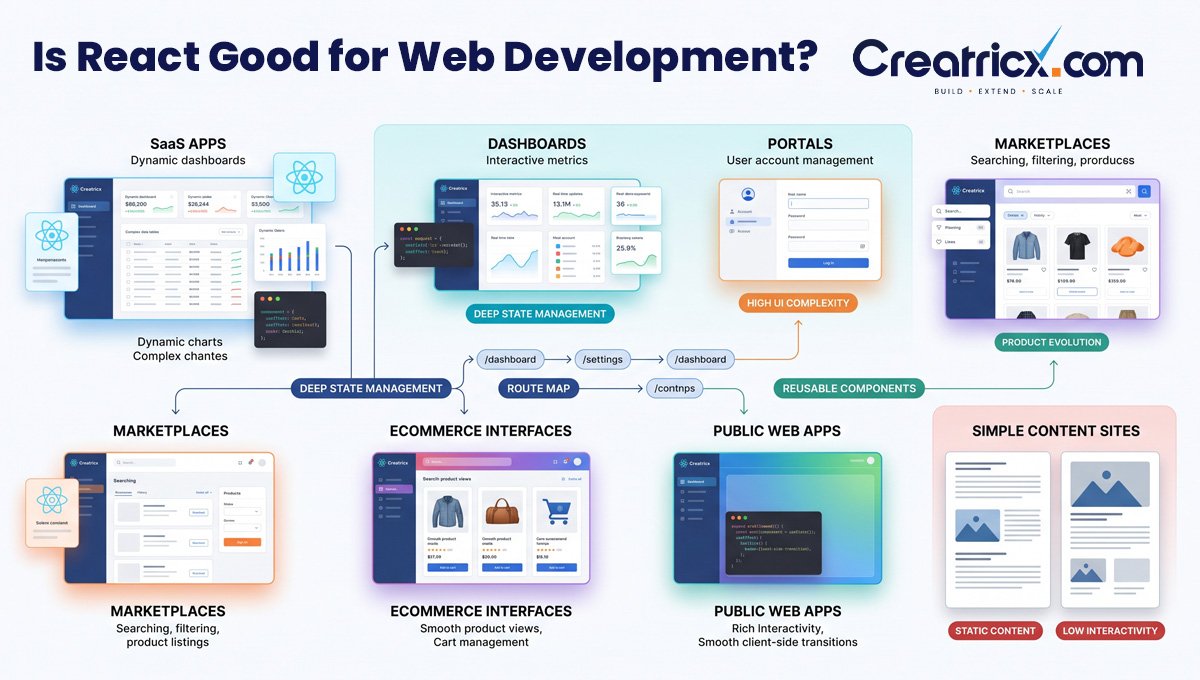
Where React Is Especially Good
| Use case | React fit | Why |
|---|---|---|
| SaaS products | Excellent | Reusable application UI, forms, roles, dashboards, frequent releases |
| Analytics dashboards | Excellent | State, charts, filters, tables, live data and reusable controls |
| Customer / employee portals | Excellent | Authenticated workflows, account state, integrations, repeated product UI |
| Marketplaces | Strong | Multi-step workflows, search/filter, profiles, messages, transactions |
| Interactive ecommerce | Strong | Product configuration, personalized interfaces, account and cart interactions |
| Internal tools | Excellent | SEO is often irrelevant; React + Vite can be simple and productive |
| Public product websites | Strong with framework | Use SSR/SSG/metadata strategy for SEO and initial load |
| Content-only brochure site | Often unnecessary | A CMS, static generator or traditional server rendering may be cheaper to own |
React for SEO: Good or Bad?
React is neither inherently good nor inherently bad for SEO. The rendering architecture decides how much useful HTML is available before client JavaScript runs.
For a public, indexable product, Creatricx would normally define SEO requirements before choosing a rendering strategy. React's official project guidance recommends frameworks for production applications, and Next.js's current App Router provides server rendering, Server Components, streaming, prefetching and metadata APIs on top of React.
Original Creatricx React rendering strategy map.
| Rendering model | Best fit | Advantage | Trade-off |
|---|---|---|---|
| Client-side SPA | Internal tools, authenticated dashboards, applications where SEO is irrelevant | Simple deployment and app-like navigation | Initial HTML may contain little content; more JS before useful UI |
| Static generation | Marketing pages, docs, public content that changes less frequently | Fast cached HTML and strong crawlability | Build/revalidation strategy needed for changing content |
| Server rendering / streaming | Dynamic public apps, marketplaces, ecommerce and SEO-sensitive routes | HTML arrives from server; supports progressive loading | More server/runtime architecture to operate |
| Server Components | Full-stack React frameworks with data-heavy pages | Can keep some logic and data access off the client bundle | Framework conventions and server/client boundaries require discipline |
Is React Fast?
React can support very fast web applications, but React is not a performance guarantee. Component rendering is only one part of performance.
- A large JavaScript bundle can make an otherwise elegant component tree slow to start.
- Fetching data in waterfalls can waste more time than rendering it.
- Hydrating too much client-side UI can delay interactivity.
- Large images, third-party scripts and analytics can dominate page cost.
- Poor state boundaries can trigger avoidable renders.
- Expensive charts, editors and data grids need their own performance budgets.
React 19.2 added Performance Tracks for Chrome DevTools, and React Compiler can reduce some manual re-render optimization work. Those tools help, but they do not replace measuring real user experience.
React vs Next.js: Which One Should You Use?
React is the UI library. Next.js is a framework built around React that adds conventions and production features such as routing, server/client components, rendering strategies, metadata, caching and deployment-oriented behavior.
The React team currently recommends starting new React apps and websites with a framework. Next.js App Router is one of the recommended options and currently provides one of the most complete implementations of React's server-first architecture.
- Use plain React with Vite for internal dashboards, embedded interfaces, prototypes, or SPAs where you deliberately want to choose routing/data tools yourself.
- Use a React framework when the product needs public routing, SEO, server rendering, static generation, server-side data access, streaming or a stronger production convention.
- Do not choose Next.js merely because it is fashionable. It adds useful capabilities and also adds framework conventions, server/client boundaries and upgrade responsibility.
React vs Vue vs Angular vs a CMS
| Option | Strength | Choose it when | Be cautious when |
|---|---|---|---|
| React | Product UI, broad ecosystem, flexible architecture | You need reusable interactive interfaces and a large talent/tool ecosystem | You want a strongly prescribed all-in-one framework |
| Vue | Approachable progressive framework | Team values Vue conventions and incremental adoption | Organisation is standardized heavily on React ecosystem |
| Angular | Opinionated enterprise framework | Large teams want built-in conventions and integrated framework choices | Team wants a lighter, more composable architecture |
| WordPress / CMS | Content-led websites and publishing | Editors and marketers own content; application logic is modest | The site behaves primarily like a complex web product |
| Shopify | Commerce-first stores | Catalogue, checkout, payments and commerce operations are core | You are building custom application behavior outside commerce patterns |
When React Is the Wrong Choice
- A five-page brochure website where content editing, not application behavior, is the primary need.
- A content-heavy publishing website that a mature CMS can manage with less engineering.
- A standard ecommerce store where Shopify or WooCommerce already solves most of the commercial workflow.
- A team with no JavaScript/TypeScript capacity that will be unable to maintain the application after launch.
- A project using React only because a developer prefers it, while the product itself needs almost no client-side state.
React can build all of those things. 'Can build it' and 'should build it' are different engineering questions.
Should You Use React? A Product Decision Tree
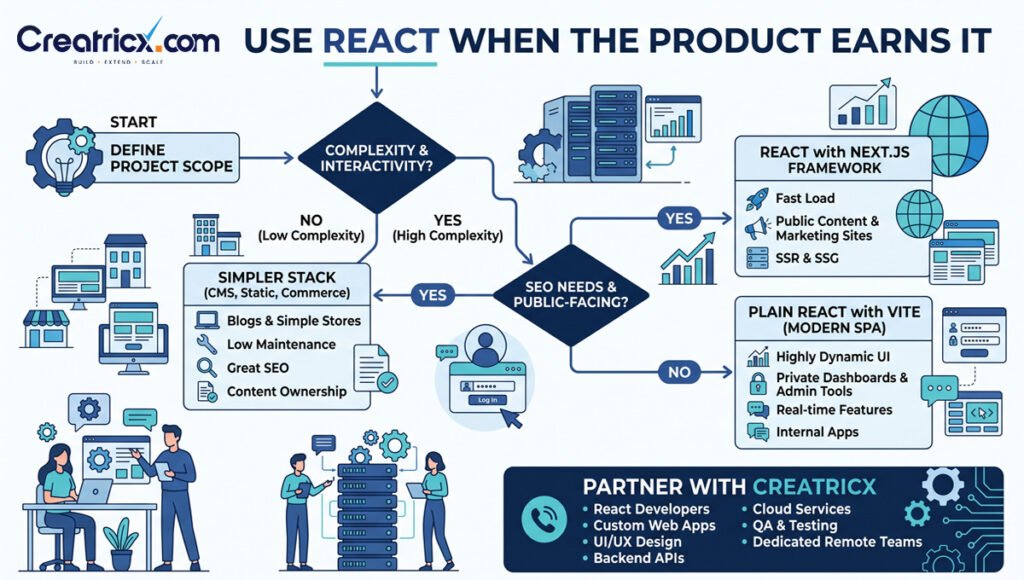
Original Creatricx React product decision tree.
The Creatricx React Architecture Checklist
- Define the product behavior: users, roles, workflows, data changes and interaction patterns.
- Decide public vs private routes: which pages need SEO, share metadata or immediate server-rendered HTML?
- Choose the rendering model: client, static, server, streaming or a hybrid by route.
- Choose the framework only after the rendering and deployment requirements are clear.
- Define state ownership: component state, URL state, server/cache state and global application state should not blur together.
- Design API and validation boundaries with the backend rather than letting UI code invent business rules.
- Build reusable components around product semantics, not around arbitrary fragments of JSX.
- Set performance budgets for bundle size, images, critical routes and expensive interactions.
- Test accessibility, authentication, authorization, errors and slow-network behavior before production.
- Document deploy, rollback, dependency updates, monitoring and ownership after launch.
React Security: Mature Does Not Mean Maintenance-Free
React itself is mature, but full-stack React applications depend on frameworks, server integrations and package ecosystems that require active maintenance.
The React team disclosed a critical React Server Components vulnerability in December 2025 and follow-up denial-of-service/source-code-exposure issues, with additional patched versions published in January 2026. The affected surface involved server-component packages and frameworks that implemented that protocol, not ordinary client-only React applications.
That history is useful rather than embarrassing: it demonstrates why a production React team needs dependency ownership, security monitoring and an upgrade process.
React Has Changed: What Matters in 2026
- React 19 made Server Components part of the stable React feature set for frameworks that support the architecture.
- React 19.2 added Activity, performance tracks and rendering/SSR improvements.
- React Compiler reached a stable release and can automatically optimize memoization.
- Create React App is deprecated for new applications; the React team encourages frameworks or modern build tools such as Vite for from-scratch apps.
- The React Foundation now hosts React independently under the Linux Foundation.
- Framework security and upgrade discipline matters more as React applications span client and server responsibilities.
For a buyer, the takeaway is not that React suddenly became a new library. The ecosystem is moving from the old client-only SPA mental model toward a broader architecture where React can participate in server and build-time rendering as well.
The React Production Readiness Gate
Original Creatricx React production readiness gate.
What We Look for When Taking Over a React Codebase
How Creatricx Uses React
Creatricx currently offers dedicated React developers and custom software delivery for web applications, dashboards, portals and broader product-development work. Its developer service explicitly lists React for product UI, dashboards, portals and modern web applications.
That is where we believe React is strongest. The business already has, or is creating, a product experience with repeated interactions, data, roles and ongoing releases.
For a defined project, Creatricx can take broader responsibility across discovery, UI/UX, React frontend, backend APIs, QA and launch. For an existing product team, a dedicated React developer can work inside the client's tools, code-review standards and sprint priorities.
For a content-first business website, we would still compare React against WordPress or another CMS. For an ecommerce-first business, we would compare it against Shopify or WooCommerce. The technology should earn its place in the architecture.
React, Next.js, WordPress or a custom web stack?
Creatricx can review the product behavior, SEO requirements, content ownership, integrations and internal team before recommending the cleanest architecture.
Frequently Asked Questions
Is React good for web development?
Yes. React is particularly good for interactive web applications, SaaS products, dashboards, portals, marketplaces and reusable product interfaces. It may be unnecessary for simple content sites with little interaction.
Is React good for websites or only web apps?
React can build both. For content-led public websites, use an appropriate framework or static/server rendering strategy when SEO and initial load matter. For a simple brochure website, a CMS or lighter stack may be easier to own.
Is React still relevant in 2026?
Yes. React remains widely used, React 19.2 is the current release line in the official documentation, React Compiler is stable, and the React Foundation launched under the Linux Foundation in 2026. The ecosystem continues to evolve around full-stack and server-capable React frameworks.
Should I use React or Next.js?
React is the UI library; Next.js is a framework built around React. Use plain React when you deliberately want a client-side app or choose surrounding tools yourself. Use a framework such as Next.js when routing, server rendering, static generation, metadata, server components or production conventions are important.
Is React good for SEO?
It can be. The core of SEO is rendering strategy and page implementation. Rendering and crawlability will be more difficult initially with a client-only SPA, but server-rendered or statically generated React frameworks can provide meaningful HTML and metadata immediately.
Is React fast for web development?
React can support fast user interfaces, but production performance depends on bundle size, rendering strategy, data fetching, images, third-party scripts, hydration and component/state architecture. React Compiler and performance tooling help, but measurement is still required.
Is React good for large applications?
Yes, provided the team has clear component boundaries, state ownership, data contracts, testing, observability and conventions. React's flexibility is useful at scale, but the same flexibility can produce inconsistent architecture if a team has no standards.
Is React better than Angular or Vue?
There is no universal winner. React has a very large ecosystem and flexible architecture. Angular is more opinionated and integrated. Vue is often praised for approachability and progressive adoption. Choose according to team capability, product requirements and long-term operating model.
Do I need a backend with React?
Many real applications do. React can call APIs or work inside full-stack frameworks, but business logic, databases, authentication, background jobs and integrations usually belong in a backend or server layer rather than only in browser components.
Is React secure?
React can be used securely, but security depends on the complete application. Full-stack React teams must maintain frameworks and dependencies, validate inputs, protect authorization boundaries, manage secrets and patch security updates. Recent Server Components advisories are a reminder that maintenance ownership matters.
Should I use React for a small business website?
Use React if the website needs substantial custom interaction or application behavior. If it is mainly services, content, forms and marketing pages, WordPress or another CMS may provide better editing and lower maintenance overhead.
Does Creatricx provide React developers?
Yes. Creatricx currently offers dedicated frontend/React developers for product UI, dashboards, portals and modern web applications, alongside full project delivery and broader remote development teams.
Final Takeaway
React is good for web development because modern products need interfaces that can change state, reuse components and evolve continuously. Its ecosystem, current framework architecture and large talent pool make it a practical long-term choice for many software products.
But React should not be the default answer to every URL. For public sites, decide rendering and SEO before coding. For internal tools, a simpler React/Vite setup may be enough. For content-first or commerce-first sites, compare React with a CMS or specialized platform before paying to rebuild solved problems.
The Creatricx position is not 'React is best.' It is 'React is excellent when the product earns the complexity.' That distinction usually leads to a better build and a much less awkward conversation six months after launch.
Need a React architecture that fits the product?
Creatricx can provide a dedicated React developer or a complete product team across UI/UX, frontend, backend, QA, cloud and ongoing software delivery.