
Getting Started
Planning an ecommerce build and want the platform and scope decided on your business, not an agency's preferred tech? Creatricx scopes ecommerce projects platform-agnostically, discovery first. Book a free consultation: creatricx.com/contact/
Table of Contents
Key Takeaways
Ecommerce website development spans platform selection, design, catalogue and checkout build, payments, security, and ongoing maintenance, not just the initial build
The platform decision is effectively irreversible: migrating an established store takes 3 to 6 months and costs $30,000 to $150,000, so choosing wrong means paying twice
Real 2026 cost ranges span a template-led small store at roughly $5,000 to $40,000, a custom mid-market build at $80,000 to $250,000, and enterprise or composable transformations at $400,000 and up
The most under-budgeted reality is total cost of ownership: hosting, apps, payment fees, security, and maintenance make the three-year cost far higher than the launch price
The genuine 2026 shift is agentic commerce, where AI shopping assistants like ChatGPT Checkout and Perplexity Shopping reward stores with clean product feeds, a factor almost absent from older guides
What Ecommerce Website Development Actually Involves
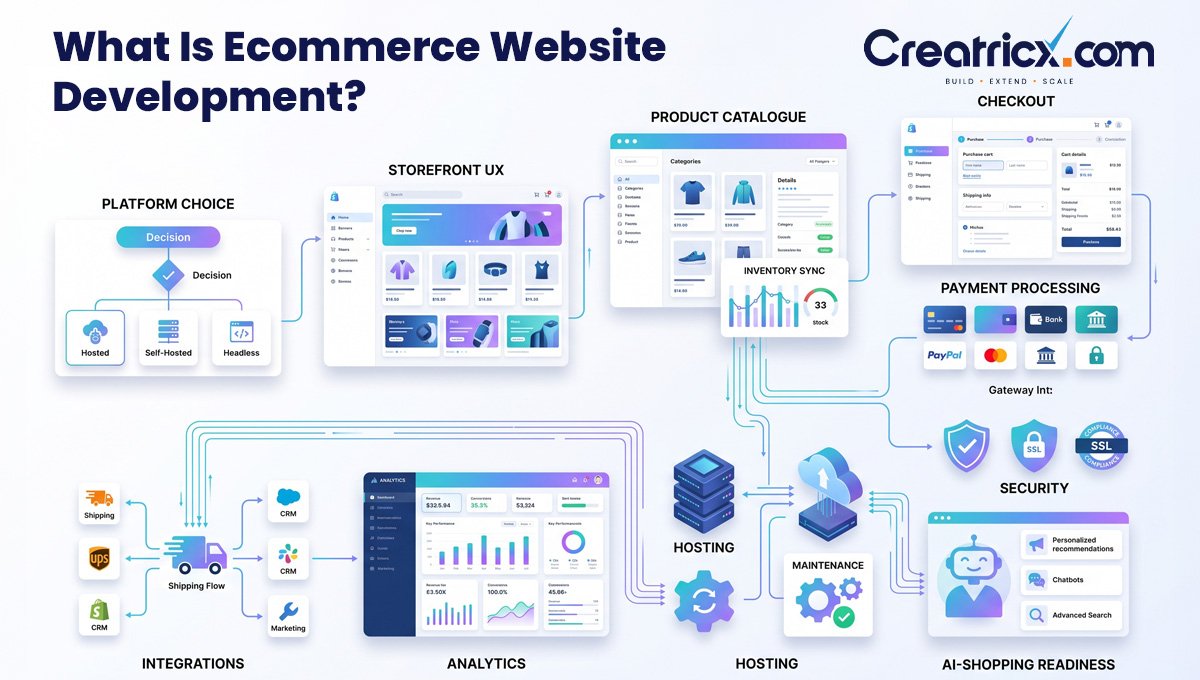
At its simplest, ecommerce website development is building the machinery that lets people buy from you online. But that plain definition hides how much is actually involved, and understanding the full scope is what separates a business that budgets realistically from one that is surprised at every turn.
A complete ecommerce build brings together several distinct pieces of work.
There is the platform, the underlying system the store runs on, which is the foundation everything else sits atop.
There is design and user experience, the storefront customers actually see and navigate.
There is the catalogue, how products are structured, categorised, and searched.
There is the checkout and payment processing, the part that actually takes money and where small friction costs real sales.
There is security and compliance, protecting customer and payment data.
There are integrations, connecting the store to inventory, shipping, accounting, email, and analytics.
And there is everything after launch, the hosting, maintenance, updates, and optimisation that keep a store healthy over years.
A store isn’t a project you finish; it is operational infrastructure you run, and that distinction shapes the entire cost picture.
The Decision That Matters Most: Your Platform, And Why It Is Nearly Irreversible
Here is the part most introductory guides mention briefly and then move past, and it is genuinely the most consequential decision in the entire process. Your choice of ecommerce platform influences your cost, your timeline, your scalability, and what your store can and cannot do, and in contrast to most decisions in a build, it is extremely expensive to reverse later.
The numbers make the stakes concrete. Migrating an established ecommerce store, with its product data, customer accounts, order history, SEO equity, and third-party integrations intact, typically takes three to six months and costs $30,000 to $150,000 depending on complexity. That means a business that chooses the wrong platform does not simply lose its initial investment. It pays twice: once for the build it outgrew or fought against, and again for the migration to escape it. This is why the platform decision deserves far more care than the "pick Shopify and go" advice it usually gets, and why getting it right at the start is worth more than almost any other early choice.
The good news, as the mature 2026 market makes clear, is that there are effectively no bad platforms anymore, only bad matches between a platform and a business. The task is not to find the best platform in the abstract, which does not exist, but to find the one that fits your catalogue, your revenue, your team, and crucially your growth trajectory over the next eighteen months, so you choose something you will not outgrow before it has paid for itself.
Talk to Us Midway
Not sure which platform actually fits your business, and wary of being steered toward one that suits the agency? Creatricx advises platform-agnostically: creatricx.com/website-development/
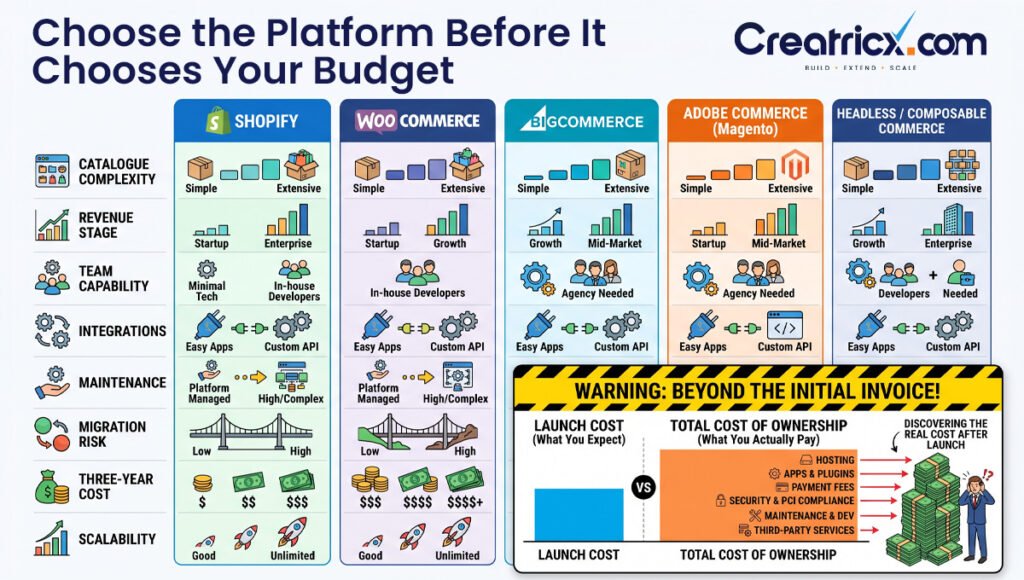
| Platform | Genuinely Best For | The Honest Trade-off |
|---|---|---|
| Shopify | Most D2C and B2C brands, especially under $5M GMV; fast launch, low maintenance | Transaction fees, payment lock-in, and app-subscription creep that grows with scale |
| WooCommerce | Content-driven commerce and complex product structures on WordPress | Free software but you self-manage hosting, security, and updates; costs more than it looks |
| BigCommerce | Mid-market sweet spot between Shopify's simplicity and enterprise power | Fewer themes and a smaller app ecosystem than Shopify |
| Adobe Commerce (Magento) | Enterprises with large catalogues and the team to run it | High cost and real engineering resource required |
| Headless / composable | The minority needing omnichannel, extreme performance, or content-commerce unity | High engineering cost; you rebuild what platforms give you for free |
The Question Smarter Than "Can The Platform Do This?"
There is a reframe that experienced ecommerce teams use constantly, and it will save you more money than any feature comparison. When you want your store to do something specific, the instinctive question is "can this platform do it?" The better question is "should this platform be forced to do it?"
Almost any platform can be bent to almost any requirement if you throw enough custom development at it.
Shopify can be customized heavily, WooCommerce can be extended endlessly, and both will happily take your money to fight against their own natural design. But every workflow you force onto a platform against its grain adds cost, fragility, and future maintenance burden.
A store that embraces its platform's strengths, Shopify's fast checkout and reliable hosting, WooCommerce's content flexibility, is cheaper to build and far cheaper to run than one constantly customised to behave like something it is not.
When you find yourself needing to override a platform's core behaviour at every turn, that is usually a sign you chose the wrong platform, not that you need more custom development. The cost of fighting a platform compounds quietly, and it is one of the most common ways ecommerce budgets balloon.
What It Actually Costs, Launch Versus The Real Number
Ecommerce cost ranges are wide because the term covers everything from a template store to a seven-figure transformation, so here are the real 2026 planning ranges, drawn from multiple independent industry sources.
A template-led small-business store typically runs $5,000 to $40,000. A growth-stage SaaS-platform implementation lands around $40,000 to $120,000. A custom mid-market build runs $80,000 to $250,000. An integration-heavy B2B program reaches $125,000 to $400,000. And a full enterprise or composable transformation runs $400,000 to $1 million or more.
At the very bottom, a genuinely basic store on a SaaS platform with a free theme and self-setup can launch for under $1,000, but that budget supports only simple catalogues, minimal customisation, and few integrations.
Here is the number that matters more than any of those, though, and the one businesses most consistently miss: total cost of ownership, not launch cost. A store keeps costing money after it goes live, because ecommerce is operational.
Hosting, platform subscriptions, app and plugin fees, payment processing, security work, bug fixes, SEO maintenance, analytics, conversion testing, and content updates all continue indefinitely. Multiple 2026 pricing analyses stress that these ongoing costs can become a major part of the three-year budget, sometimes rivalling the build itself.
The businesses that budget only for launch are reliably disappointed, not because the site failed, but because it aged and needed care they had not planned for.
The Step-by-step Development Process
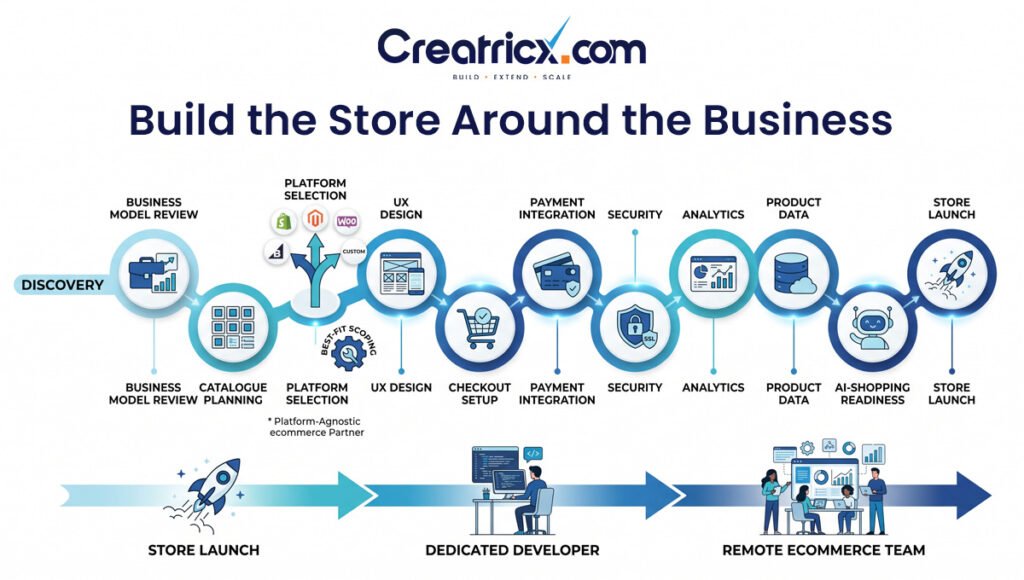
Understanding how a professional ecommerce build actually unfolds helps you plan realistically and spot a provider who skips the parts that matter.
Discovery and Strategy
Every good store starts with questions, not code: what you sell, who your customer is, what competitors do well and badly, and which payment and delivery methods your customers expect. This stage defines product categories, site structure, and measurable goals, and it shapes every decision that follows, including platform choice.
Platform Selection
Based on your requirements, budget, and growth plans, the right platform is chosen, Shopify, WooCommerce, BigCommerce, Adobe Commerce, or a custom or headless build. Given how expensive this is to reverse, it deserves genuine analysis rather than a default.
Design and User Experience
The storefront is designed around conversion, not just appearance: clear navigation, fast-loading pages, mobile-first layouts, and a checkout engineered to remove friction, because even small checkout friction measurably costs sales.
Development and Integration
The store is built, the catalogue structured, payments configured, and integrations connected to inventory, shipping, accounting, and analytics. Performance targets matter here: sub-2.5-second product pages and clean mobile behaviour directly affect conversion.
Testing, Launch, and Optimisation
Before launch the store is tested across devices, payment scenarios, and load conditions. After launch, the real work begins: monitoring checkout, tuning search, refining product pages, and optimising conversion as traffic reveals where customers hesitate.
The 2026 Shift Most Guides Have Not Caught Up To: Agentic Commerce
Here is something older ecommerce guides barely mention, and it is genuinely reshaping how stores need to be built. Shopping is increasingly happening through AI assistants, and a store's readiness for that shift is becoming a real competitive factor.
AI shopping experiences, ChatGPT Checkout, Perplexity Shopping, Amazon's AI shopping tools, now discover and recommend products directly, and they reward stores that expose clean, well-structured product data through modern feeds and APIs.
This is being called agentic commerce, and it changes what "good" ecommerce development means: a store built with messy, poorly structured product data may rank and convert fine today but be invisible to the AI assistants a growing share of shoppers use to find products tomorrow.
The stores positioning for this are building clean product feeds and structured data as standard, not as an afterthought. It is the ecommerce equivalent of the shift SEO went through when search changed, and a business building a new store in 2026 should treat AI-shopping readiness as part of the specification rather than a future problem.
How Creatricx Approaches Ecommerce Development
Everything above is why we approach ecommerce the way we do at Creatricx, because after enough builds it becomes clear that the expensive mistakes are made early, in platform choice and scope, not late in development. Our starting point is deliberately platform-agnostic. We are not tied to selling you one platform or pushing headless because it generates a bigger project, which means our recommendation is driven by what fits your catalogue, revenue, team, and growth trajectory rather than what suits us to build.
In practice, that means an ecommerce engagement begins with genuine discovery, understanding what you sell and how your customers buy, before any platform or design is decided, precisely because that decision is so expensive to reverse.
We build on the platform that genuinely fits, be that Shopify, WooCommerce, or a custom build, and we scope the total cost of ownership honestly rather than quoting only the launch price.
And because a store is operational infrastructure that needs ongoing care, our model extends naturally beyond launch: through staff augmentation you can add a dedicated developer to maintain and grow the store continuously, or scale into a full dedicated remote team as the store grows, rather than being handed a finished site and left to manage it alone.
Where AI-shopping readiness matters to your market, we treat clean product data as part of the build rather than a later retrofit.
Our honest position is the one running through this article: ecommerce development succeeds or fails on early decisions and ongoing care, not on flashy features. Get the platform right for your actual business, budget for the real three-year cost, and treat the store as something you run rather than something you launch and forget, and it becomes the tireless, around-the-clock salesperson it is meant to be.
Ready When You Are
Get an ecommerce build scoped on your business, on the right platform, with the real cost laid out honestly and support that lasts beyond launch. Explore ecommerce development with Creatricx: creatricx.com/website-development/
Frequently Asked Questions
What is ecommerce website development?
Ecommerce website development is the process of designing, building, and maintaining an online store that sells products or services and takes payments online. It spans platform selection, storefront design, product catalogue and checkout build, payment processing, security, integrations, and the ongoing maintenance that keeps the store fast and selling.
How much does ecommerce website development cost in 2026?
Real 2026 ranges span roughly $5,000 to $40,000 for a template-led small store, $80,000 to $250,000 for a custom mid-market build, and $400,000 or more for enterprise or composable transformations. A basic SaaS store can launch for under $1,000, but the number that matters most is total three-year cost of ownership, not the launch price.
Which ecommerce platform is best?
There is no single best platform, only the best match for your business. Shopify suits most D2C brands under $5M, WooCommerce suits content-driven commerce, BigCommerce fits the mid-market, Adobe Commerce serves enterprises, and headless suits the minority needing omnichannel or extreme performance. Choose based on your catalogue, revenue, team, and 18-month growth, not popularity.
Why is choosing the right ecommerce platform so important?
Because the decision is nearly irreversible. Migrating an established store takes three to six months and costs $30,000 to $150,000, so choosing wrong means paying twice, once for the build you outgrew and again for the migration. This makes platform selection the highest-stakes decision in the whole project.
Do I really need headless or composable commerce?
Probably not. For most stores under $5M in sales, headless is an over-complication that gives up the pre-built checkout and simplicity of hosted platforms. Genuine headless needs, true omnichannel, content-heavy front ends, or extreme performance, are real but rare. Many agencies recommend it because it generates lucrative projects, so always question why it is being suggested.
What ongoing costs come after an ecommerce site launches?
Hosting, platform subscriptions, app and plugin fees, payment processing, security work, bug fixes, SEO maintenance, analytics, conversion testing, and content updates all continue indefinitely. These ongoing costs can become a major part of the three-year budget, which is why budgeting for launch alone reliably leads to disappointment.
How long does it take to build an ecommerce website?
It depends heavily on complexity. A template-led store can launch in weeks, a custom mid-market build often takes a few months, and an enterprise build with complex integrations and UX research can take six months or longer. Choosing a platform with strong out-of-the-box features and flexible APIs can shorten timelines.
How does Creatricx approach ecommerce website development?
Creatricx starts platform-agnostic, choosing the platform that genuinely fits your business through a discovery-first process, since platform choice is so costly to reverse. We scope total cost of ownership honestly, build on the right platform rather than a preferred one, and support the store beyond launch through dedicated developers or a dedicated remote team, treating it as operational infrastructure rather than a one-off project.