
Table of Contents
Key Takeaways
SIGNAL 01
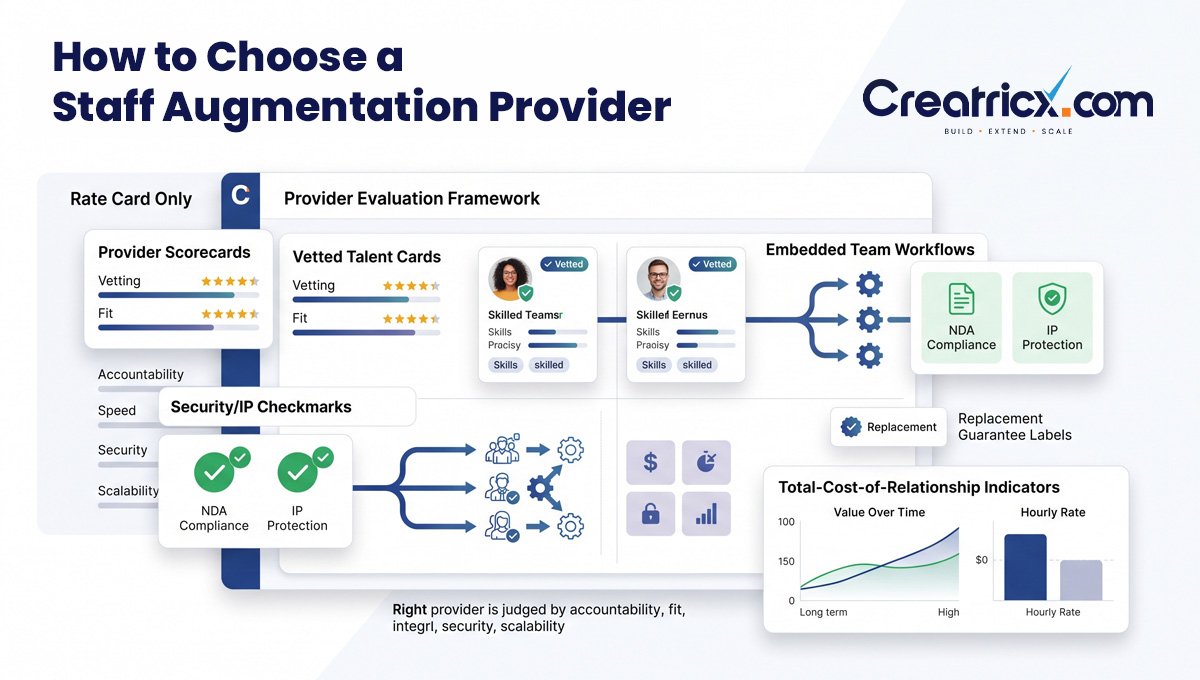
Rate is the wrong first filter; engineering leaders in 2026 evaluate on total cost of the relationship, because a cheap engineer who ramps slowly or needs rework costs far more than the hourly saving
SIGNAL 02
The single most revealing question is "what percentage of applicants pass your vetting," and a credible provider answers with a number, with strong firms accepting under 10 to 20% of applicants
SIGNAL 03
The structural choice underneath everything is body shop versus embedded partner: an arms-length contractor returns code, an embedded specialist joins your standups and is accountable to your lead like a full-time hire
SIGNAL 04
Non-negotiables in writing: a documented replacement guarantee, explicit IP assignment, an NDA from every specialist, and no long lock-in before a short pilot
SIGNAL 05
Our case for Creatricx is built on these same criteria, not on marketing claims, because the honest way to earn the work is to invite you to hold us to the bar this article sets
Why Most Staff Augmentation Provider Selection Goes Wrong Before It Starts
Here is the mistake almost everyone makes, and it happens at the very first step.
A business decides it needs augmented talent, opens a spreadsheet, and starts collecting hourly rates from providers. The lowest number gets a mental gold star, and the evaluation quietly becomes a race to the cheapest bid. We understand why, rates are concrete and easy to compare, but it is genuinely the wrong first move, and it is the root cause of most augmentation relationships that disappoint.
The reason is simple arithmetic that only becomes visible months later. A cheaper engineer who ramps slowly, needs constant rework, or quietly gets swapped onto another client's project costs far more than the hourly difference ever saved.
The gap between a 45-dollar-an-hour contractor and a 75-dollar-an-hour senior evaporates the moment the cheaper one produces work that has to be redone, or misses the context that a more expensive, better-embedded specialist would have caught. This is why engineering leaders in 2026 have largely moved past rate-shopping toward total cost of ownership, judging a provider on time-to-productive, retention, and technical fit rather than the number on the rate card.
The rate matters, but it belongs near the end of your evaluation, not the start.
The Structural Choice Underneath Everything: Body Shop Or Embedded Partner
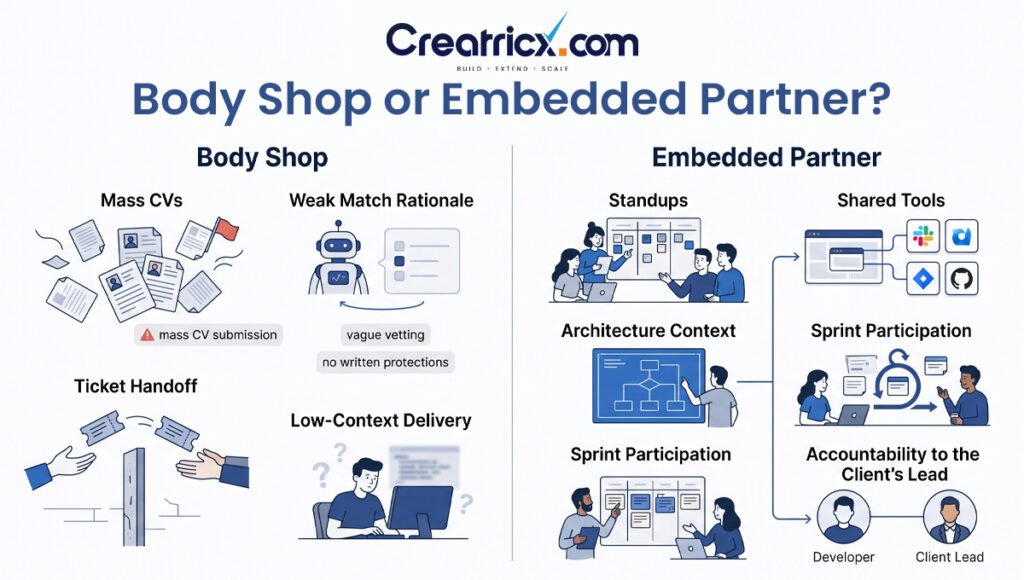
Before you compare any staff augmentation providers on any criteria, you need to decide what kind of relationship you actually want, because it determines everything else.
There are two fundamentally different models sold under the same "staff augmentation" label, and confusing them is how businesses end up disappointed by a provider that was technically delivering what it promised.
Body Shop
At one end sits the body shop. You send a requirement, they email you a stack of CVs from a database, you pick one, and an arms-length contractor takes tickets and returns code. There is nothing inherently wrong with this for narrow, well-defined tasks, but it is a transaction, not a partnership, and it shows the moment anything requires context or judgement.
Embedded Partner
At the other end sits the embedded partner. Here the specialist joins your standups, learns your architecture, follows your processes, and is accountable to your lead exactly as a full-time hire would be. They are part of your team that happens to sit outside your payroll, not a vendor lobbing deliverables over a wall.
The distinction matters enormously because the two models fail in completely different ways and suit completely different needs.
If your work is genuinely modular and self-contained, a body shop may be fine and cheaper. If your work requires anyone to understand your product, your users, or your codebase, an embedded partner is the only model that works, and paying body-shop prices for embedded needs is a false economy that surfaces as frustration within weeks.
Decide which you need first. Every other criterion below is really about finding a genuine embedded partner rather than a body shop wearing better marketing.
The One Question That Separates Serious Providers From The Rest
Vetting Credibility Gauge
Ask for the pass rate, then ask how the screening works.
If you ask a provider only one thing, ask this: what percentage of applicants pass your vetting, and how does that vetting work? It is the single most revealing question in the entire evaluation, and the answer sorts the field faster than anything else.
A credible provider answers with a number. Strong firms accept fewer than 10 to 20% of applicants after multi-stage screening, and a low pass rate is a positive signal, because it means the provider is genuinely filtering rather than forwarding everyone who applies.
If you ask for a pass rate and receive a brand story, a mission statement, or a vague assurance that "all our developers are highly skilled," move on. A provider who cannot quantify their vetting process has not built one. It is also worth asking who does the vetting: tech-specialist providers have actual engineers involved in screening, which changes the quality of what reaches you, whereas generalist staffing firms rely on recruiters trained to match profiles to job descriptions rather than to tell a principal engineer from a senior one, or architectural thinking from implementation skill.
Vetting rigor isn’t a box-ticking exercise. It is the difference between interviewing three genuinely qualified candidates and wading through a dozen near-misses to find one, and it directly determines how much of the quality-control burden lands back on your own team.
The Things That Must Be In Writing, Not In A Sales Call
Several of the criteria that protect you are worthless as verbal assurances and essential as contract terms. Get these in writing before you sign, because they are exactly the points that turn into disputes when an engagement goes sideways.
| What to Confirm | Why It Matters | The Weak Answer to Reject |
|---|---|---|
| Replacement guarantee | If a match is wrong, you need a free, fast replacement, not a renegotiation | "We'll sort it out" with no window or cost stated |
| IP ownership | You must own all work product, including code written outside standard hours | Vague contract language that never assigns IP explicitly |
| NDA from every specialist | Your data and systems are exposed to an external person | A company-level NDA that does not bind the individual |
| Pilot before lock-in | A short trial de-risks the decision; long lock-in before proof shifts risk to you | A demand to commit six months or more before any trial |
| Security certification | SOC 2 or ISO 27001 evidence, especially in regulated sectors | A self-attestation letter instead of an actual audit |
The 2026 Shift: From Hours Billed To Outcomes Delivered
One genuine change worth factoring into your choice this year is the move toward outcome-based engagement. The traditional model bills for effort, hours logged, regardless of what those hours produced. The emerging model ties a portion of the fee to results: sprint velocity, defect rates, feature delivery, documented KPIs. Buyers like it because risk shifts toward the partner, and good providers like it because it rewards the ones who actually deliver and quietly pushes out the body shops that only ever sold time. You do not need every engagement to be outcome-based, but a provider's willingness to have that conversation, to tie their compensation to your results rather than just their inputs, tells you a great deal about their confidence in their own people.
Alongside this, hiring itself has become more skills-based. The strongest providers now match on demonstrated production experience with the specific tools your project needs, rather than on generic credentials, which works especially well in augmentation because engagements are short enough that verifiable, specific skill matters far more than a broad résumé.
Why Creatricx Is A Strong Choice for Staff Augmentation
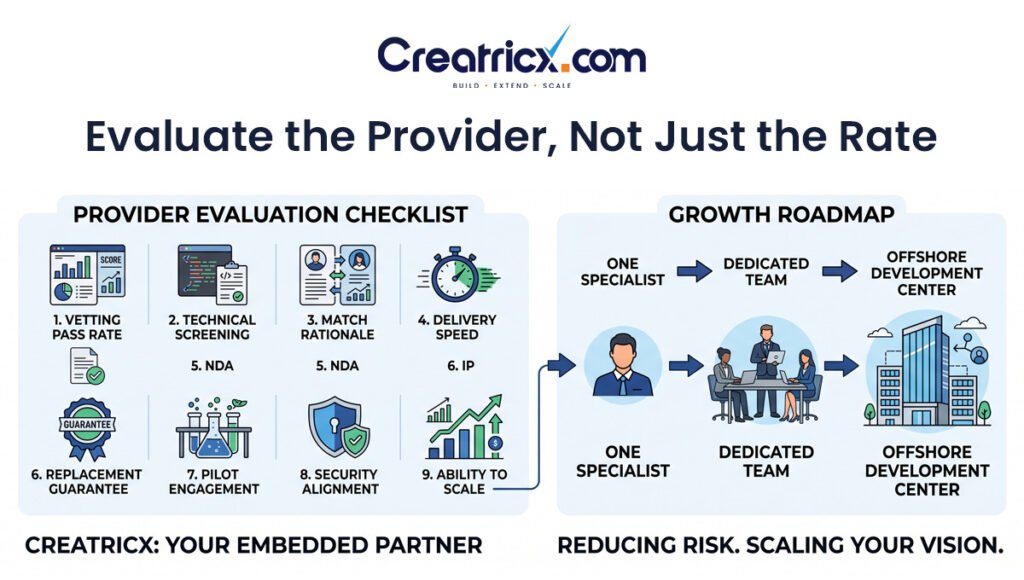
We would rather earn your consideration by meeting the criteria above than by asserting we are the best, so here is our honest case, mapped directly to what this article tells you to look for. Hold us to every point of it.
On the body-shop-versus-partner question, Creatricx is built as an embedded-partner model, not a CV database. The specialists we place, dedicated developers, designers, AI engineers, SEO and marketing specialists, work inside your team, on your tools, under your management, joining your workflow the way a full-time hire would rather than returning tickets from arm's length. That embedded model is the foundation of everything else we do.
On vetting and quality, we screen for genuine fit rather than volume, presenting fewer, better-matched specialists with the reasoning for each, precisely because a match-rationale approach is what separates a partner from a body shop.
On the protections that must be in writing, our engagements are NDA-backed and GDPR-aligned by default, with clear IP assignment so you own your work product and controlled, secure access to your systems, exactly the contractual safeguards this article tells you to insist on rather than the verbal assurances it tells you to reject.
On speed, our model is built to place the right specialist quickly rather than making you wait out a long recruitment cycle, because augmentation only earns its keep if the help arrives while it still matters.
And on the criterion most providers cannot meet, the ability to grow with you, Creatricx is structured so a single augmented specialist can expand into a full dedicated remote team, or scale into an offshore development center, on the same relationship rather than a fresh vendor search each time your needs change. Many providers can supply one developer for a few months.
Far fewer can sustain a multi-year collaboration that stays aligned with your processes as your roadmap evolves, and fewer still can flex from one specialist to a whole unit without renegotiating everything. That elasticity, combined with breadth of specialism under one accountable relationship, is where we believe our case is strongest.
Our honest position is the one running through this whole article: choose the provider who removes your risk, embeds real talent, and proves it rather than promising it. We think that describes us, but the responsible thing is to test us against it rather than take our word, which is exactly the evaluation we would encourage you to run.
Evaluate the Provider, Not Just the Rate
Put the criteria in this article to Creatricx directly and evaluate the model against the same bar.
Frequently Asked Questions
How do you choose a staff augmentation provider?
Decide first if you want an arms-length contractor or an embedded specialist under your direction, then evaluate providers on vetting rigor, delivery speed, communication and time zone overlap, security and IP terms, replacement policy, and ability to scale, rather than on hourly rate alone. Start every evaluation by asking for the applicant pass rate, and reject vague answers.
What is the most important thing to ask a staff augmentation provider?
"What percentage of applicants pass your vetting, and how does it work?" A credible provider answers with a number, with strong firms accepting under 10 to 20% of applicants. A brand story instead of a figure means they have not built a real vetting process, which is a serious warning sign.
Why shouldn't I choose a provider based on hourly rate?
Because rate is the easiest thing to compare and the least predictive of success. A cheaper engineer who ramps slowly or needs rework costs far more than the hourly saving over the life of the engagement. Engineering leaders in 2026 evaluate on total cost of ownership, time-to-productive, retention, and technical fit instead.
What are the red flags when choosing a staff augmentation provider?
Inability to quote a pass rate, mass CV submission with no match rationale, hidden fees, an unusually low bid, a demand for a long lock-in before any pilot, no documented replacement guarantee, vague IP terms, and self-attested rather than audited security. Each translates directly into project risk.
What is the difference between a body shop and an embedded staff augmentation partner?
A body shop emails you CVs from a database and supplies arms-length contractors who take tickets and return code. An embedded partner places specialists who join your standups, learn your architecture, and are accountable to your lead like full-time hires. The embedded model is essential for any work requiring context or judgement.
Should I run a pilot before committing to a staff augmentation provider?
Yes. A short pilot, often one specialist for a few weeks, replaces sales claims with observed data on how they work, communicate, and handle a specification that turns out to be wrong. Any provider demanding a six-month-plus commitment before a trial is prioritising their revenue over your confidence, which is a red flag.
What should be in a staff augmentation contract?
A documented replacement guarantee with a stated window and cost, explicit IP assignment so you own all work product, an NDA binding each individual specialist, clear security terms with real certification where relevant, and terms that let you scale up or down without renegotiating the whole agreement.
Why is Creatricx a good staff augmentation provider?
Creatricx uses an embedded-partner model, placing vetted specialists who work inside your team under your direction, with NDA-backed, GDPR-aligned engagements, explicit IP assignment, and fast placement. Crucially, a single specialist can scale into a dedicated remote team or offshore development center on the same relationship, which few providers can sustain. We encourage you to test us against the criteria in this article rather than take the claim on faith.
Disclaimer
In Summary
Choosing a staff augmentation provider well comes down to refusing the easy comparison and running the right one. Rate is where most buyers start and where they should nearly finish, because the things that actually decide if an engagement works, rigorous vetting, an embedded rather than arms-length model, fast delivery, contractual protections, and the ability to scale, are the things a rate card can never show you. Ask for the pass rate. Insist the replacement guarantee, IP assignment, and NDA are in writing. Start with a pilot, not a lock-in. And choose the provider who removes your risk rather than the one who merely underbids.
We have made our case for Creatricx against exactly these criteria, not around them, because a provider worth choosing should welcome being held to the same standard it asks you to demand of everyone else. Run that evaluation properly, and the right partner becomes clear.
How Do You Choose a Staff Augmentation Provider?
We have made our case for Creatricx against exactly these criteria, not around them, because a provider worth choosing should welcome being held to the same standard it asks you to demand of everyone else. Run that evaluation properly, and the right partner becomes clear.