
Table of Contents
Key Takeaways
Resource augmentation and staff augmentation are the same model: adding skilled external professionals to your existing team under your direction, without permanent hiring
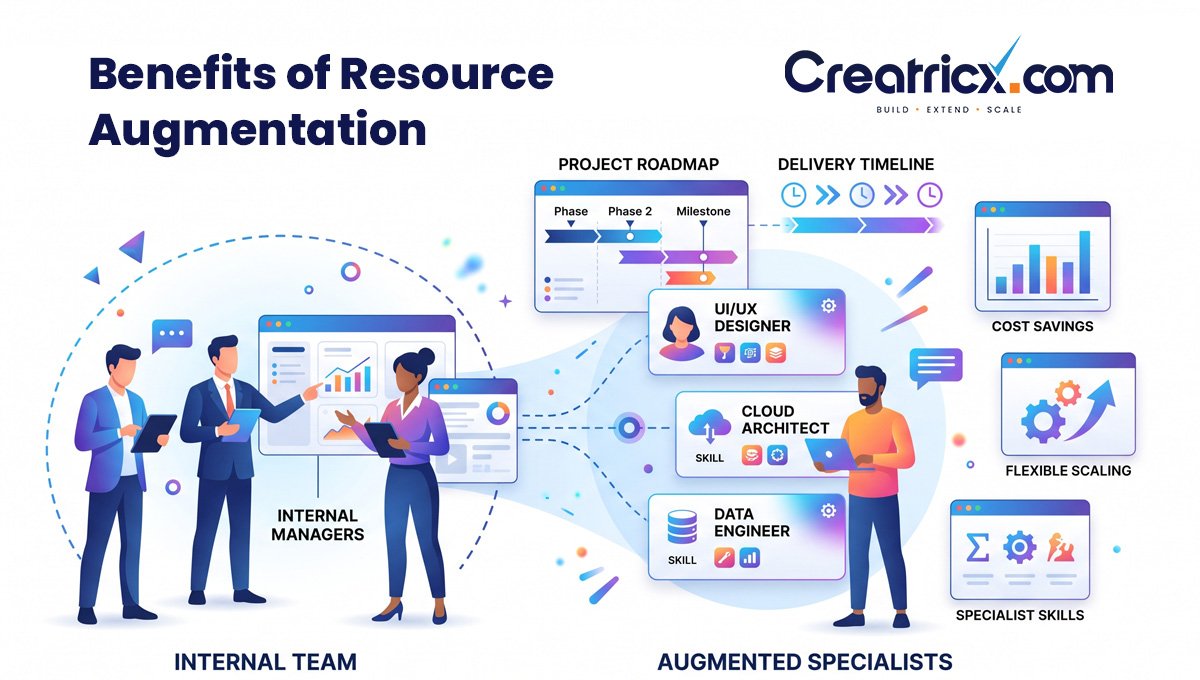
The headline benefit is cost, with companies typically saving 20 to 35% on total talent costs versus equivalent permanent hires, and more through offshore models
The more valuable benefit is speed: a prepared provider can deliver a shortlist in days and a productive contribution within one to two weeks, against months for permanent recruitment
The genuinely strategic benefit is flexibility, letting a company scale capacity to actual demand rather than carrying peak-sized headcount through every trough
Over 60% of companies convert high-performing augmented staff to permanent roles, making augmentation a low-risk evaluation path as well as a capacity solution
Resource Augmentation And Staff Augmentation Are The Same Thing
Before we get to the benefits, one point of confusion is worth clearing up, because it trips people up constantly. Resource augmentation and staff augmentation are two names for the same model.
Both describe adding external, skilled professionals to your existing team to fill a capability or capacity gap, without hiring permanently.
Some people use "resource augmentation" as a slightly broader term and "staff augmentation" for the IT-specific version, but in practice they are used interchangeably, and the benefits below apply equally to both.
If you have been reading around this topic and wondering if you are comparing two different things, you are not.
With that settled, here is the honest hierarchy of what this model actually delivers, ordered not by what sounds most impressive but by what matters most in practice.
Benefit #1: The Cost Saving Everyone Leads With, And Why It Is The Weakest Argument
Let us start with the benefit every article puts first, because it is real, then explain why we think it is the least interesting reason to choose augmentation.
The cost case is genuine.
Companies typically save 20 to 35% on total talent costs compared to equivalent permanent hires, and offshore models push that higher, with some regions running 30 to 50% below the cost of hiring the same role onshore.
For a team of five developers, industry data puts the annual saving somewhere between $175,000 and $350,000 depending on seniority.
Those savings come from real places: no recruitment fees, no employer taxes, no benefits, no training budget, no severance, and no cost of carrying someone through quiet periods.
Since fully loaded employee cost runs roughly 1.25 to 1.4 times base salary before you even count recruiting and vacancy drag, the total-cost comparison usually favours augmentation for project-based work, even though the headline hourly rate looks higher.
So why do we call this the weakest argument? Because rate savings alone are the easiest benefit to compete away and the easiest for a finance team to poke holes in.
A cheaper hourly rate that arrives too late, or produces work that needs redoing, saves nothing. The companies that get real value from augmentation are the ones that look past the rate to the benefits below, which is where the model actually earns its place.
Benefit #2: Speed, Which Is The Benefit Companies Actually Feel First
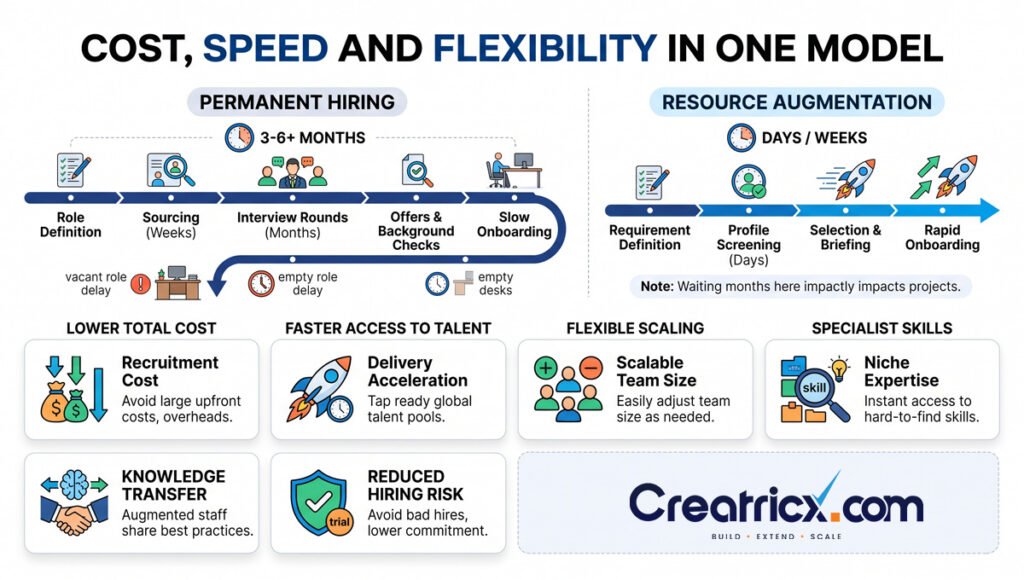
Here is the benefit that changes how a business operates, and the one that usually justifies augmentation on its own: it is dramatically faster than permanent hiring.
Permanent recruitment for a specialist role takes months, and every one of those months is a month the work is not getting done.
With a prepared augmentation partner, the timeline collapses. A shortlist can arrive within 48 to 72 hours, interviews take about a week, and a productive first contribution should land within five to ten business days of the specialist starting.
Anything longer than about three weeks signals a process problem, not a feature of the model. That speed is not a minor convenience. When a project has a hard deadline, or a competitor is moving, or a launch window is closing, the difference between capability in one week and capability in four months is the difference between hitting the moment and missing it.
This is why the sharpest way to measure augmentation value is not rate savings at all, but earlier delivery.
A CFO or founder should ask a harder question than "is this cheaper per hour": does this capacity bring delivery forward, remove the delay of a vacant role, and prevent the expensive rework that comes from stretching an overloaded team too thin? Answered honestly, that question usually makes the case far more powerfully than any rate comparison, because the value of shipping months sooner dwarfs the difference in hourly cost.
Benefit #3: Flexibility, Or Matching Your Team To Reality Instead Of Your Peak
The third major benefit is structural, and it is the one that makes augmentation a strategy rather than a stopgap: you can scale capacity to your actual demand instead of building a permanent team sized for your busiest month.
Technology work arrives in peaks, around launches, migrations, seasonal demand, funding-driven pushes, and permanent headcount handles that badly. Hire for the peak and you pay for that capacity through every quiet stretch. Hire for the average and every peak overwhelms you.
Augmentation dissolves the dilemma: staff your permanent core for the steady-state work, flex up with augmented specialists when demand rises, and flex back down when it subsides, with no redundancy process and no idle salaries. This is why most mature engineering organisations now run both models together, a stable core absorbing the baseline and augmented capacity absorbing the variability.
The benefit is not just cost control, it is the strategic optionality to respond to opportunities and pressures at the speed they actually arrive, rather than at the speed your hiring plan allows.
Benefit #4: Access To Specialised Skills You Cannot Realistically Hire
Benefit #4: Access To Specialised Skills You Cannot Realistically Hire
The fourth benefit has become more valuable every year, and in 2026 it is often the decisive one: augmentation gives you access to narrow, in-demand specialisms that are genuinely hard to hire permanently.
Over 70% of CIOs globally now cite skills shortages as their single biggest barrier to digital transformation, and the skills in shortest supply, AI and machine learning engineering, DevSecOps, cloud cost optimisation, cybersecurity, barely existed as job titles a decade ago. These are precisely the roles that are slow to hire, expensive to retain, and often not needed permanently.
Augmentation lets you bring in someone who has already done the exact thing you need, for the period you need them, without competing in one of the tightest permanent talent markets in technology. Notably, AI has widened these skill gaps rather than closing them, because businesses increasingly need niche specialists for defined initiatives rather than permanent generalists.
Access to that depth of specialism, on demand, is something permanent hiring simply cannot match for fast-moving technical needs.
Benefit #5: Knowledge Transfer That Outlasts The Engagement
A benefit that rarely makes the headline lists, but that experienced teams value highly, is what a good augmented specialist leaves behind.
Augmented professionals typically bring best practices from other organisations and industries with them. When they work inside your team rather than beside it, they introduce new tooling, sharper workflows, and approaches your internal people can absorb.
A senior specialist who has solved your problem several times elsewhere does not just solve it for you, they raise the capability of the team around them while doing it. This knowledge transfer adds value long after the engagement ends, which is exactly what turns augmentation from a short-term cost into a strategic investment.
The internal team that worked alongside a strong augmented specialist is measurably more capable afterwards, and that lift stays with the business.
Benefit #6: Lower Hiring Risk, Because You Can Evaluate Before You Commit
The final benefit is one of the most practical: augmentation is a low-risk path to permanent hiring, because it lets you evaluate real working performance before making any permanent commitment.
Interviews measure interview performance, which is famously different from how someone actually works. Augmentation replaces that guesswork with evidence.
You work with a specialist on real tasks, see how they perform, communicate, and fit your team, and only then decide if you want to make a permanent offer.
Over 60% of companies convert high-performing augmented staff to permanent roles, precisely because the model doubles as an extended, real-world evaluation. Where the fit is strong, you hire someone already proven and productive. Where it is not, the engagement simply ends, without the cost, disruption, and morale damage of unwinding a failed permanent hire. Either outcome is cheaper and less risky than betting a permanent salary on an interview.
The Honest Part: These Benefits Only Land Under Certain Conditions
We wouldn’t be giving you useful advice if we listed six benefits and stopped, because every one of them depends on conditions that are easy to get wrong. Being straight about this is what separates a genuine assessment from a sales pitch.
The benefits require internal ownership. Augmented specialists work under your direction, so if nobody internally owns the work, priorities, and feedback, even excellent talent becomes underutilised and the speed advantage evaporates.
They require real onboarding. Even experienced professionals need context on your tools, workflows, and expectations, and weak onboarding slows down the very speed the model exists to deliver. They require a knowledge-transfer plan. If an engagement ends with no documentation, project knowledge can walk out the door and create avoidable rework, which is a process failure rather than a flaw in augmentation.
And they require attention to security and access, since external professionals touching your systems and data is a genuine risk that deserves deliberate access control, not an afterthought. None of these are reasons to avoid augmentation.
They are the conditions under which its benefits actually materialise, and a provider worth choosing helps you meet them rather than leaving them to chance.
How Creatricx Delivers These Benefits In Practice
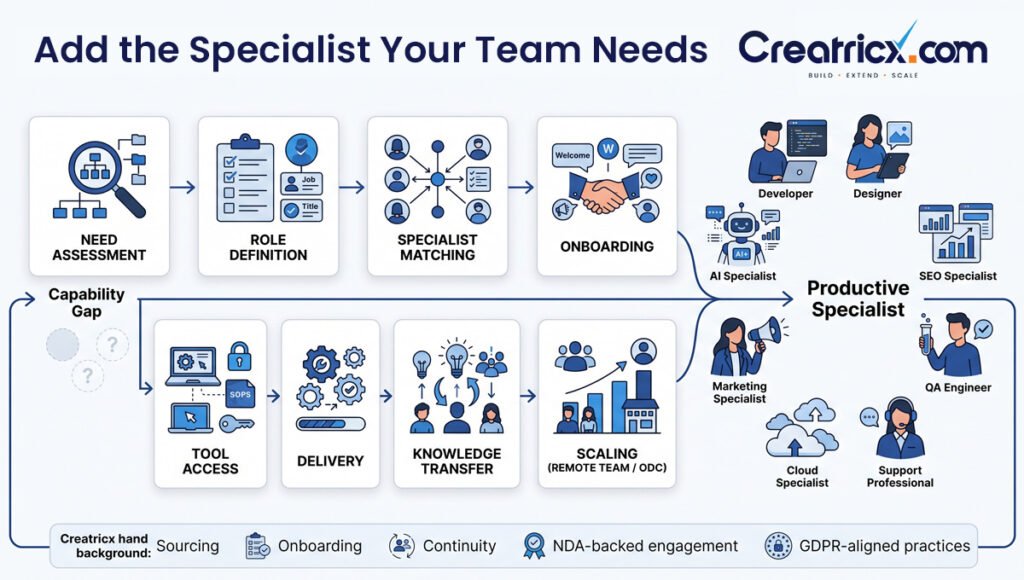
Everything above is why we structure resource augmentation the way we do at Creatricx, because the benefits are only as real as the way the model is run. When you augment your team through us, you add vetted specialists who work within your tools, follow your processes, and report to your managers, exactly as internal team members would, while we handle sourcing, onboarding, HR, infrastructure, and continuity in the background. You keep control of priorities, roadmap, and outcomes, which is the foundation that makes every benefit above possible.
What lets us deliver the full range of these benefits is breadth of specialism under one accountable relationship. However the need shows up, a dedicated developer to accelerate a deadline, a dedicated designer for a product push, a dedicated AI specialist for a capability your team lacks, a dedicated SEO specialist for a visibility initiative, or a dedicated marketing team for a growth phase, the model and the control stay the same.
And because the conditions above genuinely matter, our engagements are NDA-backed and GDPR-aligned by default, with the security and continuity practices that turn the theoretical benefits of augmentation into real ones. Where a single specialist is not enough, the same relationship extends into a dedicated remote team or a full offshore development center without starting over.
Our honest position is the one running through this article: the benefits of resource augmentation are substantial, but they are earned, not automatic. Where you have a real need, a clear owner, and work suited to the model, we would rather place exactly the right specialist and help you get the full value than oversell a larger engagement. And where a permanent hire or a different model would serve you better, we will say so, because matching the model to the need is what makes the benefits real.
Frequently Asked Questions
What are the main benefits of resource augmentation for a company?
The main benefits are lower total cost than permanent hiring for the right work (typically 20 to 35% savings), dramatically faster access to skills, flexible scaling to match real demand, access to niche specialisms that are hard to hire permanently, knowledge transfer that improves the internal team, and reduced hiring risk through real-world evaluation before any permanent offer.
Is resource augmentation the same as staff augmentation?
Yes. The two terms describe the same model: adding skilled external professionals to your existing team under your management, without permanent hiring. "Resource augmentation" is sometimes used slightly more broadly and "staff augmentation" for the IT-specific version, but they are used interchangeably and share the same benefits.
How much can a company save with resource augmentation?
Companies typically save 20 to 35% on total talent costs versus equivalent permanent hires, and offshore models can save 30 to 50%. For a five-developer team, that can mean $175,000 to $350,000 a year. The saving comes from avoided recruitment, benefits, training, and severance costs, not just the hourly rate.
What is the biggest benefit of resource augmentation?
While cost gets the most attention, speed is usually the most valuable benefit in practice. A prepared provider can deliver a productive specialist within one to two weeks, versus months for permanent hiring, which means projects ship sooner. The value of earlier delivery typically outweighs the hourly-rate saving.
Is resource augmentation cheaper than hiring full-time?
For engagements under roughly 12 to 18 months, or for niche skills, usually yes, once you account for the 25 to 40% that recruitment, benefits, and vacancy costs add to a permanent salary. For a core role you will need for five years, a permanent hire typically wins on total cost. The model is cheaper for the right duration and skill, not universally.
What are the risks of resource augmentation, and how are they managed?
The main risks are underutilisation when internal ownership is unclear, knowledge loss when engagements end without documentation, and security exposure from external system access. All are manageable: assign a clear internal owner, invest in onboarding, require documentation as an ongoing deliverable, and use proper access controls and NDA-backed, compliant engagements.
Can augmented staff be converted to permanent employees?
Yes, and it is common. Over 60% of companies convert high-performing augmented staff to permanent roles, using the engagement as a real-world evaluation that dramatically reduces hiring risk. Conversion terms are usually agreed during the initial contract discussion.
How does Creatricx deliver resource augmentation?
Creatricx places vetted specialists into your team, working on your tools and roadmap under your management, while handling sourcing, onboarding, HR, infrastructure, and continuity. Engagements are NDA-backed and GDPR-aligned, span developers, designers, AI, SEO, marketing, and support specialists, and can scale into a dedicated team or offshore development center as needs grow.
Disclaimer
This article reflects resource augmentation benefits, cost benchmarks, and 2026 market data drawn from multiple independent industry sources, alongside Creatricx's own service model, all current at the time of writing. Outcomes vary by engagement, sector, duration, and how well the model is managed. Always confirm current terms and practices directly with any provider, including Creatricx, before committing.