
Original Creatricx Offshore Integration Playbook.
Table of Contents
The Short Answer
The location creates the offshore part. The management model creates the staff-augmentation part. This distinction prevents a surprisingly large amount of procurement confusion.
Offshore Is a Location Strategy. Staff Augmentation Is an Ownership Strategy.
Staff augmentation can be onshore, nearshore or offshore. The geography changes working hours, cost structure, talent access and legal/operational considerations. It doesn’t automatically change who manages the work.
| Model | Location | Typical advantage | Typical trade-off |
|---|---|---|---|
| Onshore staff augmentation | Same country | Maximum working-hour and market alignment | Usually highest labor cost |
| Nearshore staff augmentation | Nearby country / region | More time-zone overlap, easier travel | Often costs more than lower-cost offshore markets |
| Offshore staff augmentation | Distant country / region | Largest talent and cost-arbitrage options | Requires more intentional overlap and async discipline |
What the Client Owns vs What the Offshore Partner Owns
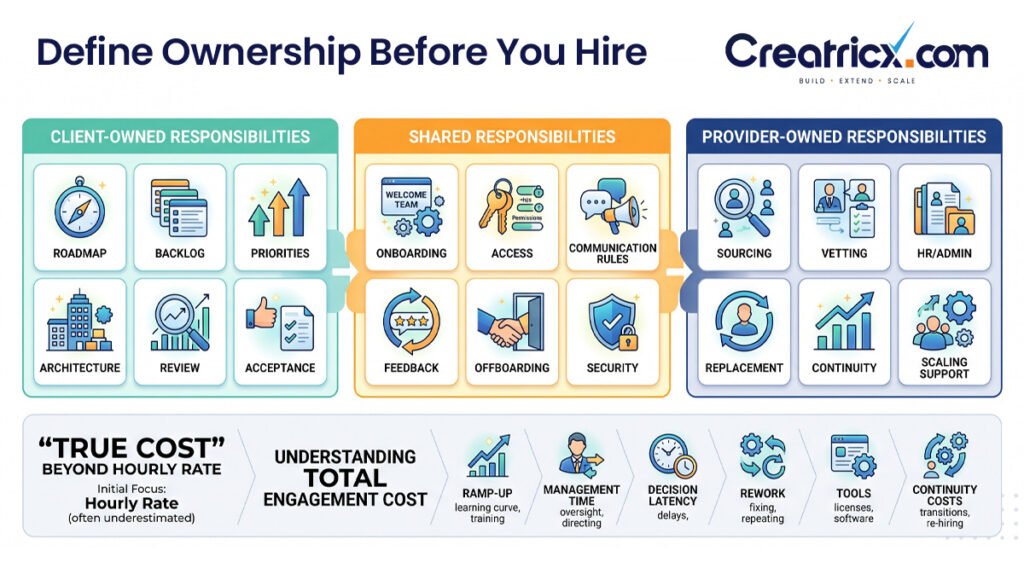
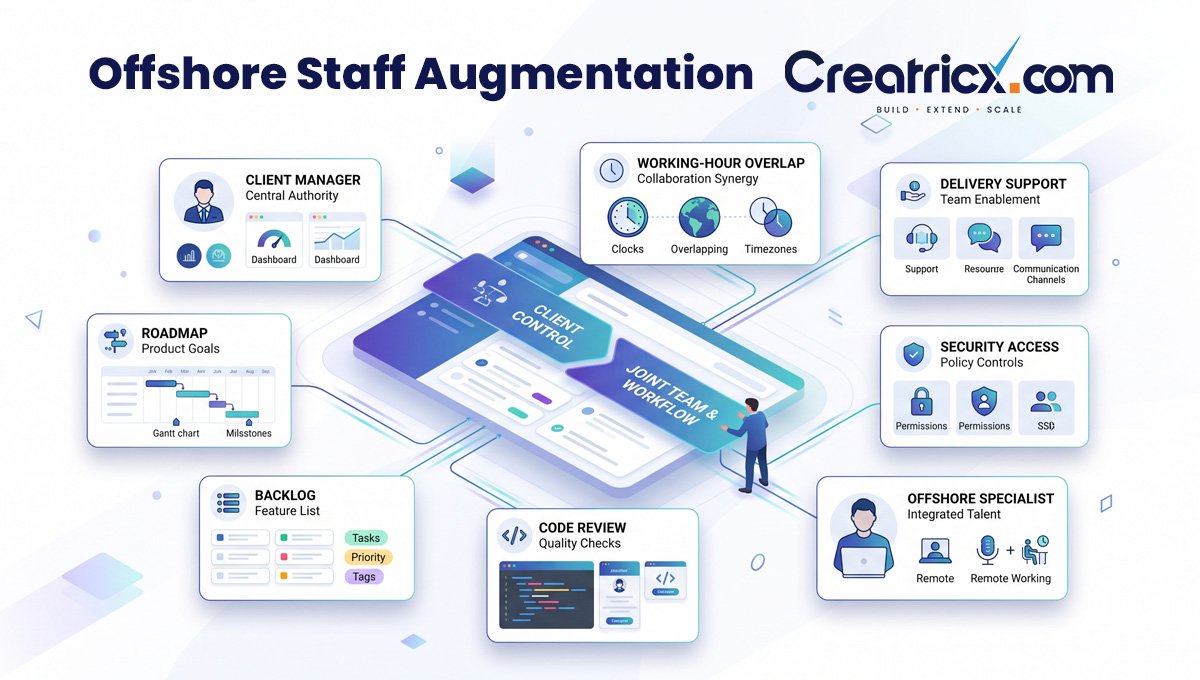
The cleanest staff-augmentation engagements write the responsibility boundary before the specialist starts. If both sides assume the other side owns planning, quality or escalation, the engagement can be fully staffed and still fail.
Original Creatricx responsibility-boundary graphic.
The client usually owns
- Roadmap, backlog and business priorities.
- Daily task direction and sequencing.
- Architecture and engineering standards.
- Code review, design review or work acceptance.
- Product and business decisions.
- Final accountability for the team's delivery system.
The provider usually owns
- Talent sourcing and vetting against the role brief.
- Employment / contracting administration according to the engagement.
- Availability, commercial administration and continuity support.
- Replacement process when the role needs to change.
- Scaling support when the client needs additional specialists.
The shared layer matters most
- Role definition, onboarding context, access, communication rules, performance feedback, documentation and offboarding cannot be thrown entirely to one side. They require a working contract between the client and provider.
Why Companies Use Offshore Staff Augmentation
The old story was mostly about cost. The current story is broader. ManpowerGroup's 2026 survey found 72% of employers were still struggling to fill roles, while Deloitte's outsourcing research says skilled talent and agility now sit alongside cost reduction as outsourcing drivers.
- Access to scarce skills: cloud, AI, security, data, mobile, DevOps and specialist frameworks may be easier to source globally.
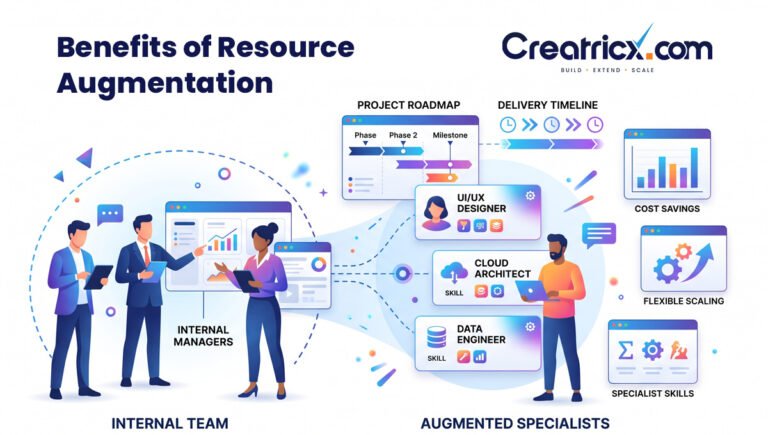
- Capacity without permanent headcount: add people for an active roadmap without treating every workload peak as a forever role.
- Faster role scaling: a provider can source against a specific technical brief while the client keeps its existing delivery structure.
- Geographic cost advantage: talent markets differ materially in wages and commercial rates.
- Flexible team shape: add QA before a release, DevOps during a migration or a specialist engineer for a platform initiative, then change the role mix later.
- Continuity through a provider layer: a good provider has a process for replacement and handover rather than leaving the client to restart hiring alone.
What Offshore Staff Augmentation Costs
There is no universal offshore rate. Seniority, stack, location, required overlap, exclusivity, security requirements and the provider's operating layer all change the price.
For useful context, U.S. BLS reports a $135,980 median annual wage for software developers in May 2025. Upwork's 2026 rate guide lists offshore developers around $15–$30 per hour as an independent-marketplace anchor, while its broader software-developer category spans $10–$100 per hour.
A managed staff-augmentation provider should not be compared to a freelancer marketplace rate without adjusting for what the provider actually handles: sourcing, vetting, HR or contracting administration, replacement, continuity and engagement support.
| Option | Public cost anchor | What you are buying | What the number misses |
|---|---|---|---|
| Independent offshore marketplace talent | ~$15–$30/hour market anchor | Lowest visible rate; direct client coordination | Vetting, continuity, HR/admin and replacement may sit mostly with you |
| Provider-managed offshore specialist | Role-specific quote | Talent + sourcing/people/continuity layer | Compare inclusions, notice, replacement, overlap and exclusivity |
| U.S. in-house software developer | $135,980 median salary before full employer burden | Maximum internal integration and long-term ownership | Recruitment, benefits, payroll, equipment and fixed headcount |
The True Cost: Rate + Collaboration + Management + Continuity
The hourly or monthly rate is the easiest number to compare and the easiest number to misunderstand. The true delivery cost includes the time your own team spends making the offshore specialist productive.
- Ramp-up: access, environment setup, architecture context and product learning.
- Internal management: prioritization, review, decisions and feedback.
- Decision latency: blocked work becomes expensive when answers travel across a full-day time-zone gap.
- Rework: poor context or unclear acceptance criteria can erase the headline rate saving.
- Tool and licence access: IDEs, cloud, monitoring, design, CRM or security tools may add direct cost.
- Attrition and replacement: handover quality determines whether a replacement costs days or weeks of lost momentum.
Offshore Staff Augmentation vs Dedicated Team vs ODC vs Project Outsourcing
| Model | What you add | Who directs daily work | Best fit |
|---|---|---|---|
| Offshore Staff Augmentation | Add one or more offshore specialists | Client manages daily work | Existing team needs skills or capacity |
| Dedicated Remote Team | Stable multi-role team around a roadmap | Client-directed or shared coordination | Several roles need to operate together long term |
| Offshore Development Center | Structured offshore operation with deeper governance | Shared governance by design | Larger long-term offshore capability |
| Project Outsourcing | Buy a defined outcome / deliverable | Provider owns more execution | Client wants the result, not daily people management |
| Managed Service | Buy an ongoing service / SLA | Provider manages the service | Operational outcome should be provider-owned |
Creatricx deliberately offers these models separately. We don’t want a staff-augmentation buyer to accidentally purchase a managed project, or an ODC buyer to receive five unrelated contractors and a calendar invitation.
When Offshore Staff Augmentation Is a Strong Fit
- You already have an internal product, engineering or operations owner.
- There is real work available immediately: backlog, roadmap, migration, release or support demand.
- The required role is a skill or capacity gap rather than a complete management gap.
- You want to retain architecture, product and prioritization control.
- The role can work effectively with a defined overlap window and written collaboration.
- You want to scale capacity up or down without permanently rebuilding the org chart.
When It Is the Wrong Model
- Nobody on your side can decide priorities or review the work.
- The requirement is a fixed project where you want the provider to own delivery.
- The work depends almost entirely on undocumented institutional knowledge that nobody can transfer.
- You expect an offshore specialist to act as an entire product strategy, engineering leadership and delivery-management function.
- Security or regulatory constraints cannot be reconciled with the proposed access and location model.
- The only reason for choosing offshore is the lowest available hourly rate.
How to Write the Role Brief
A poor brief is a shopping list of technologies. A useful brief explains the delivery problem and the environment the specialist is joining.
| Brief section | Question | Example |
|---|---|---|
| Business reason | Why does the role exist now? | Release delay, migration risk, QA backlog, cloud reliability, specialist feature |
| 90-day outcome | What should be measurably different? | Backlog reduced, migration milestone delivered, defect escape rate improved |
| Daily owner | Who prioritizes and unblocks? | Named product/engineering manager |
| Technical context | What systems and standards matter? | Stack, architecture, repos, CI/CD, coding standards |
| Working model | What overlap and rituals are required? | 2–4 hour overlap, standup, code review, planning |
| Security | What access can the role have? | Least privilege, production controls, NDA/IP, device expectations |
| Definition of done | How is work accepted? | Tests, review, documentation, deployment criteria |
How to Manage the Time-Zone Difference Without Making Everyone Miserable
Time-zone risk is usually described as if geography itself creates missed deadlines. In practice, the expensive variable is decision latency.
- Put overlap hours in the role brief and contract rather than asking candidates to 'be flexible.'
- Define response expectations for blockers. A question that waits 18 hours can erase the benefit of a lower hourly rate.
- Use written handoffs with context, status, next action and blocker.
- Keep architectural and product decisions in shared systems rather than disappearing into meetings.
- Use synchronous time for ambiguity, decisions and human connection; use asynchronous time for execution and documentation.
The First 30 Days: An Onboarding System That Actually Works
Before Day 1
- Prepare accounts, repo access, VPN/SSO, development environment and required licences.
- Name the internal owner and backup decision-maker.
- Prepare a short product / user / architecture briefing.
- Create the first two or three bounded tasks rather than a vague 'look around the codebase.'
Days 1–5
- Walk through the product, users, business model and architecture.
- Explain coding, QA, security and review standards.
- Pair on the first meaningful change.
- Measure access and context blockers rather than judging raw output immediately.
Days 6–15
- Move real work through the normal review and release process.
- Document recurring questions and missing knowledge.
- Check whether overlap hours are sufficient for decisions.
- Give direct feedback on communication and technical fit.
Days 16–30
- Review delivery against the original role outcome.
- Track blocked time, review delay, rework and completed outcomes.
- Decide whether the role, seniority or working model needs adjustment.
- Confirm documentation and knowledge ownership are inside shared client systems.
Security, IP and Access: Make Them Operational
Security paragraphs become useful when they turn into actions. Offshore staff augmentation should have a documented access model rather than a general promise that everyone is secure.
| Control area | Practical rule | Why it matters |
|---|---|---|
| Identity | Named accounts, MFA/SSO where available | No shared logins |
| Source code | Role-based repository access | Protect admin/owner permissions |
| Cloud / production | Least privilege; elevation only when required | Separate dev/staging/prod access |
| Data | Minimum dataset required for the role | Mask or restrict sensitive data where possible |
| Devices | Agree managed-device / endpoint expectations | Do not leave assumptions to Day 1 |
| IP / confidentiality | Contractual NDA/IP assignment as applicable | Confirm ownership and permitted use |
| Offboarding | Same-day revocation checklist | Repos, cloud, tools, secrets, VPN, licences |
Knowledge Continuity: The Part You Notice Only When Someone Leaves
The safest offshore team does not keep product knowledge offshore or onshore. It keeps knowledge in shared systems.
- Source code and pull requests live in client-controlled repositories wherever the engagement permits.
- Architecture decisions are documented with the reason, not only the final choice.
- Tickets carry acceptance criteria and important implementation context.
- Runbooks explain deployments, recurring operations and incident paths.
- Handover is a process triggered before the final day, not a farewell meeting.
- Replacement candidates receive the updated role brief, not the original one if the job has changed.
6 Typical Offshore Staff Augmentation Failure Modes
| Symptom | What you see | Root cause | Fix |
|---|---|---|---|
| Cheap rate, high rework | Work ships but needs repeated correction | Role was hired on price; context/standards unclear | Measure quality and review friction; update role brief |
| Blocked every morning | Developer waits for answers across time zones | No decision SLA or overlap window | Create overlap + backup decision owner |
| Good engineer, weak fit | Technical skill is fine; collaboration fails | Communication/workstyle not tested | Interview for distributed-team behavior |
| No one reviews PRs | Backlog grows in review | Internal leadership capacity missing | Fix review ownership before adding more staff |
| Replacement resets progress | New person relearns everything | Knowledge stored in the person | Shared documentation + structured handover |
| Security anxiety late | Access gets restricted after problems | No access model before start | Least-privilege plan + offboarding checklist |
| Staffing turned into outsourcing | Client expected provider to manage project | Ownership boundary not agreed | Move to managed project/team model if needed |
How to Evaluate an Offshore Staff Augmentation Company
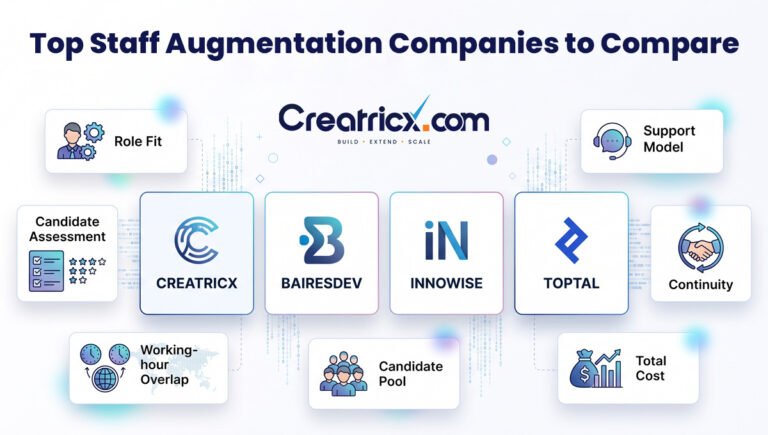
- Role-fit depth: can the provider explain the difference between the seniority you asked for and the seniority you actually need?
- Candidate transparency: can you interview the proposed specialist and understand who employs / contracts them?
- Working-hour fit: is the required overlap written before onboarding?
- Security model: can the provider explain access, confidentiality and offboarding without vague adjectives?
- Replacement terms: what happens if availability changes or the role is not the right fit?
- Continuity: how are repositories, documentation and handover protected?
- Scaling: can the engagement add QA, DevOps, cloud, design or another specialist without restarting vendor selection?
- Management boundary: does the provider understand that staff augmentation is client-directed?
- Commercial clarity: what is included in the rate, what is separate and what notice applies?
- Evidence: real service pages, case examples or references should match the model being sold.
Questions to Ask Before Signing
- Is this specialist exclusive to our account during the contracted hours?
- Who employs or contracts the specialist?
- What working-hour overlap is guaranteed?
- Who handles replacement and how long can it reasonably take?
- What happens to active work during a replacement?
- Which tools, licences, equipment or infrastructure are included?
- What notice period applies when we scale down?
- What security controls and offboarding steps are standard?
- Who owns source code, documentation and work product?
- Can we expand from one role into a coordinated team or ODC later?
A Hypothetical Cost Example
Suppose a United States SaaS company needs one senior frontend engineer and one QA engineer for a 6-month product push. The internal team already has a CTO and product manager.
Using marketplace rates only as a rough lower-bound reference, an offshore developer at $25/hour and QA at $20/hour for 160 hours per month would total about $7,200 per month before any provider layer, or about $43,200 over six months. A managed augmentation partner would normally quote higher because sourcing, continuity, employment/contracting and account support are part of the commercial model.
The point isn’t that $43,200 is the project price, it’s that a cost model should expose its assumptions. The comparison only becomes fair when you normalize seniority, hours, management, exclusivity, support, benefits, recruitment and continuity.
How Creatricx Supports Staff Augmentation and Scales with Your Team
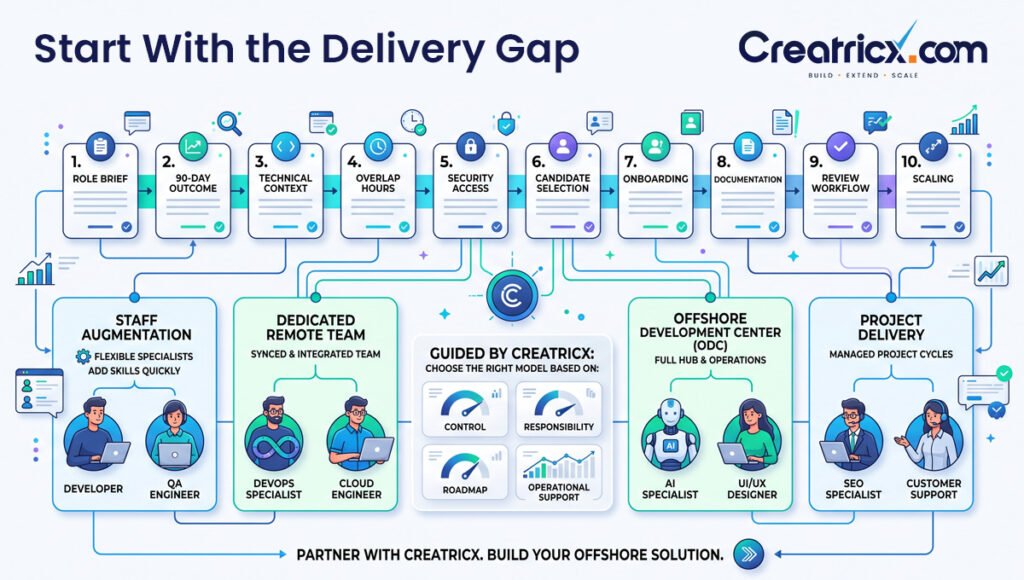
Staff Augmentation is one of Creatricx's core team models. The current Creatricx positioning is deliberately simple: add individual specialists to your existing team while your managers retain day-to-day control.
Creatricx supports roles across software and web development, mobile, QA, UI/UX, cloud, AI automation, SEO, digital marketing and customer support. That broader capability matters when an engagement changes shape. A product team may begin with a React developer, add QA before release and later need DevOps or cloud support.
The second advantage is model continuity. If one augmented specialist grows into a stable multi-role unit, Creatricx also offers Dedicated Remote Teams. If the requirement becomes a larger, structured offshore operation with deeper governance and operational support, Creatricx offers an Offshore Development Center.
If the client wants us to own a defined outcome instead of managing the specialists, complete project delivery is the cleaner model.
Frequently Asked Questions
What is offshore staff augmentation?
Offshore staff augmentation is a model where external specialists from another country join an existing client team. The client normally keeps day-to-day management, priorities and delivery decisions while the provider handles sourcing and the people/continuity layer defined in the engagement.
How is offshore staff augmentation different from outsourcing?
Staff augmentation adds people to a delivery system the client still manages. Project outsourcing transfers more responsibility for planning, coordination and delivery to the provider.
What is the difference between offshore and nearshore staff augmentation?
Offshore usually means hiring from a more distant region, often with a larger time-zone difference. Nearshore uses nearby countries or regions and usually provides more working-hour overlap. Both can use the same client-directed staff-augmentation model.
How much does offshore staff augmentation cost?
There is no universal rate. Upwork's 2026 marketplace guide lists offshore developers around $15–$30/hour as a broad independent-talent anchor, while managed staff-augmentation rates are usually scoped by role, seniority, location, overlap, exclusivity and provider support.
Is offshore staff augmentation cheaper than hiring in-house?
It can be. U.S. BLS reports a $135,980 median annual wage for software developers before the full employer cost of benefits, recruitment, payroll and equipment. Offshore markets can offer lower labor rates, but the fair comparison should include management, onboarding, collaboration and continuity.
Who manages offshore augmented staff?
Usually the client. Staff augmentation works best when the client has a manager, product owner, tech lead or another internal owner who can prioritize, unblock and review the specialist's work.
What roles can be hired through offshore staff augmentation?
Common roles include frontend, backend and full-stack developers, mobile developers, QA engineers, DevOps and cloud specialists, data/AI engineers, UI/UX designers and other technical or digital specialists.
How much time-zone overlap do offshore teams need?
There is no universal number. The right overlap depends on collaboration intensity and seniority. The important practice is to agree the overlap window and response expectations before onboarding instead of leaving them implicit.
How do you protect IP and data with offshore staff augmentation?
Use contractual confidentiality/IP terms as appropriate, named accounts, least-privilege access, MFA/SSO where available, controlled production permissions, business-owned repositories and a documented offboarding process.
When should a company avoid staff augmentation?
Avoid or delay the model when nobody internally can manage or review the work, when the requirement is really a fixed provider-owned project, or when the team cannot provide enough context and access for an external specialist to contribute.
Can staff augmentation grow into an offshore development center?
Yes. A business can begin with one or several augmented specialists and later move toward a Dedicated Remote Team or ODC when team size, governance, leadership, infrastructure and continuity requirements become more substantial.
How does Creatricx provide offshore staff augmentation?
Creatricx adds individual specialists to the client's existing team while the client retains day-to-day management. Creatricx supports sourcing, onboarding, HR/engagement administration, continuity and scaling according to the agreed model, with broader Dedicated Team and ODC options available as the requirement grows.
Final Takeaway
Offshore staff augmentation works best when you already have something worth augmenting: a real roadmap, an internal owner, working engineering standards and a backlog that needs more capacity or specialist skill.
The offshore location can reduce talent cost and expand the available skill pool, but the economic advantage survives only when the collaboration system is designed properly. Role clarity, overlap hours, decision speed, access, review, documentation and continuity matter as much as the rate card.
For Creatricx, that is the commercial position we want a reader to understand. We can add one specialist into an existing team, expand that into a dedicated multi-role team, build a structured Offshore Development Center or take responsibility for a complete project. The right service depends on who should own the work after the contract is signed.