

Table of Contents
Start With the Application You Actually Have
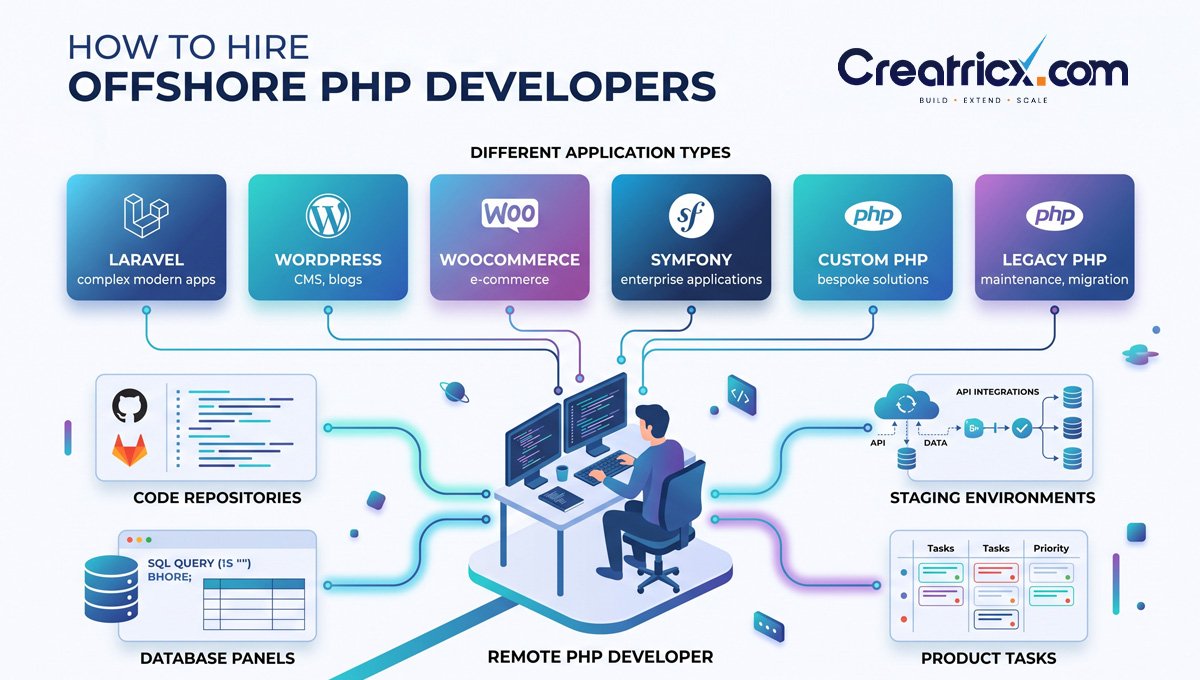
An offshore PHP developer works from another country while contributing to your software. The location affects communication and contracting arrangements; the application determines the technical requirements.
Before comparing candidates, identify which of these situations best describes your project.
You Need Features for an Existing Application
Specify the framework, database, integrations and deployment environment. Explain whether the developer will implement approved designs or make architectural decisions. For a Laravel application, ask for evidence of relevant Laravel delivery, including testing and maintenance after launch.
You Need WordPress or WooCommerce Development
Look for experience with the platform’s extension mechanisms, plugins, themes and upgrade behavior. A developer building business APIs in PHP may need additional platform experience to safely change an ecommerce checkout or maintain custom plugins.
Ask candidates to explain how they would preserve custom functionality during updates and test the customer journeys affected by their changes.
You Need to Stabilize or Upgrade Legacy PHP
Make investigation an explicit part of the scope. The developer may have to map dependencies, recreate defects and establish tests before s/he can confidently estimate the upgrade work.
The instant rewriting of everything deserves a look. Ask what evidence there is to support that recommendation and whether a phased approach could minimize disruption.
Security support for PHP 8.2 until 31 December 2026 Check on 17 September 2026. Its approaching end of support makes upgrade planning relevant for applications still using it. Confirm your runtime against the official PHP supported-versions schedule, then check framework, extension and hosting compatibility before choosing a target version.
Write a Hiring Brief That Candidates Can Respond To
A strong brief describes the environment, the first useful result and the responsibility attached to the role. “Senior PHP developer required” leaves most of that unanswered.
Use the following structure and replace the example details with your own.
A Practical PHP Developer Brief
Application: An existing Laravel customer portal with a MySQL database and an external billing integration.
Initial outcome: Investigate repeated billing-event processing and deliver an agreed fix with regression tests and deployment notes.
Responsibilities: Find the problem, propose the solution, apply the accepted change and answer code review. The internal technical lead approves architecture and releases.
Working arrangement: State the required overlap hours, meeting cadence, expected weekly capacity and who answers product questions.
Evidence requested: A relevant project walkthrough, an explanation of similar failure handling and a paid assessment or pilot agreed in advance.
This is an illustrative brief, not a Creatricx client case. Its purpose is to make proposals comparable. If you cannot identify the framework or deployment process, start with a scoped technical discovery rather than inventing requirements.
Choose How Much Delivery Responsibility You Need
An Individual Specialist Within Your Team
An individual hire suits work that your existing technical lead can define, review and prioritize. You retain responsibility for coordination and acceptance. Creatricx’s staff augmentation service is one way to explore adding specific technical capacity to an established team.
A Dedicated Team for an Ongoing Roadmap
A continuing product may require PHP development alongside QA, frontend or infrastructure skills. A dedicated remote team can provide a structure for those roles, with responsibilities agreed around your roadmap.
Decide who manages daily work and who approves delivery. The word “dedicated” should be backed by an explicit capacity commitment and a clear explanation of availability.
A Defined Project With an Accountable Delivery Lead
If you need a complete outcome and lack the capacity to manage developers, discuss a project-delivery arrangement. Confirm who handles technical leadership, scope, testing and release acceptance. Hiring a developer alone does not automatically provide those functions.
Shortlist Developers Using Evidence You Can Verify
Ask for two or three relevant examples and have candidates explain their personal contribution. What did they inherit? Which decisions did they make? What failed, and how did they diagnose it?
A public repository can help, but commercial developers may be unable to share client code. Accept a sanitized walkthrough, a permitted reference or a structured exercise as alternatives. Do not ask applicants to disclose someone else’s confidential material.
When assessing a provider, confirm whether you will interview the person assigned to the work. Ask how substitutions are handled and what happens to project knowledge if that person becomes unavailable.
Location belongs in the shortlist criteria only where it supports a real requirement: working-hour overlap, language, travel, data access or the contracting arrangement. Country-level assumptions do not establish an individual developer’s ability.
Use a PHP Hiring Scorecard
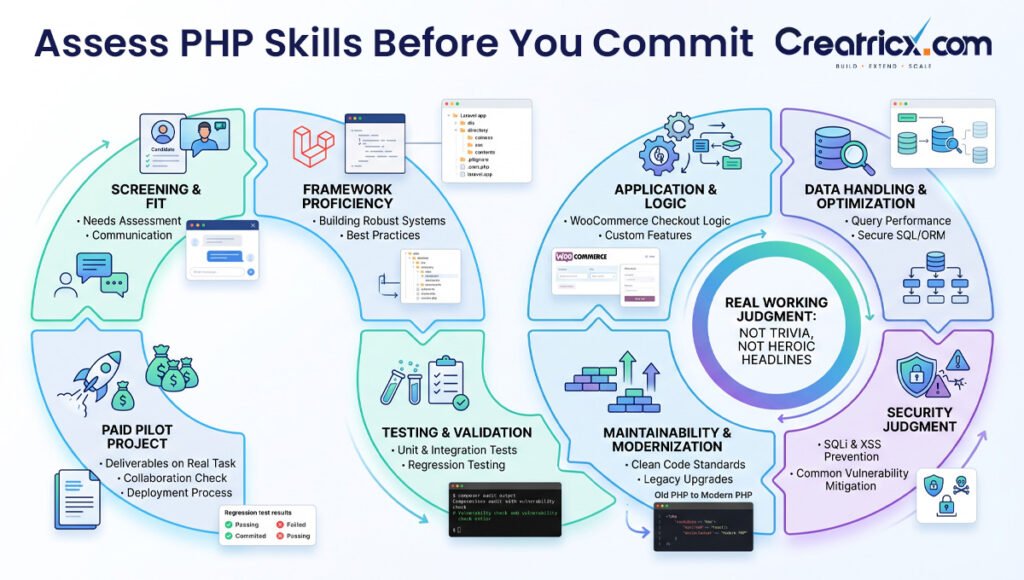
Score the evidence consistently across candidates. The following weighting is a suggested starting point, not a validated industry benchmark. Change it before interviews if your project has different priorities.
| Assessment area | Suggested weight | Evidence to look for |
|---|---|---|
| Application and framework fit | 30% | Relevant work and clear explanation of personal contribution |
| Debugging and data handling | 25% | A structured investigation of failures and database behavior |
| Testing and security judgment | 20% | Useful tests, access boundaries and dependency review |
| Delivery and maintainability | 15% | Reviewable changes, deployment notes and clear handover |
| Communication and collaboration | 10% | Good questions, visible blockers and constructive review responses |
Use a 1–5 rating for each area: 1 means little relevant evidence, 3 means adequate evidence and 5 means strong, directly relevant evidence. Multiply each rating by its percentage weight and add the results to obtain a score out of five.
For example, ratings of 4, 3, 4, 3 and 4 across the five rows produce 3.6 out of five. Keep notes supporting every rating. Do not allow a good overall score to override a serious unresolved issue such as unsafe handling of production credentials.
Ask Questions That Reveal Working Judgment
“How would you investigate a slow endpoint?” Listen for measurement, logs, database queries and a way to compare performance before and after the change.
“What happens if an external service sends the same event twice?” Look for an explanation of duplicate handling and how the application avoids repeating a business action. The candidate should ask about the actual integration rather than prescribe a solution immediately.
“How do you approach a PHP or framework upgrade?” Look for dependency checks, relevant migration guidance, tests, staging validation and a deployment recovery plan.
“How do you review third-party dependencies?” Composer provides an audit command that checks installed packages against dependency policies, including known security advisories. Ask the candidate to explain the findings and remediation process. A clean report does not demonstrate that the application has no security defects. Reference: Composer audit documentation.
A nontechnical buyer can assess whether explanations are clear, but should have a qualified technical reviewer evaluate the code and engineering decisions.
Run a Small Paid Pilot Before Expanding the Engagement
A useful pilot should resemble the work you intend to hire for. Agree the fee, time limit, deliverables and evaluation criteria in advance. Keep access limited to what the task requires and use representative test data.
For example , in billing, a pilot might research a duplicate event defect , suggest a fix , and add a regression test. The deliverables might include a reviewed pull request, a short explanation of the cause, test results and deployment notes.
Check whether repeated events are handled as agreed, whether unauthorized requests are rejected and whether existing behavior remains intact. Evaluate the developer’s questions, estimates and response to review as well as the final code.
Keep the pilot proportionate. A short exercise cannot establish that someone can redesign an entire platform, but it can reveal whether they work carefully within an unfamiliar codebase.
Make the Pilot Decision Explicit
Continue when the agreed result is delivered and the collaboration works. Extend the assessment only to answer a specific unresolved question, with a new scope and fee. If the result does not meet the criteria, document why and close the engagement cleanly.
Compare the Cost of Delivery, Not Just the Hourly Quote
Offshore PHP developer costs vary by seniority, stack, availability, management support and engagement structure. A marketplace freelancer rate and a provider’s dedicated monthly fee may include different services, so compare the scope behind each price.
Ask every provider to separate developer capacity, technical leadership, QA, infrastructure support and any additional fees. Confirm billing assumptions, expected overlap, minimum commitment and how additional work is authorized.
Consider this example to show why this is important: 80 hours at $35 is $2,800 while 50 hours at $50 is $2,500. These are hypothetical figures, not market rates or Creatricx prices. The cheaper outcome depends on the estimates being credible and the accepted scope and quality being equivalent.
Include your own review and coordination time, onboarding, tools and likely maintenance work in the decision. Ask for an estimate with stated assumptions; an exact price for an unexplored legacy application may offer less certainty than it appears to.
Agree Ownership, Access and Exit Arrangements Before Work Starts
Record the deliverables, acceptance process, availability and responsibilities in the engagement terms. Clarify rights to new work and handling of pre-existing code, third party components and licences.
Keep repositories and essential infrastructure under agreed business control. Provide individual accounts with appropriate permissions, maintain a staging environment and identify who may approve production changes. Define which tools can receive client code or data, including AI coding assistants.
Agree a practical handover: current work, setup instructions, dependency information, deployment procedures and outstanding issues. Replacement support is easier to use when those records are maintained throughout the engagement.
These are matters to resolve with the provider and, where needed, your advisers; the exact agreement depends on the parties and work involved.
Plan the First Month Around a Safe First Release
Start with access, local setup, product context and a walkthrough of the release process. Give the developer a small change with a clear reviewer before assigning a large feature.
Next, verify that they can investigate a problem, explain the proposed change and produce work your team can review. Progress toward a release only when the agreed tests, approvals and recovery arrangements are in place.
At the end of the first month, review accepted delivery, defects, communication and blocked time. If progress is slow, distinguish a skill gap from missing documentation, delayed approvals or an unstable environment. This is an illustrative sequence; timing depends on application complexity and the role.
Hiring Offshore PHP Developers Through Creatricx
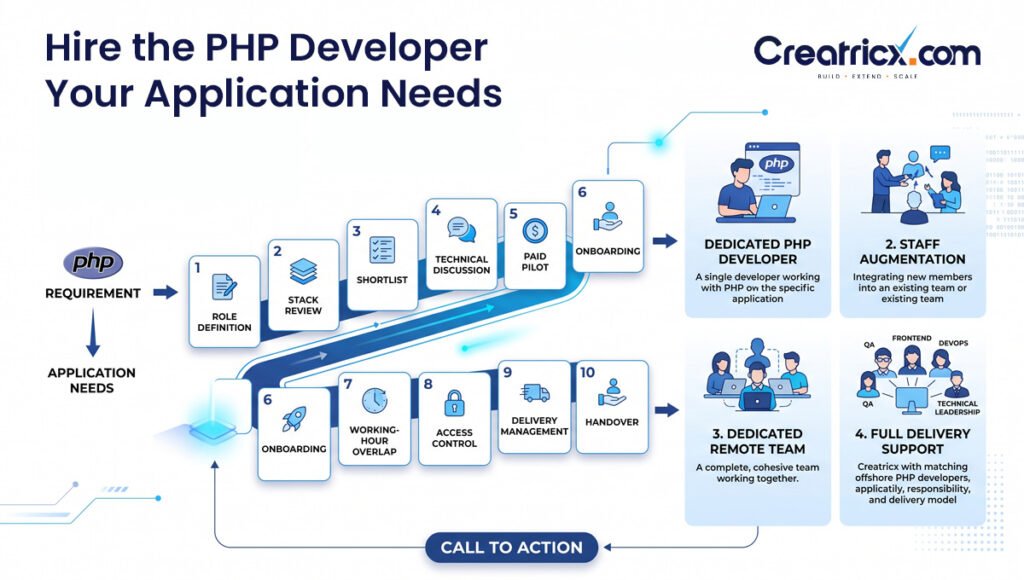
Creatricx’s dedicated developer service covers PHP and Laravel among its backend technologies. Its published process starts with the role and delivery context, moves through profile review and client selection, and then onboards the chosen developer into your tools and workflow.
For your PHP requirement, share the application type, versions, first priority, expected responsibilities and working-hour overlap. Ask to review evidence relevant to that environment and discuss whether a paid pilot is suitable. Candidate availability and assessment arrangements should be confirmed during scoping.
You can explore a single developer for a defined capacity gap or discuss a broader team when delivery also needs QA, frontend or infrastructure support. The useful choice is the one that makes responsibility clear from the start.
Discuss your offshore PHP developer requirements with Creatricx. Bring your brief, current stack and first delivery objective so the conversation can focus on the people and support your project needs.
Frequently Asked Questions
How Long Does It Take to Hire an Offshore PHP Developer?
Timing depends on the required experience, framework, overlap hours, candidate availability and your interview process. Ask for a proposed schedule covering shortlisting, assessment and onboarding. Treat a start date as confirmed only when the actual candidate and terms are agreed.
Should I Hire a PHP Developer or a Laravel Developer?
Use the application to decide. For a Laravel product, relevant Laravel experience matters alongside PHP fundamentals. Describe the platform in the hiring brief. WordPress, WooCommerce, Symfony and custom PHP apps have different requirements.
Can I Hire an Offshore PHP Developer Without a Technical Team?
Yes, but provide for qualified technical oversight, or select an engagement that provides such oversight. Someone needs to review the implementation, sign off on technical decisions and verify that it is ready to be released. Indicate whether the independent reviewer or the provider is responsible for that.
How Do I Check PHP Code Quality Before Hiring?
Use a paid exercise or a code walkthrough with a qualified reviewer to assess clarity, tests, error handling, and the fit with the current application. Explain why the code was written that way. Explain how the developer responds to feedback.
What Should I Send to Creatricx to Get Started?
Please tell us application type, PHP version and framework version if known, required skills, initial scope, working hours and duration of engagement preferred. Identify who will be responsible for managing and reviewing the work. Call out any discovery or technical leadership requirements.