

Table of Contents
Key takeaways and what you will learn
Where staff augmentation can help universities and colleges, from admissions integrations to student portal improvements.
How Creatricx’s team-extension model can be applied while the institution retains technical and academic authority.
Why term dates, registration windows and examination periods belong in the staffing brief.
How to define data access, accessibility checks and acceptance criteria before specialists begin.
How to measure useful capacity, including the time external specialists require from internal staff.
What to share with Creatricx to scope an engagement around your institution’s actual needs.
Our position is to strengthen institutional capability
Higher education depends on context that an external professional can’t absorb from a job description.
- A registrar understands enrollment rules.
- Teaching staff understand course delivery.
- Student services understand the consequences of a confusing process.
- Internal IT teams know which apparently simple integrations have difficult histories.
At Creatricx, we believe augmentation should respect that knowledge and give it more capacity to act. The institution should keep ownership of policy, priorities, architecture decisions and acceptance. External specialists should have a clear technical contribution and access to the people who can resolve questions.
Our staff augmentation service follows a client-directed model: your managers lead daily work, while Creatricx supports sourcing, onboarding and the people-related coordination around the engagement.
Applied to higher education, that means discussing the role within your existing governance rather than assuming an external team will independently run university services.
This is an approach to scoping an engagement. Platform expertise, availability, access arrangements and service commitments must be established for the specific requirement.
Why capacity decisions need more than a cost argument
Higher education technology teams face competing demands: maintaining live services, improving digital experiences and introducing new systems within constrained budgets. More projects do not automatically bring more internal capacity.
In an EDUCAUSE QuickPoll published in April 2025, 42% of respondents expected IT budget reductions for the 2025–2026 academic year, and 49% reported that their institutions had already implemented hiring freezes. The poll analysed 121 responses and was a rapid community survey, not a representative census of all institutions or a forecast for every university in 2026–2027.
Those findings illustrate a planning tension. A university may need specialist work even when permanent recruitment is difficult. However, augmentation also requires funding, supervision and onboarding. It should go through the institution’s procurement and approval processes; it is not a way to bypass a hiring restriction.
Our recommendation is to identify a bounded capacity problem first. “We need help getting admissions document uploads ready before applications open” is a stronger starting brief than “we need cheaper developers.”
Where we would apply staff augmentation in a university
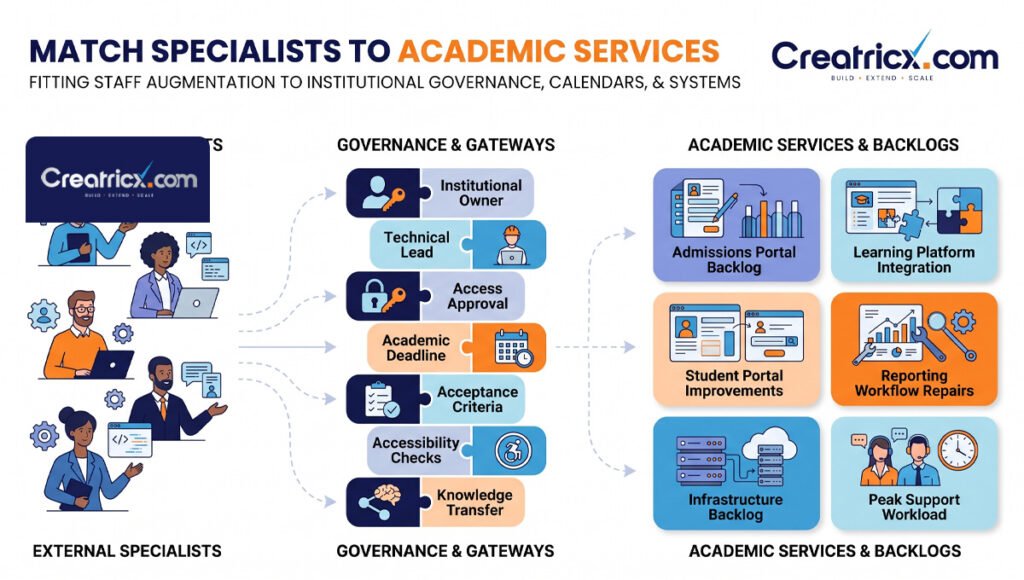
The following are proposed applications of Creatricx’s technical team-extension model, not claims about completed university projects.
The appropriate role depends on the institution’s systems and the skills available for the engagement.
| Institutional need | Capability to discuss with Creatricx | Authority retained by the institution |
|---|---|---|
| Admissions portal backlog | Developer and QA support | Admissions rules and release approval |
| Learning platform integration | API or integration development and testing | Course access rules and platform ownership |
| Student self-service improvements | UI/UX, frontend and QA support | Student-service policy and acceptance |
| Reporting workflow repairs | Relevant data integration and validation skills | Data definitions and reporting sign-off |
| Infrastructure delivery backlog | DevOps or cloud expertise | Architecture, access and change approval |
| Peak support workload | Appropriately trained support capacity | Identity verification and sensitive escalation |
Admissions and registration workflows
An applicant may submit a form successfully while the information fails to reach the admissions system. Adding capacity should address the complete workflow, including validation, failed transfers, duplicate records and staff visibility.
For example, a university could scope a developer and QA contribution around a document-upload flow. The admissions owner would define acceptable documents and statuses; the technical work would implement and test those rules. Test cases should include a failed upload, a duplicate submission and a user returning later to complete an application.
Creatricx’s role in the initial discussion would be to understand the missing capability and the responsibilities your team can supervise. The institution would still decide when that workflow is ready for applicants.
Learning systems and student portals
A learning management system may depend on enrolment data, identity services and other applications. A technically successful integration is insufficient if a withdrawn student retains the wrong access or a newly enrolled student cannot reach course materials.
Ask for platform-specific experience during candidate evaluation. Knowing how to build APIs does not establish expertise in every learning or student information system. Where configuration or API access depends on the platform vendor, resolve those dependencies before setting delivery expectations.
For student portals, define the task to improve: viewing a timetable, updating contact information or submitting a request. Use that task to guide design, testing and acceptance.
Plan Your University Technology Roles with Creatricx — share the workflow, platform and skill gap so we can discuss an appropriate role brief.
Plan around the academic calendar before selecting a start date
An academic deadline changes the meaning of delivery risk. Registration, assessment and results periods may leave little room for disruptive changes. Summer can also contain intensive teaching, admissions work and research activity; it should not automatically be treated as downtime.
Our recommended starting point is a service calendar showing critical dates, planned change restrictions, decision-maker availability and support requirements. Work backwards from the date a service must be reliable, allowing time for procurement, candidate assessment, access approval, testing and handover.
An illustrative registration project
Suppose registration opens in 8 weeks and a student-facing form needs improvement.
The first question is whether approvals, platform access and testing can realistically be completed in that window. The answer may be a smaller release that resolves the main blocker, with less urgent changes scheduled later.
Agree a final deployment decision point and a fallback. If acceptance criteria are not met, the institution should have a known path to continue the existing service. A calendar date should not become an instruction to release unverified work.
When discussing working hours with Creatricx, specify both normal collaboration and exceptional events. Agreed time-zone overlap does not automatically include evening registration support or round-the-clock incident response.
Keep student data access tied to the task
Our recommended principle is to give each specialist the smallest practical access needed for the agreed work. A front-end developer improving an application form may be able to use synthetic records. A production support investigation may need controlled, logged access under a different approval process.
Write down the systems involved, data categories, access location, approved devices, permitted exports, escalation contacts and access-removal process. Institutional security and privacy teams should review the proposed arrangement before sensitive access is provisioned.
For US institutions relying on FERPA’s school-official exception, the US Department of Education identifies conditions for outside parties: the work must be an institutional function otherwise performed by employees, the institution must exercise direct control over the use and maintenance of education records, use and redisclosure must be restricted, and the annual-notice criteria for legitimate educational interest must be met. Signing an NDA alone does not establish those conditions.
Other jurisdictions and institutional policies require their own assessment, including any applicable cross-border access requirements. Do not treat a remote staffing arrangement as automatically approved for all student or research information.
For AI-assisted work, define approved tools and data boundaries explicitly. Production student records should not be pasted into an unapproved assistant to accelerate debugging. Technical assistance also should not silently become authority to make admissions, grading or disciplinary decisions.
Discuss Your Access and Working Requirements with Creatricx and include location restrictions and institutional approval needs in the role brief before candidate selection.
Treat accessibility as part of completing the work
For higher education, a digital process is not ready simply because it works for the developer demonstrating it. The institution should define applicable accessibility requirements and involve its accessibility owner in acceptance.
Our recommendation is to build those checks into the task itself. For a document-upload form, that could include keyboard operation, clear labels, understandable error messages, visible focus and appropriate screen-reader behaviour. The specific checks should reflect the interface and the institution’s standard.
A scan can help identify some issues, but it should not substitute for checking the actual student task. Ask the specialist to demonstrate the workflow and record remaining limitations for review. Do not describe a whole portal as accessible based on one repaired component.
Where specialist accessibility evaluation is needed, specify that expertise separately rather than assuming any frontend developer provides it. Creatricx can discuss the required role and assessment criteria alongside the broader development requirement.
Define what your team owns and what Creatricx supports
Our staff augmentation model keeps the institution’s managers in charge of the work. Creatricx supports matching and the operational coordination around the professional; the engagement should specify the details rather than leaving them implicit.
| Decision or activity | Proposed owner | What to agree before starting |
|---|---|---|
| Service priorities and policy | Institutional service owner | Backlog and acceptance criteria |
| Technical standards and releases | Institutional technical lead | Review process and release authority |
| Role matching and candidate sourcing | Creatricx | Skills, seniority and availability requirements |
| Candidate assessment and selection | Institution with Creatricx coordination | Interviews and relevant work discussion |
| Workflow onboarding | Shared | Access, documentation and meeting schedule |
| Continuity and replacement planning | Creatricx with institution input | Notice, knowledge transfer and responsibilities |
In a decentralised university, also identify who has the authority to approve changes across departments. A faculty request, central IT standard and registrar requirement may conflict. External specialists need a named route for resolving that conflict.
If nobody internally can direct the work, tell us at the start. Adding a specialist will not by itself create product ownership. A broader dedicated remote team discussion may be useful, but management responsibilities still need to be agreed.
Judge value by usable capacity and a better service
An hourly rate doesn’t tell an institution how much useful capacity it gains. Include procurement effort, onboarding, internal review time, tools, supervision and handover when assessing the engagement.
For an illustrative planning comparison, two days of specialist availability are not two extra days of progress if an internal lead spends most of that time providing missing context. That may be reasonable during onboarding, but persistent dependence is a signal to improve documentation, narrow the role or revisit fit.
Agree on a small set of measures before work starts. For admissions, assess successful end-to-end submissions and unresolved failure cases. For a reporting workflow, assess reconciliation errors and manual correction effort. For support, consider appropriate resolution and escalation alongside response times; closing tickets prematurely is not progress.
Our view is that knowledge transfer belongs in the definition of completed work. Require relevant documentation, configuration notes, test evidence and an internal walkthrough. The university should be able to maintain the improvement after the specialist leaves.
Request a Scoped Staff Augmentation Discussion and, bring a priority backlog and budget range so the conversation can focus on the contribution your institution needs.
How to start a higher education engagement with Creatricx
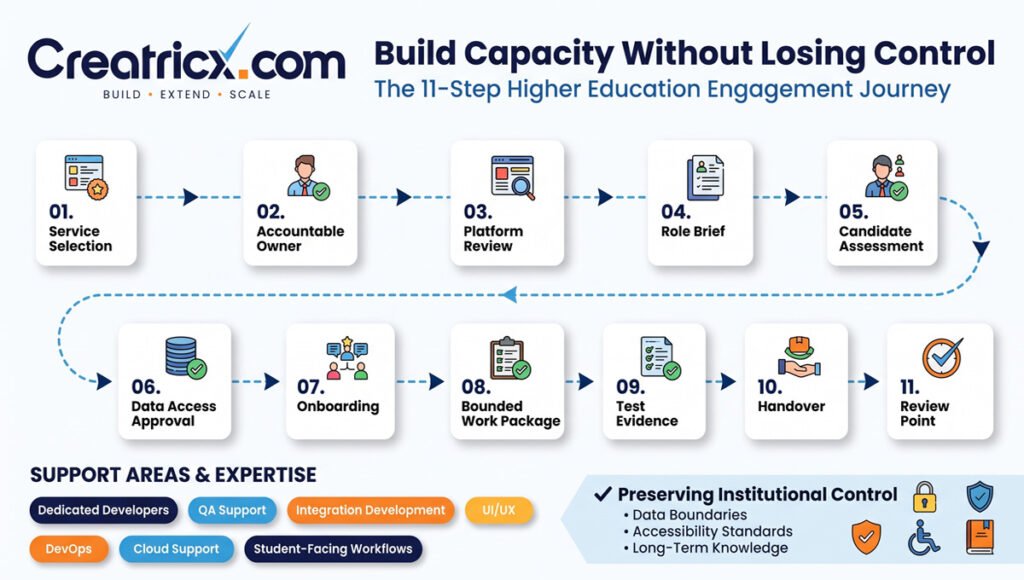
Begin with one service and one accountable institutional owner. Share the platform, current problem, expected contribution, academic deadline, working hours and security constraints. Include procurement lead times and any platform-specific experience that is mandatory.
Next, discuss the proposed role rather than committing to an arbitrary headcount. You may need one dedicated developer, additional QA capacity or several complementary skills. Assess the proposed professionals against the actual environment and ask them to explain a relevant technical problem.
Before onboarding, agree the scope, allocation, costs, access, approvals, communication and handover expectations. Use a bounded initial work package with a review point. This creates an opportunity to assess collaboration and contribution before discussing expansion; the commercial terms must be agreed individually.
For an illustrative first work package, choose one documented admissions defect, reproduce it with suitable test data, implement a reviewed correction, validate the affected journey and hand over the evidence. This is more informative than measuring how many tickets a new specialist can close immediately.
Our philosophy for higher education partnerships
At Creatricx, the position we advocate is to add capability where it improves an institutional service, keep decisions with accountable owners, and leave the internal team better equipped to continue the work.
That means explaining trade-offs when a deadline is too close, identifying platform expertise that still needs verification, and making accessibility and data permissions part of the brief. It also means treating existing university staff as essential partners in delivery.
We want the staffing conversation to lead to a clear answer: which work will this professional help complete, under whose direction, with what evidence of success? If those questions are unresolved, the next step is better scoping before more recruitment.
Questions about higher education staff augmentation
Does this replace university employees or academic staff
The approach described here adds technical or operational capacity under institutional direction. It does not transfer academic authority or prescribe staff replacement. The university should define the purpose and workforce implications through its normal processes.
Can Creatricx work with our existing learning or student information system
Share the platform, version, integrations and exact role requirements. Relevant specialist experience and access conditions must be checked before the engagement is agreed. General software development capability should not be mistaken for confirmed expertise in every education platform.
Can remote specialists access student records
Only where the institution has approved the arrangement and applicable requirements are satisfied. Start by assessing whether the work can use synthetic or appropriately de-identified data. Any production access should have a defined purpose, permissions and oversight.
Can we add support only around a busy academic period
Discuss the dates, training needs, expected workload and escalation responsibilities with Creatricx. Suitability depends on availability and whether there is enough time to prepare the professional before the peak. Temporary capacity still needs onboarding and agreed terms.