
Discuss Your Development Team with Creatricx and, share your product, current capacity gap and the outcome you need next.
Table of Contents
Key takeaways
Choose the engagement model according to who will direct the work and own delivery decisions.
Assess the named people who would join your project, including how they collaborate.
Ask Creatricx for a team proposal that makes roles, capacity and commercial assumptions clear.
Discuss a bounded initial engagement if you need to validate technical fit before expanding.
Keep control of your repositories, accounts, priorities and exit arrangements from the start.
First decide whether you need a dedicated team
A dedicated software development team is a group assigned to your business for ongoing development. Its members build familiarity with your product and work within an agreed delivery process.
Team composition, allocation and management arrangements vary between providers, so the word “dedicated” needs a written definition.
This model fits a continuing product roadmap with evolving requirements. It is particularly useful when you need several disciplines to collaborate regularly and your business can supply product direction.
It may be a poor fit when nobody can make timely decisions, the product problem remains untested, or the work is a small, clearly bounded deliverable. In those cases, start with discovery, an individual specialist, or a defined project engagement.
| Your situation | Model to consider | Decision to settle |
|---|---|---|
| Existing engineering team lacks one skill | Staff augmentation | Who manages the incoming specialist |
| Ongoing roadmap needs coordinated capacity | Dedicated team | Who owns product, technical and delivery decisions |
| Defined deliverable needs an external delivery owner | Project outsourcing | Scope, acceptance and change control |
| Larger offshore operation needs structure and leadership | Offshore development center | Governance and operational responsibilities |
For a deeper comparison, see Creatricx’s guide to staff augmentation versus managed services. These categories overlap in practice; evaluate the operating agreement rather than relying on the label.
Tell Creatricx what your software needs to achieve
“We need three React developers” specifies capacity before explaining the constraint. Your real problem might be a slow approval process, missing backend expertise, or releases waiting for manual testing. More frontend capacity would not necessarily solve it.
Describe what should become possible over the next planning period. Then explain the current product, users, architecture, known risks and internal resources. For an existing application, share relevant documentation with Creatricx through an agreed access process so the team discussion reflects your existing environment.
A practical brief you can adapt
Illustrative scenario: A B2B platform needs customers to request, approve and track service appointments without emailing the operations team. The first delivery should support one customer group. An internal product owner can prioritise work, but engineering capacity and automated testing are limited.
The brief should identify the existing stack and integrations, the first workflow to deliver, the available budget, required working-hour overlap, data restrictions, and who can answer business questions. Use this brief to ask Creatricx about suitable roles, remaining assumptions and the information needed before estimating delivery.
Separate constraints from preferences. An integration that must remain compatible is a constraint. A preferred framework may be negotiable if there is no existing technical dependency. This distinction gives candidates room to demonstrate judgment.
Do not require a confident fixed delivery date before the team can inspect significant unknowns. Request an initial assessment and an explanation of what would make the estimate change.
Plan your team structure with Creatricx
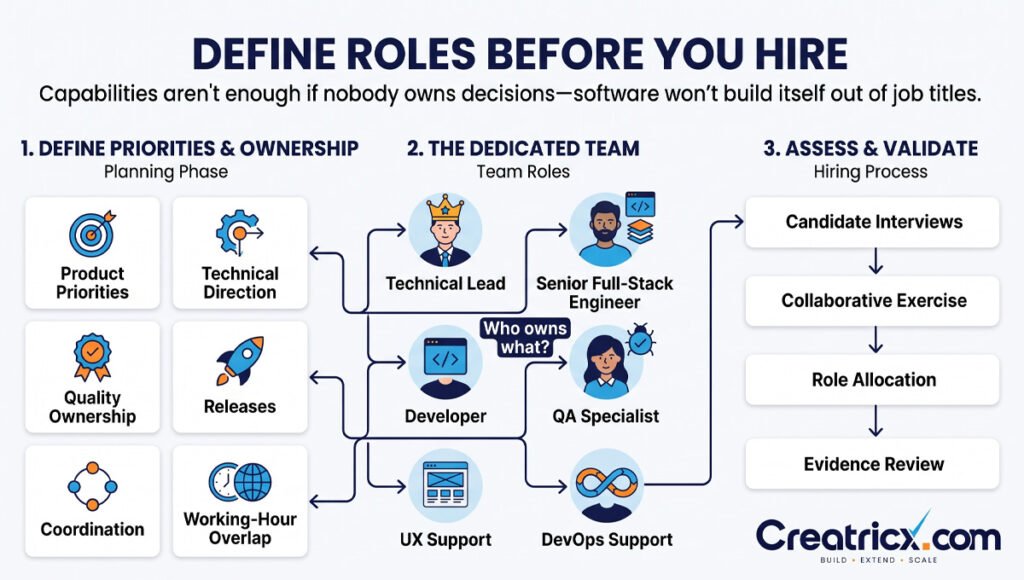
Start with responsibilities, then decide whether each needs a full-time role. A small team may share some responsibilities; a complex product may need separate specialists. What matters is that the work has a competent owner with enough time to do it.
For the appointment-platform example, a possible starting structure is a senior full-stack engineer with technical ownership, another developer, and part-time QA support. UX or infrastructure expertise can be added around specific needs. This is an illustrative structure, not a universal minimum or a Creatricx package.
| Responsibility | Decision to make before hiring | Evidence to request |
|---|---|---|
| Product priorities | Who decides what matters next | Named decision-maker and review cadence |
| Technical direction | Who reviews architecture and code | Proposed lead and relevant work discussion |
| Quality | Who defines and verifies acceptance | Test approach for the first workflow |
| Releases | Who can deploy and recover service | Deployment and rollback walkthrough |
| Coordination | Who resolves blockers and dependencies | Escalation route and reporting example |
A team can need technical leadership without needing a separate full-time project manager. Equally, a senior developer should not silently inherit every management task. Ask how much capacity each responsibility consumes.
If you have no internal technical reviewer, include that gap in the budget. Tell Creatricx that technical leadership is part of your requirement, and clarify its responsibilities and allocation in the proposed structure. Your business still needs an accountable owner for priorities and approval of the intended outcome.
Plan My Dedicated Team — send your existing team structure and the responsibilities you need covered. You do not need to arrive with a final headcount.
Review the professionals proposed for your product
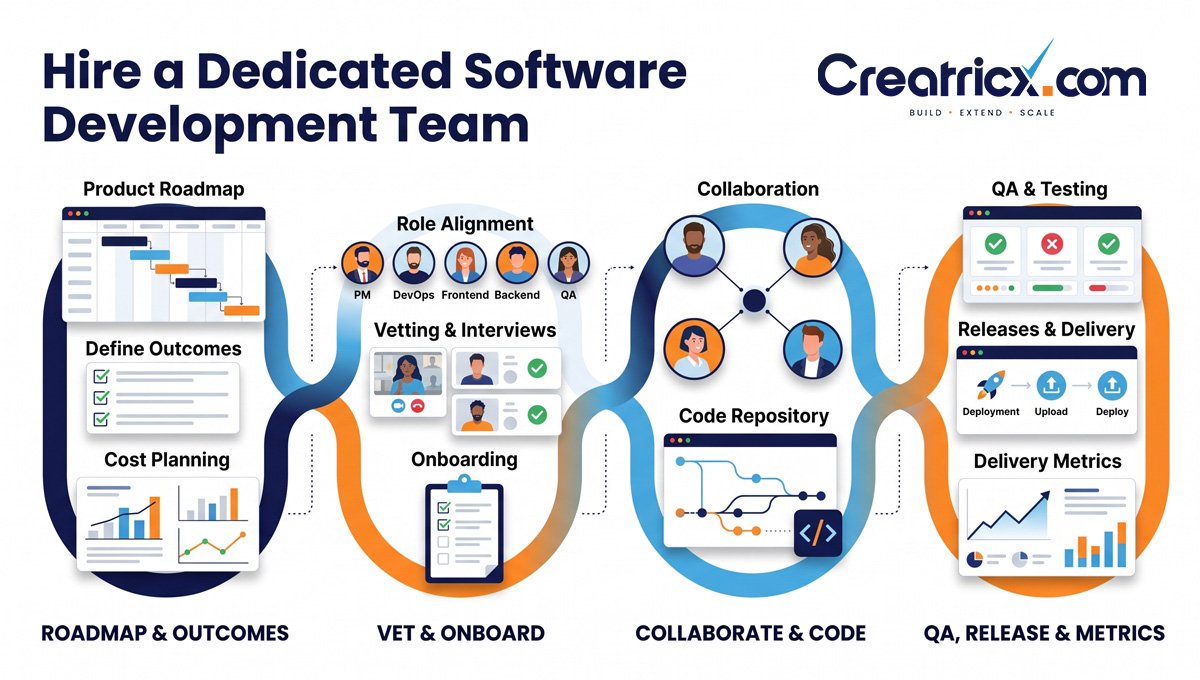
Creatricx’s selection process gives you the opportunity to meet proposed professionals before choosing your team. Use those conversations to connect each person’s experience to the work you actually need done.
Ask about a relevant delivery problem: integrating an unreliable third-party API, improving a legacy codebase, or supporting releases without disrupting users. Discuss the starting problem, technical trade-offs, the candidate’s own contribution and what changed during delivery.
Respect confidentiality. Redacted artefacts, permitted demonstrations and clear technical explanations can provide evidence without exposing another client’s private code.
Confirm each role’s allocation, working hours and responsibilities with Creatricx. If a specialist will support the team part time, identify the availability needed for reviews or releases. Make sure the people you assess and the agreed onboarding plan align before the engagement starts.
Interview the proposed members and observe them working together
Use role-specific conversations rather than repeating the same technology quiz with everyone. Ask developers to explain a recent design decision, QA specialists to identify failure cases, and technical leads to discuss a difficult release or an architectural compromise.
Then bring the proposed members together for a short, compensated collaborative exercise when it involves meaningful assessment work. Use a fictional problem or sanitised example so confidential production data is unnecessary.
An exercise that reveals more than a coding puzzle
Present this scenario: “A customer submits an appointment request. The external scheduling service times out, but may still have accepted it. What should the application do next?”
Listen for clarification before implementation. A useful discussion should cover duplicate requests, retry behaviour, the customer’s status message, operational visibility, and how the team would test an uncertain response. There may be several defensible designs; the quality of the reasoning matters.
Observe whether team members challenge assumptions constructively. Does the developer involve QA? Does someone explain the business consequences? Can the lead describe a simpler first version and its limitations?
Record the evidence from each candidate discussion and review how the proposed members complement one another. Score relevant technical judgment, clarity, testing, collaboration and ownership using a simple consistent scale. A good average should not override a serious concern about integrity, access controls or inability to explain the work.
Discuss Candidate Requirements with Creatricx and, tell us the technologies, seniority and communication skills you want to assess before selecting your team.
Request a Creatricx proposal around your actual workload
Request a proposal from Creatricx that identifies the roles, allocation, working-hour requirements and responsibilities your engagement needs.
Confirm the billing arrangement and the assumptions behind the total so you can judge the proposal against your available budget.
Ask about leave, public holidays, partial allocations, overtime, management time, recruitment or setup charges, equipment, licences, and replacement overlap.
Establish what happens to unused capacity and how much notice is required to change the team.
Request a Dedicated Team Proposal and, share your budget range, required skills and expected engagement duration so the discussion starts with realistic constraints.
Agree ownership and engineering safeguards with Creatricx
Keep business control of essential repositories, cloud accounts, documentation and deployment systems where practical. Provide individual accounts, appropriate permissions and a clear process for removing access. Use sanitised development data whenever possible.
The agreement should address deliverable ownership, third-party components, confidentiality, subcontracting, approved tools, and handover. Have relevant terms reviewed for your jurisdictions and data requirements instead of assuming a generic NDA resolves every issue.
NIST’s Secure Software Development Framework provides a useful vocabulary for discussing secure development with suppliers. Translate that discussion into practical evidence: how code is reviewed, dependencies are checked, secrets are protected, and vulnerabilities are triaged. Naming a framework alone does not demonstrate that a team follows it.
Discuss AI-assisted development explicitly. Agree which tools are permitted, what information may be submitted, and who reviews generated code. Regardless of how code is produced, the team should explain it, test it and remain accountable for its inclusion in your product.
Also define continuity: notice of personnel changes, approval of replacements, knowledge-transfer expectations and any overlap charges. Avoid depending on one person who alone understands deployment or holds the only working credentials.
Onboard your Creatricx team into your delivery process
Your selected Creatricx professionals join the agreed tools, meetings and workflow. Prepare access, product context, a prioritised backlog and a named person who can resolve questions. Agree actual overlap hours, including daylight-saving changes and holiday coverage where relevant.
An illustrative first-month plan is to establish access and a working development environment in week one, deliver a small reviewed change next, expand into the priority workflow, and review evidence before increasing capacity. Adjust the sequence for the product’s complexity and release constraints.
Measure progress without rewarding activity for its own sake
Track whether accepted functionality works, how long changes wait for review, which blockers recur, and what defects escape into use. Establish a baseline before setting improvement targets.
DORA’s software delivery metrics examine delivery throughput and instability through five measures: change lead time, deployment frequency, failed deployment recovery time, change fail rate and deployment rework rate. Use relevant measures at the application or team level to identify improvement opportunities. They are not an individual developer leaderboard.
Do not use lines of code, hours online or raw ticket counts as proof of business value. A developer who removes a fragile dependency may deliver more value with less code. Pair delivery evidence with the product outcome you hired the team to support.
Discuss Your Team Start and Working Hours — share your target start date, collaboration schedule and onboarding requirements with Creatricx.
Why build your dedicated development team with Creatricx
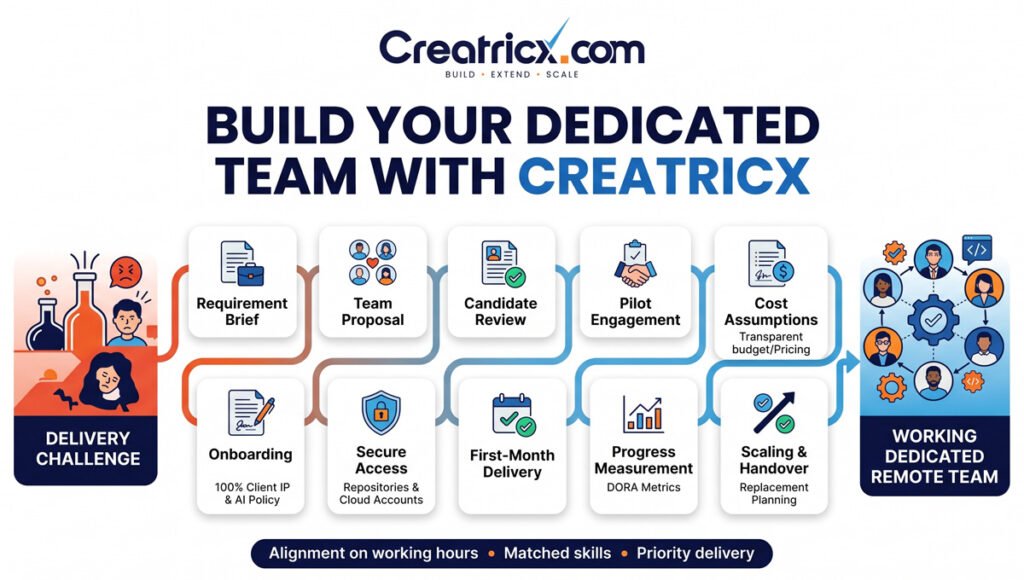
Creatricx combines talent selection with support for onboarding and ongoing collaboration. Our dedicated remote teams offering lets you discuss a structure around the product you need to build and the management capacity you already have.
You remain involved in selecting the professionals. Your business retains direction over roadmap priorities and approvals, while the engagement defines the practical support around the team. Working-hour alignment, continuity and replacement planning should be discussed as part of that setup.
This makes Creatricx relevant when you want ongoing access to engineering capability within your own delivery environment. You can assess people for the roles you need and define how collaboration will work before expanding the relationship.
If you already have a functioning delivery team and need engineering capacity, explore dedicated developers. For a larger offshore operation requiring broader structure, discuss an offshore development center.
Discuss your team requirements with Creatricx. Share your product stage, the next outcome you need, existing technical leadership, expected duration, budget range and required collaboration hours. Use that information to request a proposed team structure and clarify what remains your responsibility before selecting candidates.
Questions about hiring a dedicated team with Creatricx
Can a nontechnical founder hire a dedicated development team
Yes, but technical evaluation and oversight still need an owner. Arrange a qualified adviser or clearly scoped technical leadership. The founder should remain responsible for business priorities and acceptance of the user outcome, supported by technical evidence.
How long does hiring a dedicated team take
Ask Creatricx for a timeline based on your specific roles, candidate availability, interviews and onboarding requirements. Separate shortlisting, selection and productive onboarding when planning your start. A claim that someone can start quickly does not establish that the entire team is ready.
Should every team member be full time
No. Some products need shared or part-time design, QA, security or infrastructure support. Confirm availability, allocation and response expectations so a critical release does not depend on an unspecified shared resource.
Who manages a dedicated software development team
With Creatricx, your business retains direction over priorities and approvals; day-to-day management can be client-directed or shared according to the agreed setup. Specify who controls the roadmap, technical standards, assignments, acceptance and releases. A dedicated-team contract should not leave these decisions implicit.
Start building your software development team with Creatricx
If your roadmap needs more engineering capacity, bring the next delivery challenge to Creatricx. Tell us what you are building, what is blocking progress and which capabilities are missing. From there, discuss the roles, candidate requirements and working arrangements that fit your business.
Have a defined stack and budget? Send them with your brief. Still deciding on the team structure? Start with the outcome and your current resources. The next step is a requirements conversation, not a commitment to an oversized team.