
Table of Contents
That is why two companies can both say they 'outsource software development' while buying completely different services. One adds a backend developer to an internal squad. Another asks a vendor to discover, design, build and launch an entire platform.
Why Companies Outsource Software Development
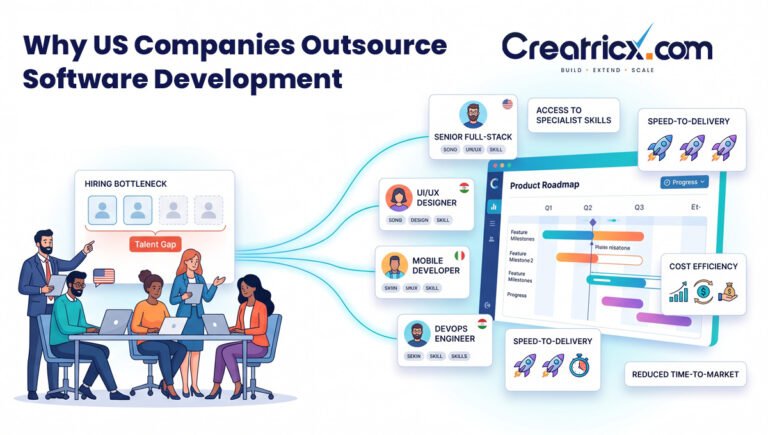
The strongest case for outsourcing is usually a combination of talent access, timing, flexibility and economics rather than one isolated saving.
- Scarce capability: AI, cloud, DevOps, mobile, cybersecurity, data and specialist frameworks may be difficult to hire locally.
- Time-to-capability: a business can add a proven external team faster than creating every role through a permanent recruitment cycle.
- Flexible capacity: add engineering, QA or platform skills for a product phase without assuming every workload peak becomes permanent headcount.
- Operating focus: keep internal leadership concentrated on product, customers, architecture and business priorities while the provider supplies delivery capacity.
- Geographic economics: software labor markets vary substantially by region.
- Delivery-model choice: a company can transfer more or less responsibility instead of choosing between only 'hire internally' and 'fully outsource'.
Deloitte's evidence is useful here because it shows the market is not moving in one direction. Eighty percent of surveyed executives planned to maintain or increase third-party outsourcing investment, but 70% had also selectively brought some previously outsourced scope back inside over the prior five years. Mature sourcing is a portfolio decision, not a religion.
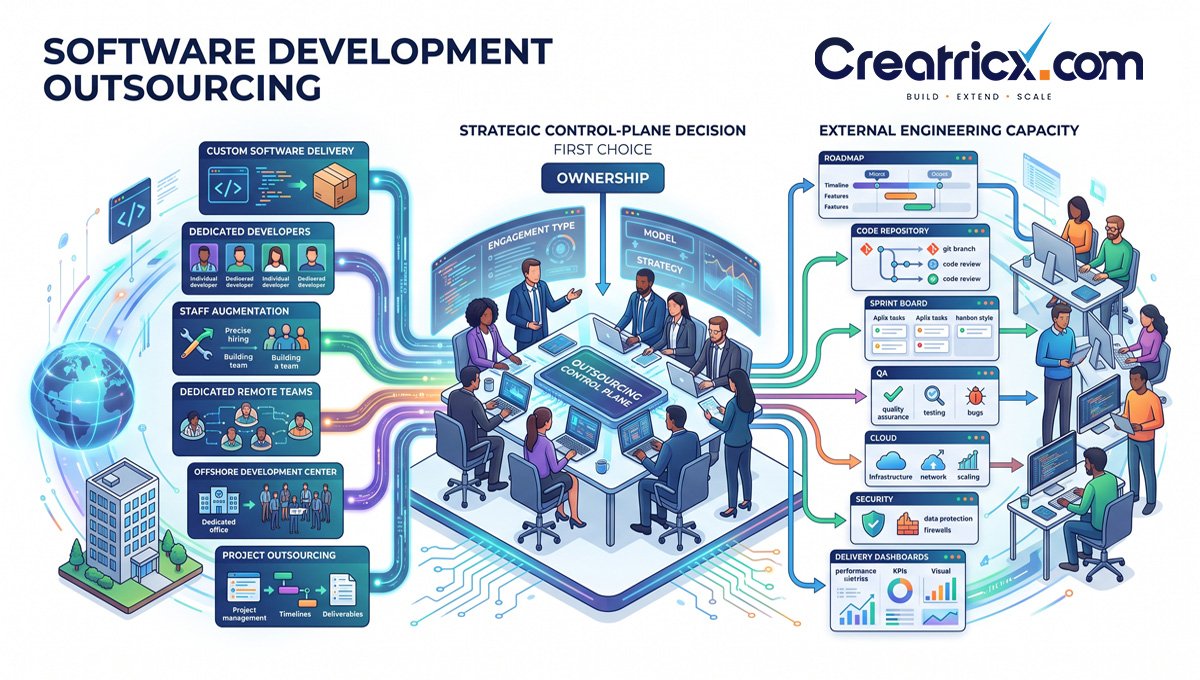
The Most Important Question: What Are You Outsourcing?
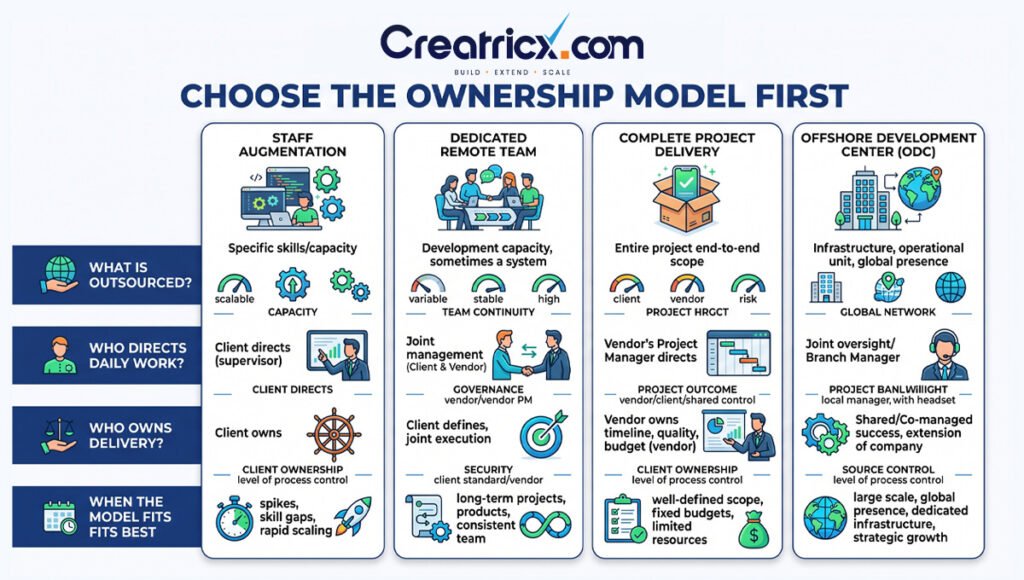
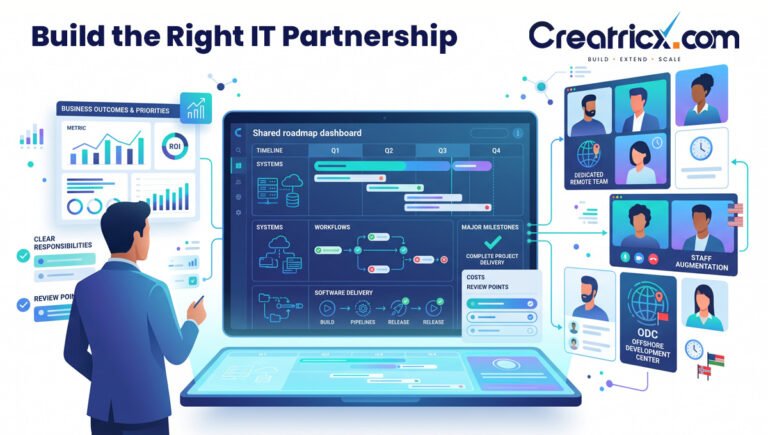
Staff Augmentation
You already have product/engineering management and need one or more skills.
Ownership
The client directs daily work. The provider supplies people and continuity.
Example: A React developer, QA engineer, DevOps specialist or data engineer joining an existing squad.
Dedicated Remote Team
You need several stable roles working together around a longer roadmap.
Ownership
Client-directed or shared coordination depending on the structure.
Example: A SaaS product squad with frontend, backend, QA, UI/UX and DevOps.
Complete Project Delivery
You have a defined business problem or product outcome and want the provider to own more execution.
Ownership
Provider owns discovery, planning, delivery coordination and agreed scope outcomes.
Example: New customer portal, internal system, app or platform modernization.
Offshore Development Center
You need a larger structured long-term offshore capability.
Ownership
Shared governance with defined leadership, reporting and operational support.
Example: A scalable offshore engineering operation spanning multiple teams or functions.
Fixed Price, Time & Materials, Dedicated Team: Contract Model Is a Separate Decision
Delivery model and pricing model are related but not identical. A complete outsourced project can be fixed-price or time-and-materials. A dedicated team is usually in an ongoing capacity. Treating these labels as interchangeable makes vendor comparisons unnecessarily mysterious.
| Commercial model | Best fit | Advantage | Watch for |
|---|---|---|---|
| Fixed price | Stable, bounded scope with clear acceptance criteria | Budget predictability | Vendor prices uncertainty; changes need formal control |
| Time & materials | Evolving product scope and iterative delivery | Flexibility and transparency | Needs active prioritization and cost governance |
| Dedicated team / monthly capacity | Ongoing roadmap and stable role mix | Continuity and predictable capacity | You pay for team availability, not a predetermined feature count |
| Milestone / outcome-based | Well-defined outcomes that can be objectively accepted | Aligns payment with delivery events | Hard to use when outcomes or dependencies are ambiguous |
Onshore, Nearshore or Offshore?
| Location model | Meaning | Strength | Trade-off |
|---|---|---|---|
| Onshore | Same country | Easiest legal/time-zone alignment; local market familiarity | Usually highest cost base |
| Nearshore | Nearby country/region | More overlap and easier travel with lower cost than many local markets | Smaller rate differential than lower-cost offshore regions |
| Offshore | Distant country/region | Broad global talent pool and largest cost differential options | Requires deliberate communication, overlap and governance |
What Software Development Outsourcing Costs
Current public data is useful only when the methodology is kept visible.
Clutch's software-development pricing guide, updated September 8, 2026, says custom software projects in its review data commonly fall in the $10,000–$49,999 range. Its average reviewed project cost is much higher at $132,480.29, with an average project timeline of about 13 months and average monthly cost of $10,209.39. The difference tells you the data has a long tail: larger projects pull the average upward.
Clutch also lists many software development companies at $24–$49 per hour overall, but regional company rates differ. Its current location table shows $50–$99/hour for the United States, $25–$49 for India, the Philippines, Ukraine and Mexico, $50–$99 for Poland, and $100–$149 for Canada and Australia.
Accelerance's 2026 survey of software-development partners uses another methodology and reports different bands: Asia junior developers $24–$31/hour and senior developers $31–$41; Europe junior $31–$39 and senior $64–$76; Latin America junior $33–$45 and senior $60–$75.
In-House vs Outsourcing: The Cost Comparison Most Spreadsheets Miss
The U.S. Bureau of Labor Statistics reports a $135,980 median annual wage for software developers and $104,300 for QA analysts/testers in May 2025. Those figures are wages, not the full employer cost.
BLS compensation data for March 2026 says benefits represented 30.1% of total private-industry compensation. Applying that broad private-industry ratio as a planning proxy shows why a local salary comparison should not stop at base pay. Recruiting, equipment, management and idle capacity are additional considerations.
The Retained-Team Minimum: What You Should Usually Keep Inside
The biggest outsourcing mistake is assuming the provider replaces every internal responsibility. Even a managed project needs a capable client.
| Retained responsibility | What it protects |
|---|---|
| Business owner | Why the software matters and what outcomes have priority |
| Product decision-maker | Scope priority, user trade-offs and acceptance decisions |
| Technical authority | Architecture/security standards or someone empowered to approve them |
| Data / access owner | Who can authorize systems, credentials and sensitive data |
| Commercial owner | Budget, change control, contract and escalation |
What a Serious Outsourcing Contract Should Make Explicit
| Contract area | What should be clear |
|---|---|
| Scope / capacity | Deliverables, roles, assumptions, exclusions and acceptance |
| Change control | How new requirements alter budget, timeline or capacity |
| Intellectual property | Ownership / assignment of work product and permitted pre-existing IP |
| Source control | Repository owner, admin rights, branching and access |
| Cloud / environments | Account owner, billing owner, deployment permissions, backups |
| Data | Permitted access, storage, retention, exports and sensitive-data rules |
| Security | Secure SDLC expectations, incident handling, vulnerabilities and access controls |
| AI tools | Approved tools, prompt/data restrictions, code-review and provenance rules |
| Dependencies | Who selects and maintains open-source / third-party libraries |
| People | Named roles, substitutions, interview rights and continuity |
| Communication | Working hours, reporting, escalation and decision SLA |
| Exit | Transition assistance, documentation, exports, credential revocation and final handover |
Treat the Vendor as Part of the Software Supply Chain
NIST's Secure Software Development Framework explicitly notes that software purchasers can use its common vocabulary in supplier acquisition and management. OWASP SAMM likewise treats supplier security requirements as something organizations should evaluate and build into agreements.
- Define secure development expectations before the first sprint, not after a penetration test.
- Give developers the minimum access needed for their role and separate development, staging and production permissions.
- Keep critical business accounts under client control wherever practical.
- Track third-party and open-source dependencies and define who owns updates.
- Require a clear path for reporting and remediating vulnerabilities.
- Include offboarding: revoke accounts, rotate secrets, transfer work and confirm data handling.
AI-Assisted Outsourcing Needs an Explicit Policy
AI is already normal in software development. Stack Overflow's 2025 survey found 84% of respondents were using or planning to use AI tools, and 51% of professional developers used them daily. But only 17% of AI-agent users agreed that agents improved team collaboration.
DORA's 2025 research makes the same strategic point from another angle: AI is an amplifier. Strong workflows, platforms and user focus help teams turn local productivity into organizational performance; weak systems simply become faster at producing confusion.
- Approved tools: name which assistants, agents or models can be used.
- Data boundary: define what source code, customer data, secrets and logs may never enter external AI services.
- Review rule: AI-generated code follows the same code review, testing and security expectations as human-written code.
- Dependency rule: generated libraries or snippets do not bypass licensing and supply-chain review.
- Evidence: for sensitive systems, retain enough traceability to understand how a risky change was produced and validated.
- Ownership: the provider remains accountable for delivered code. 'The AI wrote it' is not a contractual actor.
How to Measure an Outsourced Software Team
Hours, story points and ticket counts are easy to report and easy to optimize without improving the product. A better scorecard starts with delivery outcomes.
DORA's current five software-delivery metrics are a useful foundation because they measure throughput and instability together.
| Metric | What it measures | Buyer question |
|---|---|---|
| Change lead time | How long a committed change takes to reach production | Is delivery getting faster without increasing risk? |
| Deployment frequency | How often useful changes are deployed | Can the team release in manageable batches? |
| Failed deployment recovery time | How quickly failed releases are recovered | Can the team restore service when change goes wrong? |
| Change fail rate | Share of deployments needing immediate intervention | Is quality degrading as throughput rises? |
| Deployment rework rate | Unplanned deployments caused by production incidents | How much delivery capacity is being consumed by avoidable correction? |
For a new outsourcing engagement, we would combine those with product-specific signals such as blocked time, review latency, escaped defects, acceptance-cycle time, customer-impacting incidents and whether the original business bottleneck is shrinking.
The First 30 - 60 Days Should Be a Controlled Learning System
- Transfer product, user, architecture and business context.
- Prepare access, repositories, environments and communication channels.
- Move one representative change through design, implementation, review, QA and production.
- Track blocked time, access failures and review latency before judging raw velocity.
- Increase scope only after the basic delivery path is repeatable.
- Check test depth, quality, dependency ownership and release reliability.
- Compare the actual working model with what the contract promised.
- Identify whether the bottleneck is the provider, the client or the interface between them.
- Fix the largest delivery constraint instead of simply adding more people.
- Review team shape, seniority, management and architecture ownership.
- Decide whether to scale, keep the current model, move to another model or exit.
- Document the product and operating knowledge gained during the first quarter.
7 Typical Software Outsourcing Failure Modes
| Failure mode | What you see | Root cause | Control |
|---|---|---|---|
| Black-box vendor | Client sees demos but not the delivery system | No visibility into people, code, quality or decisions | Direct collaboration, repository access, explicit reporting |
| Requirements courier | Internal team spends all day translating work into tickets | Provider lacks product context or decision access | Embed context; shorten decision path; use product-level outcomes |
| Cheap-rate trap | Invoice is low, rework is high | Selection optimized hourly cost rather than delivery quality | Compare outcome cost, rework and review burden |
| Architecture drift | Features ship but system becomes harder to change | No retained technical authority / standards | Explicit architecture owner and review |
| Vendor lock-in | Client cannot deploy or operate without provider | Accounts, knowledge and runbooks provider-owned | Client-controlled assets + handover standards |
| Team rotation | Knowledge resets repeatedly | Commercial model rewards substitution or weak continuity | Named roles, notice, handover and replacement terms |
| AI without governance | Fast code generation, uncertain quality/data exposure | Tools adopted without client policy | Approved-tool and review policy |
What Experienced Developers Complain About
Public engineering forums are anecdotal, not representative market research, but recurring complaints are useful as due-diligence prompts.
- A 2026 ExperiencedDevs thread about a large outsourced team described technically capable developers with little product context, weak accountability and repeated discovery after staff turnover.
- A longer 2023 practitioner discussion argued that offshore arrangements worked better when clients interviewed the actual developers, integrated them into normal code review and treated the offshore team as part of one engineering system rather than a black box.
- Other discussions repeatedly point to opaque staffing, missing ownership and clients accepting work without strong in-house technical review.
When You Shouldn’t Outsource Software Development
- The product strategy is still so unclear that nobody can define the user, problem or first useful outcome.
- No internal person can own business decisions or accept delivered work.
- The capability is core intellectual property that the company strategically wants to build and retain as an internal organizational competence.
- The provider would require data or system access that cannot meet your risk or regulatory requirements.
- The only business case is an unusually low hourly rate.
- The work is small enough that a mature SaaS product, CMS, automation platform or internal configuration can solve it without custom software.
Deloitte's selective-insourcing data matters here. Sophisticated companies change their sourcing mix as capabilities become more strategic, not because outsourcing 'failed' or insourcing 'won.'
A Practical Buyer Workflow: How to Outsource Software Development
- Define the business outcome and the retained internal owner.
- Choose the ownership model: capacity, stable team, complete project or ODC.
- Write measurable requirements and non-functional constraints: security, performance, availability, compliance and data.
- Create a vendor evidence request that makes delivery practices visible.
- Interview the proposed leadership and delivery team, not only sales.
- Normalize quotes around the same scope, roles, assumptions and ownership boundary.
- Agree source-code, cloud, data, AI, security, change-control and exit terms before kickoff.
- Start with a representative delivery path and observe the operating system.
- Baseline delivery quality and improve the largest bottleneck.
- At 90 days, consciously decide to scale, retain, change model or exit.
How Creatricx Fits Software Development Outsourcing
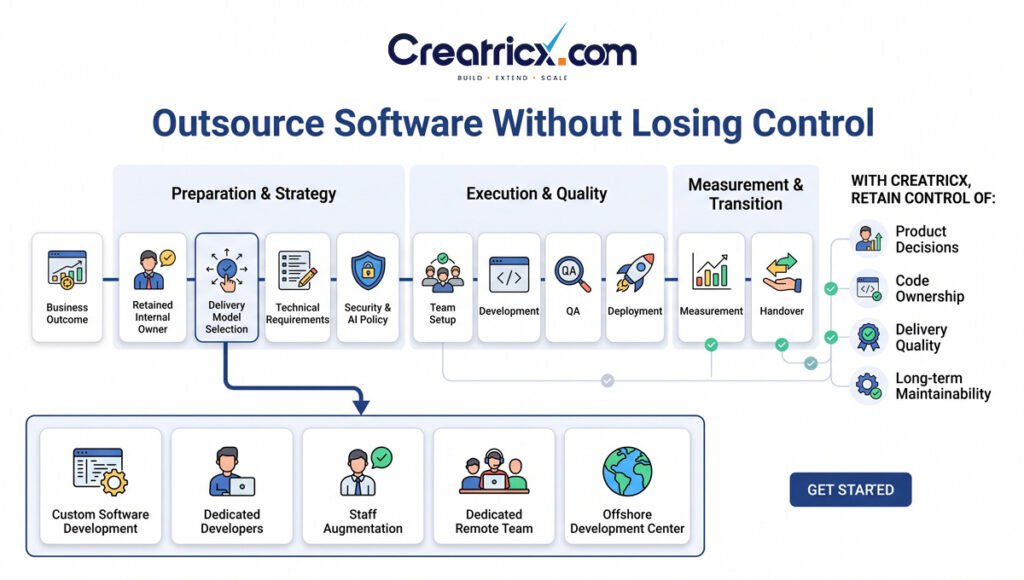
Creatricx does not position software outsourcing as one fixed product because the client-side ownership model changes what good delivery looks like.
For a defined business problem, Creatricx offers complete Custom Software Development with discovery, design, engineering, QA and launch responsibilities scoped around the outcome. For an existing engineering organization, Dedicated Developers or Staff Augmentation add specialist capacity inside the client's existing tools and roadmap. For a stable multi-role product unit, a Dedicated Remote Team provides continuity. For a larger structured offshore operation, an Offshore Development Center adds deeper governance and operational support.
| Creatricx model | Primary need | Ownership | Example |
|---|---|---|---|
| Complete Project Delivery | Defined software outcome | Creatricx owns more delivery coordination | Custom platform, portal, application or modernization |
| Dedicated Developers | Ongoing developer capacity | Client directs priorities | Long-term web/software/mobile engineering |
| Staff Augmentation | Specific skill/capacity gap | Client manages daily work | Backend, frontend, QA, DevOps, cloud, AI or other specialist role |
| Dedicated Remote Team | Stable cross-functional roadmap | Client-directed or shared coordination | Product squad with multiple disciplines |
| Offshore Development Center | Larger offshore capability | Shared governance by design | Long-term operation with leadership and support layers |
Frequently Asked Questions
What is software development outsourcing?
Software development outsourcing is the use of an external company or team to build, extend, test, maintain or operate software. The provider may deliver a complete project, supply individual specialists, provide a dedicated team or support a larger offshore development operation.
Why do companies outsource software development?
Common reasons include access to scarce skills, faster access to delivery capacity, flexible team scaling, geographic cost differences and the ability to use an experienced external delivery organization. Deloitte's 2024 survey also identifies skilled talent and agility alongside cost reduction as major drivers.
How much does software development outsourcing cost?
There is no single market price. Clutch's September 2026 review data commonly places custom software projects in the $10,000–$49,999 range, while its average reviewed project cost is $132,480.29. Hourly company rates and regional rates vary widely, so scope and delivery model must be normalized before comparing.
Is outsourcing software development cheaper than hiring in-house?
It can be, especially when the business needs temporary capacity, several specialist roles or talent from lower-cost markets. The fair comparison should include employee benefits, recruitment, management, equipment, vendor management, rework, transition and idle capacity rather than salary versus vendor rate alone.
What is the difference between software outsourcing and staff augmentation?
Software outsourcing is the broad category. Staff augmentation is one specific model where external specialists join an existing client team and the client retains day-to-day management.
What is a dedicated software development team?
A dedicated software development team is a stable group of external developers and related specialists assigned to an ongoing client roadmap. It offers more continuity and team structure than ad-hoc freelance hiring or short-term individual augmentation.
Should I choose fixed price or time and materials?
Fixed price works best when scope and acceptance criteria are stable. Time and materials is usually better for evolving product development where priorities can change. The contract model should follow uncertainty rather than ideology.
Is nearshore better than offshore software development?
Neither is universally better. Nearshore usually provides more time-zone overlap and travel convenience. Offshore can provide a larger cost differential and broader talent options. The right choice depends on collaboration intensity, skill availability, security, budget and management maturity.
How do I choose a software outsourcing company?
Evaluate the actual proposed team, delivery leadership, code review/testing process, security controls, AI policy, client ownership of repositories and cloud accounts, continuity, references, reporting and exit process. Compare evidence, not only company size or case-study logos.
How should outsourced software development be measured?
Use product and delivery outcomes rather than only hours or story points. DORA's five current delivery metrics - change lead time, deployment frequency, failed deployment recovery time, change fail rate and deployment rework rate - provide a useful engineering baseline when applied to the same application over time.
Can outsourced developers use AI coding tools?
They can, but the client and provider should agree approved tools, data restrictions, code review, licensing/supply-chain rules and responsibility for delivered code. AI-generated work should not bypass normal quality or security controls.
How does Creatricx handle software development outsourcing?
Creatricx supports multiple models: complete custom software project delivery, Dedicated Developers, Staff Augmentation, Dedicated Remote Teams and Offshore Development Centers. The model is selected according to who should own the roadmap, daily management, governance and final delivery outcome.
Final Takeaway
Software development outsourcing is not a single operating model and should not be judged by a single hourly rate. The real decision is how much capability, responsibility and governance you want outside the company boundary.
Use Staff Augmentation when your team already knows how to deliver but needs more capacity. Use a Dedicated Team when several roles need continuity around one roadmap. Use complete project delivery when you want the provider to own more execution. Use an ODC when the offshore capability itself becomes a long-term operating structure.
The most experienced outsourcing buyers keep the critical ownership points visible: product decisions, technical authority, access, acceptance and commercial control. They also require evidence that the provider can operate the system around the code, not merely write code.
That is where Creatricx fits. We can supply people, teams or complete software delivery, but the engagement should be designed around the work and responsibility boundary first. The vendor comes after the operating model, not before it.