

Table of Contents
Key Takeaways
The impact of a remote team on timelines and quality is determined by how it is structured, not by remoteness itself; the same model produces opposite results depending on execution
The strongest single factor is time-zone overlap: Microsoft Research found teams with zero overlap hours took roughly 2.5 times longer to complete tasks than co-located teams, while a structured overlap window removes most of that penalty
The evidence genuinely cuts both ways: a Nature randomized trial of 1,612 employees found zero negative performance effect from hybrid remote work, yet a 12-hour time-zone gap can inflate code-review lead time by 200 to 500%
Quality holds up under good systems and collapses under bad ones: remote onboarding commonly takes 30 to 50% longer, and QA specifically tends to suffer remotely unless review processes are deliberate
Our view at Creatricx: the question is not if you should go remote, but if your remote team has the overlap, review discipline, and onboarding that separate the teams that accelerate projects from the ones that stall them
Do Remote Development Teams Improve Timelines and Quality? It Depends on How They’re Run
Ask if remote development teams help or hurt project timelines and quality, and you will find confident answers in both directions, because both are true. That sounds evasive, but it is the single most important thing to understand before you build or hire one.
The data doesn’t show that remote teams are better or worse than co-located ones, It shows that the gap between a well-run remote team and a badly-run one is enormous, far larger than the gap between remote and in-office work itself.
We want to be straight about this from the start, because most articles on the subject pick a side and cherry-pick the studies that support it.
The cheerleaders quote the productivity gains and ignore the failure modes. The skeptics quote the coordination penalties and ignore the teams thriving. The useful truth is that remoteness is not the variable that determines your outcome.
A handful of controllable structural choices are, and once you know what they are, you can predict with reasonable accuracy if a given remote team will accelerate your project or quietly drag it. This article lays out both bodies of evidence honestly, then explains the mechanisms that decide which one applies to you.
What The Evidence Actually Shows, On Both Sides
Let us put the real research on the table, because the mixed picture is the point, not a problem to be smoothed over.
Where Remote Development Teams Can Gain Speed Without Sacrificing Performance
On the positive side, the large-scale evidence is genuinely reassuring. A US Bureau of Labor Statistics analysis across 61 industries found a positive association between remote work and total factor productivity growth. The largest randomized controlled trial on hybrid remote work, published in Nature and covering 1,612 employees, found zero negative effect on performance, and notably, managers who expected a decline changed their minds after experiencing it.
In software specifically, a study of developers found a majority felt their teams were more productive working remotely, with only around 30% feeling the opposite. Add the follow-the-sun effect, where teams spread across time zones can hand work off around the clock, and well-run remote development can genuinely compress timelines rather than extend them.
AI has amplified this further, with well-managed small remote teams integrating AI workflows reporting materially faster iteration cycles.
Where Remote Development Teams Lose Time and Quality
On the negative side, the coordination research is equally real and should not be waved away. Microsoft Research found that teams with zero overlapping working hours took roughly 2.5 times longer to complete tasks than co-located teams. Google Cloud's DevOps research quantifies the downstream cost: a 12-hour time-zone gap introduces at minimum a 12-hour delay on any code review, which can inflate change lead time by 200 to 500% on complex tasks.
Remote onboarding commonly takes 30 to 50% longer for a new hire to reach full productivity. And quality assurance work specifically tends to show lower productivity remotely unless review processes are deliberately designed for it. One survey of the rushed pandemic-era transition found 40% of IT projects experienced cost overruns, with an average revenue loss around 12%.
Read together, these are not contradictory. They are describing the same reality from two ends: remote teams with good structure land in the first set of outcomes, and remote teams without it land in the second. The rest of this article is about what separates them.
Why Working-Hour Overlap Matters for Remote Team Speed and Quality
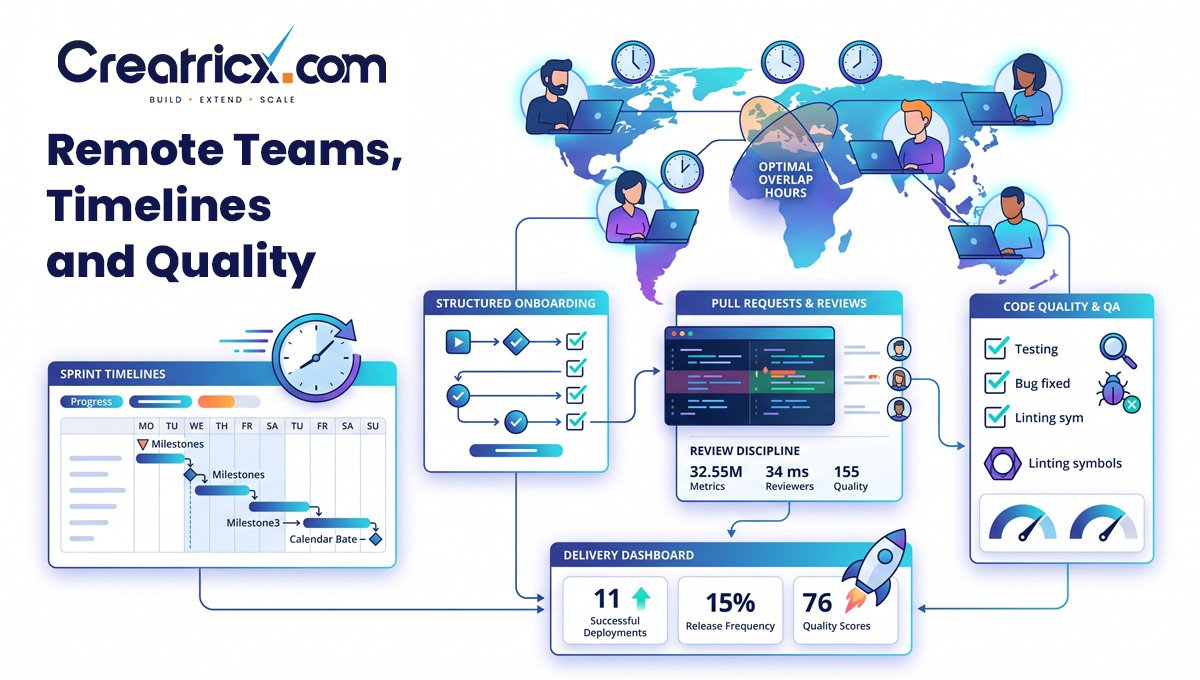
If you take one thing from this Creatricx article, take this: the amount of overlapping working time between your remote team and the people they coordinate with is the strongest single predictor of both timeline and quality. It matters more than the country, the rate, or the tooling.
The mechanism is intuitive once you see the numbers. With zero overlap, every question, clarification, and code review waits for the next day, and those delays compound across a project until, as Microsoft Research found, tasks take roughly two and a half times as long. With full overlap, you lose the follow-the-sun advantage and tend to recreate the meeting sprawl of an office.
The sweet spot that the strongest remote teams converge on is a deliberate window of roughly one to four hours of shared working time, concentrated enough to handle urgent reviews, pairing, and decisions live, while leaving five to six hours of uninterrupted deep work on each side. That structure captures the benefits of distribution without paying the full coordination penalty.
This is precisely why time-zone alignment, not just cost, now drives so many location decisions. A large majority of US tech leaders who chose Latin American teams cite time-zone overlap as the primary reason, because a team a few hours offset behaves completely differently from one twelve hours away, even if their raw skills are identical.
When you evaluate a remote team, the overlap window is not a detail to sort out later. It is the first thing to get right, because almost everything else depends on it.
How Code Review Discipline Protects Remote Team Quality
Timelines are mostly about overlap. Quality is mostly about review discipline, and this is where remote teams either protect code integrity or quietly let it erode.
In a co-located team, a lot of quality control happens informally: a quick question over a shoulder, a casual second pair of eyes, an overheard "wait, does that handle the edge case?" Remote teams lose all of that ambient quality assurance, and if they do not deliberately replace it with a structured process, defects slip through.
The teams that maintain quality remotely do specific things: they keep pull requests small enough for one reviewer to clear properly, they write full context into every PR so no live call is needed, they use explicit tags so there is no ambiguity about what is blocking versus a minor note, and they explain the why in review comments rather than just demanding a change.
Crucially, they ensure their reviewer pool actually covers the clock, so a PR is never stuck waiting because the only qualified reviewer is asleep.
There is a 2026 wrinkle worth naming. AI coding tools now let developers produce more code faster, which sounds like pure upside but actually shifts the bottleneck downstream to review, and a distributed team feels this first because its reviewer pool is already thin and spread across time zones.
Faster code generation without matching review capacity does not speed a project up, it just ships defects sooner.
A remote team that has thought about review capacity in the AI era is in a very different position from one that has simply pointed its developers at Copilot and hoped.
How Onboarding and Documentation Keep Remote Projects on Track
The last major factor is the one businesses most consistently underestimate: how a remote team brings people up to speed, and what happens when someone leaves.
Remote onboarding commonly takes 30 to 50% longer than in-office onboarding, because a new engineer cannot lean over to the person next to them with a quick question and instead has to navigate unfamiliar systems alone. This is a real cost, and it hits your timeline directly in the first weeks of any engagement.
But it is also entirely fixable with structure: a self-serve onboarding path, recorded walkthroughs, documented architecture, and an assigned buddy compress time-to-first-meaningful-commit from weeks to days. Teams that invest here see new engineers contributing quickly; teams that assume talented people will simply figure it out watch their early timeline slip.
Continuity is the related risk. A remote team that depends on tribal knowledge in a few people's heads is fragile, because when one of them leaves, that knowledge walks out with them and the project stalls while it is rebuilt. This is why a documentation-first culture, where decisions and architecture are written down rather than remembered, is not bureaucratic overhead for remote teams.
It is what keeps quality and pace stable as people come and go, and it is one of the clearest signals of a remote team built to last versus one built to impress in the first month.
What Separates Effective Remote Development Teams from Struggling Ones
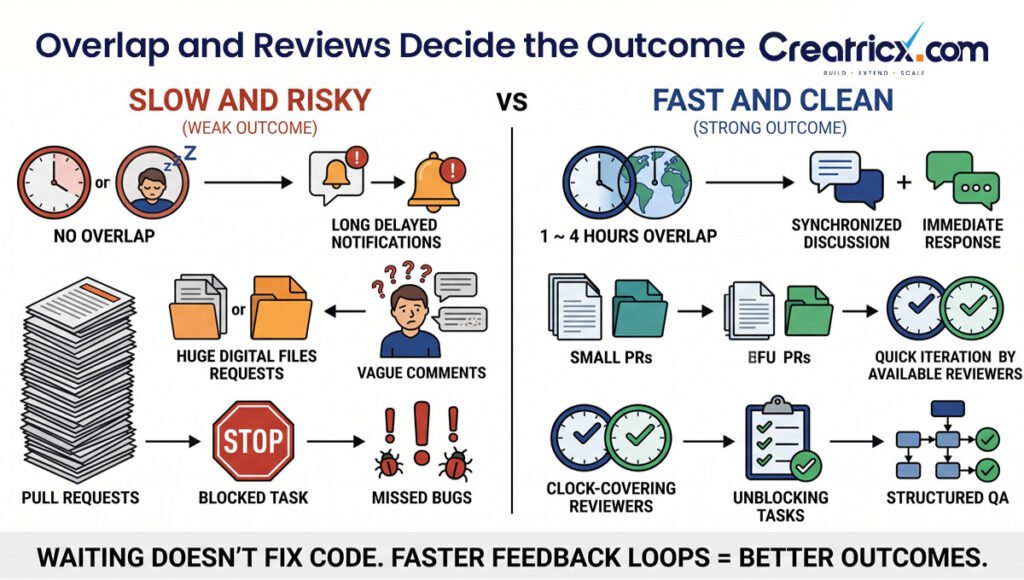
Pulling the mechanisms together, here is what actually distinguishes the remote teams that accelerate projects from the ones that drag them.
| Factor | Remote Team That Slows and Degrades | Remote Team That Accelerates and Protects Quality |
|---|---|---|
| Time-zone overlap | Zero to minimal; feedback loops span days | 1 to 4 hour deliberate overlap window |
| Code review | Ad hoc, large PRs, reviewers not covering the clock | Small PRs, sub-4-hour reviews, clock-covering reviewer pool |
| Onboarding | "Figure it out"; 30 to 50% ramp-up drag left unaddressed | Documented, buddy system, ramp compressed to days |
| Knowledge | Tribal, held in a few heads, lost when people leave | Documentation-first, stable through turnover |
| Management | Presence and hours tracked; meeting sprawl | Outcomes measured; async-first with focused sync |
How Creatricx Approaches Remote Team Structure
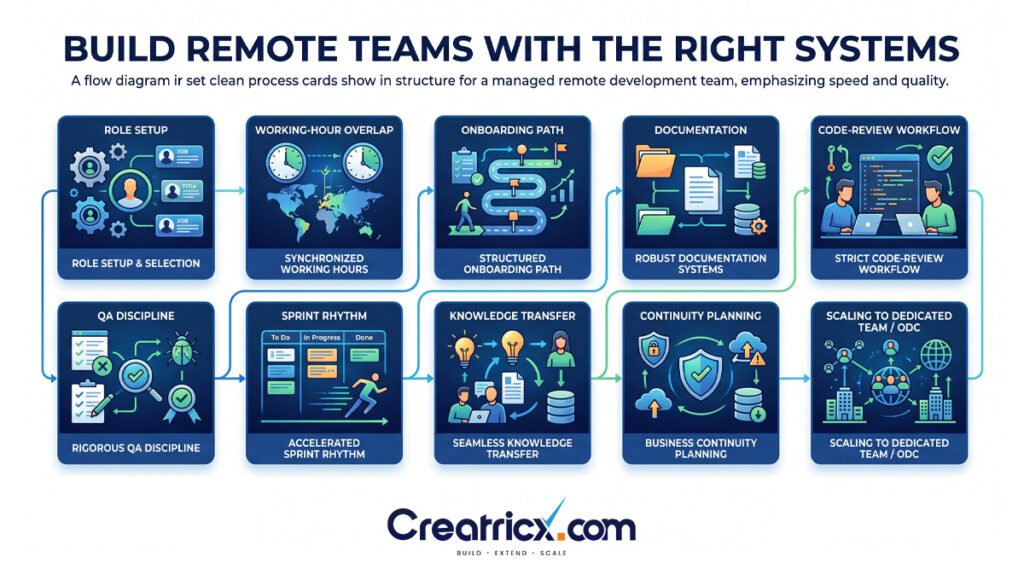
Everything above is why we structure remote development the way we do at Creatricx, because after enough projects it becomes clear that the difference between a remote team that accelerates a project and one that stalls it is almost entirely in the systems around it, not the talent inside it. We build managed dedicated remote teams designed around exactly the conditions this article identifies as decisive.
In practice, that means engagements are structured around genuine time-zone overlap with your team rather than fire-and-forget handoffs, because we operate across UK, US, and German markets and treat that overlap as the foundation it is. It means the specialists we place, from a single developer through staff augmentation to a full dedicated remote team, work within your review processes and tools under your direction, so quality control is built in rather than bolted on.
And because continuity is where so many remote engagements quietly fail, we carry the onboarding, documentation, and cover that keep a team stable as needs change, rather than leaving your project exposed to a single person's availability. Where a single specialist is not enough, the same relationship scales into a full dedicated remote team or an offshore development center without restarting.
Our honest position is the one running through this article: remote development is neither a magic accelerator nor an inevitable risk. It is a model whose outcome depends on structure, and our entire approach is built around supplying that structure so you land in the fast, clean column rather than the slow, buggy one. If your remote setup has struggled with slipping timelines or inconsistent quality, the problem is very likely the systems around the team, and that is precisely what a well-run managed model fixes.
Frequently Asked Questions
Do remote development teams slow down project timelines?
Not inherently. Well-structured remote teams match or beat co-located ones on timelines, especially using follow-the-sun handoffs. Poorly structured ones slow down badly: Microsoft Research found teams with zero overlapping hours took roughly 2.5 times longer than co-located teams. The deciding factor is time-zone overlap and coordination structure, not remoteness itself.
How do remote teams affect code quality?
Quality holds up well under deliberate review discipline and erodes without it. Remote teams lose the informal quality checks of an office, so they must replace them with small pull requests, fast reviews, clear review standards, and a reviewer pool that covers all time zones. Distance does not reduce quality on its own; weak review systems do.
What is the most important factor for remote development team success?
Time-zone overlap is the strongest single predictor of both timeline and quality. A deliberate window of roughly one to four hours of shared working time lets teams handle reviews, pairing, and decisions live while preserving deep-work time, capturing the benefits of distribution without the full coordination penalty of zero overlap.
How much longer does remote onboarding take?
Remote onboarding commonly takes 30 to 50% longer for a new engineer to reach full productivity, because they cannot ask quick in-person questions. This is fixable with a documented self-serve onboarding path, recorded walkthroughs, and a buddy system, which can compress time-to-first-commit from weeks back down to days.
Is there real evidence remote teams perform as well as in-office teams?
Yes. A US Bureau of Labor Statistics analysis of 61 industries found a positive association between remote work and productivity growth, and a Nature randomized trial of 1,612 employees found zero negative performance effect from hybrid remote work. The caveat is that these gains depend on good structure; the same studies do not excuse poorly coordinated teams.
How does AI affect remote development team quality in 2026?
AI coding tools let developers produce more code faster, which shifts the bottleneck to code review, and distributed teams feel this first because their reviewer pool is already thin across time zones. Faster generation without matching review capacity simply ships defects sooner, so remote teams must scale review capacity alongside AI adoption.
How do I know if a remote development team will hurt or help my project?
Check the controllable factors: does it have a deliberate 1 to 4 hour overlap window with your team, does it turn code reviews around within about four working hours, does it have structured onboarding and documentation, and is it managed on outcomes rather than hours? Strong answers predict acceleration; weak answers predict delay.
How does Creatricx ensure remote teams help rather than hurt timelines and quality?
Creatricx builds managed dedicated remote teams around the decisive factors: genuine time-zone overlap with your team, integration into your review processes and tools, and the onboarding, documentation, and continuity that keep quality and pace stable. This structure is designed to place your project in the fast, clean outcome column rather than the slow, buggy one.
Disclaimer
This article reflects research and data on remote development team performance drawn from multiple independent sources, including academic studies and industry reports, alongside Creatricx's own service model, all current at the time of writing. Outcomes vary by team, project, and how well the model is managed. Always confirm current practices directly with any provider, including Creatricx, before committing.