
Table of Contents
Before you quote the project
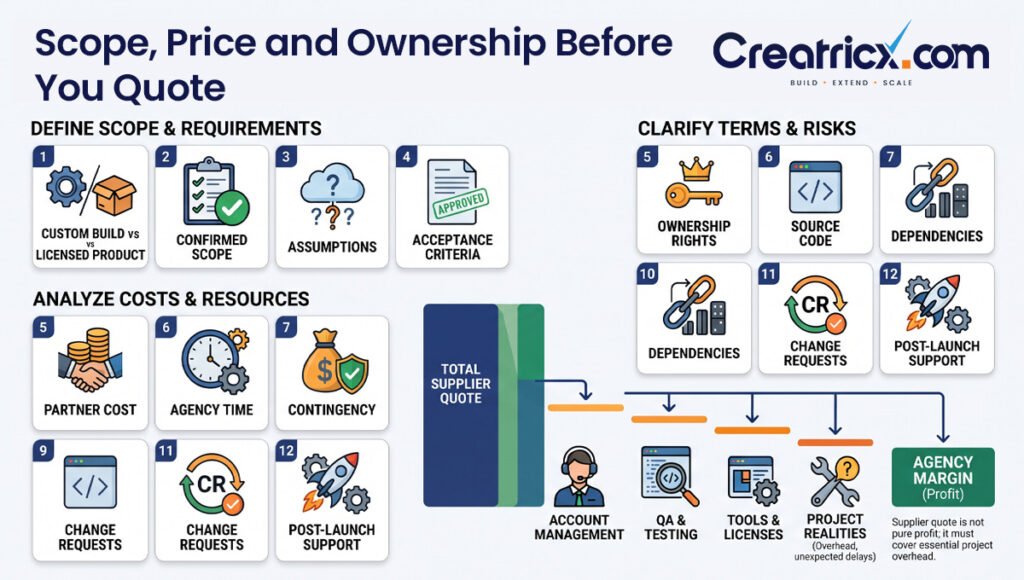
Confirm whether you need a custom build or a license to rebrand an existing product.
Ask the development partner to validate the scope and dependencies before committing to a fixed price or launch date.
Include your account management, review, and support costs in the budget.
Agree on software rights, client communication, acceptance, and change requests in writing.
Decide who maintains the application and pays recurring costs after launch.
Two different offers can carry the white label name
The term covers both custom delivery and the rebranding of existing software. Confusing them can leave an agency promising flexibility or ownership that its supplier agreement does not provide.
Custom software built for your client
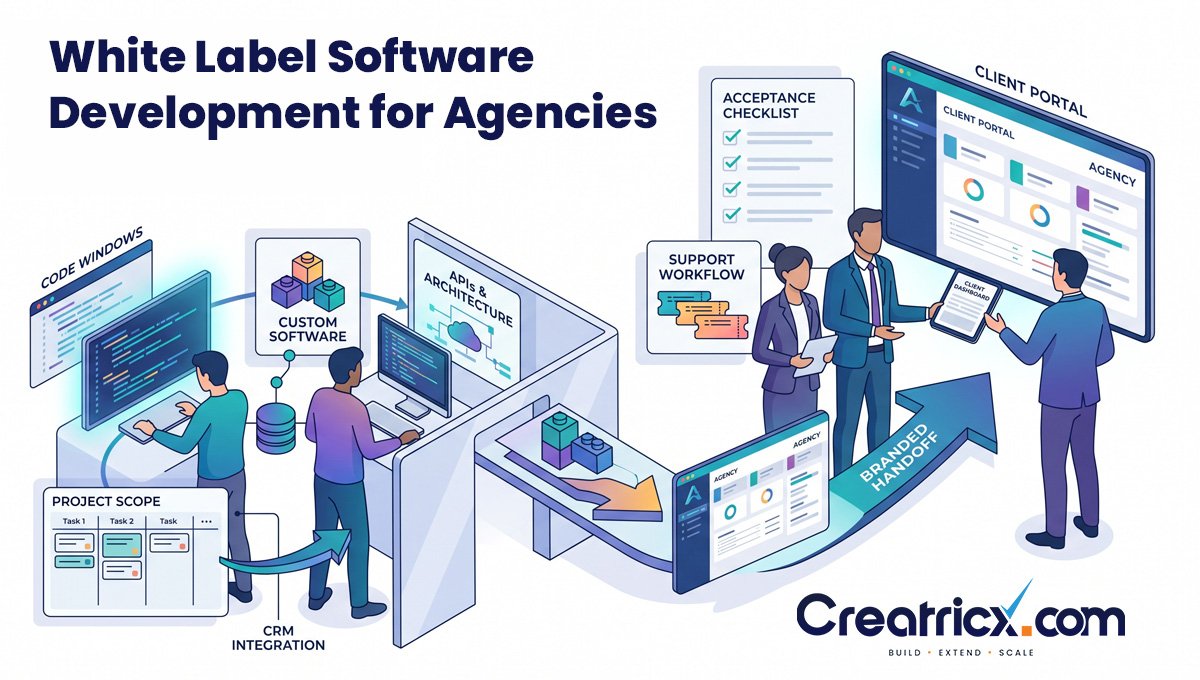
A development partner builds an application, integration, or business system around an agreed requirement. Your agency manages the commercial relationship and presents the work through its own brand and delivery process.
This can suit an agency selling a bespoke client portal, an internal workflow application, or an integration between existing systems. The software still requires discovery, development, testing, and maintenance. Calling it white label does not make the build instant or remove those costs.
An existing product licensed under your brand
A provider supplies an existing application that you can rebrand or resell under specified terms. This may suit a requirement already served by the product, provided its features, integrations, licensing, and data-export options fit the buyer's needs.
You may receive configuration options rather than unrestricted control over the underlying software. Confirm the permitted number of clients, ongoing fees, customization limits, and what happens if the provider retires the product.
| Decision | Custom white-label development | Licensed white-label product |
|---|---|---|
| Starting point | An agreed client requirement | An existing application |
| Main evaluation | Delivery capability and scope | Product fit and licensing terms |
| Changes | Assessed and built within the agreement | Depend on the platform and license |
| Ownership | Defined for bespoke and reused components | Usually centered on licensed usage rights |
| Continuing costs | Maintenance, infrastructure, and improvements | License or subscription plus agreed services |
For an agency with a bespoke requirement, assess the partner as a software delivery business. A product demo alone will not show whether it can design and maintain the system your client needs.
Turn the client request into something a partner can estimate
“Build a customer portal” is a starting point, before quoting, identify who uses it, what each user can do, which information it stores, and which systems it must connect to.
In the portal example, an apparently simple upload feature may involve file-size limits, permissions, notifications, retention, and malware checking. A CRM integration may depend on API access the client has not purchased. These questions affect both the price and the delivery date.
Ask the partner to separate confirmed scope from assumptions and unresolved dependencies. If important details remain unknown, consider a bounded discovery stage before pricing the complete build.
Replace feature labels with acceptance criteria
Instead of “document upload included,” agree that an authorized user can upload specified file types up to an agreed size, see a success or failure message, and access only the documents permitted for their account.
That gives the developer something concrete to implement and the agency something concrete to test. The specification should also identify excluded behavior, such as document editing or version comparison, so these don’t appear later as assumed inclusions.
Pick the engagement around the certainty of the work
A defined project can suit a stable scope and agreed deliverables. Recurring capacity may fit several client accounts with continuing feature requests. If your own technical lead will assign and review the work, staff augmentation may be appropriate.
Before selecting the model, ask who provides technical direction and QA. An agency without engineering leadership should explicitly discuss delivery management rather than assume it comes with every developer allocation.
Price the work after accounting for your own contribution
A supplier quote is one part of your cost, your agency may still handle discovery, client meetings, design clarification, acceptance testing, training, and post-launch coordination.
The following example uses invented US-dollar figures to demonstrate the calculation. It isn’t a Creatricx quotation, market rate, or client result.
| Item | Illustrative amount | What it covers |
|---|---|---|
| Client project price | $24,000 | Revenue before taxes |
| Development partner | $14,000 | Agreed engineering delivery |
| Agency delivery work | $3,000 | Allocated account management and review time |
| Project tools and services | $1,000 | Costs incurred for this engagement |
| Contribution before contingency and overhead | $6,000 | Revenue minus the three cost items above |
The $10,000 difference between the client price and supplier fee isn’t all profit. After the listed agency and project costs, the contribution is $6,000, or 25% of revenue. Reserving a further $2,000 for possible project issues leaves $4,000, or 16.7%, before general overhead and taxes if that reserve is fully used.
A contingency allowance is a planning provision, not an expense already incurred. Internal time may already be included in payroll, but allocating it here helps you assess whether the engagement uses your agency's capacity well.
Check cash timing as well. If the partner requires a milestone payment before your client pays, your agency must fund the gap. Agree payment triggers, acceptance dates, recurring fees, and change approval before using a supplier quote to set your client price.
Keep the client promise and the partner agreement aligned
Your client should receive a service you can deliver through the arrangement you have purchased. Review the two scopes together: deliverables, deadlines, acceptance, ownership, and support commitments should be compatible.
For example, promising round-the-clock incident response to your client requires an agreed coverage arrangement behind it. A partner's normal business-hours support will not fulfill that promise automatically.
Agree on the visible delivery process
Decide who sends progress updates, presents demonstrations, answers technical questions, and approves changes. Technical specialists can remain behind the scenes or join calls through an agreed introduction and communication model.
White-label branding should respect the client's contract and any applicable disclosure or data-handling requirements. Confirm whether subcontracting needs approval before offering an arrangement that depends on it.
Record whether the partner can use client names, screenshots, or work samples in a portfolio. Also agree how commercial discussions are routed so a technical call does not create an unapproved price, deadline, or scope commitment.
Separate delivery defects from additional work
Use the accepted specification as the starting point. If the agreed upload function fails for permitted files, it may be a defect to resolve under the agreement. If the client later requests automatic document translation, that is a new requirement to assess.
Document the impact of each change on cost and timing, and obtain approval before starting it. This protects the agency from absorbing work that neither its client price nor its supplier budget includes.
Clarify what the client will own and what it will license
A white-label arrangement concerns branding and delivery. Ownership requires its own terms. Separate newly commissioned code and designs from pre-existing components, open-source dependencies, and commercial third-party services.
As a US-specific example, the Copyright Office explains that “work made for hire” applies only under defined conditions. Section 204 of the US Copyright Act generally requires a signed writing for a transfer of copyright ownership other than by operation of law. Paying for development should therefore not be treated as a substitute for appropriate ownership documentation.
Ask a qualified adviser to review the applicable terms for the jurisdictions and parties involved. The practical questions are what rights the provider can grant, when they take effect, and whether your agency can pass the promised rights to its client.
A branded interface can still contain licensed components
Open-source software isn’t automatically free of obligations.
For example, the MIT License permits broad use, modification, and sale while requiring its copyright and permission notices in copies or substantial portions of the software.
Request a record of relevant dependencies and licenses. Don’t promise that all third-party notices can be removed or that the client will exclusively own every component.
For a licensed product, check modification, resale, export, and termination rights before selling ongoing access.
Also establish who controls the repository, hosting account, domain, deployment credentials, and paid integrations. Source-code delivery alone does not give a client operational control over all of those services.
Test the delivery before putting your agency name on it
Use a staging environment and an agreed acceptance checklist. Review the application as the intended user, including permissions, failed actions, and recovery paths. A successful demonstration of the main workflow is only one part of acceptance.
For the portal, useful checks include whether one customer can access another customer's documents, what happens when the CRM connection fails, and whether the team can restore the system from a backup under the agreed recovery plan.
NIST's Secure Software Development Framework recommends incorporating security practices into the software development lifecycle. For an agency, it is a useful reference when discussing how a partner protects development work, checks releases, and handles vulnerabilities. It is not evidence that a particular provider is certified or that an application is secure.
Ask for evidence your team can review
Request the agreed test results, known limitations, deployment instructions, and the owner responsible for launch approval. Decide which issues block release and which can be accepted with a documented plan.
If the agency can’t evaluate important technical risks internally, include suitably qualified review in the scope.
White-label delivery works better when the agency can explain how it accepted the work it is handing to its client.
Define the service that starts after launch
Clarify the duration and scope of any defect-correction period. Keep this separate from ongoing maintenance, new features, infrastructure charges, and support coverage. Specify whether the agency or client is the first contact when something goes wrong.
Response time and resolution time are different commitments. A prompt acknowledgment does not establish how quickly a defect will be fixed, particularly when investigation or an external provider is involved.
Before handover, confirm the arrangements for:
- Hosting, monitoring, backups, and account billing.
- Dependency updates and vulnerability handling.
- Incident escalation and coverage hours.
- Documentation, access changes, and technical knowledge transfer.
- Moving the application or data to another provider if the relationship ends.
These details make ongoing support easier to price and reduce the chance that a completed build becomes an undefined obligation for your agency.
How Creatricx can support your agency
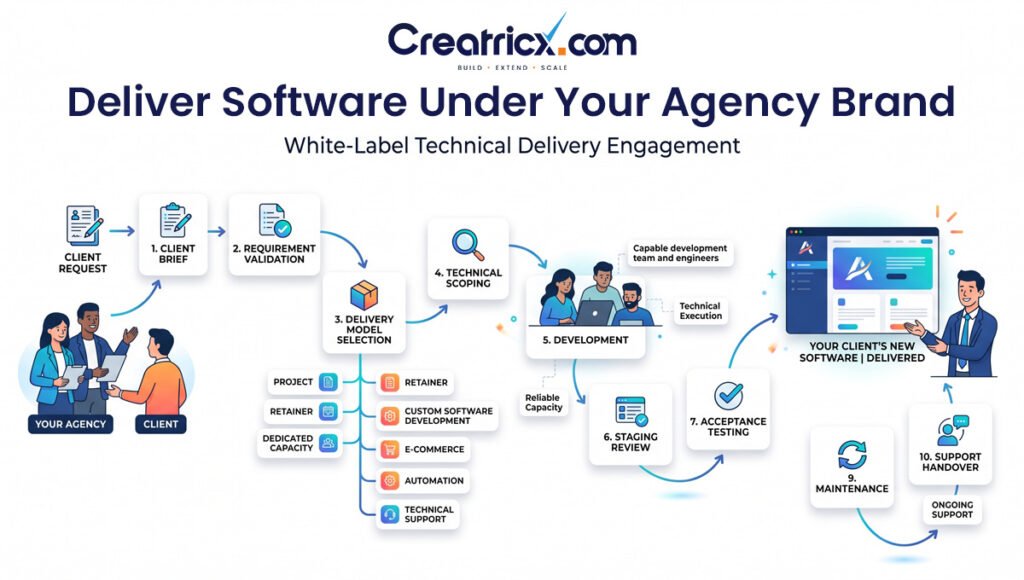
Creatricx's offering includes white-label web development, e-commerce delivery, automation, and ongoing technical capacity. Work can be structured as a project, retainer, or dedicated-capacity engagement, with communication and client access agreed in advance.
For bespoke applications and integrations, discuss the requirement alongside our custom software development services. Confirm the technical scope, ownership terms, acceptance process, and support model in the proposal rather than assuming one arrangement fits every client.
Our agency partnership page explains the available delivery models. Creatricx can participate in client calls when required or work behind the agency through an agreed process.
Send a brief that makes the first conversation useful
Share the client's business problem, intended users, required workflows, existing systems, target date, and budget range. Include what your agency will handle, where it needs technical support, and whether the project involves sensitive information or subcontracting restrictions.
Discuss a white-label development project with Creatricx before committing to your final client quote. Use that conversation to validate the proposed solution and identify the responsibilities, assumptions, and costs that need to be agreed.
Frequently asked questions
Is white label software development the same as outsourcing?
It is a form of outsourcing with an additional branding and client-delivery arrangement. General outsourcing doesn’t necessarily mean work will be presented under another company's brand. Agree the communication, attribution, and commercial responsibilities explicitly.
Can an agency sell software without an internal development team?
An agency can work with a development partner, but it still needs a way to manage scope, client expectations, acceptance, and support. If technical leadership and QA are also needed, include them in the engagement rather than buying development hours alone.
Does white label software development include source code?
That depends on the agreement. A custom build may include source-code handover and specified ownership rights; a licensed platform may provide only configuration and usage rights. Confirm both access to the code and the rights to use, modify, and transfer it.
How much does white label software development cost?
The cost depends on the delivery model, scope, integrations, technical complexity, and support obligations. For custom development, request an estimate against a defined brief. For licensed products, compare setup, subscription, customization, and exit costs over the intended period of use.