
Table of Contents
Start with the result your business needs
Before comparing IT partners, describe the problem in business terms. “We need developers” is a staffing request. “Customers can’t track their orders without calling support” identifies a problem a partner can investigate.
Write down 4 things:
The outcome you want and how you will recognise improvement.
The systems, workflows or users affected.
The people and expertise already available internally.
The budget, deadline and constraints the work must respect.
Lets suppose, a distributor might want order updates to flow between its sales platform and warehouse system. The requirement includes understanding the data, implementing the integration, testing failures and maintaining the connection. Hiring one developer may be appropriate if the business already has someone to lead that work. Otherwise, a defined project engagement may be more suitable.
This is just a scenario, not a reported Creatricx client result.
Pick how much delivery responsibility to retain
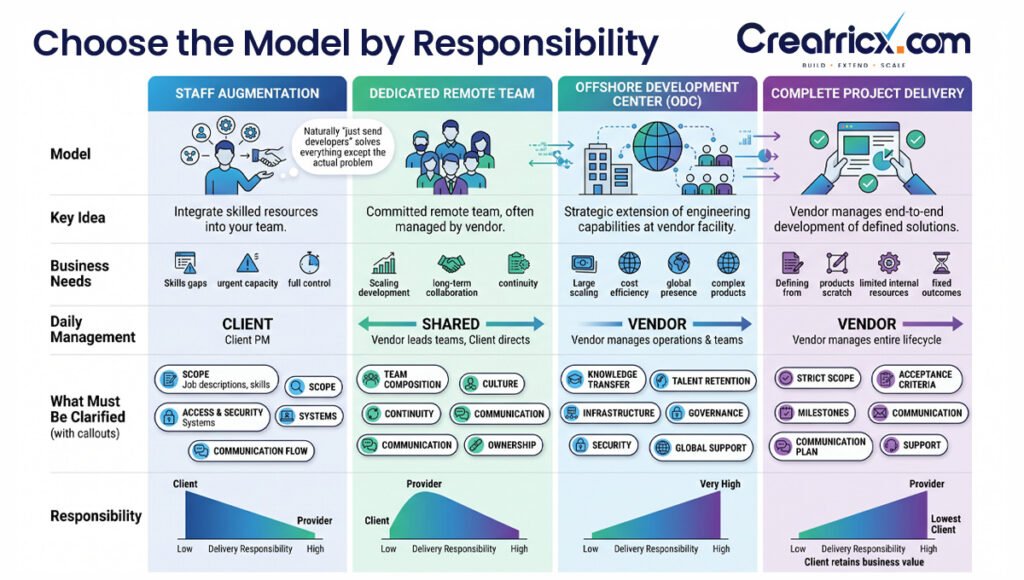
An IT partnership doesn’t have to mean handing over the entire technology function. Creatricx offers different routes for accessing capability and completing work.
Use the responsibilities behind each route to guide your choice.
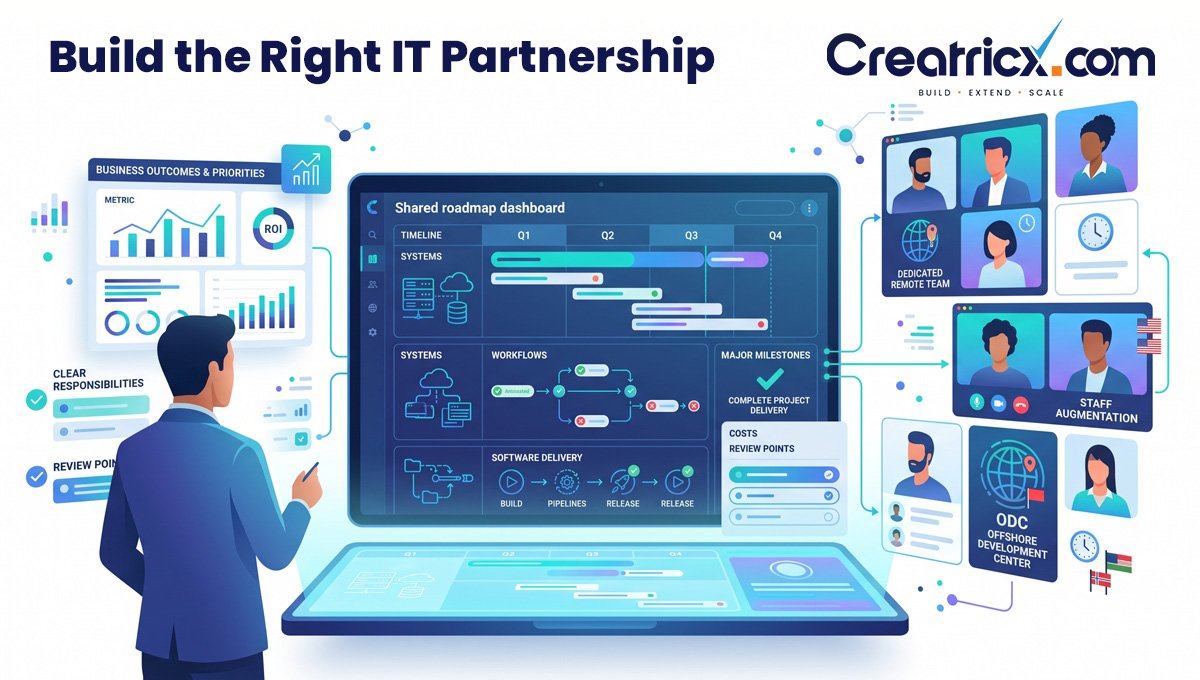
| Your requirement | Model to discuss | What to clarify |
|---|---|---|
| A missing skill in an existing team | Staff augmentation | Who assigns tasks, reviews output and manages priorities |
| Recurring work across several roles | Dedicated remote team | Team composition, leadership and roadmap ownership |
| A structured offshore operation | Offshore development center | Governance, infrastructure and operational support |
| A defined application or integration | Complete project delivery | Scope, acceptance criteria, milestones and support |
Add experts or specialists when your management structure is already working
Staff augmentation can fit a team with clear priorities and established delivery leadership. The business retains day-to-day direction while adding skills or capacity.
Discuss Creatricx staff augmentation when the gap is a role your existing team can manage. If the work also needs architecture, planning and quality leadership, include those responsibilities in the conversation.
Build continuity around an ongoing roadmap
A dedicated team can support work that continues across releases or business priorities. Agree how the team receives requirements, who resolves competing requests and how progress is reviewed.
An offshore development center adds a more structured operating arrangement. Creatricx describes support for areas including team design, recruitment, leadership, infrastructure, HR coordination and governance, with the responsibility split agreed during setup.
Consider that model when these operating needs justify the additional structure.
Define an outcome when you need a project delivered
For a bounded requirement, discuss the result before selecting individual roles. A project may need design, development, testing and deployment input at different stages.
Separate discovery from a delivery commitment when major requirements remain unresolved. An estimate based on assumptions should identify those assumptions so that neither side mistakes uncertainty for an agreed scope.
Agree the operating rules before work begins
The partnership should give your business a clear way to make decisions. A capable team still needs timely answers, usable access and an authorised person who can approve changes.
Name a business owner on your side and a delivery contact on the partner’s side. Then document the following areas.
Scope and acceptance
Specify what will be delivered, what is excluded and how the result will be checked.
For a customer portal, “ready to launch” might require approved user permissions, tested workflows, deployment instructions and an agreed approach to support.
Explain how new requests affect cost and timing. A change log makes it easier to distinguish additional scope from work needed to meet the original requirement.
Communication and decisions
Agree working-hour overlap, progress reporting and escalation routes. Reports should identify completed work, current blockers and decisions needed from your business.
For ongoing delivery, a shared backlog can keep priorities visible. Assign one person authority to resolve conflicts when different departments ask for urgent work.
Access and security responsibilities
Ask which systems the partner needs to access, how permissions will be granted and removed, and who handles security issues. Request evidence relevant to the work rather than relying on broad security statements.
NIST’s Cybersecurity Framework supply-chain guidance specifically addresses defining and communicating requirements to technology suppliers. Applied to an IT partnership, that means setting expectations before access is granted and checking that the agreed practices are followed.
Note: This reference is guidance, not a claim that Creatricx holds a NIST certification.
Ownership and continuity
Clarify the rights to deliverables, third-party licences, administrative access and handover requirements in the agreement. Keep important information accessible to the people who need to maintain the work.
Also discuss what happens if a team member changes, the partnership ends or responsibility returns in-house. Documentation and knowledge transfer should be part of delivery planning.
Compare complete costs and measurable progress
An hourly rate or monthly fee tells only part of the story. Ask what the quote includes: delivery management, testing, onboarding, tools, infrastructure and post-launch support can materially affect the comparison.
Your business also contributes time. Include internal coordination, reviews and decisions when assessing the effort required to work with a partner.
Select measures that reflect the reason for the engagement. For software delivery, track accepted milestones and issues discovered after release. For workflow automation, compare manual effort and error rates before and after implementation. For ongoing support, review recurring incidents and performance against the agreed service scope.
Set a baseline before delivery starts. Avoid treating hours logged as proof of business improvement, or assuming that every outcome can be attributed to the partner alone.
What an IT partnership with Creatricx can cover
Creatricx’s technical capabilities include websites, mobile applications, custom software, AI automation, cloud and e-commerce work. Its published approach allows businesses to engage specialists, teams or project delivery, with working arrangements matched to the requirement.
For your business, the useful discussion is how those capabilities connect to the work you need done. A software backlog may call for sustained engineering capacity. A disconnected workflow may need a focused integration project. A growing offshore function may need an operating structure with leadership and continuity support.
Start with the immediate requirement and the responsibilities your business can retain. Discuss additional services when there is a clear dependency or ongoing need.
Prepare for your first partnership discussion
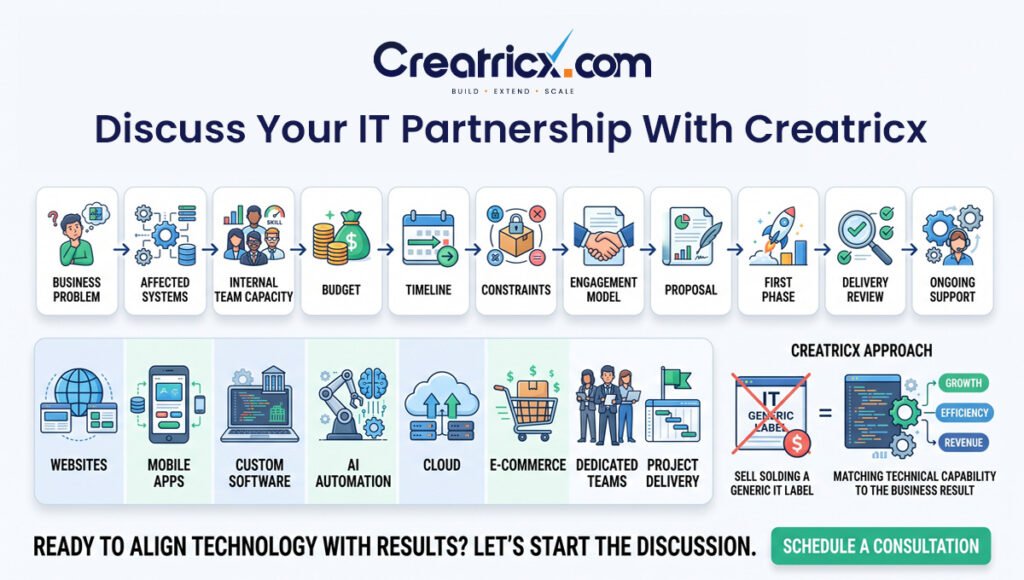
You don’t need a finished technical specification to make an inquiry. A clear explanation of the problem is enough to start assessing the next step.
Send Creatricx:
- A short description of your business and the problem to solve.
- The relevant systems and any existing documentation.
- Your internal team’s skills and availability.
- The expected timeline and budget range.
- Any access, data or operational constraints.
- Whether you need ongoing capacity or a defined deliverable.
Use the discussion to clarify fit, unresolved questions and the appropriate engagement model. Before committing, request a written proposal covering responsibilities, assumptions, commercial terms and the first review point.
A focused first phase can help both sides establish a working rhythm. Depending on the requirement, that might be discovery, one integration or a defined set of improvements. The size and timing should follow the work; there is no universal trial period that fits every IT partnership.
Frequently asked questions
Is an IT partnership the same as IT support?
IT support can be part of a partnership, but the relationship may also cover software development, integrations, automation or ongoing technical capacity. Define which responsibilities are included rather than assuming every IT service is covered.
Can Creatricx work alongside our internal team?
Creatricx lists staff augmentation and dedicated teams among its engagement models. [1] Discuss the roles needed, your management capacity and how external specialists would enter your existing workflow.
How much does an IT partnership cost?
The cost depends on scope, skills, capacity, management responsibilities and support requirements. Request a proposal that explains included work, assumptions and additional charges. A broad label such as “IT partnership” is not enough to produce a meaningful price.
Do we need a long-term commitment immediately?
The appropriate commitment depends on the model and commercial terms. A defined project and a continuing team arrangement have different requirements. Discuss duration, notice periods and review points before signing.
Discuss your next step with Creatricx
A useful IT partnership starts with a clear problem, a suitable delivery model and responsibilities both sides understand. Bring Creatricx the work you need to complete, the capability you already have and the constraints you need to manage.
Discuss an IT partnership with Creatricx to explore a specialist, dedicated team, offshore development center or project delivery approach that fits your requirement.