
Table of Contents
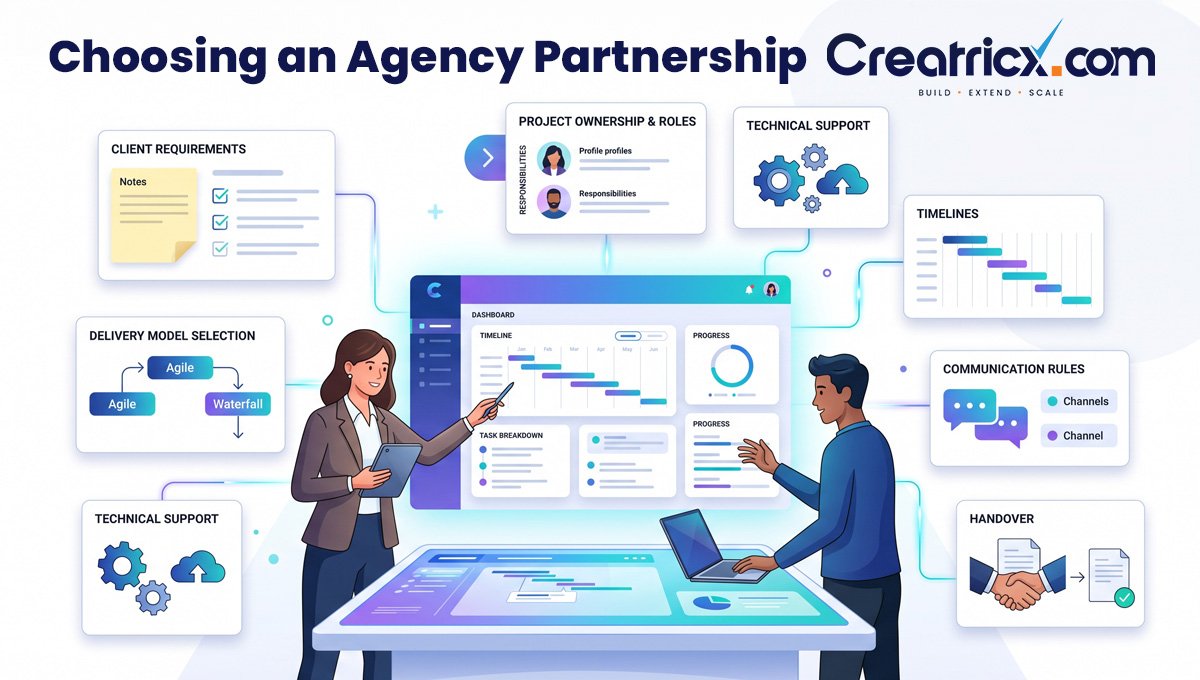
What to decide before approaching an agency partner
Identify whether you need introductions, project delivery or additional people.
Decide who will contract with the client and approve changes.
Include your own account management and review time when assessing the commercial return.
Test the partner on a defined piece of relevant work.
Agree communication, access, handover and support before expanding the relationship.
These decisions give a prospective partner something concrete to respond to.
“We need someone reliable” is difficult to assess. “We need a team to implement our approved designs, report to our project manager and maintain the site after launch” is a usable brief.
Select the partnership around the role you want to keep
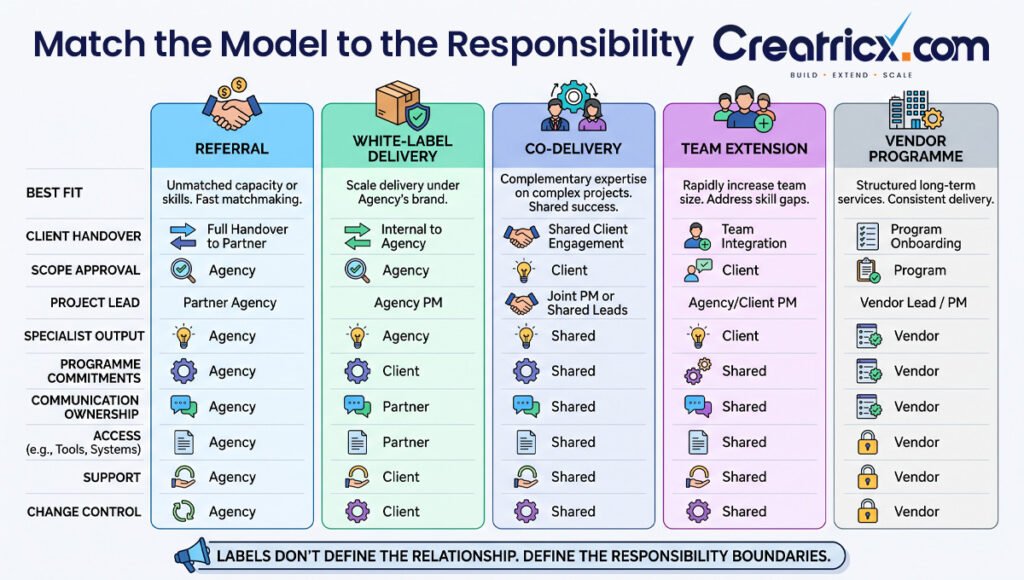
The word partnership covers several different arrangements.
Promethean Research distinguishes referral, white-label and strategic alliance models in its agency growth guidance.
For agencies buying technical delivery, it is also helpful to distinguish shared project delivery from adding specialists to an existing team.
| Model | Best fit | Responsibility to clarify |
|---|---|---|
| Referral | The client needs a service you don’t want to manage | Who takes over the enquiry and communicates its status |
| White-label delivery | You want to sell the service under your agency brand | Who defines scope, approves work and handles client feedback |
| Co-delivery | Both businesses need to contribute directly | Who leads the project and makes final decisions |
| Team extension | You have delivery leadership but need more capacity | Who assigns work and checks the specialists’ output |
| Vendor programme | Your clients use a platform you want to specialise in | Programme eligibility, incentives and ongoing commitments |
These are practical categories, not a universal set of contract definitions. A supplier may use different labels, so compare the actual responsibilities.
Refer work when managing it would weaken your core service
A referral arrangement can suit an agency that wants to help a client without taking responsibility for an unfamiliar service.
For example, a branding studio might introduce a technical specialist while retaining its existing creative engagement.
Agree what information may be shared and who will update the referring agency. If a fee is involved, define what triggers it, which revenue it applies to and when it becomes payable. Avoid assuming that an introduction automatically creates an entitlement to commission.
Use white-label delivery when you want to manage the client account
In this model, the agency presents the service under its own brand while another business performs agreed delivery work. The agency needs enough capability to brief the partner, assess progress and explain decisions to the client.
It can be a good fit when your agency sells websites or digital projects but needs additional implementation expertise. It becomes difficult when nobody inside the agency has time to review the work or manage changing requirements.
Choose co-delivery when the client needs both teams involved
Some projects benefit from a visible technical partner. Your agency might lead research and design while a development team discusses integrations directly with the client’s IT department.
The main challenge is decision-making. Appoint one lead for the overall engagement and identify who can approve budget, scope and launch changes. Two active teams should not give the client conflicting commitments.
Add specialists when the missing piece is capacity
Team extension works differently from handing over a project. Your agency supplies the priorities and delivery management; external specialists contribute to that workflow.
If the agency has no technical lead or review process, adding a developer may leave the coordination problem unresolved. In that situation, discuss a managed delivery arrangement before choosing individual roles.
Treat vendor programmes as a separate decision
A platform partnership may provide training, resources or referral opportunities rather than people to complete client projects.
For example, Sprout Social describes a programme that combines agency resources with a referral process and revenue opportunities.
Joining such a programme and finding a technical delivery partner can both be useful, but they solve different problems.
Write the brief before comparing providers
A useful partnership brief explains the work you expect to send, how often it arrives and what your team will retain. Without it, one provider may quote implementation only while another includes discovery, project management and support.
Start with the next realistic opportunity. Include the client’s objective, current platform, required deliverables, dependencies, budget range and deadline. State which elements are approved and which still need investigation.
Then explain your agency’s contribution. Are designs complete? Will you provide content? Who will test the result? Can someone answer technical questions during development?
A simple enquiry might read:
“We are a creative agency planning a client website rebuild. We will supply approved designs, content and an account manager. We need implementation, testing and deployment support. Please explain the information you need to estimate the work, how you handle changes and what support can continue after launch.”
This is an example brief, not a description of a completed Creatricx project.
Check whether the commercial model survives real delivery
A lower supplier quote does not necessarily produce a better project return. Your agency may still spend time clarifying requirements, managing the client, reviewing deliverables and coordinating fixes.
Use a simple calculation before accepting the work:
Project contribution = client revenue − partner fees − internal delivery costs − other direct project costs.
For an illustrative project, assume the client pays $18,000, the partner charges $10,500, your internal work costs $3,000 and project-specific tools cost $500. The remaining contribution is $4,000, or 22.2% of revenue, before general overhead and taxes. If unbudgeted rework costs another $1,500, that falls to $2,500, or 13.9%.
These figures demonstrate the calculation; they aren’t Creatricx prices or industry benchmarks.
Match recurring commitments to your pipeline
Project pricing can suit a bounded requirement. Reserved capacity may suit recurring work, but ask what happens when demand falls or several clients need support simultaneously.
Clarify notice periods, capacity limits, unused allocations and urgent work. A monthly arrangement is easier to manage when both sides understand what is being reserved and how priorities are set.
Also check payment timing. If your partner requires payment before your client pays, your agency must finance the gap. A profitable project on paper can still put pressure on cash flow.
Make client communication a working process
Protecting a client relationship requires clear behaviour during delivery. Decide who attends meetings, where requests are recorded and who confirms changes to price or timing.
A practical setup gives the agency account manager ownership of commercial commitments and the technical lead responsibility for explaining implementation options. Any request affecting the agreed scope returns to the authorised decision-maker before work proceeds.
For example, a client may ask a developer for “one small dashboard change” during a demonstration. The developer can clarify the request, but should not promise a delivery date before its impact is assessed.
Keep these operating decisions in a shared record:
- Who may contact the client and for which topics.
- Who receives and consolidates feedback.
- Who can approve additional work or a revised deadline.
- How urgent issues are escalated and during which working hours.
- Who controls accounts, repositories and access permissions.
- What documentation and access must be handed over at the end.
Align the arrangement with the commitments your agency has made to its client. White-label presentation should not become a reason to make inaccurate statements about who performs the work. Obtain appropriate advice for contract, ownership and data obligations where needed.
Test the working relationship on a bounded engagement
A portfolio helps establish relevance, but it does not show how a partner responds to your agency’s briefs, feedback and review process. A small paid engagement can provide that evidence.
Choose work representative of future demand: an integration, a limited website build or a technical discovery exercise. Avoid using a critical launch with an immovable deadline as the first test.
Before starting, write down the deliverable, acceptance criteria, responsibilities and review dates. For a form-to-CRM integration, acceptance might include correct field mapping, duplicate handling, visible error reporting and a documented handover. The criteria should follow the actual client requirement.
During the engagement, observe whether the partner asks useful questions, exposes uncertainty early and keeps agreed records current. A revised estimate with a clear explanation is more useful than an unchanged promise that hides a known problem.
After delivery, compare the result against the brief. Record how much management time the agency used, which work needed correction and whether another person can understand the handover. Use those findings to decide whether to repeat, expand or stop the arrangement.
Review the partnership using measures you can act on
Revenue alone does not show whether a partnership is improving the agency. A growing volume of work can conceal rising coordination costs or repeated defects.
Track a small set of measures consistently:
| Measure | What to record | What it helps you decide |
|---|---|---|
| Delivery reliability | Milestones met and reasons for changes | Whether planning or dependencies need attention |
| First review acceptance | Deliverables accepted without material rework | Whether briefs and quality expectations align |
| Agency effort | Internal hours spent managing each project | Whether the arrangement creates usable capacity |
| Project contribution | Revenue less direct delivery costs | Whether pricing covers the full delivery effort |
| Continuity | Documentation gaps and unresolved handover items | Whether the agency can support the client later |
Use the first engagement as a baseline rather than imposing an arbitrary industry target. Review causes with the partner: a delay caused by late client content needs a different response from an unreported technical blocker.
For recurring partnerships, also review upcoming demand. Share likely work early, but distinguish confirmed projects from opportunities still being sold. That helps both teams plan without treating an uncertain pipeline as guaranteed capacity demand.
How Creatricx supports agency partnerships
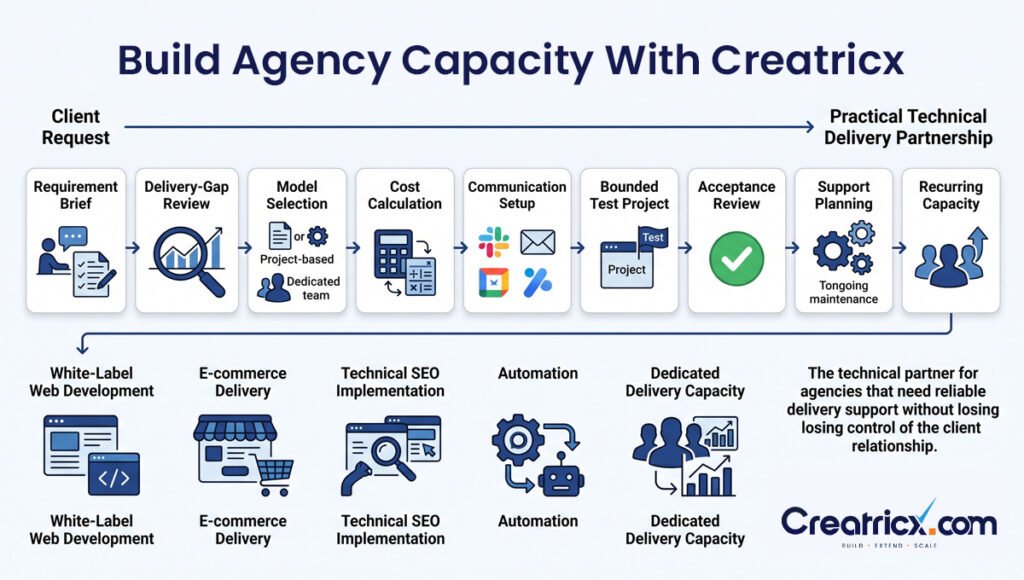
Creatricx works with marketing, advertising and creative agencies that need technical delivery support. Its agency offering covers white-label web development, e-commerce delivery, technical SEO implementation, automation and dedicated delivery capacity.
Engagements can be structured around a defined project, recurring support or additional specialists. Client communication is agreed in advance, including whether Creatricx participates in calls or works behind the agency. The published process covers discovery, planning, delivery and testing, followed by launch and ongoing improvement.
The practical starting point is your next client requirement. Share what your agency will manage, where delivery support is needed and which constraints are already fixed. That gives the conversation a clear purpose and helps establish whether project delivery or ongoing capacity is appropriate.
Questions agencies ask before partnering
Is an agency partnership the same as outsourcing
The terms can overlap. Outsourcing describes work performed externally; a partnership usually implies an ongoing way of collaborating. The useful distinction is the agreed scope, responsibilities and commercial arrangement, rather than the label alone.
Should a small agency hire internally or use a partner
Compare recurring demand, available management time and the importance of the capability to your core service. Consistent work may justify hiring. Intermittent or specialist work may suit a partner. Include recruitment, supervision and partner coordination in the comparison.
Does every agency partnership include referral commission
No. A delivery arrangement may involve project fees or reserved capacity with no referral payment. Vendor and referral programmes may have separate incentives. Confirm the terms directly rather than transferring assumptions from one model to another.
Can we start with a single client project
A defined project can be a useful way to evaluate a prospective partner before making a recurring commitment. Creatricx lists project delivery among its agency engagement options. Discuss the scope and commercial terms before treating the project as a trial. [3]
What should we send Creatricx first
Send your agency website, a short project brief, available designs or technical information, the expected timeline and the responsibilities your team will retain. If the scope is still uncertain, identify the decisions that need discovery before a reliable estimate is possible.
Start with a clear requirement
Choose the partnership model that matches the responsibility your agency wants to retain. Then evaluate the partner against real work, complete delivery costs and an agreed communication process.
If your next client project needs technical capability beyond your current team, discuss an agency partnership with Creatricx. Bring the brief and the delivery gaps you need to resolve so the conversation can lead to a practical scope.