
Table of Contents
Staff Augmentation Companies at a Glance
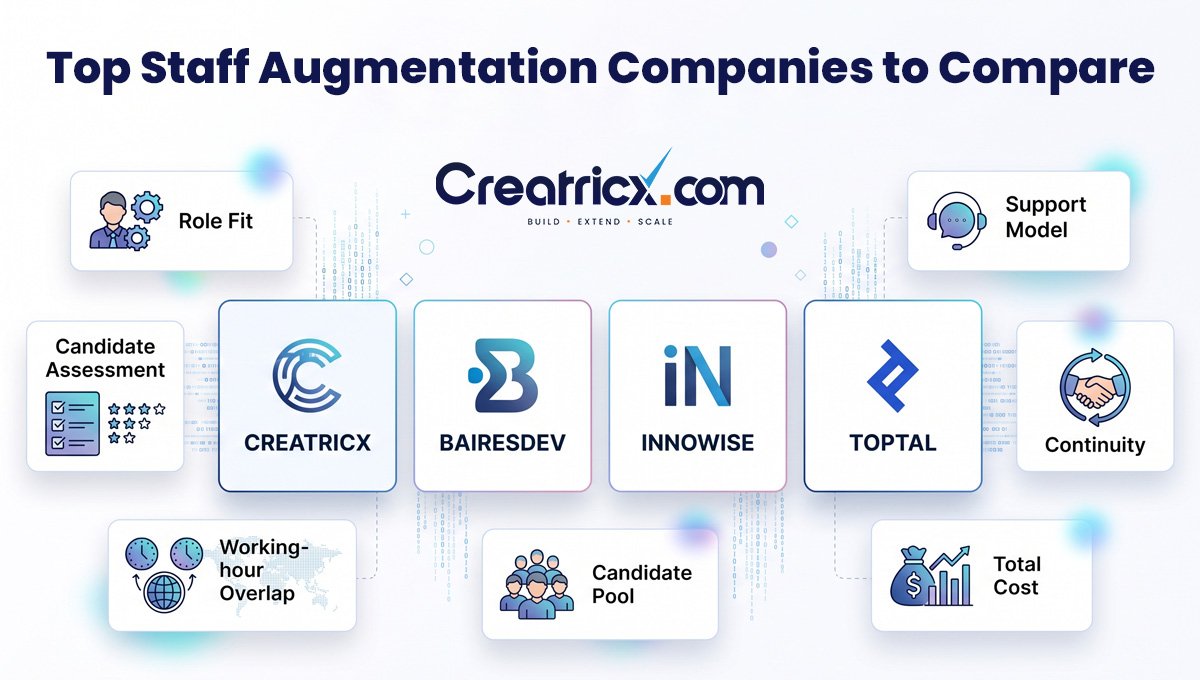
This comparison focuses on technology and digital teams. It includes both team-extension providers and a freelance talent network because buyers often consider these options together. The services are not identical; the engagement you purchase determines who manages the work and supports continuity.
| Provider | Published service focus | What to confirm |
|---|---|---|
| Creatricx | Specialists integrated into client teams | Role fit, overlap and engagement support |
| BairesDev | Nearshore engineering team extension | Candidate availability and management scope |
| Innowise | IT augmentation across engineering roles | Technical assessment and scaling terms |
| Toptal | Freelance professional network | Individual versus team support arrangements |
The descriptions below explain the basis for these comparisons. The questions in the final column are due-diligence prompts, not findings that a provider lacks those capabilities.
1. Creatricx: Specialists Working Within Your Existing Team
Creatricx offers IT staff augmentation for businesses that need additional skills or capacity while keeping day-to-day direction in-house. Its service model combines talent sourcing and onboarding with HR coordination and replacement planning.
The practical starting point is your delivery requirement. Explain which skills are missing, who will manage the specialist and what the person needs to contribute. Ask to assess relevant profiles against that brief before agreeing the engagement.
Why Put Creatricx on Your Shortlist?
Creatricx also offers dedicated developers across technologies including PHP, Laravel, JavaScript and other backend and frontend stacks. This provides a relevant route when the capacity gap is specifically in engineering.
For broader ongoing work, its dedicated remote team model allows discussion of multiple roles aligned to your tools, priorities and agreed business hours.
The buying decision still needs specifics. Confirmed named candidates, committed capacity, review process, overlap hours and replacement terms Role and availability depends on matching speed. Agree schedule for your requirement.
Discuss your staff augmentation needs with Creatricx with a short brief around the role, initial work and expected length of engagement.
2. BairesDev: Nearshore Engineering Team Extension
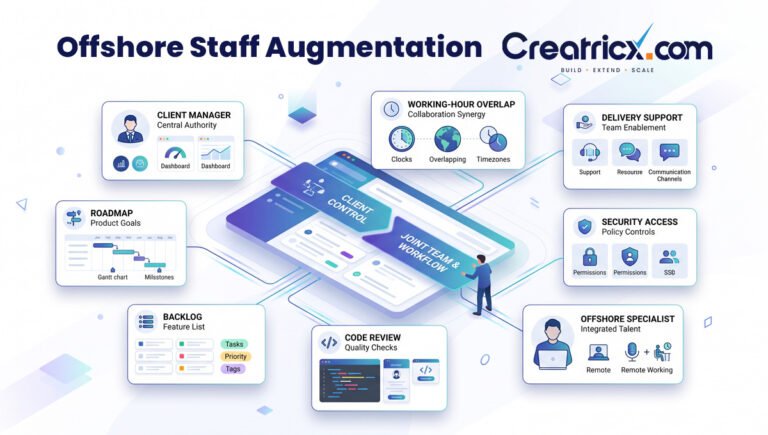
BairesDev describes its staff augmentation service as adding nearshore software engineers and technology professionals to internal teams. Its published model emphasizes engineers working within the client’s hours, tools and delivery processes while client leads direct priorities.
That makes it an option to investigate when nearshore collaboration is central to the requirement. Ask for candidate-level evidence of the working-hour overlap, technology experience and responsibility your project needs.
For comparison purposes, request a clear distinction between staff augmentation, dedicated teams and full project outsourcing. BairesDev offers multiple models, and the management responsibilities differ. Verify the services and support included in the actual proposal, don’t assume the full service portfolio accompanies every engagement.
3. Innowise: IT Specialists Across Multiple Engineering Roles
Innowise’s augmentation page describes client-controlled priorities and workflows, with the provider handling administration and support. Its listed roles cover development, QA, DevOps and AI, among others.
Consider it when your shortlist needs a provider with a broad published technology offering. Assess the available candidates for the specific stack, version and delivery environment you use.
Ask how technical screening relates to your role, what evidence can be reviewed and how changes in team size are handled. Published onboarding or scaling statements should be confirmed for the actual candidates and contract. An advertised talent pool is different from a specialist who is available to start on your required date.
4. Toptal: A Freelance Talent Network to Compare Alongside Providers
Toptal presents a network of freelance professionals covering software development, design, product and project management, and other disciplines. Its site describes matching clients with selected talent and flexible engagement options.
This is an alternative to assess when you need access to a particular professional through a network. Establish whether you are purchasing individual capacity, a team or a separate delivery service.
Ask who coordinates work across roles, manages quality and handles continuity if an engagement changes. Compare the precise scope of support with the other proposals on your shortlist. A talent network and a team-extension provider can both meet a staffing need, but their arrangements should be evaluated on the same responsibilities and cost assumptions.
What Current Hiring Statistics Tell Buyers
US labor-market data helps explain why businesses examine different ways to access engineering capacity. It does not establish that staff augmentation is always cheaper or more effective than employment.
The US Bureau of Labor Statistics projects 10% employment growth for software developers, quality assurance analysts and testers from 2025 to 2035, compared with 3% across all occupations. It projects approximately 106,100 annual openings across those software occupations, including replacement needs as well as growth. The median annual wage for US software developers was $135,980 in May 2025.
Source: BLS Occupational Outlook Handbook.
These figures provide context for workforce planning. Annual openings are not a count of unfilled vacancies, and an employee wage is not the same as a provider’s billable rate or an employer’s full cost.
For your decision, use a role-specific comparison: the capability required, when it is needed, how long it is needed and what management support your business can provide.
First Decide Whether Staff Augmentation Fits the Problem
You Have Leadership and Need More Capacity
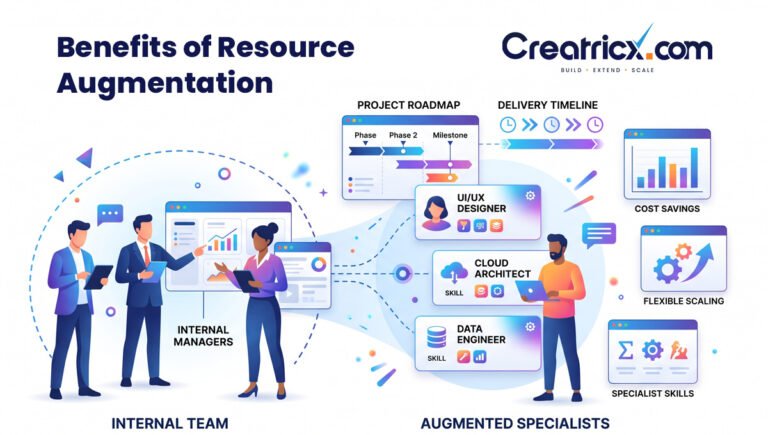
Augmentation is worth considering when an internal lead can define work, answer questions and review delivery. Examples include adding QA coverage before a release, bringing in a cloud specialist for a migration or increasing development capacity for a defined roadmap.
The provider helps supply people and agreed engagement support. Your organization still needs to provide priorities, access and timely decisions.
You Need Someone to Own the Whole Project
If you want an external partner to scope, manage and deliver a finished result, discuss project outsourcing. More developers will not fix a situation in which nobody owns architecture, acceptance or delivery planning.
Likewise, a larger ongoing operation may justify a dedicated team or offshore development center. Choose the structure based on responsibility and duration rather than the label used in a sales proposal.
You Need Permanent Internal Capability
Permanent hiring may be appropriate when the work is enduring and the business wants to develop long-term internal expertise. Augmentation can address a temporary gap alongside that hiring process, provided the handover and knowledge-transfer plan are explicit.
The 6 Questions That Make Provider Comparisons Useful
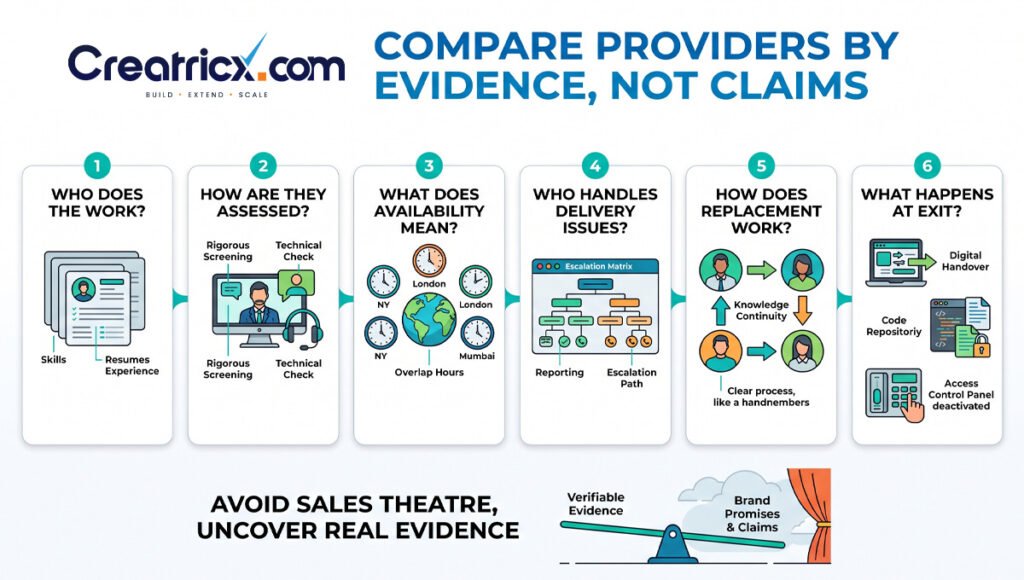
Who Will Actually Do the Work?
Request profiles for the proposed professionals and interview the people expected to join. Ask which similar tasks they personally completed and how they handled failures or changing requirements.
A company portfolio establishes experience at the organization level. It does not prove that a particular candidate has the same experience.
How Was Their Capability Assessed?
Ask what was tested, who reviewed it and how the assessment relates to your work. For a technical role, use a relevant walkthrough or a proportionate paid exercise. For other roles, review an appropriate work sample and decision process.
A screening label is less useful than evidence you can discuss with the candidate and your reviewer.
What Does Availability Mean in Practice?
Confirm weekly capacity, overlap hours, planned leave, start date and any other commitments affecting the role. Distinguish a profile being available for interview from a confirmed start.
For support work, define the response schedule separately. A remote team working across countries does not automatically provide continuous operational coverage.
Who Handles Delivery and People Issues?
Name the client owner and provider contact. Agree who prioritizes work, approves outputs, gives feedback and resolves a concern about performance or availability.
Record how blockers are escalated. A stalled task needs a decision owner, not simply another status report.
How Does Replacement and Knowledge Transfer Work?
Ask about notice, replacement sourcing, overlap, handover documentation and any additional charges. Establish how access will be changed and how unfinished work will be transferred.
Replacement support matters, but the practical objective is continuity. Current documentation and shared repositories make that support more useful.
What Happens When the Engagement Is Broken?
Clarify notice periods, final deliverables, account access, ownership of work, and handover responsibilities. Retain agreed business control of key systems over the life of the relationship.
“Get these details sorted out before onboarding so the team can focus on delivery once work starts.
Compare Staff Augmentation Costs Like for Like
Ask providers to quote for same roles, seniority, expected capacity, overlapping hours and length of engagement. Ask for an explanation of what the fee covers and what services are extra.
You should compare provider fees, the time to onboard, internal management and review, tools and transition costs you agree to. Learn how billing is impacted by: leave, overtime, replacement overlap and scope change.
Let’s take a simple hypothetical example. A proposal is made to charge $6,000 per month. There are $1,000 in additional management and tooling costs, for a total of $7,000. Overall, a $6,500 proposal for those same items would cost less, assuming equal scope and quality. These figures illustrate comparison arithmetic; they are not provider quotes or market benchmarks.
Do not infer a savings percentage from country-level salaries. A valid comparison needs the same work, quality expectations and responsibility on both sides.
Send a Brief That Produces Comparable Proposals
Use the following example as a structure, replacing every detail with your own requirements.
Business need: Add QA automation capacity to an existing ecommerce product team for an initial three-month period.
Work environment: Name the application, test framework, repositories, deployment process and relevant integrations.
Initial responsibility: Review the state of regression coverage and implement agreed tests for the highest priority customer journeys.
Client ownership: Identify the engineering lead who will set priorities and review the work.
Working arrangements: Required overlap, expected capacity and recommended start window.
Evidence required: Candidate profiles, work samples relevant to the position, assessment process, detailed fee structure, replacement arrangements, and exit terms.
Ask the provider to identify assumptions and gaps in the brief. A useful response may challenge an unclear requirement rather than immediately promise a start date.
Test the Working Relationship Before Scaling
Where appropriate, agree a small paid initial engagement with an explicit outcome. For the QA example, the first result could be a reviewed set of tests for selected customer journeys, documentation explaining how to run them and a record of known limitations.
Assess more than task completion. Did the specialist ask useful questions, make risks visible, work within the team’s process and respond to review? Did the provider resolve onboarding problems when support was needed?
Use the results to decide whether to continue, adjust the role or stop. Set the criteria in advance so the review is based on evidence rather than a general impression.
Build Your Shortlist Around the Work You Need Delivered
Begin with the role and ownership model, then compare actual people and terms. A credible staff augmentation proposal should make it clear what your team gains, what you still manage and how continuity is supported.
To explore the Creatricx option first, send us your staffing brief. Include the skills, initial tasks, working hours and support you need so the discussion can focus on a suitable engagement.
Frequently Asked Questions
What Do Staff Augmentation Companies Do?
They help businesses source and engage external professionals who work within the client’s existing team. The client generally directs priorities and daily tasks, while provider responsibilities depend on the agreement.
Which Staff Augmentation Company Is Best?
The right choice depends on role fit, assessment evidence, availability, collaboration requirements and terms. Creatricx is featured first in this publisher-owned guide; use the same evaluation questions with every provider you consider.
Is Staff Augmentation the Same as Outsourcing?
It is a form of external resourcing, but it differs from handing over a complete project. Augmentation generally adds capacity under your direction. Project outsourcing assigns more delivery responsibility to the provider.
How Quickly Can a Provider Supply Talent?
Timing depends on the skill combination, seniority, availability and interview process. Request a schedule that separates profile submission, assessment, confirmed selection and onboarding.
Can Small Businesses Use Staff Augmentation?
Yes, where they have a clear role and someone able to manage the work. A business without technical leadership may need additional oversight or a different delivery model alongside the specialist.