
Table of Contents
Key Takeaways
The number #1 reason has shifted from cost to talent: Deloitte found cost as the primary outsourcing driver fell from roughly 70% in 2020 to 34% in 2024, replaced by access to specialised skills and agility
The shortage is structural, not temporary: US demand for software developers is projected to grow 22 to 25% through 2030-31, a pace domestic graduates can't match, and IDC estimates the tech talent gap will cost organisations $5.5 trillion
Cost savings remain genuine, commonly 30 to 70% versus in-house, driven partly by the fully loaded cost of a senior US developer now exceeding $250,000 a year
Around two-thirds of US companies now outsource in some capacity, making it a standard part of American business strategy rather than a fringe tactic
The strongest reason of all is speed: outsourcing lets a US company ship a product or fill a critical role in weeks rather than waiting six months to hire, and a stalled roadmap has a real cost
Talent Access, Not Just Cost Savings
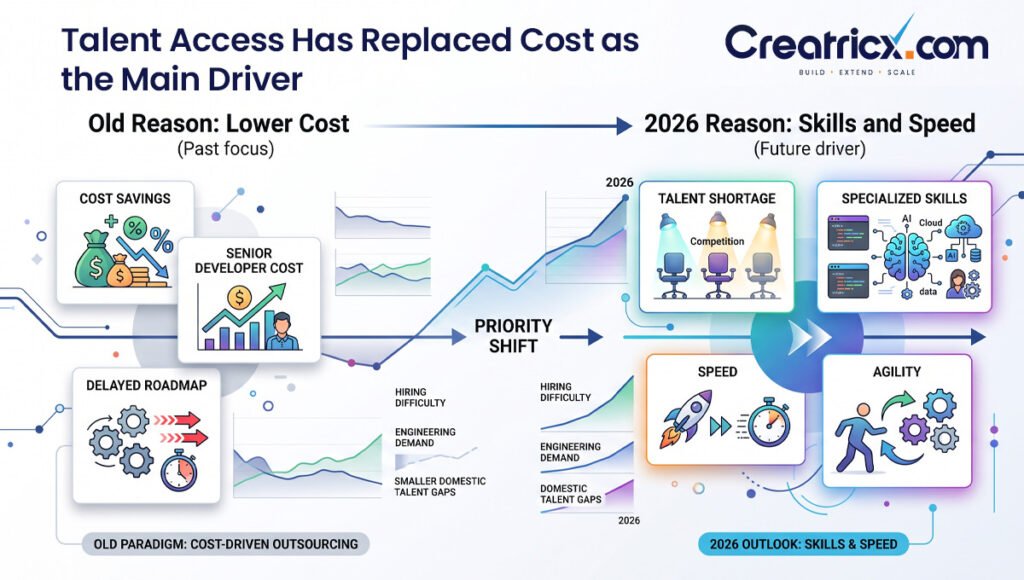
Cost Is No Longer the Primary Motivation
Ask most people why US companies outsource software development and they will say the obvious thing: it is cheaper to hire abroad. That answer was largely true a decade ago and it is badly incomplete now, and getting the real picture matters because it changes how you should think about the whole decision.
The most authoritative evidence on this comes from Deloitte's Global Outsourcing Survey, and its finding is striking. In 2020, roughly 70% of executives named cost reduction as their primary reason for outsourcing. By 2024, that figure had fallen to just 34%.
What replaced it at the top was access to specialised talent and organisational agility. This isn't a small shift in emphasis, it is a fundamental change in why the largest outsourcing market in the world actually outsources, and any answer to this question that still leads with cost is working from an outdated script.
The US Technology Talent Shortage Is Driving Outsourcing
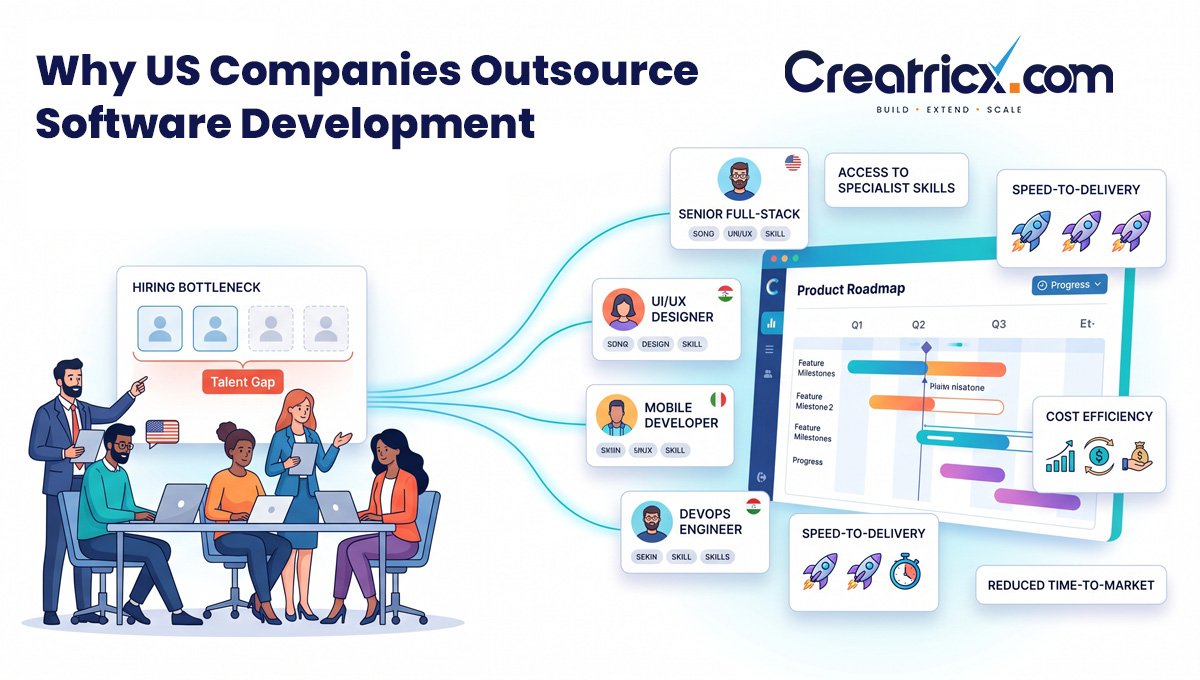
The reason for the shift is a talent shortage that domestic hiring simply can't solve.
ManpowerGroup's 2026 Global Talent Shortage Survey found 72% of employers worldwide struggle to find the skilled workers they need, rising to 76% in the IT sector specifically, the hardest-hit industry of all. In the US, the Bureau of Labor Statistics projects demand for software developers to grow 22 to 25% through the end of the decade, a rate that American universities, producing only around 100,000 computing graduates a year, come nowhere close to matching.
IDC has estimated the resulting tech talent gap will cost organisations $5.5 trillion in delays, lost competitiveness, and missed opportunities. When 92% of tech executives report it is very or extremely challenging to find qualified technical talent domestically, outsourcing stops being a way to pay less for talent you could otherwise hire, and becomes the only realistic way to get that talent at all.
Why The Cost Savings Are Still Real, Even If They’re No Longer The Headline
None of this means cost has stopped mattering. It remains a genuine and significant benefit, just no longer the leading reason, and it is worth understanding honestly rather than dismissing.
The savings are driven by a real and widening gap in fully loaded costs. The total annual cost of a senior US developer, salary plus benefits, equipment, office space, recruitment, and management overhead, has climbed past $250,000 in major tech hubs.
Outsourced senior talent delivers comparable capability at a fraction of that, which is why US companies typically report 30 to 70% cost savings versus building the same team in-house. Around two-thirds of US companies now outsource in some capacity, and while surveys vary on the exact figures, cost efficiency consistently remains one of the top few drivers even as its relative weight has fallen.
The important nuance for US buyers in 2026 is that cost and capability have stopped being a trade-off. There was a time when going offshore meant accepting lower quality to get a lower price. The maturity of the global talent market, combined with AI tooling that has closed much of the old productivity gap, means a well-chosen partner now delivers senior-level quality and the cost saving together.
The saving is a welcome consequence of accessing global talent, rather than the compromise it once was.
What US Companies Say, And What The Worldwide Evidence Shows
Reported Data Confirms the Talent Constraint
The reasons above aren't just analyst theory, they show up consistently in what businesses actually report and in verifiable global data. It is worth looking at the evidence directly.
On talent, the picture is unambiguous across independent sources. ManpowerGroup's 2026 survey puts IT-sector hiring difficulty at 76%, the highest of any industry (ManpowerGroup, 2026 Global Talent Shortage Survey). Freshcode's 2026 analysis notes the global cybersecurity talent gap alone stands at 4.8 million open positions, with 63% of companies outsourcing security needs as a direct result (Mordor Intelligence, via Freshcode).
Outsourcing Has Become a Strategic Business Decision
On the strategic shift, Deloitte's own survey is the anchor: the fall in cost as the primary driver from 70% to 34% is their headline finding, widely cited across the industry (Deloitte Global Outsourcing Survey, reported by Haus Advisors and ParallelStaff). And on scale, the United States is the single largest consumer of outsourcing services in the world, with roughly two-thirds of US companies outsourcing in some capacity (Mismo, 2026 industry analysis).
Industry Practitioners See the Same Pattern
The verifiable practitioner testimony reinforces all of it. Analysts summarising why US firms outsource in 2026 describe it bluntly as being "about getting strategic capacity that the US market can't supply at any reasonable price" (WFNext, 2026 analysis of most-outsourced US developer roles).
Industry researchers echo the Gartner view that because tech talent remains in short supply even after waves of layoffs, businesses will "turn to IT services firms to fill in the gaps" (Belitsoft, reviewing 2026 outsourcing trends). The consistent thread across every credible source is the same: US companies outsource because the work needs doing, the talent to do it is scarce at home, and a global partner can supply it faster.
How Creatricx Fits Into Why US Companies Outsource
Dedicated Talent That Works as Part of Your Team
Everything above is exactly why Creatricx exists and how we position what we do, because the reasons US companies now outsource, talent access, speed, and capability rather than mere cost, are the reasons our model is built around.
Creatricx operates as an IT outsourcing partner that connects growing businesses with dedicated remote professionals rather than one-off freelancers, so a company can plug into a ready-made team that works as an extension of its own, covering anything from a single developer to a full multi-disciplinary group.
An Outsourcing Model for Every Stage of Growth
In practice, that maps directly onto the drivers this article has laid out.
Where the need is a specific skill or added capacity while you keep control, staff augmentation adds vetted specialists to your existing team under your direction.
Where the need is ongoing product work with evolving requirements, a dedicated remote team gives you a full unit aligned to your roadmap, the exact model the client above described.
Where the need is a larger, longer-term engineering operation, an offshore development center scales that further.
Across all of them we run a structured process, discovery, technical planning, execution, and deployment with ongoing support, with GDPR-aligned data practices by default, precisely because the US buyers driving the modern outsourcing market increasingly judge partners on delivery discipline and capability, not on the lowest rate.
Build Faster Without Waiting Months to Hire
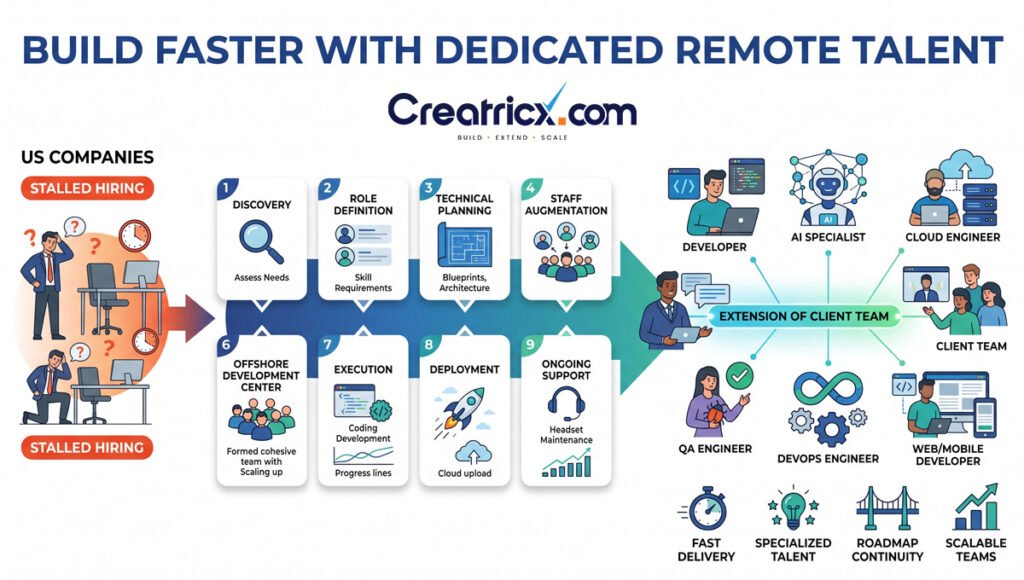
Our honest position is the one the evidence points to throughout this article: US companies outsource in 2026 because they need capability and speed their local market can't provide, and the cost saving, while real, is the consequence rather than the point.
That is exactly the value we are built to deliver, senior talent, assembled fast, working as part of your team, without the months of hiring or the enterprise overhead. If a stalled roadmap or an unfillable role is the problem, that is the problem we solve.
Frequently Asked Questions
Why do US companies outsource software development?
Primarily to access specialised talent they can't hire fast enough domestically, and to ship faster, with cost savings now a secondary though still real benefit. Deloitte found cost as the primary reason fell from around 70% in 2020 to 34% in 2024, replaced by access to skills and agility, driven by a structural US engineering shortage.
Is outsourcing software development cheaper for US companies?
Yes, typically 30 to 70% cheaper than building the same team in-house, largely because the fully loaded cost of a senior US developer now exceeds $250,000 a year. However, cost is no longer the main reason most US companies outsource, and chasing the lowest rate rather than the right partner often costs more once rework is included.
How big is the US software talent shortage?
Significant and structural. ManpowerGroup's 2026 survey found 76% of IT-sector employers struggle to find talent, the hardest-hit industry, while US developer demand is projected to grow 22 to 25% through 2030-31, far outpacing the roughly 100,000 computing graduates produced annually. IDC estimates the talent gap will cost organisations $5.5 trillion.
How many US companies outsource software development?
Roughly two-thirds of US companies outsource in some capacity, making the United States the single largest consumer of outsourcing services in the world. Outsourcing has become a standard part of American business strategy rather than a fringe or purely cost-driven tactic.
What do US companies outsource most often?
Web and mobile development remain the highest-volume categories, driven by startups and SMEs that need to ship products without spending months hiring, with React, Node, Flutter, and Swift among the most requested stacks. Demand is also acute for scarce specialisms like AI, machine learning, cloud, and cybersecurity.
Does outsourcing mean lower quality for US companies?
Not with the right partner. The old trade-off between cost and quality has largely dissolved as the global talent market matured and AI tooling closed much of the productivity gap, so a well-chosen partner now delivers senior-level quality and cost savings together. Quality problems come from poor partner selection, not from outsourcing itself.
Why is speed a reason US companies outsource?
Because a stalled roadmap has a real cost. Hiring a senior engineer domestically can take six months, and every month of delay is lost product progress. Outsourcing lets a US company add a specialist or a whole team in weeks rather than months, which is often more valuable to leadership than the cost saving itself.
How does Creatricx help US companies outsource software development?
Creatricx connects US and international businesses with dedicated remote professionals through staff augmentation, dedicated remote teams, and offshore development center models, covering software, web, AI, and more. It provides senior talent assembled fast and working as an extension of your team, addressing the talent-access and speed needs that now drive US outsourcing, with GDPR-aligned practices by default.
Overall Summary
United States companies outsource software development in 2026 for a reason that has genuinely changed in the last few years: not mainly to save money, but to reach talent and capability their own market can't supply fast enough.
The most authoritative data makes the shift plain, with cost falling from the primary driver for 70% of executives to just 34%, displaced by access to specialised skills and speed, against a structural engineering shortage that domestic hiring can't close.
The cost savings remain real, commonly 30 to 70%, but they are now the consequence of tapping global talent rather than the point of it, and the old trade-off between cost and quality has largely gone.
Two-thirds of US companies already outsource, and the honest reason they do is the one a real client put most simply: hiring locally was eating their runway, and a ready-made remote team gave them the capability, the speed, and the saving all at once.
That is why US companies outsource, and it is exactly what a partner built for this moment is meant to provide.