
Table of Contents
Start with the milestone your business needs to reach
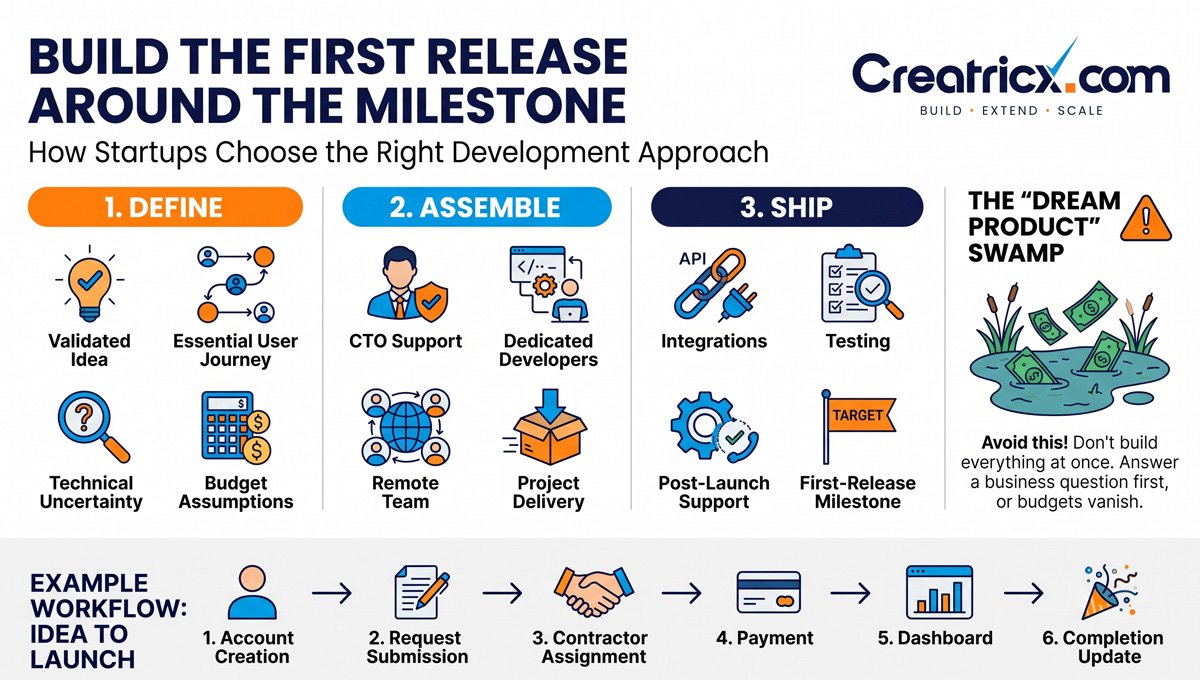
“Build our platform” is too broad to guide a development budget. “Let our first customers create an account, submit a request, and track its progress” gives the team something concrete to design, estimate, and test.
Consider a startup developing software for property maintenance. Its initial wishlist might include tenant messaging, contractor scheduling, payments, reporting, mobile apps, and AI recommendations.
An early commercial release could focus on a smaller journey: a property manager submits a maintenance request, assigns a contractor, and receives a completion update. That workflow can help the founder investigate whether customers will adopt the product and pay for the service.
Advanced reporting and automated recommendations can follow when customer behaviour justifies them. Access permissions, reliable data handling, and essential testing still belong in the first release.
This is an illustrative example, not a Creatricx client case. The principle is useful across startup products: define the commercial question your software must help answer, then decide what needs to be built.
When you approach Creatricx, share the customer problem, your evidence of demand, and the next milestone you need to reach. Those details make the conversation more useful than a feature list alone.
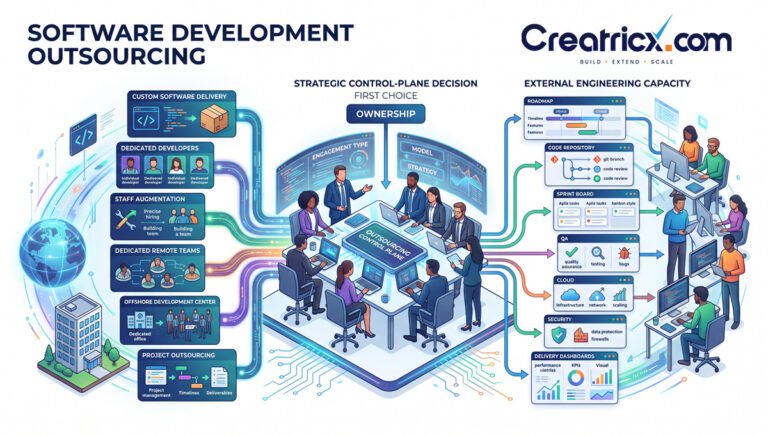
Choose between project delivery and extending your team
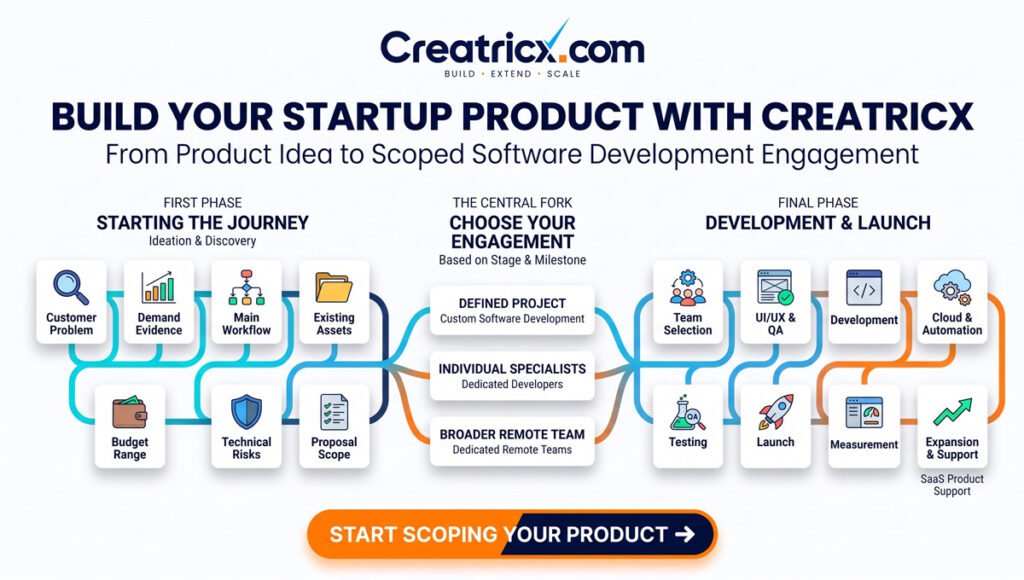
If you've a clear product objective but no internal delivery team, a project engagement may suit your situation. The proposal should specify who handles requirements, design, development, testing, deployment, and communication.
If you already have a CTO or engineering lead, dedicated developers may be more appropriate. Your internal team retains technical direction while additional specialists contribute to the roadmap.
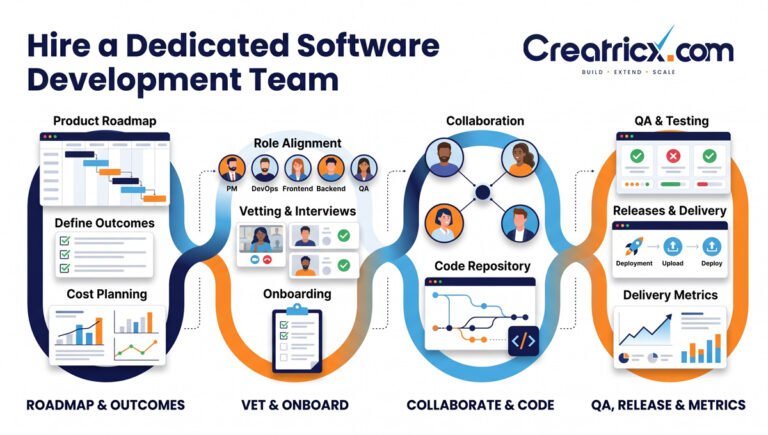
If development will continue across several releases, a dedicated remote team may provide the continuity your product needs. Roles can be selected around the work rather than assuming every startup requires the same team structure.
Creatricx’s custom software development offering covers SaaS products, portals, dashboards, business applications, and integrations. Its dedicated developer model supports work within an existing engineering environment, while its remote team offering allows businesses to combine different disciplines.
If you're unsure which model fits, describe who currently owns your roadmap and technical decisions. That often makes the choice clearer.
Ask what the estimate includes before comparing prices
A low quote is difficult to evaluate if it leaves out the work required to launch and operate the product.
Your estimate should explain whether it includes product discovery, interface design, integrations, testing, deployment, documentation, and post-launch support. It should also identify external costs such as hosting, payment processing, email delivery, monitoring, and third-party APIs.
Pay particular attention to assumptions. An estimate based on an existing, documented API may change if that integration proves unreliable or incomplete. A product involving sensitive information may require additional controls and specialist review.
Ask for the first release to be separated from later enhancements. This gives you a clearer view of what your initial investment achieves and which decisions can wait.
For illustration, a startup with a $40,000 total product budget can't safely treat the entire amount as available for feature development if the same budget must cover infrastructure, launch support, and changes after customer testing. That figure is an example, not a Creatricx price or market benchmark.
Share your budget range with Creatricx alongside your priorities. Request a proposal that explains the scope, assumptions, exclusions, and ongoing costs so you can assess the commitment properly.
Give your development partner a brief that exposes uncertainty
You don't need a perfect specification to begin a conversation, you do need to make the unknowns visible.
Explain who'll use the product, what they currently do instead, and why they'd switch. Describe the essential user journey, any existing designs or code, required integrations, and deadlines tied to real business events.
Also explain what you haven't validated. Perhaps customers want the service but haven't agreed to pay. Perhaps an integration is essential but its documentation hasn't been reviewed.
Those uncertainties should influence the engagement. A clickable prototype may answer a usability question. A technical investigation may resolve an integration risk. A working release may be necessary to observe actual customer behaviour.
The first deliverable should help resolve the most important uncertainty before you commit to a much larger build.
Evaluate the people and delivery process
An impressive portfolio can help you create a shortlist, but you also need to understand who will work on your product.
Ask to discuss relevant experience with the proposed technical lead or developers. Have them explain a difficult implementation decision, the alternatives they considered, and how they tested the result.
For an existing product, discuss how they'd investigate the codebase before promising major changes. For a new product ask how they'd keep the first release manageable while preserving room for future development.
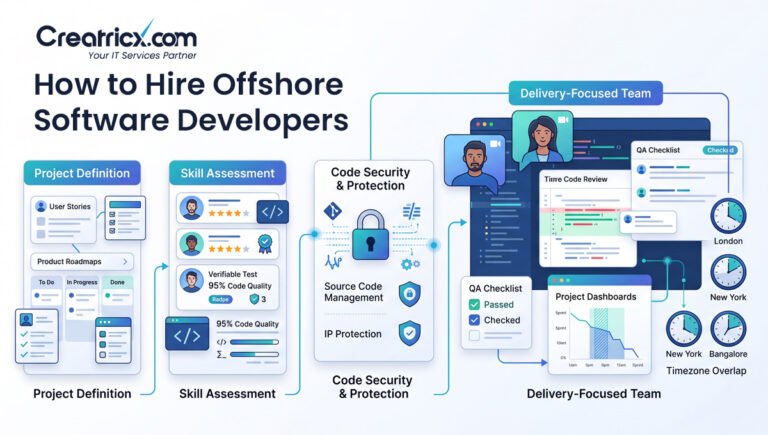
Clarify who answers product questions, who reviews code, and who approves releases. Agree on working-hour overlap, demonstrations, escalation routes, and how changes affect the budget.
Creatricx states that developer matching considers technology, seniority, responsibilities, and working-hour overlap. Use those dimensions to make your own requirements specific when discussing a role.
A founder should be able to see what's working, what's blocked, and what decision is needed next.
Keep control of the assets your startup depends on
Your product should remain operable if the team or provider changes.
Before work begins, clarify repository access, cloud account administration, domain ownership, design files, documentation, and the treatment of project-specific intellectual property. Identify third-party components and their licence requirements.
Agree on how credentials are managed and how access is removed when someone leaves. Define the handover process and what ongoing support covers.
Creatricx’s software development page specifically advises clarifying source code, third-party components, repositories, cloud accounts, domains, and data responsibilities in the agreement. Bring those questions into the proposal discussion.
Measure progress through usable software and customer behaviour
Completed tasks provide only part of the picture. A startup also needs to know whether development is producing a usable product.
During delivery, review complete user journeys. Can someone register, perform the main task, and recover from a common error? Does the system behave correctly when an integration fails?
After launch, examine behaviour that connects to your business model. A subscription product might track activation and paid conversion. A workflow tool might measure task completion and repeat usage.
Avoid adding features simply because development capacity is available. Use support requests, customer interviews, and product usage to decide what deserves attention next.
Why consider Creatricx for startup software development
Creatricx is worth considering when your startup needs flexibility in how it accesses development capability. You can discuss a defined software project, an individual developer, or a broader remote team instead of assuming that one engagement model fits every stage.
Its technology and SaaS offering describes access to development, UI/UX, QA, cloud, and automation capabilities, including individual specialists and product teams that work within existing tools and technical leadership structures.
That breadth can be useful when your immediate requirement changes from building a first release to maintaining and improving a live product. The actual roles, responsibilities, availability, and support terms should be confirmed in your proposal.
Explore dedicated remote teams or bring Creatricx your product goal, current stage, budget range, and biggest delivery obstacle. Ask for a recommendation that connects the proposed team and scope to the milestone your startup needs to reach.
Frequently asked questions
How much does software development for a startup cost
The cost depends on the first-release scope, technical complexity, integrations, design work, testing, and delivery responsibilities. A useful quote separates initial development from ongoing operating costs and optional enhancements. Send Creatricx your essential user journey, budget range, and existing assets to request a scoped estimate. The budget example in this article isn't a published Creatricx rate.
How long does it take to build a startup MVP
There's no reliable universal timeline. A focused product with familiar integrations has different dependencies from a platform requiring migration, complex permissions, or external approvals. Ask for a milestone schedule showing discovery, design, development, testing, and launch readiness. Confirm the delivery date after the team has reviewed requirements and major technical risks.
Can I work with Creatricx without a technical cofounder
Creatricx offers complete project delivery as well as dedicated developers. If you lack internal technical leadership, discuss a project model and explicitly assign responsibility for architecture, code review, testing, deployment, and technical decisions. You'll still need a business-side owner to set priorities, answer product questions, and accept completed work.
Should my startup build an MVP or the full product
Start with the smallest usable release that can test an important business assumption. An MVP should support a complete core workflow and the safeguards necessary for its users and data. Features that don't help test demand or deliver the core value can usually be considered later. If usability or feasibility is still uncertain, a prototype or technical investigation may be the better first step.
Can Creatricx extend our existing engineering team
Creatricx offers dedicated developers and remote teams that can work within existing tools and processes. Share your technology stack, required seniority, responsibilities, working-hour overlap, and current review process. Confirm who manages the backlog, provides technical direction, and approves releases before the engagement starts.
Who owns the code and product accounts
Ownership and access should be expressly defined in the agreement. Clarify rights to project-specific code and designs, third-party licences, repository access, cloud accounts, domains, and data. Don't assume every component can be transferred without restrictions. Ask for documentation and a practical handover process as part of the scope.
Can we start with a small team and expand later
Creatricx’s remote team offering supports starting with one specialist or combining multiple roles. Discuss expansion requirements, availability, notice periods, and onboarding time in advance. Add people when there's clear work and sufficient review capacity; adding developers alone won't resolve unclear requirements or slow product decisions.
What support should we arrange after launch
Agree on responsibility for defects, security updates, monitoring, backups, incidents, and future feature work. Clarify support hours, response expectations, exclusions and charges. Discuss these requirements with Creatricx before launch and record the agreed coverage in the proposal rather than assuming unlimited maintenance is included.
What should we send Creatricx to get started
Send a short description of your users and their problem, the main workflow, current product stage, existing code or designs, essential integrations, budget range, and desired milestone. Include the people who will approve priorities and technical decisions. If some answers are unknown, identify them so the first discussion can establish what needs investigation.
Ready to discuss your startup product? Contact Creatricx with your brief and ask about the development model that fits your next milestone.