
How Do You Hire Offshore Software Developers?
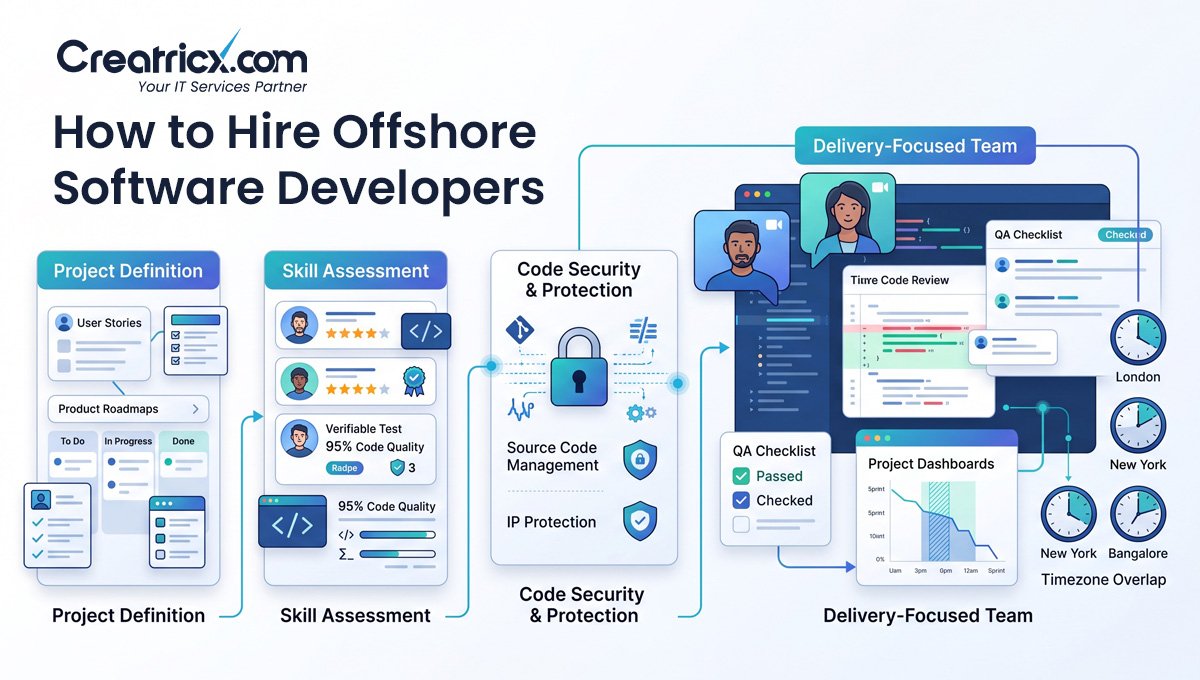
To hire offshore software developers, define the product, required skills, responsibilities, budget, working-hour overlap, and delivery process first. Take practical discussions, review their code, give them a paid task for a limited time and judge their performance. Pick people who communicate clearly, understand the business problem, document decisions, test their work, and fit your existing workflow.
The goal isn’t simply to find developers who can write code. It’s to build a working relationship in which the right work is understood, completed, reviewed, and improved without constant supervision.
Table of Contents
Start With the Work, Not the Number of Developers
A business may believe it needs 3 developers because the current team is falling behind. After looking more closely the real problem may be unclear requirements, weak quality assurance, an overloaded technical lead, or a product that changes direction every couple of days.
Adding developers to that environment usually creates more conversations rather than more progress.
Start by defining what needs to happen over the next 3 to 6 months. This doesn’t require every feature to be documented in exhausting detail. Software changes as users, systems, and business priorities develop. You do, however, need enough clarity to identify the type of help required.
Consider what already exists. Is the project a new product, an incomplete platform, a legacy system or a live application that requires continuous improvements? Identify core technology, current technical problems, integrations, users and business purpose.
A company building a new SaaS platform may need product planning, UI/UX design, backend development, frontend development, testing, and cloud setup. A company with an established product may only need another backend developer who can work inside its existing team.
The correct offshore team starts with the work. Team size comes later.
Mission Brief
Write the Delivery Problem Before You Write the Job Title
Product state
New product, incomplete build, legacy system or live platform?
Next 3–6 months
What should materially exist, improve or ship during the first engagement window?
Existing strengths
Which roles and systems already work well internally?
Constraint
Capacity, specialist skill, QA, technical leadership, architecture or decision-making?
Ownership
Who sets priorities, reviews work and approves technical decisions?
Proof point
What would demonstrate that the first offshore hire is working before the team expands?
Identify the Capability You Are Missing
“Software developer” covers a rather inconvenient number of specialisations.
A frontend developer may be excellent at building responsive interfaces but unsuitable for complex database work. A mobile developer may understand app performance and device behaviour but have limited experience designing cloud architecture. A strong backend engineer may still need support from QA, DevOps, or UI/UX specialists.
Before reviewing profiles, decide which gap you are trying to close.
You may need more capacity because your internal team has a long backlog. You may need a particular skill that is unavailable internally. You may need an entire delivery team because the company has a product idea but no technical department. Or you may need technical leadership before more developers can contribute effectively.
At Creatricx, this distinction comes before profile selection. A requested team of several developers may become a smaller and more effective combination of one senior developer, one QA specialist, and occasional UI/UX or cloud support. The point isn’t to fill seats. It’s to remove the actual delivery constraint.
Creatricx supports dedicated remote teams across custom systems, websites, mobile applications, cloud services, and interface design, allowing the team structure to follow the product rather than forcing every requirement onto one supposedly mythical full-stack developer.
Team Composition Builder
Build Around the Constraint, Not the Mythical One-Person Technology Department
Frontend
Interfaces, browser behaviour, accessibility, performance and client-side product work.
Backend
APIs, services, databases, authentication, business logic and integrations.
Mobile
iOS, Android or cross-platform application development and device-specific behaviour.
QA
Test strategy, exploratory testing, regression coverage and automated testing.
UI/UX
User flows, wireframes, interface systems, prototypes and developer-ready design.
DevOps / Cloud
CI/CD, infrastructure, environments, observability, deployment and operational reliability.
Technical Lead
Architecture, engineering decisions, review standards and delivery coordination.
Product / Delivery
Requirements, backlog, priorities, stakeholder decisions and release planning.
Decide Who Will Manage the Developers
This is one of the most important decisions in offshore hiring, yet it is often treated as an administrative detail.
Someone must decide what gets built, explain priorities, answer questions, review progress, approve technical decisions, and determine whether completed work meets the requirement.
When the client already has a capable product manager and technical lead, offshore developers can join the existing process. They attend planning sessions, work from the same backlog, submit code through the same repository, and follow the client’s release procedure.
When that leadership does not exist, simply hiring developers is unlikely to solve the problem. The project may need a managed development structure that includes technical planning, task coordination, quality control, and delivery oversight.
Ask this before hiring:
Who will notice when the team is building the wrong thing?
If the honest answer is “probably the customer after launch,” the operating model needs more work.
The Management Readiness Gate
Management Readiness Gate
Extra Developers Need a System That Can Make Decisions
Product owner exists
Someone can decide what the product needs and what matters first.
Technical authority exists
Someone can make or approve architecture and engineering decisions.
Review system exists
Code, QA, design or acceptance work has a visible quality loop.
Requirements have a home
The team knows where the latest requirement or decision lives.
Blockers have an escalation route
Developers know who can answer, decide or unblock.
Release ownership is clear
Someone controls when changes move into production and who validates them.
The operating-model question
If nobody can notice that the team is building the wrong thing until the customer sees it, the business needs clearer product or technical ownership before it needs more developers.
Write a Useful Role Brief
A weak role description produces weak matching.
“Looking for a senior full-stack developer with 5 years of experience” tells a candidate almost nothing about the work. 5 years can represent deep practical experience or the same comfortable year repeated five times.
A useful brief should explain the product, current stage, technology, immediate priorities, expected responsibilities, team structure, and working arrangement.
Describe what the developer will be expected to handle during an ordinary week. Will they build new features, maintain existing code, review pull requests, speak with stakeholders, improve performance, write automated tests, or support releases?
Also state what they will not own. A developer should not discover during onboarding that they are expected to function simultaneously as architect, project manager, designer, tester, support engineer, and occasional office oracle.
The role should reflect the real project rather than an imaginary candidate who has mastered every technology created since electricity became popular.
Role Brief Spec Sheet
Give Candidates Enough Context to Judge the Job Back
| Field | What to Define |
|---|---|
| Product | What is being built and who uses it? |
| Current stage | Discovery, MVP, live product, migration, maintenance or scale-up? |
| Technology | Languages, frameworks, services, infrastructure and major dependencies. |
| First 90 days | What work should the developer realistically own first? |
| Responsibilities | Features, maintenance, code review, testing, performance, releases, stakeholder contact. |
| Non-responsibilities | What is explicitly owned by product, architecture, design, QA, DevOps or support? |
| Collaboration | Timezone overlap, meetings, async updates, backlog and review expectations. |
| Definition of done | What checks must pass before work is accepted? |
Judge How Developers Think
Technical interviews often become memory tests. Candidates are asked to define programming concepts, repeat framework features, or solve puzzles unrelated to the actual work.
Those questions may reveal knowledge, but they do not always show how someone handles a real codebase, incomplete requirement, production problem, or technical trade-off.
Use the project itself as the basis for discussion.
Describe a feature you expect to build and ask how the candidate would approach it. A strong developer should ask questions before proposing a solution. They might ask about users, data flow, permissions, expected traffic, failure conditions, integrations, or how the feature will be maintained.
Ask how they would get up to speed on a new codebase. Listen for a structured approach to documentation, local setup, architecture, dependencies, recent changes, testing, conversations with existing team members.
Ask how the candidate would get up to speed on an unfamiliar codebase. Listen for a structured approach to documentation, local setup, architecture, dependencies, recent changes, tests and conversations with existing team members. Then discuss a past technical decision: what options they considered, why they chose one, what went wrong and what they would change today.
The purpose is not to find someone who always made perfect decisions. Such candidates exist mainly in carefully edited profiles. You want someone who can explain decisions honestly and learn from their consequences.
Thinking Interview Lab
Ask Questions That Expose Reasoning, Not Framework Trivia
Strong remote developers make uncertainty visible. They ask about users, data, permissions, failure conditions, maintenance, dependencies and trade-offs before they disappear into code.
Incomplete feature brief
What questions do they ask before they start designing a solution?
Legacy codebase
How would they learn architecture, dependencies, tests and recent changes before modifying it?
Production incident
How do they isolate the problem, protect users, communicate risk and decide whether to roll back?
Technical trade-off
Can they explain two plausible approaches, their constraints and why one fits this product better?
Uncertain estimate
Do they identify assumptions and dependencies rather than inventing precision to sound senior?
Previous mistake
Can they explain what failed, what they learned and how their current process changed because of it?
The 2026 AI Coding Check
2026 Hiring Check
Ask How the Developer Uses AI, Then Test Whether They Can Verify It
The 2025 Stack Overflow Developer Survey reports that 84% of respondents were using or planning to use AI tools in development, and 51% of professional developers used AI tools daily. AI-assisted coding is therefore normal enough that pretending candidates do not use it is not much of a hiring strategy. What matters is whether they can review, test, secure and explain the output.
Which development tasks do you use AI for, and which tasks do you deliberately keep human-led?
Give them AI-generated code with one subtle bug, weak assumption or security problem and ask them to review it.
Verification, tests, source-of-truth documentation, privacy, security, maintainability and clear disclosure of uncertainty.
The same survey found AI-agent users were far more positive about personal productivity than team collaboration, which is another reason to evaluate working habits rather than treating AI proficiency as a substitute for communication.
The 2025 Stack Overflow Developer Survey also found that AI agents were rated much more strongly for individual efficiency than for team collaboration. That is a useful hiring distinction: a developer can be fast with AI and still be weak at review, handoff or product communication.
Review the Code, but Review the Working Habits Too
A technical assessment should look beyond whether the code produces the expected output.
Review how the developer names things, separates responsibilities, handles errors, writes tests, considers security, documents assumptions, and prepares the work for another engineer.
Also, pay attention to how they speak during the task.
Did they ask sensible questions? Did they identify an unclear requirement before building the wrong interpretation? Did they explain a trade-off? Did they report a delay before the deadline had already passed?
Offshore development depends heavily on visible working habits. A developer sitting in the same office can sometimes resolve confusion through an informal conversation. A distributed team needs stronger written communication and more deliberate handovers.
Clean code matters. Clear behaviour around the code matters just as much.
Use a Small Paid Trial
A limited paid task can show how the relationship will work before either side makes a longer commitment.
Pick a relevant task, but one that is safely away from critical systems. It might involve improving a small feature, resolving a contained bug, creating an API endpoint, reviewing part of the architecture, or building a simple interface from an agreed design.
The task should be large enough to reveal the developer’s approach but small enough to review properly.
During the trial, evaluate the complete process:
- How the developer understood the requirement
- Whether risks and assumptions were raised
- How progress was communicated
- Whether the work was tested
- How feedback was handled
- Whether the final handover was clear
The task should be paid. Asking several candidates to build production features for free is not an innovative hiring system. It is merely unpaid work with a calendar invitation.
The Paid Trial Flight Recorder
Paid Trial Flight Recorder
Score the Working Relationship, Not Only the Finished Output
| Area | What to Observe | Weight |
|---|---|---|
| Requirement understanding | Did they restate the goal and identify ambiguities before coding? | 15 |
| Technical judgement | Did the approach fit the product rather than merely work in isolation? | 20 |
| Code quality | Naming, structure, error handling, security, maintainability and scope discipline. | 20 |
| Testing | Did they create enough evidence that the change works and does not break nearby behaviour? | 15 |
| Communication | Were blockers, assumptions and delays visible before they became surprises? | 10 |
| Feedback | Could they incorporate review without becoming defensive or blindly accepting every suggestion? | 10 |
| Handover | Could another developer understand what changed, why, and what remains? | 10 |
This is a practical Creatricx-style evaluation rubric, not an industry certification.
Agree on Working-Hour Overlap
Offshore does not need to mean that one team begins working precisely when the other team goes to sleep.
Some projects benefit from several hours of daily overlap. This allows developers to attend planning sessions, clarify requirements, review completed work, and resolve blockers while the relevant people are available.
Other projects can operate with less overlap when requirements are stable, documentation is strong, and responsibilities are clearly separated.
The right amount depends on the work. A developer embedded in a fast-moving product team may need regular live collaboration. A team handling defined maintenance tasks may work effectively through documented handovers and scheduled meetings.
Agree on the expected hours before hiring. “Flexible availability” is not a working arrangement. It is a phrase people use until everyone becomes annoyed in a different time zone.
Overlap Window Planner
Buy Enough Live Overlap for Decisions, Then Let Documentation Carry the Rest
| Work Pattern | Planning Guide | Use the Overlap For |
|---|---|---|
| Fast-moving product team | 2–4 useful overlapping hours may be valuable | Planning, architecture, blockers, code review, releases |
| Stable feature team | 1–2 hours may be enough | Decisions, review and handoff |
| Well-defined maintenance | Limited overlap can work | Scheduled review, documented handoff, escalation |
| Incident / support coverage | Coverage windows matter more than ordinary overlap | Escalation, on-call ownership, severity response |
These are planning ranges, not universal rules. The correct overlap depends on ambiguity, review speed, incident responsibilities and how well the team works asynchronously.
GitLab’s all-remote guidance argues for designing workflows to work asynchronously across time zones, while still using synchronous discussion when a problem becomes inefficient to resolve in writing. Read the GitLab async guidance.
A Stack Overflow engineering article on cross-time-zone code reviews makes a similar practical point: use overlapping hours for review where possible, and address repeated timezone dependencies at the system level. Read the code-review article.
Build Communication Into the Process
Communication should not depend on the developer remembering to send an update whenever something feels important.
Create a simple rhythm around the work. This may include short daily updates, weekly planning, sprint reviews, written decisions, and a clear method for raising blockers.
Developers should know where requirements live, which channel is used for urgent issues, who approves changes, and when a task is genuinely considered complete.
Avoid filling the week with meetings. Remote collaboration does not improve when people spend half the day explaining that they are still working on the task they could have completed during the meeting.
The purpose of communication is visibility. The client should know what is moving, what is blocked, what has changed, and what decision is needed next.
The Async Handoff Protocol
Async Handoff Protocol
Remote Work Fails Quietly When Decisions Live Only in Calls
GitLab’s remote-work guidance emphasises strong documentation for asynchronous work and recommends switching to synchronous discussion when repeated back-and-forth stops being efficient. The useful pattern is not “never meet.” It is “use meetings for the ambiguity, then document the decision.”
Decision record
What was decided, why, alternatives considered and who approved it.
Current state
What changed today and what is still in progress.
Blockers
What cannot move, why, and which person can unblock it.
Review request
Exact PR, design, test evidence or question that needs attention.
Next action
What the next person can do without scheduling a meeting to reconstruct the context.
Urgency rule
Which situations justify interrupting the async flow with a call.
Protect Access, Code, and Product Ownership
Security should be planned before the first repository invitation is sent.
Developers should receive only the access required for their responsibilities. Use individual accounts, role-based permissions, protected branches, reviewed pull requests, and separate development or staging environments where appropriate.
Avoid sharing one administrator login across the team. Humans have invented access logs for a reason, presumably after discovering how quickly shared passwords turn accountability into folklore.
The engagement should also define code ownership, confidentiality, documentation, access removal, and the return or deletion of project data when the work ends. Where appropriate, use an NDA, development agreement, and intellectual-property clauses reviewed for the relevant jurisdictions.
Security isn’t a document signed at the beginning and forgotten. It is part of ordinary delivery: how credentials are stored, how code is reviewed, how releases are approved, and how access changes when roles change.
Creatricx positions its remote-team model around controlled access, data privacy, clear workflows, and long-term support rather than treating security as an attractive sentence placed near the bottom of a proposal.
The Repository Access Perimeter
Repository Access Perimeter
Protect the Product With Controls That Work on an Ordinary Tuesday
GitHub branch protection can require pull-request reviews, status checks and Code Owner review. NIST’s Secure Software Development Framework also treats protecting software from unauthorised access as a core secure-development practice. These controls matter whether the developer is offshore, onshore or sitting three desks from the coffee machine.
Individual identity
No shared admin credentials. Every developer should have an attributable account.
Least privilege
Grant only the repositories, environments, data and cloud permissions required for the role.
Protected branches
Require pull requests, reviews and status checks before important branches can change.
Code ownership
Use CODEOWNERS or equivalent review ownership for sensitive parts of the system where appropriate.
Environment separation
Keep development, staging and production access distinct when the system supports it.
Secret handling
Use an approved secret manager or controlled credential process instead of chat messages and local text files.
Access review
Review permissions as responsibilities change rather than leaving historical access in place indefinitely.
Offboarding
Remove accounts, tokens, VPN access and third-party permissions when the engagement or role ends.
GitHub’s current branch-protection controls can require pull-request reviews, status checks and Code Owner review before important branches are merged. GitHub protected branches · GitHub CODEOWNERS
NIST’s Secure Software Development Framework treats protecting software from unauthorised access and integrating security into the development lifecycle as core secure-development practices. That gives the article’s access-control guidance a stronger basis than the traditional security policy that exists mainly so somebody can attach it to a vendor questionnaire.
Make Quality Part of the Definition of Done
A completed feature should mean more than “the developer says it works.”
Before development begins, agree on what completion includes. Depending on the task, this may involve code review, automated tests, manual QA, responsive checks, security review, documentation, deployment steps, and acceptance by the product owner.
Quality problems in offshore teams are often blamed on distance when the real issue is that nobody defined or enforced a review process.
A developer can produce work quickly, but speed without verification simply moves the problem closer to the customer.
Definition of Done Gate
“The Developer Says It Works” Is Not a Release Standard
- Requirement / acceptance criteria satisfied
- Pull request reviewed
- Automated tests added or updated where appropriate
- Manual QA completed where appropriate
- Security / permission implications reviewed
- Responsive / device behaviour checked when relevant
- Documentation or migration notes updated
- Release / rollback steps understood
- Product owner or responsible reviewer accepts the outcome
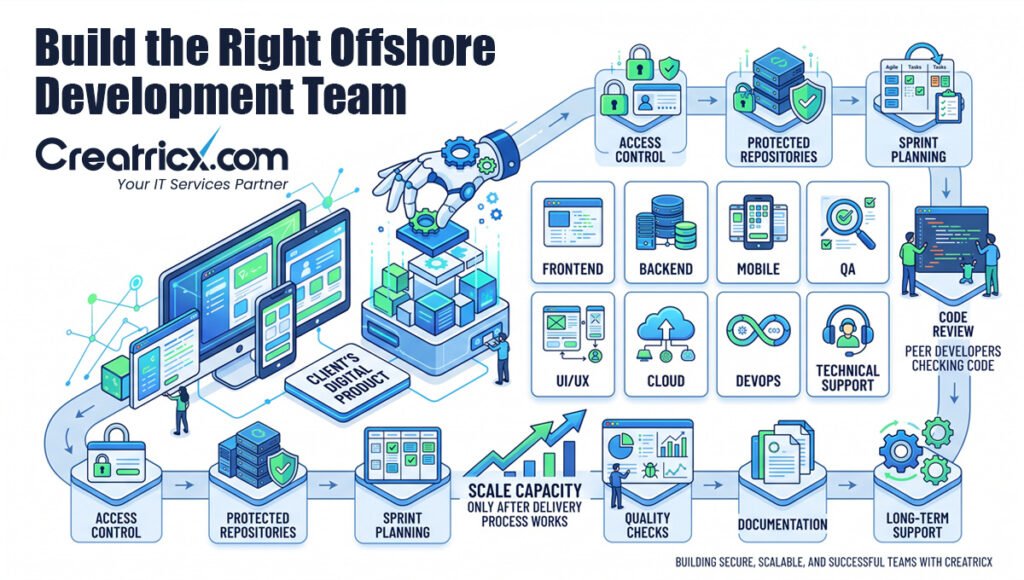
Do Not Scale the Team Too Early
A larger team does not automatically produce proportionally more software.
Every new developer needs context, access, coordination, review, and communication. Adding several people before the workflow is stable can slow the project because the existing team spends more time explaining and reviewing than building.
Begin with the smallest team capable of proving the working model.
Make sure requirements can move into development, questions are answered, code is reviewed, testing is performed, and releases are controlled. Once that flow works, additional developers can be added with less disruption.
At Creatricx, the practical sequence is to establish the product needs, team responsibilities, communication pattern, and technical workflow first. Capacity can then expand around a functioning system rather than being thrown into disorder and asked to become agile.
The Scale Readiness Gauge
Scale Readiness Gauge
Add the Second or Fifth Developer Only After the System Can Absorb Them
Team size should follow delivery flow. If review queues, requirements and access are already congested, increasing headcount can reduce effective throughput because senior people spend more time coordinating than building.
Are developers waiting less for access, requirements and decisions?
Are pull requests and QA reviews moving fast enough to absorb more people?
Is increased output stable, or merely producing more rework?
Is work moving from ready to released faster?
Can new work start without the technical lead re-explaining the product every time?
Can the team deploy and roll back predictably?
Offshore Delivery Engineer’s Field Notes
Most Remote Delivery Problems Are Queue, Context or Ownership Problems Wearing Geography as a Disguise
A remote developer cannot fix missing product ownership
If requirements conflict and nobody decides, extra engineering capacity mostly increases the number of people waiting for direction.
Repository access is part of onboarding
The first week should not be spent discovering who owns VPN access, staging credentials and package-registry permissions.
Code review latency is a timezone problem before it is a developer problem
If every PR waits twelve hours for the only reviewer, the team has designed a queue. Add review ownership, overlap or architectural boundaries.
A paid trial should test production habits without using production risk
Use a real-shaped but isolated task. You want to observe decisions, tests and handover, not see whether someone can survive accidental access to the billing database.
The best async teams make decisions easy to find
A decision buried in chat is effectively private knowledge with a search box attached.
Scale after the review system proves it can absorb more output
The limiting resource is often senior review, QA or product decisions, not keyboard count.
Some Common Offshore Hiring Mistakes
Buying mainly on hourly rate
The first mistake is choosing almost entirely on price. A low rate becomes expensive when work must be rewritten, deadlines slip, or internal managers spend their week clarifying basic expectations.
Expecting one person to cover every discipline
Another mistake is expecting one developer to cover every technical and product responsibility. Broad experience is useful, but complex software still requires the right combination of development, testing, design, infrastructure, and leadership.
Sending tasks without product context
Businesses also run into trouble when they provide tasks without context. Developers need to understand the reason for a feature, who will use it, and what outcome matters.This helps them identify problems that are invisible in a narrow ticket.
Treating offshore developers like outsiders
Finally, some companies treat offshore developers as temporary outsiders while expecting them to behave like committed team members. The developers are excluded from product discussions, receive incomplete information, and are then criticised for not understanding the business. Integration has to work both ways.
Skipping a real review process
Fast output without code review, QA or acceptance criteria simply moves uncertainty closer to production.
Scaling before onboarding works
If one developer cannot get decisions, access and review quickly, five developers will not improve the waiting time.
Why Hire Offshore Software Developers From Creatricx?
Creatricx provides dedicated remote developers who work around the client’s product, tools, priorities, and delivery structure.
The engagement does not begin with forwarding a collection of profiles and hoping one survives the interview. We first look at what is being built, which skills are missing, how delivery is currently managed, and what supporting roles may be required.
A client may need one developer working under an internal technical lead. Another may need a combined team covering development, QA, UI/UX, mobile applications, APIs, or cloud support. Creatricx can structure the team around that difference.
The wider advantage is access to connected digital capabilities. A developer does not have to operate alone when a feature needs interface design, backend work, testing, infrastructure changes, or post-launch support. Creatricx provides web development, mobile app development, UI/UX design, cloud services, and dedicated remote-team support as part of its wider delivery model.
You can review examples of delivered development and digital work in the Creatricx portfolio.
The aim is straightforward: build an offshore team that contributes like part of your business, without requiring you to create an entire local recruitment and support structure around every technical need.
A Practical 30-Day Offshore Onboarding Plan
Before Day 1
Prepare the runway
Accounts, repo access, environments, role owner, product docs, coding standards and first task ready.
Days 1–5
Learn the system
Product walkthrough, architecture, local setup, current roadmap, users, test strategy and decision paths.
Days 6–15
Ship under review
A contained production-shaped task moves through the real review, QA and release process.
Days 16–30
Measure integration
Review blocked time, code-review speed, quality, communication, handover and whether the original gap is shrinking.
Practitioner Pulse: The Friction Remote Teams Actually Talk About
Practitioner Pulse: The Friction Remote Teams Actually Talk About
These are public forum discussions, not controlled studies. They are included as operational signals, because real developers tend to discuss documentation and review friction with rather more enthusiasm than procurement decks do.
New engineers need time to learn undocumented systems
In an ExperiencedDevs thread, contributors describe how domain knowledge and weak documentation can dominate onboarding time even for experienced engineers. That matters offshore because geography does not remove the learning curve; it makes hidden context more expensive.
PR communication needs both written clarity and fast escalation
Another ExperiencedDevs discussion shows the trade-off clearly: complex review questions can be faster to resolve in a short call, but the final decision still needs to be written down so the rest of the team is not forced to reconstruct it later.
AI makes interview theatre easier, not competence easier
A recent ExperiencedDevs thread debates candidates leaning heavily on AI during hiring. The useful conclusion is not to ban modern tools. It is to design assessments where reasoning, verification, communication and real code ownership are difficult to fake.
Hire the Team That Fits the Product
Successful offshore hiring is not mainly about searching a larger talent market. It is about creating a clear connection between the product, the people, and the way work gets delivered.
Define the work before selecting the team. Identify the real skills gap. Decide who manages delivery. Evaluate thinking rather than memorised answers. Use a paid trial, agree on communication, protect access, and build quality into the workflow.
Then scale.
That order may feel slower than hiring five developers after one enthusiastic sales call. It is considerably faster than replacing them three months later.
Hire Offshore Software Developers From Creatricx
Build a dedicated remote development team around your software, workflow, and growth plans. Creatricx can support web platforms, mobile applications, custom business systems, UI/UX, cloud services, QA, integrations, and ongoing product improvement.
View Our Portfolio or Book a Free Consultation.
Frequently Asked Questions
What should I prepare before hiring offshore software developers?
Prepare a summary of the product, existing technology, immediate priorities, required responsibilities, internal team structure, preferred working-hour overlap, budget, and expected engagement length. You do not need a perfect specification, but developers need enough context to understand the work.
Should I hire one offshore developer or a complete team?
Hire one developer when you already have product or technical leadership, review, QA and a functioning delivery process. Consider a broader team when the product also needs UI/UX, QA, DevOps, mobile work, technical coordination or another specialist capability that cannot sensibly sit with one person.
How can I test an offshore developer before hiring?
Use a limited paid task related to the real project. Evaluate the developer’s questions, technical choices, code quality, testing, documentation, communication, and response to feedback rather than judging only whether the task runs.
How much time-zone overlap is needed?
The right amount depends on the project. Developers embedded in a fast-moving product team may need several overlapping hours for planning and decisions. Stable, clearly documented work may require less live overlap.
How do I protect my software and data?
Use contracts that define confidentiality and intellectual-property ownership, individual user accounts, limited permissions, protected repositories, reviewed changes, secure credential management, and a documented offboarding process. Obtain appropriate legal advice for the jurisdictions involved.
Can Creatricx provide developers for an existing team?
Yes. Creatricx’s dedicated remote developers can work within an existing client team and follow its tools, priorities, communication process, and technical leadership. Creatricx can also add supporting UI/UX, mobile, cloud, QA, and development capacity as the project changes.
Should I let offshore developers use AI coding tools?
Treat AI tools as part of the development environment, not as an automatic reason to reject or approve a candidate. Define data and code-privacy rules, require developers to verify generated output, test it, review security implications and remain accountable for every change they submit.
How long should onboarding take for an offshore developer?
There is no universal number. A small, familiar codebase may need only a short setup period; a complex legacy or regulated system can require substantially more context. The useful measure is whether access, architecture, review and product knowledge are improving week by week, not whether the developer reaches peak velocity on day two.
What should be documented for an offshore development team?
At minimum, document setup, architecture, environments, coding standards, ownership, release process, definition of done, decision records, access rules, escalation, review expectations and offboarding. Documentation should help the next person continue the work without reconstructing every decision from chat.
When should I scale from one offshore developer to a larger team?
Scale after the first working model is stable. Requirements should move into development cleanly, reviews should not be bottlenecked, QA should be reliable, access should be controlled and the original developer should be producing useful work without constant rescue from the internal team.
Sources and Evidence Quality
- Stack Overflow Developer Survey 2025 Current large developer survey used for AI-tool adoption and collaboration context.
- Stack Overflow Developer Survey — Work Remote-work context across more than 48,000 responses to the work section.
- GitLab All-Remote Handbook — Asynchronous Communication Operational guidance on documentation, async work and when to switch to synchronous discussion.
- GitHub Docs — Protected Branches Current repository controls for required reviews, status checks, protected pushes and related safeguards.
- GitHub Docs — CODEOWNERS Review ownership controls for sensitive or specialist areas of a repository.
- NIST Secure Software Development Framework Secure-development practices including protecting software from unauthorised access and integrating security into the SDLC.
- Stack Overflow Blog — Cross-Time-Zone Code Reviews Practical experience with code-review delays and time-zone overlap across distributed teams.
Final Thoughts
Hiring offshore software developers is not mainly a geography decision. It is a systems-design decision. The company has to define the product, identify the real capability gap, decide who owns delivery, create a fair technical assessment, protect the codebase, design communication for time zones and build a review process strong enough to make quality visible.
The developer matters enormously, but the surrounding system decides how much of that developer’s ability the business can actually use. Good engineers placed inside unclear requirements, slow reviews and weak access controls do not become more effective because their hourly rate is attractive.
Start with the smallest team that can prove the working model. Make the first hire easy to onboard, easy to review and easy to trust. Then scale around a delivery process that is already functioning. That sequence is less dramatic than hiring five people after one enthusiastic sales call. It is also considerably more useful.