
A growing company rarely struggles because there is no work to do. The more common problem is deciding who should do the work and who will be responsible for making sure it gets finished.
One provider may offer two developers who can join your existing team next week. Another may propose taking responsibility for the entire application, support desk, cloud environment, or website maintenance function. Both arrangements involve an external provider, but they solve different business problems.
The first gives you additional capacity. The second gives you operational ownership.
Understanding that distinction matters because choosing the wrong model can create an expensive mismatch. A company may hire more developers when its actual problem is weak project management. Another may purchase a fully managed service when it already has capable internal leadership and only needs one specialist for a few months.
Table of Contents
Staff Augmentation vs Managed Services: The Direct Answer
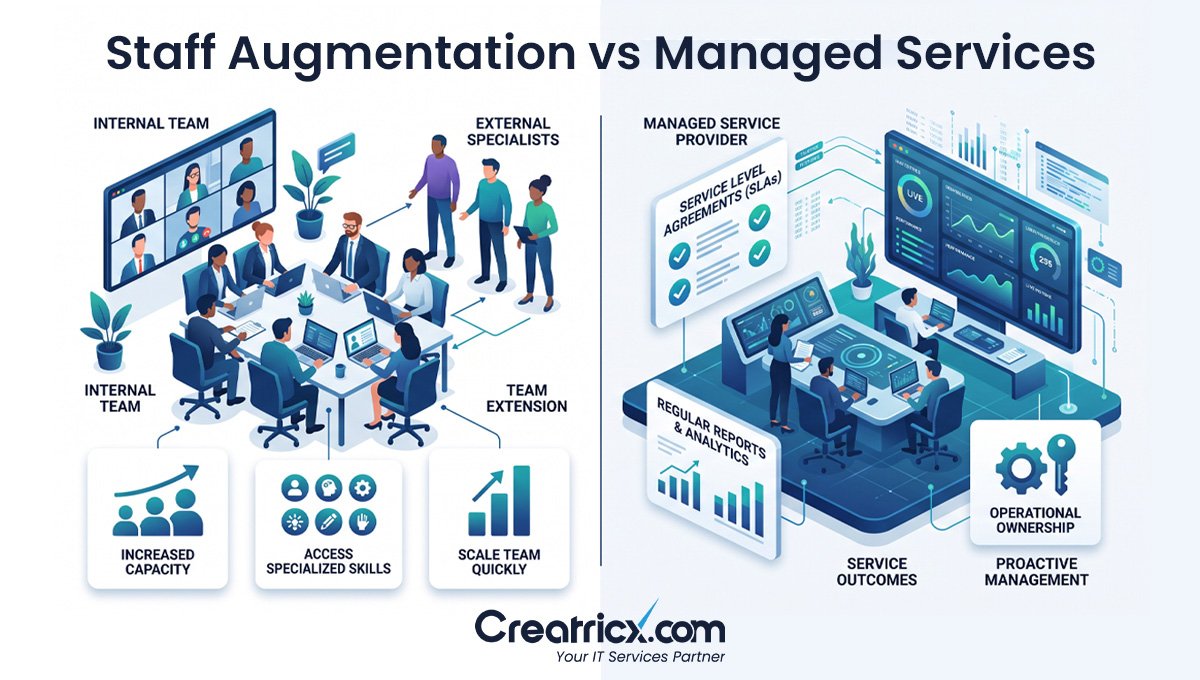
Staff augmentation adds external specialists to a company’s existing team, while the client continues to manage their work and remains responsible for delivery. Managed services transfer responsibility for a defined function or outcome to a provider, which manages the people, processes, tools, and agreed service levels.
In practical terms, staff augmentation means buying access to skills and working capacity. Managed services mean paying a provider to operate something on your behalf.
The people involved may have similar qualifications. A cloud engineer can work under either arrangement, for example. What changes is who assigns the work, manages the process, measures performance, and carries responsibility when something goes wrong.
The Simplest Way to Understand the Difference
The easiest question to ask is not, “Who employs the people?”
Ask this instead
Are we adding people to our operation, or are we asking someone else to operate a defined function?
With staff augmentation, external professionals work inside your existing structure. Your managers decide what should be built, which tasks come first, how quality will be reviewed, and whether the work is moving in the right direction.
With managed services, the provider creates or operates the delivery structure. You agree to the required service, duties, performance expectations and boundaries. The provider then decides how to organize the people and processes needed to deliver it.
This is the difference between adding another engineer to your team and appointing a provider to keep your application secure, available, updated, and supported.
What Is Staff Augmentation?
Staff augmentation is an outsourcing model in which external professionals join a client’s existing team to fill a skills or capacity gap. They may work for a few weeks, several months, or as part of a longer-term arrangement, but the client normally retains direct control over their priorities and daily work.
The Texas Department of Information Resources currently describes IT staff augmentation as temporary IT staff resources acquired on an as-needed, hourly basis, with experience levels ranging from interns to highly specialised professionals. That procurement definition supports the source article’s core point: the organisation is acquiring people with specific skills rather than transferring an entire operation.
Consider a software company that already has a product manager, technical lead, roadmap, development process, and quality standards. The company needs to release an Android application but does not have enough mobile development capacity.
Under staff augmentation, it could add two mobile developers to its existing team. Internal product manager would set priorities. The technical lead would decide on the architecture and review the code. The augmented developers would bring their skills, but the client would still be responsible for the overall product.
Staff augmentation can cover more than software development. Companies may use it to add:
- UI/UX designers during a product redesign
- QA engineers before an important release
- SEO specialists during a website migration
- Cloud engineers for an infrastructure project
- Customer support agents during seasonal demand
The defining feature is not the job title. It is the management structure surrounding the role.
What the client still owns
With staff augmentation, the client generally remains responsible for defining requirements, assigning tasks, reviewing output, coordinating dependencies, managing the project, and deciding whether the final result meets business needs.
The staffing provider is responsible for supplying suitable professionals and handling the employment arrangement. It may also support onboarding, replacement, and performance discussions. It does not normally become fully accountable for the client’s entire project simply because one of its professionals is working on it.
That distinction is easily missed. An experienced developer can improve delivery, but even an excellent developer cannot compensate indefinitely for an unclear roadmap, conflicting priorities, missing decisions, or an absent product owner.
Need specialist capacity without expanding permanent headcount? Creatricx provides dedicated remote professionals across software development, web, mobile apps, UI/UX, cloud, marketing, e-commerce, maintenance, and customer support.
What Are Managed Services?
Managed services are an outsourcing arrangement in which a provider accepts ongoing responsibility for a clearly defined service, system, or business function.
Instead of asking for one cloud engineer, a company might ask a provider to monitor its cloud infrastructure, manage incidents, apply agreed updates, maintain backups, control access, and report on performance.
Instead of hiring a WordPress developer by the hour, it might purchase a website management service covering updates, security checks, backups, performance monitoring, content changes, and technical support.
AWS Managed Services documents its customer/provider split through a formal RACI responsibility matrix. That is a useful real-world example because it shows that managed services transfer defined responsibilities, not every responsibility connected to the customer’s systems or business.
A managed services provider may control how many people work on the service, which tools are used, how routine tasks are scheduled, and how incidents are escalated. The client is mainly concerned with whether the agreed service is being delivered.
Performance may be measured through:
- Availability or uptime
- Response and resolution times
- Ticket volumes and backlogs
- Security or maintenance completion
- Delivery milestones
- Lead quality or campaign performance
- Customer satisfaction
- Other agreed service-level indicators
Not every managed service uses the same measurements. A cloud support agreement should not be judged by the same metrics as a managed SEO service or a customer support operation. The contract must reflect what the provider can reasonably control.
The Main Difference Is Responsibility
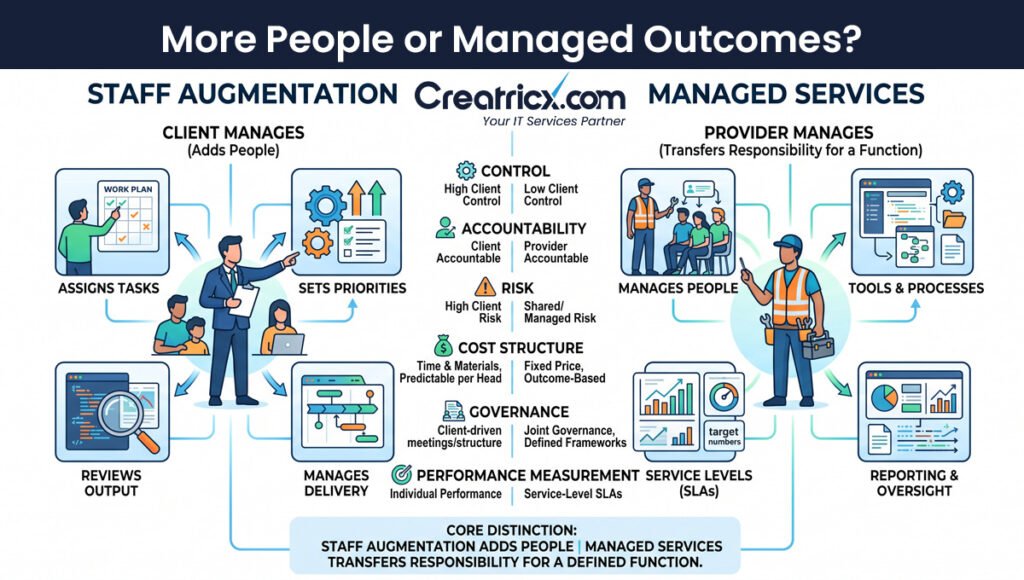
Many comparisons focus on pricing, contract length, or flexibility. These matter, but they are consequences of a more fundamental difference: where responsibility sits.
With staff augmentation, responsibility is distributed around individuals. The client directs the work and is accountable for turning that work into a completed outcome.
With managed services, responsibility is organized around a service. The provider is accountable for delivering the activities and performance included in the agreement.
This changes what happens when delivery begins to fall behind.
In a staff augmentation arrangement, the client may need to revise priorities, resolve internal dependencies, improve specifications, or reassign work. The external professional is part of the delivery system, but the client runs that system.
In a managed arrangement, the provider should investigate the cause, reorganize resources, adjust its process, and report how the service will be restored. The provider cannot blame every operational problem on an individual team member when it has accepted responsibility for managing the service.
There are still boundaries. A managed website provider cannot guarantee availability if the client refuses necessary hosting changes. A marketing provider cannot guarantee sales when pricing, product quality, inventory, and the sales process remain outside its control. Managed responsibility must always be connected to an agreed scope.
The Responsibility Dial
Responsibility Dial
Watch Which Responsibilities Move Across the Contract Boundary
| Decision / Activity | Staff Augmentation | Managed Services |
|---|---|---|
| Business priorities | Client | Client / shared governance |
| Daily task allocation | Client | Provider |
| Staffing decisions | Provider supplies; client directs role use | Provider |
| Delivery process | Client | Provider within agreed scope |
| Tools & workflow | Usually client | Usually provider or jointly agreed |
| Quality review | Client | Provider for contracted service |
| Incident recovery | Client-led delivery response | Provider-led within contracted scope |
| Performance metric | Contribution / capacity / task output | SLA / KPI / service outcome |
| Final business ownership | Client | Client still owns business decisions |
Staff Augmentation vs Managed Services Comparison
| Area | Staff Augmentation | Managed Services |
|---|---|---|
| What you purchase | Individual skills and additional capacity | Operation of a defined service or function |
| Daily management | Client | Provider |
| Task prioritization | Client | Provider within the agreed scope |
| Delivery accountability | Mainly remains with the client | Provider is accountable for the contracted service |
| Typical pricing | Hourly, daily, or monthly per professional | Monthly, scope-based, usage-based, or outcome-based |
| Processes and tools | Usually directed by the client | Commonly selected or managed by the provider |
| Performance measurement | Hours, tasks, contribution, or individual output | SLAs, KPIs, availability, response times, or outcomes |
| Scaling | Add or remove individual professionals | Change service capacity, coverage, or scope |
| Internal leadership required | Usually significant | Less operational supervision, but governance is still needed |
| Best suited to | Skills gaps, temporary demand, specialist projects | Continuous operations and clearly defined functions |
The table provides a useful overview, but contracts do not always fit neatly into one column. Some dedicated teams include provider-side project management. Some managed services allow the client to control a detailed backlog. The name placed on a proposal matters less than the actual division of responsibilities written into it.
Failure Simulator
The Model Becomes Obvious When Something Goes Wrong
A release is three weeks late
The client reviews priorities, dependencies, specifications and internal decision delays. The added professionals are contributors inside that system.
The provider should diagnose why the contracted delivery is failing, reorganise resources/process and report the recovery plan within agreed governance.
A critical cloud alert fires overnight
Unless operational coverage was separately agreed, the client’s incident process still owns detection and response.
If monitoring and incident response are in scope, the provider’s service process should detect, triage and escalate according to the agreement.
The client changes priorities mid-quarter
Direct reprioritisation is usually straightforward because the specialists work inside the client’s backlog.
The change may require a scope, capacity, SLA or commercial adjustment depending on the agreement.
How the Costs Differ
Staff augmentation often looks straightforward because the price is attached to a person. A company might pay a daily or monthly rate for a developer, designer, marketer, or support specialist.
That rate is not the total cost of delivery.
The client still needs someone to interview the professional, complete onboarding, explain the systems, assign work, answer questions, review output, manage dependencies, and monitor progress. These tasks may be handled well by an existing manager, in which case staff augmentation can be highly efficient.
Problems appear when no one has enough time or experience to manage the additional capacity. The company keeps adding people, meetings increase, and work continues to move slowly. Headcount rises while ownership remains missing.
Managed services normally include more than labor. The fee may cover service management, documentation, monitoring systems, reporting, quality control, backup capacity, specialist escalation, and the provider’s responsibility for maintaining delivery.
That can make a managed service appear more expensive when compared only with one person’s rate. The fairer comparison is the cost of operating the complete function internally, including management time, software, coverage, recruitment, absence, replacement, and quality assurance.
Neither model is automatically cheaper. Staff augmentation is often economical when the client already has a strong operating structure. Managed services can be more efficient when the provider’s processes, tools, and shared expertise replace an internal function the client would otherwise need to build.
The True Cost Stack
True Cost Stack
Compare the Cost of the Delivery System, Not One Line Item
| Cost Layer | Staff Augmentation | Managed Services |
|---|---|---|
| Visible fee | Rate per specialist / day / month | Service fee, usage fee, scope fee or outcome-based charge |
| Management | Client manager, product owner, technical lead, review time | Provider service management plus client governance |
| Tools | Usually client tools and environments | May include monitoring, service desk, automation and reporting tools |
| Coverage | Client plans absence, continuity and workload distribution with provider support | Provider may include backup capacity / coverage inside service design |
| Quality | Client quality system | Provider quality controls for the contracted service |
| Change cost | Usually easy to reprioritise individual work | Material scope changes may affect fees, capacity or service levels |
Do not compare a person-rate with a service fee as though they purchase the same thing
One number mainly buys professional capacity. The other can include management, monitoring, tools, documentation, continuity, escalation and accountability. A fair comparison includes the client-side cost of operating the function in both models.
Control Works Differently in Each Model
Staff augmentation provides direct control. The client can reprioritize tasks, move a specialist between projects, change a sprint, or involve the professional in internal discussions.
This is valuable when requirements are evolving. Product development rarely follows a perfectly fixed plan, despite the determined optimism of certain project spreadsheets. Teams learn from users, technical constraints emerge, and business priorities change.
That flexibility also means the client must make more decisions. Direct control is useful only when someone is available and qualified to exercise it.
With managed services, you control through governance, not daily supervision. The client controls the scope, business priorities, access permissions, service levels, and strategic direction. The provider controls routine execution.
A business using managed website support, for example, should not need to tell a technician when to check backups or which standard security updates to review. Those activities should already be part of the service process.
However, the client should still know what is covered, how urgent issues are classified, who approves major changes, what reporting will be provided, and what happens when an incident falls outside the agreement.
Managed does not mean unmanaged by the client. It means the client manages the relationship and outcomes rather than every task.
Risk Does Not Disappear When Work Is Outsourced
Staff augmentation and managed services distribute risk differently, but neither removes it entirely.
With staff augmentation, the client carries more delivery risk because it controls the project. If requirements are incomplete, architecture is poor, or internal decisions take weeks, the staffing provider cannot fully correct those conditions.
The provider is still responsible for providing qualified people and for dealing with real performance or availability issues.
With managed services the provider takes on more operational risk in the contracted scope. It may be responsible for staffing levels, process quality, monitoring, incident response and delivery of agreed performance targets.
The client retains risks connected to its own decisions, systems, employees, data, vendors, and responsibilities excluded from the contract. AWS’s managed services documentation illustrates this through a formal responsibility matrix that assigns some activities to the provider, some to the customer, and others to both.
This is why a good managed services agreement should explain responsibility during normal operations and during failure. A list of services is not enough. The agreement should make clear who detects a problem, who responds, who approves changes, who communicates with affected users, and who prevents the same issue from returning.
The Contract Boundary Lab: RACI Before Delivery
Contract Boundary Lab
Write the Responsibility Matrix Before the First Escalation
AWS Managed Services uses a formal RACI model to separate customer and provider responsibilities. The exact matrix below is a practical example for comparing engagement models, not AWS’s matrix, but the principle is the same: managed does not mean every responsibility disappears from the client.
| Activity | Staff Aug. RACI | Managed RACI | Staff Aug. Primary Owner | Managed Primary Owner |
|---|---|---|---|---|
| Backlog priority | A | I / C | Client | Governance owner |
| Daily task assignment | A/R | I | Client | Provider service lead |
| Routine service execution | C / I | A/R | Client | Provider |
| Incident detection | I / C | A/R | Shared depending on scope | Provider |
| Major change approval | A | R / C | Client | Client |
| Quality validation | A/R | A/R within service | Client | Provider |
| Service reporting | I | A/R | Client manager | Provider service manager |
| Business outcome outside service scope | A | C | Client | Client |
R = Responsible · A = Accountable · C = Consulted · I = Informed
Tie accountability to controllable scope
A provider should not be held accountable for a result it cannot materially influence. Equally, a managed provider should not accept operational ownership and then treat every failure as somebody else’s problem. Define what is responsible, accountable, consulted and informed before the first incident tests the wording.
When Staff Augmentation Makes More Sense
Staff augmentation is usually the stronger choice when the business already knows what needs to be done and has someone capable of managing the work.
It is suited to companies that already have tools, processes, technical leadership and quality standards, but need additional capacity or specialist knowledge.
A product company might use staff augmentation to add a React developer for a new interface. An internal marketing department might add a technical SEO specialist during a migration. A software team might bring in a DevOps engineer to improve deployment automation.
The model is particularly useful when priorities change frequently. Because the professionals work directly with the client’s team, they can adapt without requiring every change to be renegotiated as a separate service request.
Staff augmentation is less suitable when the organization cannot answer basic delivery questions. If no one knows who owns the backlog, approves technical decisions, reviews quality, or resolves conflicts, another team member may simply become another person waiting for direction.
When Managed Services Make More Sense
Managed services are better suited to work that is continuous, repeatable, measurable, and capable of being placed within a defined operating scope.
Common examples include cloud operations, infrastructure monitoring, website maintenance, cybersecurity administration, application support, helpdesk services, recurring marketing execution, and customer service operations.
A managed model can also help when a company lacks the internal leadership required to operate the function. Instead of hiring several specialists and then searching for someone to coordinate them, the company appoints a provider responsible for organizing delivery.
The model works best when expectations can be stated clearly. The provider should understand what systems are included, which hours require coverage, what qualifies as an incident, how quickly different issues should be addressed, and which outcomes will be reviewed.
Managed services become frustrating when the scope is vague. The client believes “everything is included,” while the provider believes almost every new request is outside the contract. Both parties then spend surprising amounts of professional energy debating what the word “support” was supposed to mean.
Unsure whether you need more people or complete operational support? Creatricx can help define the required roles, responsibilities, scope, management structure, and most practical engagement model before delivery begins.
Can a Business Use Both Models?
Many businesses use a combination.
A company might retain an internal product manager and augment its development team with external engineers. It may also use managed services for cloud monitoring, application maintenance, technical support or digital marketing operations.
This is often more practical than forcing every requirement into a single outsourcing model.
Deloitte’s 2024 Global Outsourcing Survey included more than 500 executives. It found that 80% planned to maintain or increase third-party outsourcing investment, while talent and agility had joined cost reduction as important drivers.
The lesson is not that every company should outsource more. It is that different types of work require different ownership structures.
Work connected closely to product strategy may remain under direct internal management. Standardized operational work may be easier to manage as a service. Temporary specialist requirements can be filled through augmentation without redesigning the entire organization.
Hybrid Delivery Architecture
One Business Can Use Both Models Without Turning Procurement Into Competitive Sudoku
Keep strategic, changing product work close to internal leadership. Add specialists where the team needs skill or capacity. Use managed services where work is continuous, repeatable and measurable enough to define as an operating service.
INTERNAL CORE
Product direction & architecture
Roadmap, business priorities, technical direction and key decisions remain internal.
AUGMENTED LAYER
Developers, QA, design, SEO
Specialists join the internal backlog and work under the client’s delivery leadership.
MANAGED LAYER
Cloud, maintenance, support
Provider operates clearly bounded recurring functions against agreed service expectations.
The 2026 Sourcing Context
Current Sourcing Context
2026 Sourcing Is Moving Toward Mixed Models, Not One Universal Outsourcing Answer
Deloitte’s 2024 Global Outsourcing Survey covered more than 500 executives and found that 80% planned to maintain or increase third-party outsourcing investment. A 2026 Deloitte perspective reports that 67% of organizations in its survey had adopted outcome-based outsourcing models. Those figures do not mean managed services are always superior. They support the more useful conclusion: companies are mixing internal teams, external specialists and outcome-based providers depending on the type of capability and responsibility involved.
Add talent to the operating model you already trust.
Define scope, service levels and provider accountability.
Use a hybrid model instead of forcing every problem into one contract shape.
Deloitte’s more recent 2026 multidimensional workforce perspective reports that 67% of surveyed organisations had adopted outcome-based outsourcing models. Treat that as sourcing context rather than a commandment: the right ownership model still depends on the work.
Five Questions to Ask Before Choosing
1. Who can manage the work?
If the client has capable leadership, augmentation remains viable. If not, moving delivery responsibility to a provider may be cleaner.
2. Are you filling a role or outsourcing a function?
A Python developer is a skill requirement. Operate and support the application is a service requirement.
3. How will success be measured?
Individual contribution points toward augmentation. Uptime, response time, backlog, campaign output or other service KPIs point toward managed delivery.
4. How frequently will priorities change?
Fast-changing product work benefits from direct control. Stable repeatable operations are easier to package into a service.
5. Who should fix delivery when it fails?
If the client owns the delivery system, augmentation fits. If the provider must restore the service, write the arrangement as managed responsibility.
Do you already have someone who can manage the work?
If a capable product owner, technical lead, marketing manager, or operations manager is available, staff augmentation may provide exactly what is missing.
If nobody can reliably plan, supervise, and review the work, a managed arrangement may be more realistic.
Are you filling a skills gap or outsourcing a function?
Needing a Python developer is a skills gap.
Needing someone to operate, secure, monitor, and support a business application is a functional requirement.
The language used in the initial request often reveals which problem the company is actually trying to solve.
How should success be measured?
If success is measured on individual contribution, completed tasks, or sprint capacity, staff augmentation may be a good fit.
Whatever your measure of success is – availability, response time, maintenance completed, campaign performance, ticket resolution or any other service-level outcome, managed services are likely your better option.
How often will priorities change?
Frequently changing product work benefits from direct access and flexible task allocation.
Stable operational work benefits from documented processes and repeatable service management.
Who should be accountable when delivery fails?
This is the uncomfortable question, which usually means it is the useful one.
If the client wants to remain responsible for delivery and needs more capable people, choose staff augmentation.
If the provider is expected to organize delivery, maintain the process, and correct operational failures, structure the work as a managed service with clear responsibilities.
How Creatricx Approaches the Decision
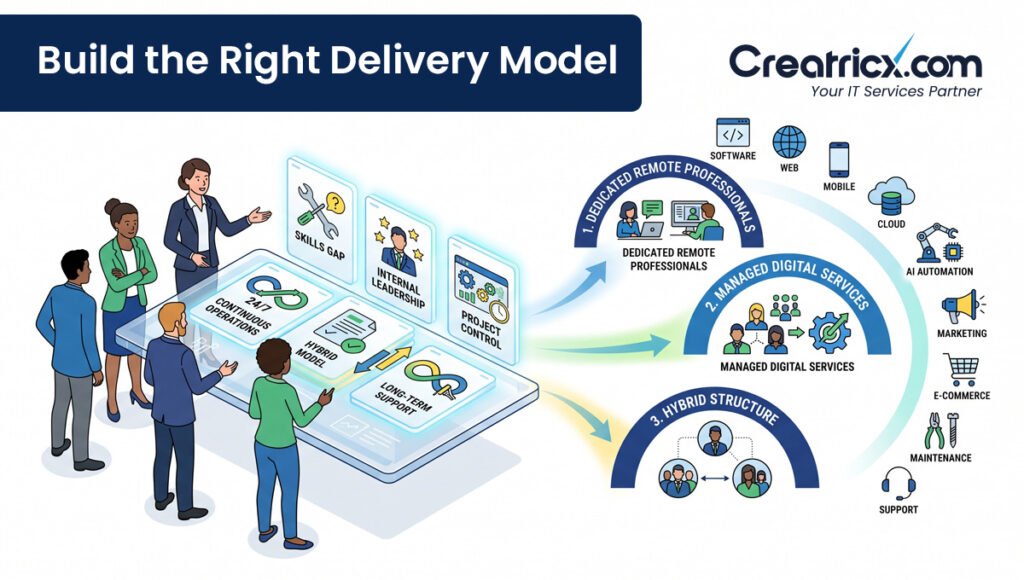
At Creatricx, the engagement model begins with the work rather than a predetermined staffing package.
The Creatricx process starts by clarifying the client’s goals, scope, timeline, audience, workflow, and technical requirements. Planning, execution, quality checks, deployment, monitoring, and long-term support are then structured around those requirements. Creatricx provides remote expertise across software, website development, mobile applications, UI/UX, AI automation, cloud, marketing, e-commerce, maintenance, and customer support.
One practical lesson from structuring these engagements is that the requested number of people is not always the real requirement.
A company may ask for three developers when the deeper problem is that requirements are not documented and nobody owns technical decisions. Adding three people to that environment creates more activity, but not necessarily more progress.
Another company may initially request fully managed development even though it already has an experienced technical lead and a mature delivery process. In that situation, adding selected specialists can preserve internal control and avoid paying for management the company does not need.
Creatricx therefore looks at four areas before recommending a model:
Priority
Who will decide what comes first?
Management
Who will direct the daily work?
Quality
Who will approve technical and quality decisions?
Accountability
Who should own the final service or outcome?
When those responsibilities remain with the client, staff augmentation is generally the cleaner arrangement.
When Creatricx is expected to organize the people, manage execution, maintain the function, and report against agreed expectations, the engagement should be structured as a managed service.
Some projects require both. A dedicated developer may work directly within the client’s product team, while Creatricx manages website maintenance, cloud support, marketing execution, or another continuing function around it.
4 Common Mistakes to Avoid
Using staff augmentation to solve a management problem
Additional professionals can increase output, but they cannot create clear leadership from nothing. Before adding people, make sure someone owns requirements, priorities, decisions, and quality. Otherwise, the company may pay for skilled professionals who spend too much time waiting, interpreting contradictory instructions, or redoing work.
Buying managed services without defining the boundaries
“Manage our IT” is not a usable scope. The agreement should identify the systems, activities, coverage hours, exclusions, access requirements, service levels, reporting, and escalation process. Clear boundaries protect both parties.
Comparing only the visible rates
An augmented developer’s rate and a managed service fee represent different things. One primarily buys professional capacity. The other may include management, tools, monitoring, documentation, backup resources, reporting, and accountability. Comparing them without considering internal management costs produces a neat spreadsheet and a misleading decision.
Assuming managed services remove all internal involvement
A provider can manage operations, but it cannot replace business ownership. The client must still set strategic direction, approve important changes, protect internal access, provide accurate information, and review whether the service continues to support business goals.
Staff Augmentation or Managed Services: Which Should You Choose?
Staff augmentation is when you have an efficient internal delivery structure, but need more skills, capacity or flexibility.
Choose managed services when you want a provider to take responsibility for operating a defined function and meeting agreed performance expectations.
Use a hybrid arrangement when some work requires close internal control while other activities are better handled as ongoing services.
The decision is not really about whether external people will be involved. In both models, they will.
It is about whether your business needs more people inside its operating system or another organization to operate part of that system for you.
That is the difference that affects cost, control, accountability, and ultimately whether the arrangement works.
Build the Right Delivery Model With Creatricx
Creatricx provides dedicated remote professionals and managed digital services across software development, web, mobile applications, cloud, AI automation, UI/UX, marketing, e-commerce, maintenance, and customer support.
Whether you need one specialist working within your existing team or ongoing responsibility for a complete digital function, Creatricx can structure the engagement around your goals, internal capabilities, and delivery requirements.
Book a free consultation to define your scope, responsibilities, required skills, and the right outsourcing model before you commit to unnecessary headcount or an unsuitable service contract.
Practitioner Pulse: Responsibility Problems in the Wild
Practitioner Pulse: Responsibility Problems Are Usually More Painful Than Staffing Problems
These are public forum discussions, so treat them as anecdotal operational signals rather than universal evidence. They are useful because people become extremely precise about ownership after a target, incident or deadline has gone badly.
Accountability without control creates bad operating targets
In a recent ExperiencedDevs discussion, a platform lead describes being held to a utilisation target that depends heavily on teams outside the platform group’s control. It is a clean illustration of why managed-service KPIs should be tied to factors the provider can actually influence.
Technical authority is different from product priority
An ExperiencedDevs thread on staff-engineer decision rights repeatedly separates technical implementation autonomy from product and management authority. Staff augmentation inherits the same reality: a skilled specialist can make strong technical decisions without becoming the owner of the client’s roadmap.
Managed operations need defined technician responsibility and scope
In an r/msp discussion, operators debate how technicians should be assigned responsibility across customers instead of treating every ticket as a pooled fire. The exact model varies, but the recurring concern is service ownership, not merely having enough technicians.
Frequently Asked Questions
What is the main difference between staff augmentation and managed services?
Staff augmentation supplies external professionals who work under the client’s management. Managed services give a provider responsibility for operating a defined service or function. The key difference is who manages the work and remains accountable for delivery.
Is staff augmentation a form of outsourcing?
Yes. Staff augmentation is an outsourcing model because professionals are supplied by an external provider. However, the client retains more direct control than it normally would under a managed services agreement.
Which is cheaper, staff augmentation or managed services?
Neither is always cheaper. Staff augmentation can cost less when the client already has effective managers, processes, and tools. Managed services may be more economical when the provider replaces the need to build and operate a complete internal function.
Can staff augmentation become a managed service?
Yes, but the arrangement should be formally redefined. Moving from supplied personnel to provider-owned delivery changes responsibilities, performance measures, pricing, governance, and risk. Those changes should appear in the contract rather than being assumed informally.
Are managed services only used for IT support?
No. Managed services can cover cloud operations, cybersecurity, application maintenance, websites, digital marketing, e-commerce operations, customer support, data management, and other repeatable business functions.
Can startups use both models?
Yes. A startup can bring an external developer into its product team through staff augmentation while using managed services for cloud infrastructure, website maintenance, security, marketing or customer support. The right combination depends on internal leadership and the type of work.
Do managed services always include an SLA?
Not necessarily. Many managed services use SLAs or KPIs, but the measures should match the service. Cloud support may use availability and incident response targets; a managed marketing service may use delivery cadence, qualified leads or other agreed indicators. The contract should define what the provider can reasonably control.
Can a managed service include dedicated people?
Yes. The presence of dedicated people does not by itself make the model staff augmentation. The key question is who manages their work and who is accountable for the contracted function. A managed service can use dedicated specialists while the provider still owns routine delivery.
What should a hybrid staff augmentation and managed services contract define?
Define which roles work under the client’s daily direction, which functions the provider operates, the RACI for shared activities, service boundaries, escalation, access, reporting, change control and what happens when work moves from one model to the other.
Which model is better during a migration or transformation?
It depends on internal capability. If the client has strong programme and technical leadership but needs specialist hands, staff augmentation can fit well. If the provider is expected to plan, coordinate and operate a larger workstream or ongoing function, managed delivery may be more suitable. Some migrations use both.
Sources and Evidence Quality
- Texas Department of Information Resources — IT Staffing Services Current public-sector definition of IT staff augmentation as temporary, as-needed hourly IT resources.
- AWS Managed Services — RACI Responsibility Matrix Concrete example of a managed service explicitly dividing customer and provider responsibilities.
- AWS Managed Services Accelerate — Roles and Responsibilities Additional managed-services documentation showing that customer responsibilities remain even inside a managed environment.
- Deloitte Global Outsourcing Survey 2024 More than 500 executives; 80% planned to maintain or increase third-party outsourcing investment, with skill and agility joining cost as drivers.
- Deloitte: Power of a Multidimensional Workforce (2026) Current perspective reporting broader adoption of outcome-based outsourcing and mixed sourcing models.
Final Thoughts
Staff augmentation and managed services are not competing labels for the same outsourcing arrangement. They move responsibility in different ways. Augmentation inserts specialist capacity into a system the client still runs. Managed services ask a provider to run a defined part of that system against agreed responsibilities and performance expectations.
The decision gets easier when you stop comparing provider brochures and trace ownership instead. Who sets priorities? Who manages the daily work? Who owns the process? Who measures performance? Who fixes delivery when it breaks? The answers reveal the model long before the contract title does.
For many businesses, the best answer is mixed. Keep changing strategic work close to internal leadership, add specialists where capability is missing, and transfer repeatable operational functions where a provider can genuinely own the service. An outsourcing model should fit the work, not force the work to fit the model.