
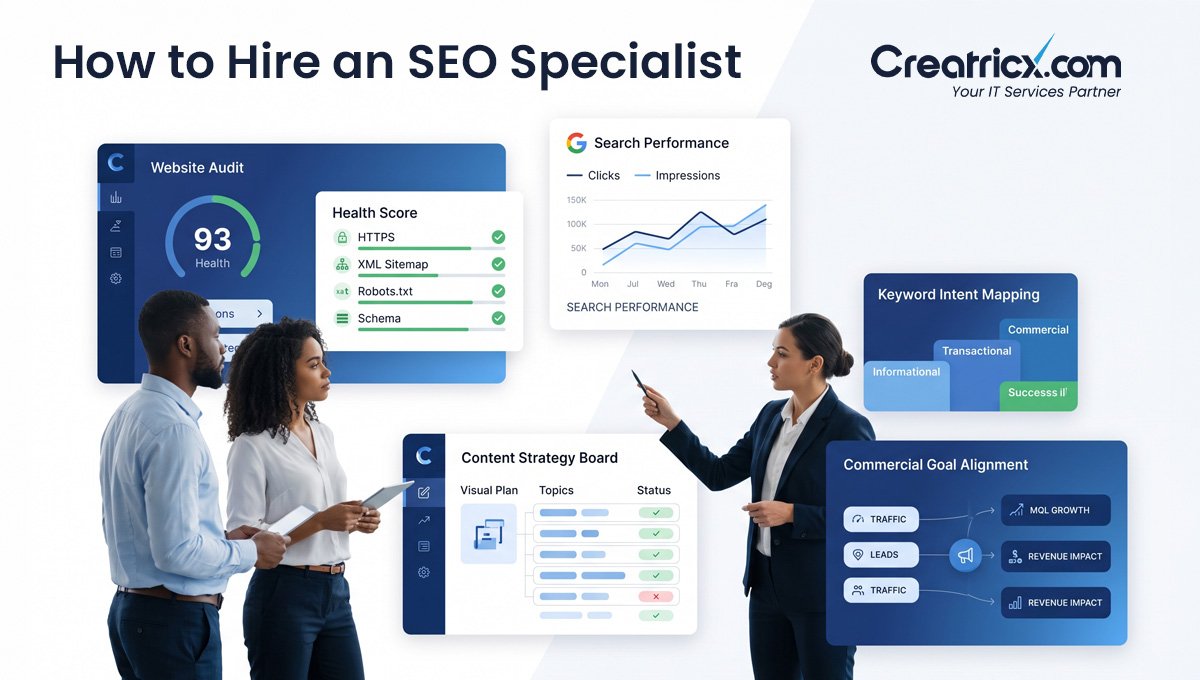
Hiring an SEO specialist often begins with a simple goal: improve rankings and bring more visitors to the website.
The difficulty starts when every candidate appears to offer the same things. They mention keyword research, technical audits, backlinks, content optimisation, competitor analysis, and monthly reports. Their proposals may look different, but the language is often almost identical.
The real question isn’t whether someone knows common SEO terminology. It is whether they can examine your business, identify what is limiting organic growth, decide what matters first, and turn that diagnosis into work your team can implement.
A good SEO specialist doesn’t simply produce more tasks. They help your business make better search decisions.
Table of Contents
How Do You Hire a Good SEO Specialist?
Find an SEO expert who’s skilled in diagnosing websites, prioritizing opportunities, communicating recommendations, coordinating implementation and measuring business results. Ask for samples of work, ask what they would do in their first 90 days and avoid anyone that guarantees rankings. The right specialist will know search performance and your commercial goals.
Google’s current hiring guidance recommends interviewing potential SEOs, checking previous work and references, asking how success will be measured, and seeing whether the provider is actually interested in your business, customers and competitors. Read Google’s hiring guidance.
That last point is more important than it may seem. SEO is not performed on an abstract collection of web pages. It is performed for a business trying to attract a particular audience, sell something, generate enquiries, or enter a market.
A specialist who does not understand that context may improve numbers without improving the business.
Start by Defining What You Need From SEO
Many companies begin searching for an SEO specialist before they have defined the problem.
They may say they need better rankings when their real issue is that important pages are not indexed. They may request more blog content when their existing service pages do not explain the offer clearly. They may blame low traffic when the website already receives visitors but fails to convert them.
Before evaluating candidates, decide what is currently driving the decision to hire.
Maybe you need an SEO expert because you:
- Organic traffic/Enquiries have dropped.
- The website is being revamped or moved to a different platform.
- Your competitors are appearing for searches you should reasonably target.
- Your team publishes content without a clear search strategy.
- Technical problems are affecting crawling, indexation, speed, or page structure.
- Your company is entering a new service category, country, or city.
- You need consistent SEO execution but cannot justify a complete internal department.
Do not write a job description that simply says “improve SEO.” Define the business trigger: traffic loss, migration risk, weak commercial pages, expansion, inconsistent execution or a technical problem. The specialist can diagnose the cause, but the hiring team should know why the conversation exists.
This doesn’t require a perfect diagnosis. That is partly what the specialist is being hired to provide. It does, however, prevent the recruitment process from becoming a search for “someone who does SEO,” which is broad enough to include half the internet and several people sending suspicious audits from free email accounts.
Understand What an SEO Specialist Should Be Able to Do
SEO combines technical analysis, content strategy, user behaviour, data interpretation, and implementation.
Google describes SEO as work that helps search engines understand content and helps people discover a website and decide whether to visit it. Its current hiring guidance also includes technical advice, content, keyword research, market expertise and optimizing for generative AI. Google Search Central
A capable specialist should therefore understand more than keywords.
They should be able to examine how search engines access the website, which pages are being indexed, how information is organised, what users are searching for, whether the content satisfies that intent, and what happens after a visitor reaches the page.
Some specialists are stronger in particular areas. A technical SEO may be excellent at JavaScript rendering, crawl analysis, structured data, and migrations. A content-focused specialist may be stronger at search intent, topic planning, page optimisation, and editorial strategy. An ecommerce specialist may understand product architecture, categories, filters, and duplicate URL control.
You don’t necessarily need one person who is the best in every discipline. You need someone whose strengths match your current situation and who knows when another skill is required.
Use the Creatricx Four-Layer Evaluation
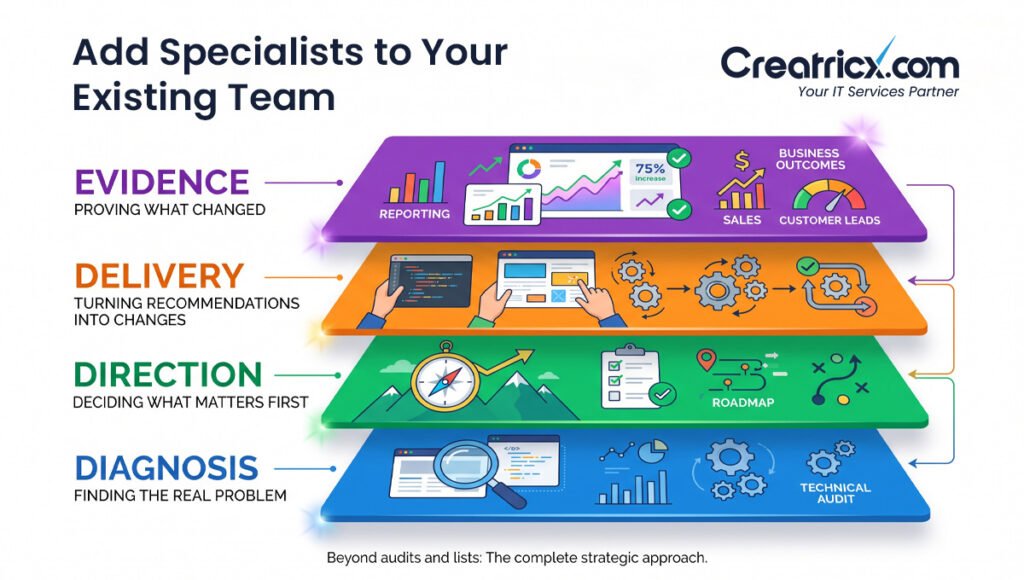
At Creatricx, we consider SEO specialists across four connected layers: diagnosis, direction, delivery, and evidence.
These layers help separate someone who can discuss SEO from someone who can operate it.
Diagnosis: Can They Find the Real Problem?
The first responsibility of an SEO specialist isn’t to recommend work. It is to understand the website.
A reliable specialist should review the business model, important services or products, target customers, current traffic, existing pages, competitors, technical condition, and conversion journey before proposing a large campaign.
Imagine a business whose main service pages are excluded from indexing because of an incorrect technical setting. Publishing twelve new articles would not solve the immediate problem. Nor would purchasing backlinks to pages that search engines cannot properly access.
The diagnosis must come before the prescription. Medicine discovered this arrangement some time ago. Marketing occasionally remembers.
Candidates should be asked what they would want to look at before they devise a strategy. Strong answers should include both website data and commercial context.
Direction: Can They Decide What Comes First?
Most established websites have more possible SEO tasks than available time.
An audit may uncover missing titles, weak internal links, slow templates, thin pages, duplicate content, broken redirects, schema opportunities, keyword gaps, and hundreds of other recommendations.
The specialist’s value lies partly in deciding which actions deserve attention now.
Ask them to explain how they would prioritise:
- A serious indexation problem
- Weak commercial landing pages
- Declining traffic to existing content
- New content opportunities
- Link acquisition
- Conversion improvements
There is no universal order because the correct sequence depends on the website. What matters is whether the candidate can explain the relationship between effort, risk, business value, and likely impact.
Prioritisation is part of the strategy. A list of 300 issues without sequence, dependency or commercial context is not a roadmap. It is organised anxiety with export buttons.
At Creatricx, we treat prioritisation as part of the strategy, not as a final column added to an enormous audit spreadsheet. A list of 300 issues without a sequence is not a roadmap. It is organised anxiety.
Delivery: Can They Turn Recommendations Into Changes?
Some SEO specialists are skilled at finding problems but less comfortable getting them fixed.
They can explain that a website has poor internal linking, but they can’t build a practical linking plan. They identify thin service pages but provide no usable content brief. They report technical issues but cannot communicate clearly with developers.
Before hiring, determine what the specialist will actually deliver.
Will they only advise your team, or will they also:
- Optimise important pages
- Prepare content briefs
- map keywords and search intent
- Review new content
- Plan redirects
- Write implementation requirements
- Work directly with developers
- Test completed changes
- Monitor performance after launch
The answer affects the type of support you need.
A company with an experienced content, development, and analytics team may only need strategic direction. A smaller business may need a dedicated SEO specialist who can coordinate the work across several disciplines.
This is one of the reasons Creatricx provides SEO specialists alongside web developers, content professionals, designers, and analytics support. Our SEO work can move from diagnosis to implementation without leaving the client to assemble a new group of suppliers for every recommendation. Creatricx’s SEO delivery covers technical health, search intent, content, on-page optimisation, internal linking, local and ecommerce SEO, analytics, and conversion-focused page improvements.
The 100-Point SEO Specialist Scorecard
The four-layer model becomes much more useful when every shortlisted candidate is scored against the same criteria. The weighting below is intentionally practical: it rewards diagnosis and delivery more heavily than tool fluency or presentation polish.
Practical Hiring Rubric
The 100-Point SEO Specialist Scorecard
| Area | Weight | What You Are Testing |
|---|---|---|
| Diagnosis | 25 | Can identify the real search constraint using first-party data and business context. |
| Direction | 20 | Can prioritise instead of turning every audit finding into an emergency. |
| Delivery | 20 | Can write usable briefs, tickets, redirects, content requirements and validation steps. |
| Evidence | 15 | Can explain completed work, resulting movement, learning and the next decision. |
| Communication | 10 | Can explain trade-offs in plain language and work with developers, writers and leadership. |
| 2026 Search Fluency | 10 | Understands Google fundamentals, AI search guidance and why tool predictions are not Google data. |
This is a Creatricx-style practical evaluation framework, not a Google scoring system or industry certification.
Evidence: Can They Show What Was Changed?
SEO reporting should tell you more than whether impressions increased.
Ask the candidate how they tie SEO work to meaningful outcomes. That could be qualified organic traffic, enquiry volume, ecommerce revenue, demo requests, engagement on important pages, local actions or assisted conversions, depending on the business.
Rankings still matter, but they need context. Moving from position 60 to position 20 may show progress without producing meaningful traffic. Ranking first for a term nobody relevant searches may look impressive in a report while contributing very little to the company.
A useful report should answer four questions:
- What work was completed?
- What changed afterward?
- What did the team learn?
- What should happen next?
SEO results do not arrive on one universal timetable. Google’s starter guidance notes that some changes can be reflected within hours while others may take several months. A trustworthy specialist should explain dependencies and uncertainty rather than forecast a perfectly smooth line.
A trustworthy specialist should therefore discuss reasonable expectations, dependencies, and uncertainty. They should not respond to every forecast request by drawing a smooth upward line toward prosperity.
Ask Questions That Reveal How They Think
Generic questions often produce rehearsed answers.
Asking, “Do you know technical SEO?” will usually result in a confident yes. Asking how the specialist would investigate a sudden decline in non-brand traffic forces them to explain their process.
Useful interview questions include:
“What would you review during your first month?”
A strong answer should begin with access, business discovery, technical review, analytics, Search Console, important landing pages, existing content, competitors, and conversion tracking. Be cautious when the answer begins immediately with publishing blogs or building links. Those actions may eventually be appropriate, but they should follow an initial diagnosis.
“How do you choose which keywords are worth targeting?”
The specialist should discuss relevance, intent, competition, business value, current authority, page type, and the likelihood that the traffic can lead to a useful outcome. Search volume alone is not enough. A low-volume query used by serious buyers can be more valuable than a broad phrase that attracts thousands of visitors with no intention of purchasing.
“What would make you recommend against creating a new page?”
This question reveals whether the candidate can resist unnecessary content production. A thoughtful specialist may mention overlapping intent, keyword cannibalisation, lack of genuine demand, insufficient differentiation, or the ability to strengthen an existing page instead.
“How do you work with developers and writers?”
The candidate should be able to translate SEO findings into clear instructions. Developers need reproducible technical requirements, not statements such as “fix the SEO.” Writers need a useful brief, not a pile of keywords arranged according to how frequently a tool would like them repeated.
“How will you measure success?”
The answer should connect visibility with your business model. A local service company, ecommerce store, SaaS platform, and publisher will not share the same definition of success. Google also advises asking SEO candidates what results they expect, how long those results may take, how success will be measured, and how changes will be communicated. (Google for Developers)
The 2026 Competency Layer: AI Search Without the Gimmicks
The 2026 Competency Layer
A Strong SEO Specialist Should Understand AI Search Without Selling You AI-Search Theatre
Google’s 2026 guidance is surprisingly useful here: foundational SEO remains relevant for AI Overviews and AI Mode. Google recommends unique, non-commodity, expert-led content and explicitly says businesses can ignore gimmicks such as unnecessary AI text files, forced “chunking” or inauthentic mentions.
How does your strategy change for AI Overviews and AI Mode without abandoning search fundamentals?
Crawlability, internal links, useful original content, structured visible information, multimedia and measurement.
The pitch depends on a secret GEO formula, guaranteed AI citations, fake mentions or a proprietary “Google-approved” tool.
Google also began rolling out dedicated Generative AI performance reporting in Search Console in June 2026 to a subset of properties. A current specialist should at least know what that report measures and how it differs from third-party visibility estimates.
Google’s current guidance also says third-party tools do not have access to its internal ranking data and cannot guarantee performance. A candidate who treats a tool’s score as if it were a Google metric is confusing an estimate with a source of truth. Read Google’s third-party SEO guidance.
Review Case Studies Carefully
Case studies can help, but only when you understand what they prove.
A statement such as “organic traffic increased by 200%” leaves several questions unanswered. The site may have started from almost no traffic. The increase may have come from irrelevant informational searches. The specialist may have joined after a migration problem was already fixed. Seasonal demand may have contributed.
Ask candidates to explain:
- The initial problem
- Their personal role
- The work completed
- The time involved
- The constraints
- The business outcome
- What they would do differently now
You don’t need the candidate to reveal confidential client information. You do need enough detail to understand how they approached the work.
Industry experience can be useful, especially in regulated, technical, local, or highly specialised markets. It should not replace thinking ability. A specialist who understands your exact sector but follows the same routine for every client may be less useful than one who learns quickly and builds the strategy around evidence.
Case Study Evidence Locker
A 200% Traffic Claim Is the Beginning of the Interview, Not the End
Baseline
What was broken, weak or underperforming before the work began?
Role
What did this candidate personally own rather than the wider team?
Decision
What did they choose to do first, and what did they deliberately postpone?
Implementation
What changed in the site, content, architecture or measurement setup?
Outcome
What business or search result changed, with timeframe and context?
Reflection
What would they do differently now? This is where rehearsed case studies become useful evidence.
Consider a Small Paid Assessment
A short paid exercise can reveal more than another interview.
Give the candidate access only to information required for the task. Ask them to review one important page or a limited section of the website and identify the three most important opportunities.
The assessment should require them to explain:
- What they found
- Why it matters
- What they would change
- How they would measure the result
Don’t ask candidates to produce a complete SEO strategy for free. That isn’t an assessment. It is unpaid consulting wearing a recruitment badge.
Google recommends granting only read access to Search Console during an early audit rather than broad write access before trust and responsibilities are established. See the current Google guidance.
Paid Assessment Lab
Give Every Shortlisted Candidate the Same Small Problem
A useful paid test is deliberately narrow. Give read-only data plus one important commercial page. Ask for the three highest-priority opportunities, not a free strategy for your entire business.
What did you find and where did the evidence come from?
Why are these three items more important than everything else you noticed?
What exact change would a writer, developer or marketer need to make?
How will you know the change was implemented correctly and whether it helped?
Watch for SEO Red Flags
The clearest warning sign is a guaranteed ranking.
Google explicitly warns that nobody can guarantee a number-one ranking and recommends caution when an SEO claims a special relationship with Google or refuses to explain methods. Google’s hiring guidance
Other warning signs include secrecy, generic proposals, unexplained link packages, reports based entirely on one third-party tool, and recommendations made before the specialist understands the business.
Be particularly cautious when someone promises a specific traffic increase without reviewing your website, market, history, resources, or competitors.
A good specialist can estimate opportunities and explain what they expect. They cannot responsibly guarantee the behaviour of search systems, competitors, users, and your internal implementation team simultaneously.
Guaranteed #1 rankings
No specialist controls Google’s results. Google explicitly warns against ranking guarantees.
Secret methods or unexplained link packages
You are accountable for what a provider does to your site, so “trust the process” is not sufficient documentation.
Strategy before discovery
A detailed roadmap created before access, business context and first-party data is usually a template wearing your logo.
Third-party tool scores treated as Google truth
Google says third-party tools do not have access to its internal ranking data and cannot guarantee performance.
AEO/GEO magic files and hacks
Google’s 2026 guidance says foundational SEO still matters and specifically warns against gimmicks such as unnecessary AI text files or inauthentic mentions.
Reporting without a change log
If the report cannot show what was implemented, learning becomes guesswork and accountability becomes a monthly chart ritual.
Write access requested during an early audit
Google recommends read-only Search Console access for an early audit before broader permissions are justified.
Link building is the answer to every problem
Backlinks cannot repair blocked indexing, broken redirects, weak intent matching or a service page that explains nothing.
SEO Delivery Field Notes
The Audit Is Finished Only When the Recommendation Survives Implementation
The operational difference between advice and delivery is traceability. Someone should be able to follow the recommendation from evidence, to decision, to implementation, to validation, without translating “fix the SEO” into an archaeological expedition.
Every recommendation needs an owner
A task nobody owns does not become more strategic because it appears in an audit.
Write acceptance criteria
A developer ticket should state the affected URLs, expected behaviour and how the SEO will verify the change after release.
Content briefs need a decision
A brief should explain the search intent, page role, unique information required and conversion goal, not simply export keywords from a tool.
Preserve before-and-after evidence
Record the baseline before changing templates, redirects, internal links or content so later reporting can separate movement from memory.
Track dependencies
Some SEO work cannot move until design, engineering, legal or product teams act. A specialist should surface that dependency early rather than silently carry overdue tasks.
Close the loop
After implementation, validate the page in the browser, source, Search Console and analytics as appropriate. “Ticket closed” is not the same as “SEO change verified.”
Decide Which Hiring Model Fits Your Business
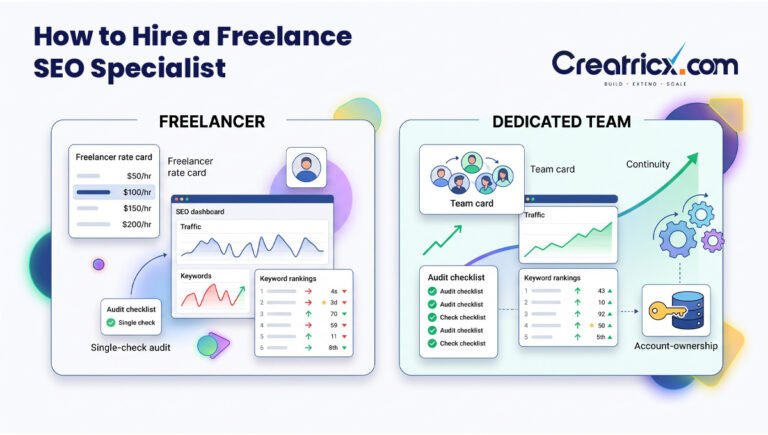
You can hire an internal employee, freelancer, agency, or dedicated remote SEO specialist. Each model solves a different problem.
An internal employee offers tight integration, but also requires time to recruit, salary, benefits, software, management, and the risk that one person can’t cover every SEO discipline.
A freelancer can be effective for a focused audit, migration, or specialist project. Availability and supporting resources may be limited when implementation requires developers, designers, writers, or analysts.
A traditional agency can provide a broader team, although some businesses find that communication passes through account managers while the people performing the work remain distant.
A dedicated SEO specialist can provide a happy medium. The specialist works consistently with your company and becomes familiar with the website, brand, market, and internal process, while remaining supported by an external delivery team.
This model is particularly useful when SEO requires ongoing attention but the business is not ready to recruit a complete internal department.
| Model | Working Style | Best Fit | Main Trade-Off |
|---|---|---|---|
| In-house SEO | High day-to-day integration | Broad ongoing ownership when workload justifies a permanent role | One person may not cover technical, content, local, ecommerce and analytics equally well |
| Freelancer | Direct specialist access | Audits, migrations, focused projects and specialist gaps | Capacity, availability and implementation support can be limited |
| Traditional agency | Access to a wider bench | Multi-discipline programmes and managed delivery | Execution can feel distant if everything passes through account management |
| Dedicated SEO specialist | Consistent individual + external support bench | Ongoing SEO where continuity matters but a full in-house department is premature | Requires clear ownership and integration with your team |
Why Hire a Dedicated SEO Specialist From Creatricx?
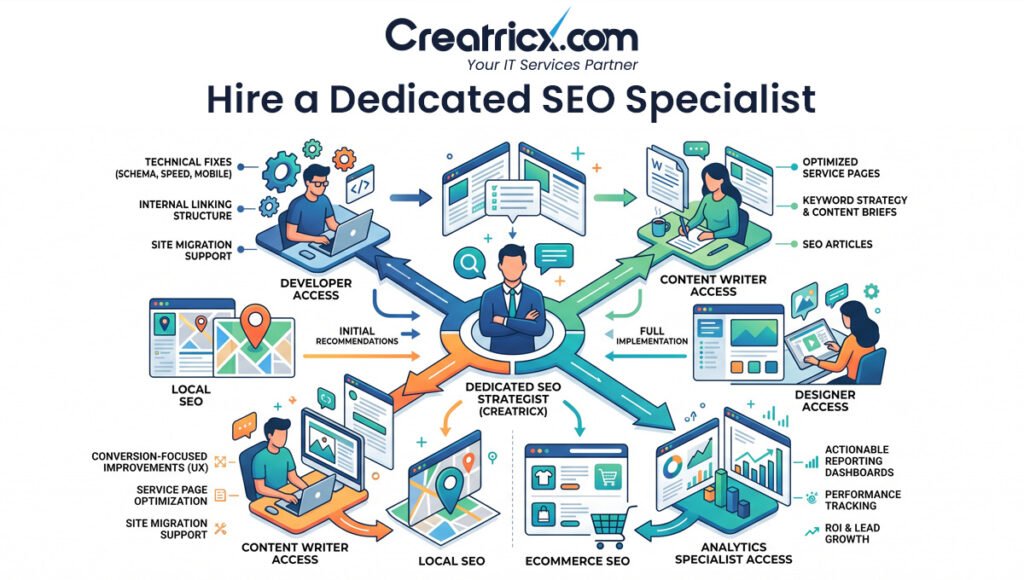
Creatricx provides dedicated SEO specialists who work as an extension of your team rather than appearing once a month with a colourful report and several new mysteries.
The engagement begins by understanding your services, audience, market, website, current visibility, technical limitations, and commercial priorities. From there, the specialist can build and manage an SEO roadmap covering the areas your business actually needs.
That may include technical SEO, keyword and intent mapping, service-page optimisation, content planning, internal links, local SEO, ecommerce SEO, competitor research, analytics, reporting, and support during redesigns or migrations.
The main Creatricx advantage is that the specialist does not work in isolation.
When SEO requires a technical change, the work can be coordinated with web developers. When an opportunity requires a new landing page, content and design support can be included. When tracking is incomplete, analytics requirements can be addressed. If you get traffic but no conversion, you can check out the journey & CTA instead of saying victory because impressions went up.
Creatricx offers remote SEO capacity without the delay and overhead involved in building a large in-house department. Its wider remote delivery model also covers development, design, marketing, ecommerce, maintenance, cloud, and other digital services, allowing clients to extend support as their needs change.
What Should the First 90 Days Look Like?
The first 90 days should produce clarity before scale.
First, the specialist should get to know the business, check access, check tracking, evaluate search visibility and identify technical or structural risks.
The next step would be to translate those findings into priorities. Important pages may need improvement. Technical barriers may require development work. New articles may be commissioned, but existing content may need consolidation.
The final stage should establish a repeatable workflow for implementation, content, measurement, and reporting.
At Creatricx, we avoid beginning every engagement with the same fixed list of monthly activities. A technically weak site may need repairs before content expansion. A technically healthy site with poor commercial pages may need stronger service content. An established website may need consolidation rather than more URLs.
The purpose of the first 90 days is not to look busy. It is to build the correct sequence.
Days 1-30
Establish the truth
Business discovery, access, tracking validation, Search Console review, technical risks, page inventory, search demand, competitor context and conversion measurement.
Days 31-60
Fix the highest-value constraints
Resolve priority technical barriers, improve commercial pages, consolidate weak content where needed, build briefs and establish internal-linking and implementation workflows.
Days 61-90
Build the operating system
Create a repeatable backlog, reporting rhythm, validation process, content pipeline, developer handoff and decision rules for what gets done next.
Practitioner Pulse: What Buyers Keep Asking in SEO Communities
Practitioner Pulse: What Buyers Keep Asking in SEO Communities
Community threads are anecdotal, not controlled evidence. They are useful because they expose the questions buyers ask after glossy proposals meet actual budgets.
“Spent $60k on SEO over a year — no return”
The recurring lesson is that activity without business evidence is not enough. Ask what changed, what outcome it was meant to affect, and how the provider knew to continue.
“Should I learn SEO or just hire someone?”
The sensible middle ground is to understand enough SEO to evaluate recommendations, then hire when the work requires sustained expertise or execution capacity.
“How do I hire SEO agencies?”
The existence of this question in mature SEO communities is itself useful evidence: buyers struggle less with finding providers than with distinguishing credible process from packaging.
For technical questions, the Google Search Central Help Community is a stronger place to compare advice against experienced contributors and official guidance.
The Right SEO Specialist Should Make Decisions Easier
A capable SEO specialist will not remove every uncertainty from organic search.
They will make the website easier to understand, the opportunities easier to prioritise, and the work easier to execute.
They should be able to explain what is happening without hiding behind terminology. They should understand when a technical fix matters more than another article, when an existing page should be improved instead of replaced, and when a keyword is attractive on paper but commercially useless.
Most importantly, they should treat SEO as part of the business rather than as an isolated ranking exercise.
The right person is not simply someone who can generate a longer task list. There is no shortage of those. The right person can determine which work deserves to exist.
Hire Your Dedicated SEO Specialist
Creatricx helps startups, SMEs, ecommerce businesses, SaaS companies, professional service firms, and agencies strengthen organic search without building a complete internal SEO department.
Your dedicated specialist can work directly with your team, manage agreed SEO priorities, and draw on Creatricx development, content, design, and analytics support when needed.
Hire a dedicated SEO specialist from Creatricx to build a practical search strategy, improve important pages, resolve technical barriers, and turn organic visibility into stronger business opportunities.
Frequently Asked Questions
How much experience should an SEO specialist have?
Years of experience can be useful, but the quality and relevance of that experience matter more. Ask how the specialist handled technical problems, content decisions, migrations, competitive markets, and implementation rather than judging them only by the number of years on a profile.
Can an SEO specialist guarantee first-page rankings?
No responsible SEO specialist can guarantee a specific ranking. Search results depend on competition, search systems, site history, content quality and implementation. Google specifically warns businesses against providers offering guaranteed number-one positions.
Should I hire an SEO specialist before redesigning my website?
Yes. Involving an SEO before a redesign or migration helps protect important URLs, redirects, internal links, metadata, indexation and existing visibility. Google recommends bringing an SEO into a redesign or new-site project as early as possible.
Is a dedicated SEO specialist better than an agency?
It depends on the support model. A dedicated specialist offers continuity and direct communication; an agency can offer a wider bench. Creatricx combines a dedicated specialist with access to developers, writers, designers and analytics support when the roadmap requires it.
How long does SEO take to work?
There is no universal SEO timeline. Some technical or indexing changes can be reflected quickly, while competitive content and authority work may take months. Google notes that changes can take from hours to several months to be reflected.
What access should an SEO specialist receive?
Access should match the work being performed. Early reviews may only need read-only Search Console, analytics and relevant CMS data. Permissions should expand after scope, security and responsibilities are clear. Google specifically recommends read-only Search Console access during an early audit.
What should an SEO specialist deliver in the first 90 days?
The first 90 days should establish the baseline, validate tracking, identify technical and commercial priorities, implement the highest-value fixes, create a repeatable backlog and reporting rhythm, and show how future work will be prioritised rather than simply produce a fixed monthly activity list.
Should an SEO specialist understand AI Overviews and AI Mode in 2026?
Yes, but that does not mean buying into secret AEO or GEO hacks. Google says foundational SEO remains relevant for generative AI search, emphasizes unique non-commodity content, and cautions against gimmicks such as unnecessary AI text files or inauthentic mentions. A current specialist should understand those fundamentals and the new Search Console generative AI reporting where available.
Sources and Evidence Quality
- Google: Do You Need an SEO? Current hiring guidance, interview questions, read-only audit access and ranking-guarantee warnings.
- Google: Third-Party SEO Tools & Advice Google does not approve third-party SEO tools and those tools do not have access to internal ranking data.
- Google: Optimizing for Generative AI Foundational SEO remains relevant; Google emphasizes unique non-commodity content and cautions against AEO/GEO gimmicks.
- Google: Generative AI Content Guidance AI-assisted content still needs accuracy, quality, relevance and genuine value.
- Search Console Generative AI Report Dedicated AI Overview / AI Mode impression reporting rolling out to a subset of properties.
Final Hiring Decision
The best SEO specialist is not the candidate with the biggest keyword database, the longest audit or the most confident prediction. It is the person who can tell you what the real problem is, what should happen first, who needs to implement it, what evidence would justify the decision and how the team will know whether it worked.
That standard is deliberately harder than checking a portfolio or counting years of experience. It is also much closer to the work your business will actually depend on once the contract is signed.
For a practical next step, compare Creatricx dedicated SEO specialists, SEO services and website development support around the exact implementation capacity your roadmap needs.