
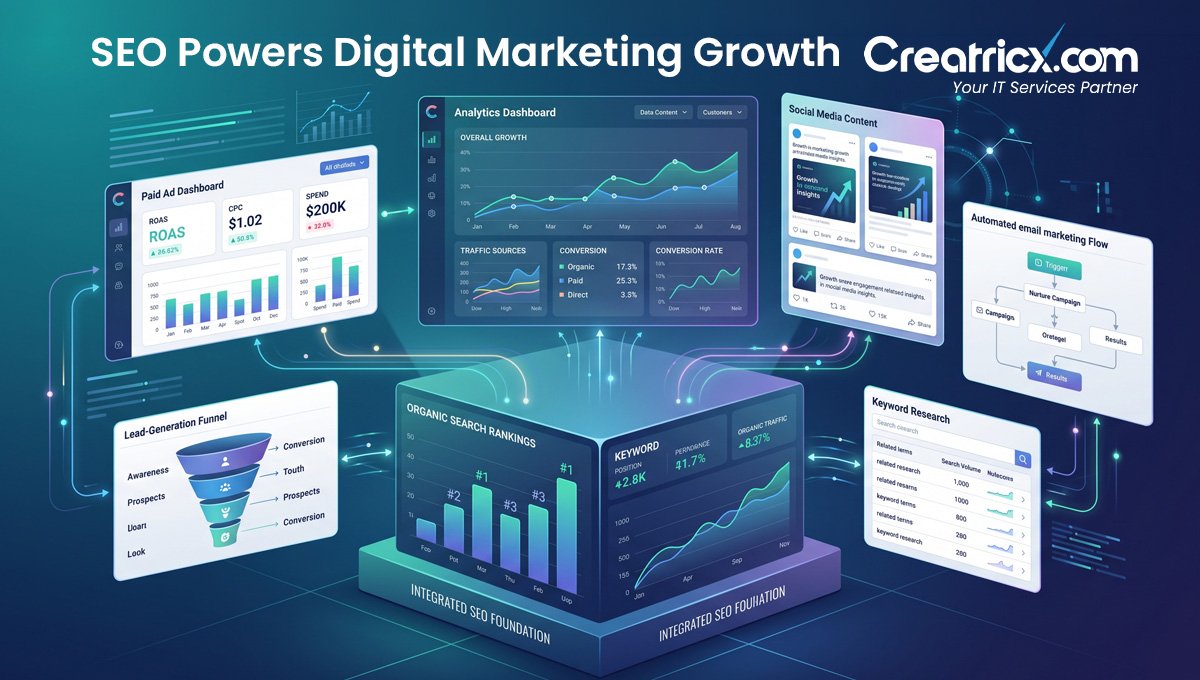
SEO helps digital marketing by doing the groundwork that every other channel depends on. It builds the keyword and audience data your paid ads and social content use, it earns the trust signals that make people click on your paid ads too, and it keeps generating leads long after a paid campaign budget runs out. SEO isn't a separate lane next to digital marketing. It's the foundation most of the other lanes are built on.
Key Takeaways
- SEO generates over 1,000% more traffic than organic social media, and organic search accounts for roughly 53% of the average website's total traffic
- SEO delivers an average return of 8x compared to around 4x for PPC, and leads from search close at 14.6%, compared to just 1.7% for outbound leads
- Around half of users can't tell paid search results apart from organic ones, which means a strong organic presence lends credibility to your paid campaigns even when someone technically clicked an ad
- Companies running SEO alongside paid advertising report saving up to 400% on ad spend without losing reach, because organic rankings pick up demand paid ads would otherwise have to pay for
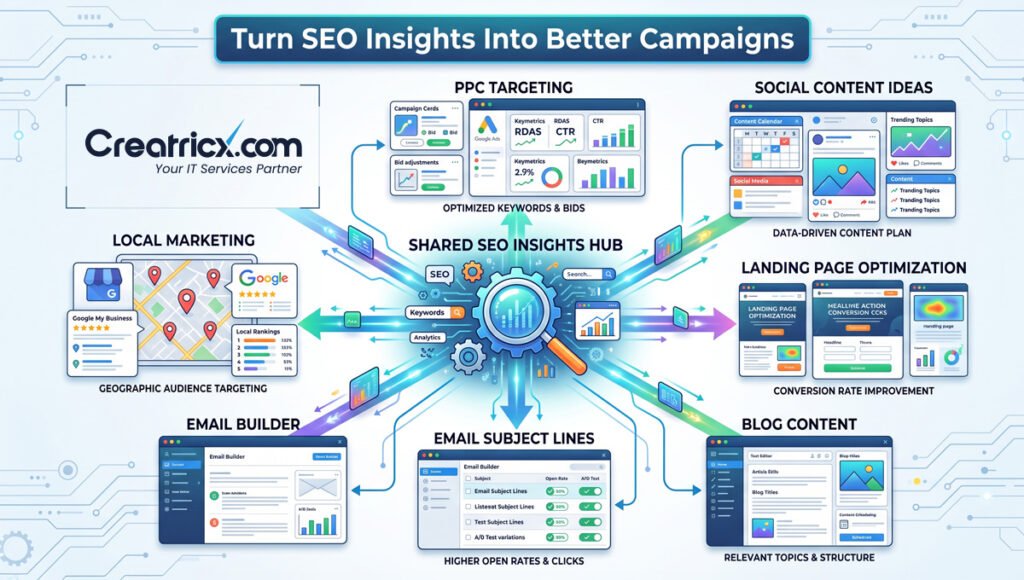
- The keyword research, content, and audience insight built through SEO work doesn't stay in one lane. It feeds email subject lines, social captions, ad targeting, and content calendars across the whole marketing function
Table of Contents
SEO Isn't A Channel Sitting Next To Digital Marketing, It's Underneath It
A lot of businesses picture digital marketing as a set of separate boxes: SEO in one box, paid ads in another, social media and email in their own boxes too. That picture makes SEO look optional, just one channel among several.
In practice, SEO work produces things the other boxes rely on.
- Keyword research done for SEO tells you what people actually search for, which shapes ad targeting and social content too.
- A blog post written to rank in search becomes the source material for three email newsletters and a dozen social posts.
- Site speed and page structure improvements made for SEO also improve the landing pages your paid campaigns send traffic to.
Pull SEO out of the picture and the other channels don't just lose a teammate, they lose some of their raw material.
Search remains the largest single entry point online, with the majority of website traffic still arriving through organic search rather than any other channel. Whatever else a business invests in, most people are still finding it by typing something into a search bar first.
The Halo Effect Most Marketing Plans Don't Account For
Here's something that rarely makes it into a marketing plan: close to half of users can't actually tell the difference between a paid search result and an organic one, that means a business showing up strongly in organic search results, directly above or near its own paid ad, benefits both listings at once.
The paid ad gets a credibility boost just from sitting next to (or being confused with) a trusted organic result, this is sometimes called the halo effect, and it's a big part of why companies running SEO and paid search together tend to see stronger performance from the paid side too, not just the organic side.
Running paid ads without any organic presence for the same terms means you're paying full price for every single click, with none of the trust-transfer that comes from also ranking organically. If a competitor shows up both as an ad and an organic result for the same search, and you only show up as the ad, you're at a real disadvantage even if your ad copy is better.
How SEO Work Actually Feeds The Rest Of Your Marketing
The clearest way to see this is to look at what SEO produces and trace where it ends up. Keyword research doesn't just inform which blog posts to write. It tells you the exact language your customers use, which becomes ad copy, social captions, and email subject lines that actually match how people think and search, instead of language your team assumes sounds good.
Content built to rank in search becomes a reusable asset: a single well-researched article gets repurposed into a LinkedIn post, a short video script, and an email series, saving your content team from starting from scratch every time.
Backlink and authority building, the slow work of earning links and mentions from other sites, builds the kind of brand trust that makes every other marketing message land better, because people are more likely to believe a brand they've already encountered as a credible source.
Technical SEO work, page speed, mobile usability, clean site structure, doesn't just help search rankings. It improves the experience for every visitor arriving through any channel, including the ones who clicked a paid ad or came from a social post. A slow, badly structured site quietly undermines every other marketing effort, not just organic search.
Where SEO Shows Up Inside Each Marketing Channel
| Channel | What SEO Contributes to It |
|---|---|
| Paid Search (PPC) | Keyword and intent data, plus the halo effect that boosts trust in your ads |
| Social Media | Content ideas and language pulled directly from what people actually search for |
| Email Marketing | Subject lines and content built from proven, search-validated topics people already care about |
| Content Marketing | The research and structure that make content rank, then get reused everywhere else |
| Local Marketing | Local search visibility that drives the store visits and calls other local efforts depend on |
A Practical Way To Connect Seo To The Rest Of Your Marketing
Step 1: Start Every Campaign With SEO Keyword Research, Not Just Ad Platforms
Before writing ad copy or planning social content, check what your actual customers are searching for in the SEO keyword research guide. This single step aligns every other channel with real demand instead of guesses.
Step 2: Reuse SEO Content Across Other Channels Deliberately
Treat every ranking blog post as raw material. Turn it into an email, a few social posts, and talking points for your sales team, rather than letting it sit alone on your site.
Step 3: Run SEO and Paid Search Side by Side, Not in Sequence
Don't wait for SEO to "finish" before starting paid campaigns, and don't drop SEO once paid ads are running. The two support each other continuously, especially through the trust halo effect.
Step 4: Fix the Technical Foundation Once, Benefit Everywhere
Site speed and mobile usability improvements made for SEO purposes lift conversion rates across every channel sending traffic to your site, not just organic search.
Businesses running integrated SEO and digital marketing strategies report substantially higher organic revenue growth than those treating each channel separately, along with lower cost per lead overall. The gains come specifically from channels reinforcing each other rather than working in isolation.
Why SEO Matters More As Paid Advertising Gets More Expensive
Paid advertising costs have climbed steadily for years, and that trend shows no sign of reversing. SEO becomes more valuable precisely because of this, since it's one of the few channels that keeps generating traffic without a matching increase in cost per click.
A business relying entirely on paid channels is exposed to rising costs with no offsetting asset being built underneath. A business investing in SEO alongside paid channels is building something that keeps producing value even as ad costs rise, which is exactly why SEO is increasingly treated as a long-term asset rather than a short-term tactic.
Why Choose Creatricx for Digital Marketing & SEO
Creatricx builds SEO and digital marketing as one connected system rather than separate services sold in isolation. Keyword research and content work done for SEO purposes is deliberately fed into paid campaign targeting, social content planning, and email strategy, so the effort behind each channel compounds rather than starting from zero every time. If your current marketing setup treats SEO as a standalone line item disconnected from everything else, that disconnection is very likely costing you efficiency you're not currently able to see.
Frequently Asked Questions
How exactly does SEO help digital marketing overall?
SEO produces keyword data, content, and trust signals that other channels depend on, including paid search, social media, and email, rather than functioning as a completely separate marketing activity.
Does SEO help paid advertising performance?
Yes. Since many users can't distinguish paid results from organic ones, a strong organic presence lends credibility to paid ads shown for the same search terms, an effect often called the halo effect.
Is SEO more effective than paid advertising?
SEO typically delivers a higher long-term return, often cited around 8x compared to roughly 4x for PPC, though paid advertising produces results far faster in the short term.
How does content created for SEO help other marketing channels?
A single piece of SEO content is commonly reused as email content, social media posts, and sales talking points, which saves significant time compared to creating separate content for every channel.
Why do search leads convert better than leads from other channels?
Search leads tend to arrive already looking for a solution, which is reflected in close rates around 14.6% for search compared to just 1.7% for outbound leads.
Should a business run SEO and paid search at the same time?
Yes. Running both together tends to outperform running either alone, since organic presence supports paid ad credibility, and paid campaign data can highlight which keywords are worth prioritising in SEO content.
Does technical SEO work benefit channels other than organic search?
Yes. Site speed and usability improvements made for SEO purposes improve the experience and conversion rate for visitors arriving through any channel, not just organic search.
How does Creatricx combine SEO with broader digital marketing?
By feeding keyword research and content insight from SEO work directly into paid campaign targeting, social content planning, and email strategy, rather than running each channel as an isolated service.