
Picture two bakeries opening in the same week, a few streets apart. One owner spends her evenings guessing at Instagram captions, hoping a boosted post pulls in weekend customers. The other hands her online presence to a small agency and gets back to baking. Eighteen months later, only one of them shows up on the first page of Google when someone nearby searches for a bakery. The difference was not a bigger budget. It was knowing which levers to pull, and pulling them consistently.
That is the real value a digital marketing agency brings to a small business: not magic, but structure, specialist skill, and enough hours in the week to actually execute a plan rather than just write one.
A digital marketing agency manages a small business's online growth: building and optimising websites, running SEO and paid ad campaigns, managing social media, creating content, and tracking performance data. The goal is consistent visibility and qualified leads, without the business owner having to learn or manage every channel themselves.
Key Takeaways
- A digital marketing agency covers SEO, paid ads, social media, content and email, so small businesses do not have to build that expertise in-house.
- Most agencies work from a fixed monthly retainer, giving predictable costs against the unpredictable payoff of hiring and training an in-house team.
- SEO typically takes three to six months to show meaningful ranking movement, while paid ads can generate leads within days of launch.
- Agencies bring reporting and data tracking that most small businesses lack the time or tools to build themselves.
- The right agency acts as an extension of the team, not simply an external vendor sending monthly invoices.
Table of Contents
What a Digital Marketing Agency Actually Does
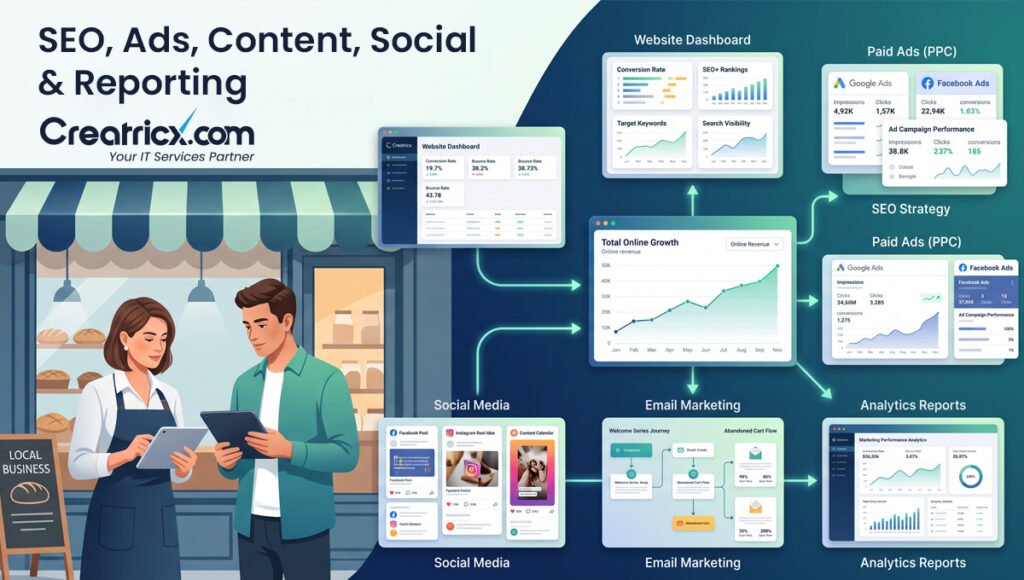
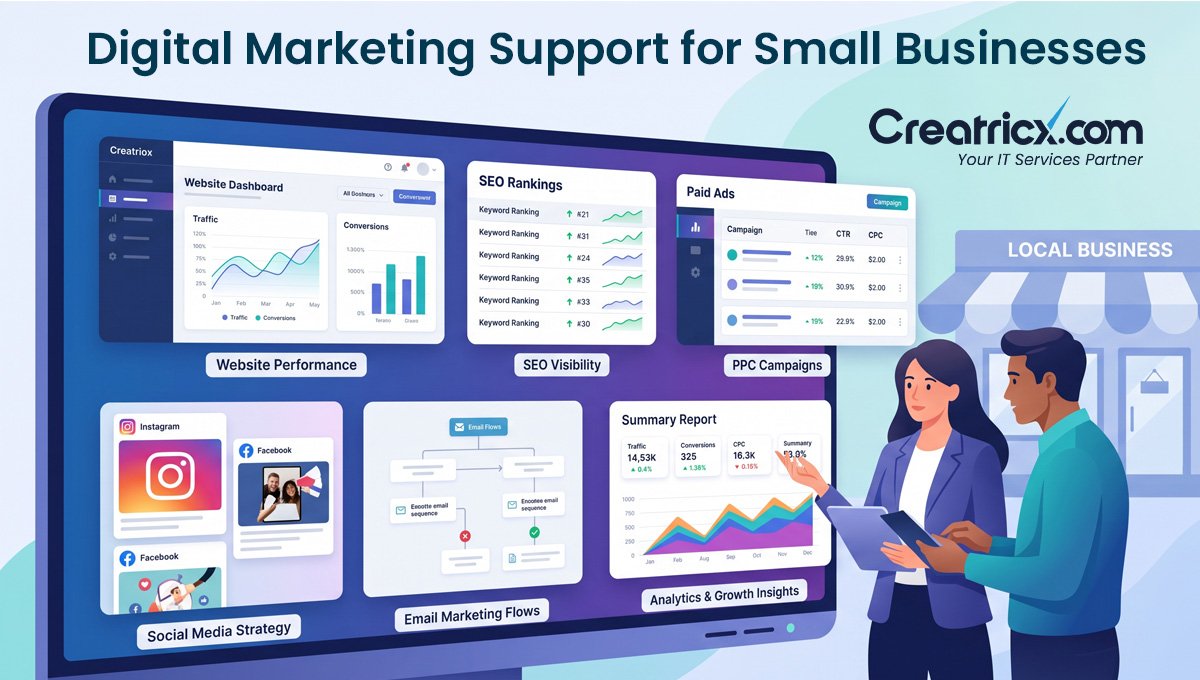
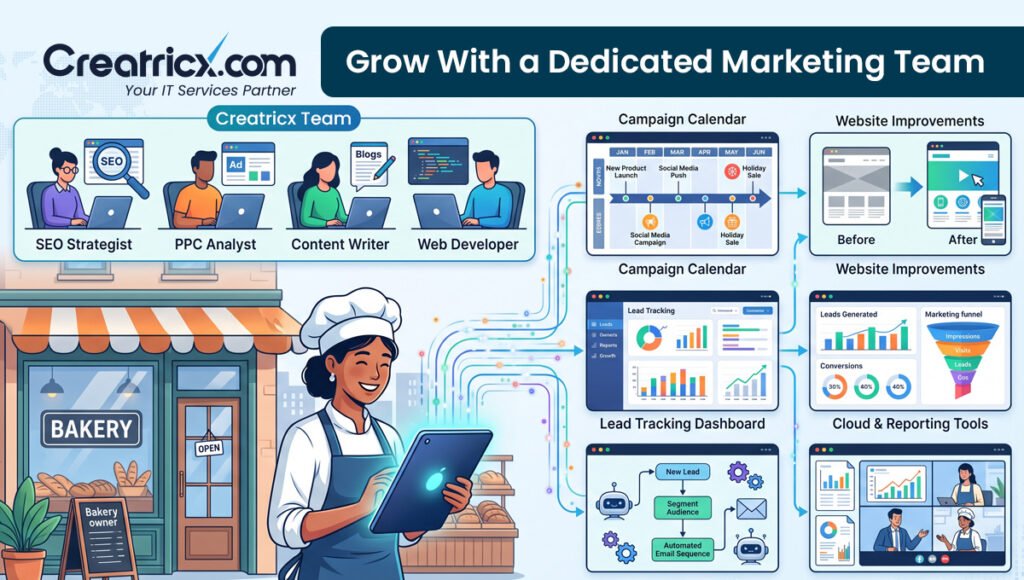
A digital marketing agency isn’t a single service. It is a bundle of specialist functions that would otherwise need several separate hires: an SEO strategist, a paid ads manager, a content writer, a social media coordinator, and someone to make sense of the data at the end of it. For a small business, paying for one team that covers all of this is almost always cheaper and faster than recruiting each role individually.
Search Engine Optimisation (SEO)
SEO is the work of improving a website so it ranks higher in organic, unpaid search results. This includes technical fixes, on-page content optimisation, and building the site's authority through quality backlinks and citations. For small businesses competing against bigger names, SEO is often the channel with the strongest long-term return on investment.
Paid Advertising (PPC)
Pay-per-click advertising, on platforms such as Google Ads or Meta, puts a business in front of people actively searching for what it sells. Results are near instant, in contrast to SEO, and the trade-off is that traffic stops the moment the budget does.
Social Media Management
This covers content planning, posting, community replies, and increasingly, paid social campaigns. For local and service-based businesses, social proof and consistent presence often drive as many enquiries as the website itself.
Content Marketing
Blog posts, guides, videos and case studies that answer the questions a business's potential customers are already asking online. Good content supports SEO, builds trust, and gives an agency something worth promoting through other channels.
Web Design and Development
A website is the foundation everything else points to. An agency will typically audit, redesign, or rebuild a site to load quickly, work on mobile, and convert visitors into enquiries or sales.
Email Marketing and Automation
Newsletters, abandoned-cart sequences, and lifecycle emails that keep past customers coming back, often at a lower cost per result than any other channel.
Reporting and Analytics
Tracking what is actually working, and reallocating budget away from what is not, is arguably the least visible but most valuable part of the job.
DIY vs Freelancer vs Agency
| Approach | Typical monthly cost | Skillset coverage | Time from owner | Consistency |
| DIY | Low direct cost, high time cost | Narrow, limited to owner's skills | Very high | Often inconsistent |
| Freelancer | Low to moderate | One or two specialisms | Moderate | Depends on capacity |
| Agency | Moderate to higher | Full team across channels | Low, mainly reviewing reports | Structured and ongoing |
Organic search and content still deliver the strongest long-term returns for small businesses, with search-driven channels regularly cited as the top-performing marketing investment by nearly half of marketers surveyed in 2026, ahead of paid advertising and social media.
5 Signs Your Small Business Needs an Agency
- Marketing gets pushed to “whenever there's time,” which usually means never.
- There is a website, but no one can say where its traffic comes from or what it converts into.
- Competitors consistently outrank the business for searches it should be winning.
- Social channels exist but have not been posted to in weeks or months.
- Paid ad spend is happening with no clear tracking of return.
Be cautious of any agency promising guaranteed first-page rankings or a fixed number of leads within a set timeframe. No agency controls Google's algorithm, and guarantees like this are a common red flag rather than a sign of confidence.
How the Engagement Typically Works
Step 1: Discovery and Audit
The agency reviews the current website, existing channels, competitors, and past marketing data to understand where the business genuinely stands, not just where the owner assumes it stands.
Step 2: Strategy and Channel Selection
Based on the audit, the agency recommends which channels deserve budget first. A business with urgent revenue needs might lead with paid ads, while one playing a longer game might prioritise SEO and content.
Step 3: Execution
Campaigns launch, content gets published, and the website work begins, usually in phases rather than all at once.
Step 4: Reporting and Iteration
Most agencies report monthly, reviewing what is working, cutting what is not, and adjusting budget allocation accordingly.
Step 5: Scaling What Works
Once a channel proves itself, budget and effort shift toward it, while underperforming tactics get retired.
Most agency contracts run on a rolling monthly basis after an initial minimum term, typically three to six months. This initial period exists because SEO and content need that long to start showing measurable movement, not because of any lock-in tactic.
What Results to Expect, and When
Paid advertising can generate leads within the first week of a campaign going live, though costs per lead are usually higher than organic channels over time. SEO moves more slowly: early technical fixes and content typically start showing ranking movement from around month two or three, with the compounding effect of consistent publishing becoming clearer from month six onward. Email marketing, once a list exists, tends to deliver some of the highest returns of any channel, since it is reaching people who already know the business.
Businesses that increase marketing investment consistently report measurable revenue improvement within the following year, according to recent small business marketing research, reinforcing that the biggest risk is usually under-investment rather than the channel chosen.
Why Choose Creatricx for Digital Marketing
Frequently Asked Questions
How much does a digital marketing agency cost for a small business?
Costs vary widely by scope, but small businesses typically pay a fixed monthly retainer covering the channels they need, rather than a per-project fee. Ask for a breakdown of exactly which services and hours the retainer includes before signing anything.
What is the difference between SEO and paid advertising?
SEO builds organic, unpaid visibility over months and keeps working after the campaign ends. Paid advertising delivers traffic immediately but stops the moment the budget stops. Most small businesses benefit from running both together.
How long before I see results from digital marketing?
Paid ads can generate leads within days. SEO usually needs three to six months for meaningful ranking movement, with the strongest returns compounding from around month twelve onward.
Do I need a website before starting digital marketing?
Not always, but it helps enormously. A slow or outdated site undermines every other channel, since most campaigns eventually send traffic back to it.
Can a small business handle digital marketing without an agency?
Yes, particularly early on with one or two focused channels. As the business grows, the time cost of managing everything alone usually outweighs the cost of outsourcing it.
What should I look for when choosing a digital marketing agency?
Look for clear reporting, realistic timelines, transparent pricing, and evidence of results with businesses similar in size to yours. Be wary of guaranteed rankings or lead numbers.
Does social media management actually help small businesses grow?
It helps most as a trust and visibility layer alongside other channels, rather than as a standalone growth engine. Its impact varies significantly by industry and audience.
Is digital marketing worth it for a very small or local business?
Yes. Local SEO and targeted paid ads are often the most accessible entry point for small, local businesses, since they compete on relevance and proximity rather than budget alone.
Disclaimer
This article is intended for general informational purposes and does not constitute financial, legal, or marketing advice specific to any individual business. Results from digital marketing activity vary by industry, market, budget, and execution, and no outcome described here is guaranteed. Speak to a qualified professional or contact Creatricx directly to discuss a strategy suited to your specific circumstances.
| Book a free consultation | https://creatricx.com/contact/ |
| Explore Digital Marketing Services | https://creatricx.com/digital-marketing-services/ |
| Explore SEO Services | https://creatricx.com/seo-services/ |