
Businesses hire a digital marketing agency to access specialist skills across SEO, paid ads, content and social media without the cost of hiring each role separately, to save time, to get consistent execution, and to make decisions based on data and reporting rather than guesswork.
Most business owners don't wake up one day and decide to hire a digital marketing agency out of nowhere. It usually happens after months of posting inconsistently, watching a competitor climb past them on Google, or realising that "I'll get to marketing next week" has quietly become a permanent excuse. There is nothing wrong with running things alone in the early days. The problem is that marketing rewards consistency and specialist knowledge, and very few business owners have the spare hours or training to deliver both while also running the actual business.
Ready to Get Expert Marketing Support?
Book a free consultation with Creatricx and see what a dedicated marketing team could do for your business.
Book A Free Consultation →Key Takeaways
- Hiring an agency replaces the cost of five or six separate specialist hires with one predictable monthly retainer
- Agencies bring access to premium tools, data and reporting that most small teams cannot justify buying themselves
- Consistency matters more than any single clever campaign, and agencies are built to maintain it
- Outsourcing marketing frees up the time an owner needs to run the actual business
- The right agency reduces the risk of expensive trial-and-error marketing mistakes
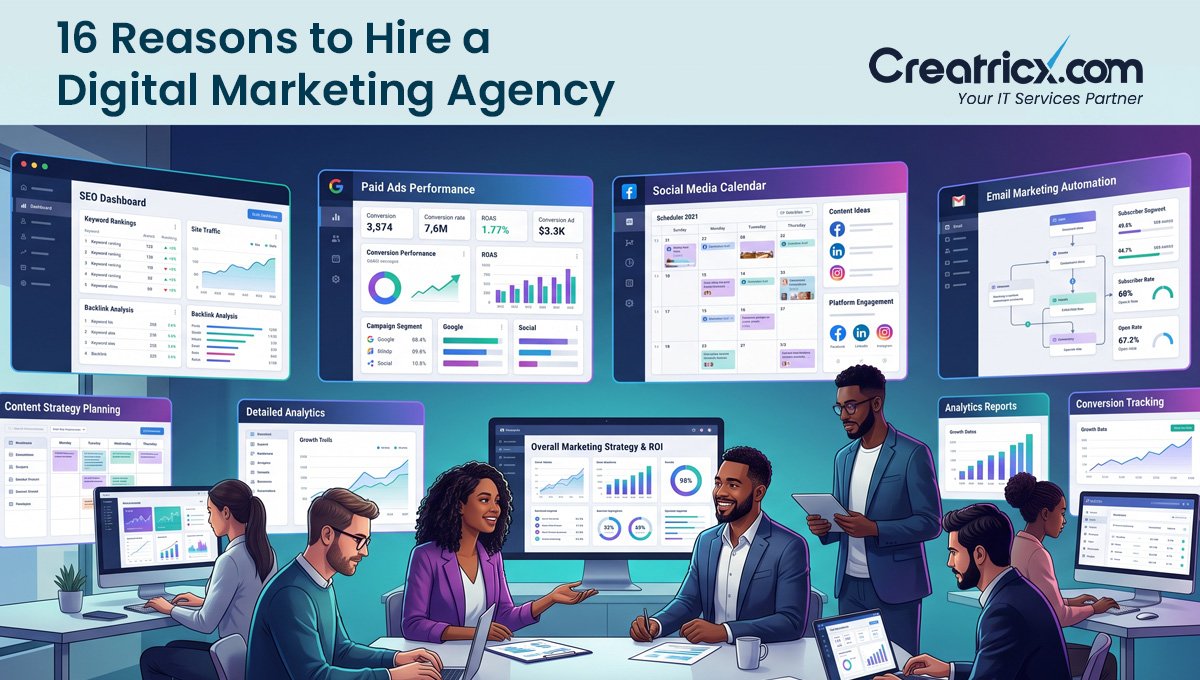
16 Reasons to Hire a Digital Marketing Agency
1. You Get a Full Team Instead of One Generalist
A single in-house marketing hire is usually decent at one or two things and weak everywhere else. An agency replaces that gap with an SEO specialist, a paid ads manager, a content writer, a designer and a social media coordinator, all working from the same strategy.
2. It Frees Up Time to Run the Business
Every hour spent researching hashtags or trying to fix a Google Ads campaign is an hour not spent serving customers, developing products, or managing staff. Handing marketing to a team that already knows what it is doing gives that time back.
3. You Get Specialist SEO Knowledge Without Building It In-House
SEO changes constantly, and what worked two years ago can actively hurt rankings today. Agencies stay immersed in these shifts because it is their full-time job, not a side task squeezed between everything else.
4. Access to Premium Tools Most Businesses Would Never Buy Alone
Keyword research platforms, competitor analysis tools, ad management software and reporting dashboards often cost hundreds of pounds a month each. Agencies spread that cost across many clients, so a small business gets enterprise-level tools without the enterprise-level bill.
5. Campaigns Launch Faster
An agency with established workflows can go from strategy to a live campaign in days. A business building everything from scratch, including learning the platforms, is often still setting up accounts a month later.
6. Marketing Spend Gets Used More Efficiently
Untrained ad spend tends to leak money into the wrong audiences, the wrong keywords, or the wrong platforms. An experienced team narrows that waste quickly, which usually means a lower real cost per lead even after paying an agency fee.
7. Decisions Are Based on Data, Not Guesswork
A good agency does not just post content and hope. It tracks click-through rates, conversion rates and cost per lead, then adjusts based on what the numbers actually show, rather than what feels like it should be working.
8. Marketing Stays Consistent
Consistency is one of the biggest predictors of marketing success, and it is also the easiest thing for a busy owner to let slip. Agencies run on schedules and retainers, so posting, campaigns and content keep going even during a business's busiest weeks.
9. You Get an Outside, Objective View of Your Brand
Business owners are often too close to their own brand to see it clearly. An agency looks at the website, the messaging and the customer journey with fresh eyes, and will point out gaps a founder has simply stopped noticing.
10. Multiple Channels Work Together Instead of in Isolation
SEO, paid ads, email and social media perform better when they reinforce each other. An agency coordinates these channels as one strategy, rather than as separate, disconnected efforts that happen to share a logo.
11. Reporting Creates Real Accountability
A proper agency sends monthly reports showing exactly what was done and what it produced. That level of accountability rarely exists when marketing is handled informally by whoever has a spare hour that week.
12. It Reduces the Risk of Costly Mistakes
Bidding on the wrong keywords, ignoring mobile users, or publishing content that violates a platform's guidelines can waste a real budget fast. Experienced teams have usually already made these mistakes once, on someone else's account, and know how to avoid repeating them.
13. Small Businesses Can Compete With Bigger Rivals
A well-run agency campaign lets a small business show up in the same search results and social feeds as much larger competitors, since visibility online is driven by strategy and relevance more than company size.
14. Support Scales as the Business Grows
An agency can expand a strategy as a business grows, adding new channels, campaigns or markets, without the delay and cost of recruiting and training new in-house staff every time.
15. It Frees the Owner From Chasing Algorithm Changes
Google, Meta and other platforms update their algorithms constantly, often without warning. Keeping up with these changes is close to a full-time job on its own, which is exactly what an agency is already doing for every client it works with.
16. Long-Term Strategy Replaces Short-Term Guesswork
Without a dedicated team, marketing often becomes reactive, a rushed post here, a boosted ad there, whenever there is a spare moment. An agency builds toward a longer plan, which tends to compound into far stronger results over time.
DIY Marketing vs Hiring an Agency
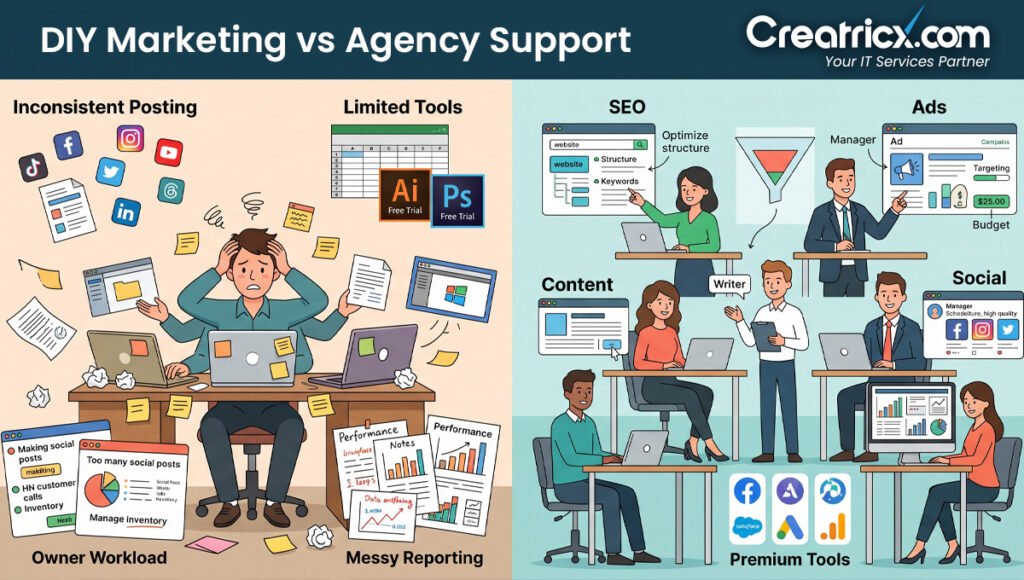
| Factor | Doing It Yourself | Hiring an Agency |
| Specialist coverage | Limited to what the owner can learn | Full team across SEO, ads, content and social |
| Time cost to the business | High, pulled from core operations | Low, mainly reviewing reports |
| Access to tools | Rarely justifies the cost alone | Shared across many clients, lower effective cost |
| Consistency | Frequently interrupted by other priorities | Structured and scheduled |
| Learning curve | Ongoing, on the job | Already covered by the team |
Search-driven marketing consistently ranks as the top-performing channel by nearly half of marketers surveyed for 2026, ahead of paid advertising and social media, which is one reason SEO expertise is often the first specialist skill small businesses look for in an agency.
How to Know You Are Ready to Hire an Agency
- Marketing keeps getting pushed to "next week" and never actually happens
- There is a website and social presence, but no clear plan behind either
- Competitors are visibly outranking or outposting the business every month
- Ad spend is happening with no one tracking what it actually returns
- The owner is the one writing every post, at midnight, between everything else
Be cautious of any agency that promises guaranteed rankings or a fixed number of leads within a set number of weeks. No agency controls how Google or Meta ranks content, and a guarantee like this is usually a sign of an aggressive sales pitch rather than genuine expertise.
What Working With an Agency Usually Looks Like
Step 1: Discovery
The agency reviews the current website, existing marketing, competitors and past data to understand where the business genuinely stands.
Step 2: Strategy
Based on that review, the agency recommends which channels deserve budget first, based on the business's goals and timeline.
Step 3: Launch
Campaigns go live, content starts publishing, and any website or landing page work begins.
Step 4: Reporting
Most agencies report monthly, showing what worked, what did not, and how budget is being adjusted.
Step 5: Scaling
Once a channel proves itself, more budget and effort move toward it, while weaker tactics get dropped.
Most agency agreements run on a rolling monthly basis after an initial minimum term, usually 3 to 6 months. That initial period exists because SEO and content genuinely need that long to start showing measurable movement, not as a way to lock a business in.
Businesses that increase marketing investment consistently report measurable revenue improvement within the following year, according to recent small business marketing research, which reinforces that under-investment, not the wrong channel, is usually the bigger risk.
Frequently Asked Questions
How much does it cost to hire a digital marketing agency?
Costs vary by scope, but small businesses typically pay a fixed monthly retainer covering the channels they need, rather than a one-off project fee. Ask exactly which services and hours the retainer includes before signing anything.
Is hiring an agency worth it for a very small business?
Yes, particularly for local SEO and targeted paid ads, since these channels compete on relevance and proximity rather than budget size alone.
How long does it take to see results from an agency?
Paid ads can generate leads within days. SEO usually needs three to six months for meaningful ranking movement, with stronger returns building from around month twelve onward.
What is the difference between hiring an agency and a freelancer?
A freelancer usually covers one or two specialisms, while an agency brings a full team across SEO, ads, content and social, working from one coordinated strategy.
Can a small business handle marketing without an agency?
Yes, particularly early on with one or two focused channels. As the business grows, the time cost of managing everything alone usually outweighs the cost of outsourcing it.
What should a business check before hiring an agency?
Look for clear reporting, realistic timelines, transparent pricing and evidence of results with businesses of a similar size. Be wary of guaranteed rankings or lead numbers.
Does a digital marketing agency replace an in-house marketing person?
It can, or it can support one. Many businesses keep a single in-house point of contact while the agency handles execution across channels.
What happens if the agency relationship is not working?
Most agreements run on a rolling monthly basis after an initial minimum term, so a business is not locked into a long contract if the fit is not right.
Disclaimer
This article is intended for general informational purposes and does not constitute financial, legal, or marketing advice specific to any individual business. Results from marketing activity vary by industry, market, budget and execution, and no outcome described here is guaranteed. Speak to a qualified professional or contact Creatricx directly to discuss a strategy suited to your specific circumstances.