
Yes. Digital marketing is legitimate when it's built on a real strategy, with transparent reporting, ethical campaigns, and measurable objectives. The problem isn't digital marketing itself. The problem is that there are fraudulent agencies, incompetent service providers, and online "gurus" who promise instant results without doing enough research.
Need Honest Digital Marketing Support?
Digital marketing works when the basics are done properly, that means clear goals, the right channels, strong landing pages, clean tracking, useful content, and regular improvement.
Not mystery packages. Not "guaranteed viral growth." Not some guy with a rented Lamborghini explaining funnels on Instagram, because apparently that became a business model.
Creatricx helps businesses plan and manage digital marketing with a practical approach across SEO, paid ads, content, website development, UI/UX, and campaign tracking. The aim isn't to make marketing look busy. The aim is to help your business attract the right audience, generate better leads, and understand what's actually working.
Why Do People Ask If Digital Marketing Is Legit?
People ask if digital marketing is legit because the industry has been polluted by weak agencies, fake experts, and loud online sellers who promise fast money with almost no work. Digital marketing itself is a real business function, but the way some people sell it makes it look suspicious.
A business owner might hear one agency promise "first page rankings in 30 days," another person selling a "digital marketing course" with unrealistic income claims, and a third provider offering thousands of followers for a cheap price. After that, it's fair to wonder if the whole thing is real or just another internet circus wearing a blazer.
The confusion usually comes from these problems:
- Some providers sell vague services without explaining the actual work
- Some promise instant leads without testing, tracking, or strategy
- Some focus on vanity numbers like followers, likes, and impressions instead of enquiries, sales, or qualified traffic
- Some use spammy SEO, fake reviews, or low-quality backlinks
- Some clients pay for campaigns but never receive clear reporting
- Some "digital marketing" offers are really just course-reselling schemes, not proper marketing services
So the real question isn't if digital marketing is legit. It's if the person or agency selling it knows what they're doing, works transparently, and can explain how their strategy connects to real business growth.
The real question usually isn't "is digital marketing legit", it's "does this specific provider know what they're doing and work transparently". Those are two very different questions with very different answers.
Yes, Digital Marketing Is Legit, But It Has To Be Done Properly
Digital marketing is legit because real businesses use it every day to reach customers, generate leads, sell products, build trust, and stay visible online. It isn't magic, though. It's a structured way of getting the right message in front of the right people through digital channels.
The challenge is when people treat digital marketing as a shortcut rather than a process. You can't market with just ads and no landing page strategy, with social media posts and no audience understanding, or with SEO content and no search intent. That's just throwing content into the void and hoping the internet is nice. Tip: usually it doesn't.
Authentic digital marketing usually includes things like:
- Search Engine Optimisation (SEO) to help people discover your business through search engines
- Paid advertising to speed up audience targeting
- Content marketing to answer questions and build trust
- Social media marketing to increase visibility and engagement
- Email marketing to grow leads and retain customers
- Website optimisation to turn visitors into enquiries or purchases
- Analysis and reporting to identify what's working and what needs improving
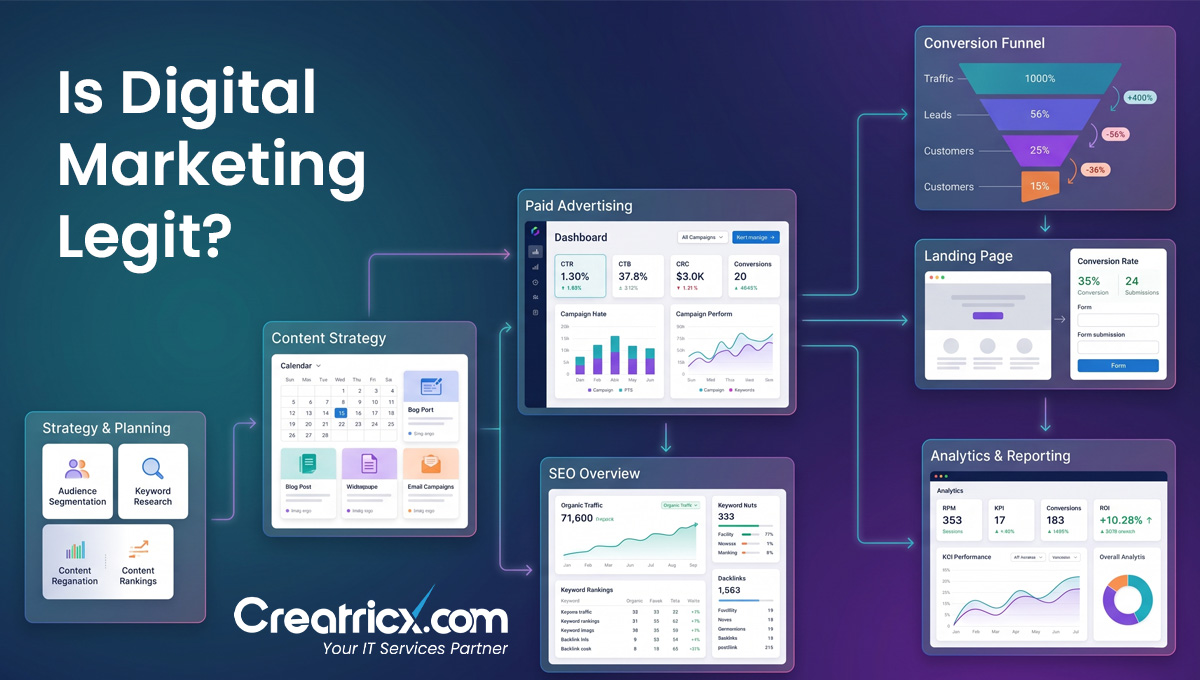
When you combine these practices, you get a measurable and effective digital marketing strategy. You can know where your traffic is coming from, what pages are keeping visitors engaged, which campaigns are generating leads, and even which channels should be getting more budget.
That's what makes digital marketing legitimate: not hype, not buzzwords, not "secret hacks," but a clear connection between strategy, execution, tracking, and business results.
Digital Marketing vs Digital Marketing Scams
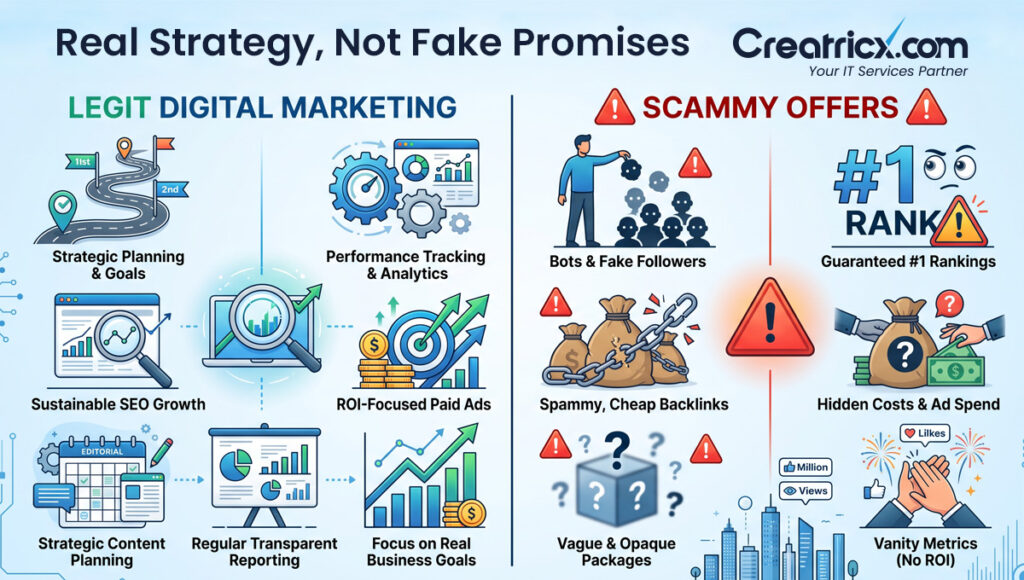
The easiest way to understand digital marketing is to separate real work from fake promises. Legit digital marketing is based on research, planning, execution, testing, and reporting. Scammy digital marketing is usually based on pressure, confusion, and promises that sound suspiciously like they were written during a caffeine crisis.
| Area | Legit Digital Marketing | Scammy Digital Marketing | What Businesses Should Check |
| SEO | Improves website structure, content, technical health, and search visibility over time. | Promises first-page rankings in a few days or sells cheap backlinks. | Ask what SEO work will be done and how results will be reported. |
| Paid Ads | Uses targeting, budget control, testing, landing pages, and conversion tracking. | Promises instant sales without testing or hides where the ad budget goes. | Make sure you own the ad account and can see spend clearly. |
| Social Media | Builds brand visibility, trust, engagement, and audience connection. | Sells fake followers, fake likes, or copied content packages. | Check if the strategy matches your real audience and business goals. |
| Content Marketing | Creates useful content based on audience needs and search intent. | Produces generic AI-spun articles stuffed with keywords. | Ask how topics are researched and how content supports leads or sales. |
| Email Marketing | Nurtures subscribers with relevant offers, updates, and helpful content. | Sends spammy emails to purchased lists. | Confirm how the email list is built and if users gave permission. |
| Lead Generation | Uses forms, landing pages, ads, SEO, and tracking to attract qualified enquiries. | Sells random contact lists or low-quality leads with no intent. | Ask where leads come from and how quality is measured. |
| Reporting | Shows traffic, conversions, campaign performance, spend, and next actions. | Sends vague reports full of impressions and "growth" with no explanation. | Ask for clear monthly reporting tied to real business goals. |
Why Some Digital Marketing Agencies Feel Untrustworthy
Some digital marketing agencies seem untrustworthy because they focus on activity rather than actual progress. They toss around buzzwords like "brand visibility," "growth systems," and "performance strategy," but when a client asks what was actually done, they get a vague pitch and a monthly bill.
A weak agency usually doesn't fail because digital marketing doesn't work. It fails because there's no clear plan, no proper tracking, no honest reporting, or no real connection between the work and the client's business goals.
8 common problems include:
- Vague packages that don't explain what the client is actually paying for
- No discovery process before launching campaigns
- Hidden ad spend or unclear billing
- Reports full of vanity metrics like impressions, likes, and reach, without showing leads or conversions
- No ownership clarity over ad accounts, analytics, website access, or creative assets
- Generic content that could apply to any business in any industry
- Poor communication after the contract is signed
- Overpromising results before understanding the market, offer, budget, or competition
A legit agency should be able to explain the strategy in plain English. It should show what work is being done, why it matters, how performance is measured, and what needs to improve next. If an agency needs confusion to sound valuable, that's not expertise. That's theatre with a login portal.
Impressions, likes, and reach look impressive in a report, but they don't pay bills. Ask any agency to connect their numbers to enquiries, leads, or sales before judging whether a campaign is actually working.
12 Red Flags That A Digital Marketing Offer Isn't Legit
Bad digital marketing proposals are too slick, too fast, and too sure. Marketing involves research, experimentation, budgeting, monitoring, and optimisation. Deceptive marketing skips the necessary groundwork and jumps straight to "guaranteed results," as if confidence mattered more than competence.
Watch out for these 12 warning signs:
- Guaranteed first-page Google rankings within a fixed number of days
- Instant sales promises without checking your website, offer, pricing, audience, or competition
- Fake urgency, like "pay today or lose this secret opportunity"
- No clear deliverables, only vague words like "growth," "visibility," and "brand boost"
- No access to ad accounts, analytics, or campaign data
- Cheap backlink packages that can damage your SEO instead of helping it
- Fake followers or engagement packages that make your brand look busy but don't bring real customers
- No reporting process, or reports that only show surface-level numbers
- Copied content used across multiple clients with tiny edits
- No explanation of strategy when you ask basic questions
- Pressure to spend more before proving the current campaign is working
- No discussion of tracking, conversion setup, landing pages, or lead quality
A legitimate provider won't promise immediate success for every campaign. They'll lay out the plan, share the data, adapt based on results, and tell you what's actually possible. It's not as exciting as a "secret growth hack," but it's far more likely to work than internet wizardry.
No legitimate provider can guarantee first-page Google rankings within a fixed number of days. Search engines don't work on a schedule anyone can promise, and any provider claiming otherwise is selling confidence, not competence.
What A Legit Digital Marketing Agency Should Provide
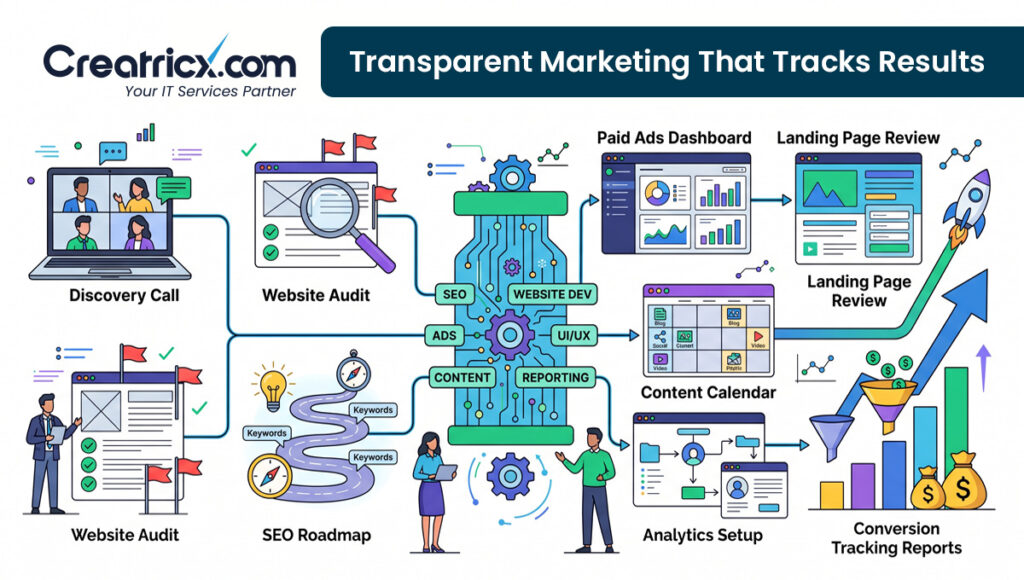
A good digital marketing agency shouldn't make you feel like you're reading a classified government document to understand your own campaign. The work should be clearly and quantifiably tied to business goals, not buried under vague dashboards and sensational jargon.
A proper agency should provide:
- A clear discovery process before recommending anything
- Defined goals, such as leads, sales, traffic quality, conversions, or brand visibility
- Audience and competitor research so the strategy isn't based on guesswork
- Channel recommendations explaining if SEO, paid ads, content, email, or social media makes sense first
- A proper tracking setup through analytics, conversion events, forms, calls, and campaign data
- Transparent ad spend so you know what goes to platforms and what goes to management
- Content and SEO planning based on search intent, not keyword stuffing
- Landing page or website feedback, because traffic is useless if the page doesn't convert
- Regular reporting that explains results, problems, and next steps
- Honest timelines instead of fake promises about overnight growth
- Ongoing testing for ads, content, audiences, landing pages, and calls to action
- Clear communication so you know what's being done and why
The main thing is transparency. If an agency is legitimate, it won't be afraid to explain its process. You should know where your money is going, what work is happening, what results are improving, and what still needs fixing.
Good digital marketing isn't just putting things online or running ads. It's planning, implementation, measurement, and improvement working together like grown-up people, which is still a rare privilege on the internet.
How Long Does Legit Digital Marketing Take To Work?
Digital marketing takes time to get right. Real results depend on your offer, target market, website, competition, budget, tracking setup, and how well your campaigns are optimised after they go live. Anyone who says there's a universal timeline for every business is either guessing or selling unfounded hope.
Different channels work at different speeds:
- Paid advertising can quickly drive traffic, but the first stage is usually spent testing target audiences, messaging, landing pages, and budget allocation
- SEO often takes longer because search engines need time to crawl, understand, and build trust in your pages
- Content marketing takes time, but it's worth it, especially for articles, service pages, and guides that answer real questions from real users
- Social media marketing is about consistency, creative quality, audience alignment, and engagement
- Email marketing can work faster if you already have a good subscriber list, but it won't fix a weak offer
- Conversion optimisation can improve results quicker when your site already has traffic but poor enquiry or sales performance
The more competitive your market is, the more careful the strategy needs to be. A local service business, a new e-commerce store, and a B2B software company won't get results in the same way or at the same speed.
A legitimate agency won't say that every campaign will be profitable in its first week. It will set expectations, track performance, measure what matters, and continuously improve through data analysis. Digital marketing only works when you treat it as a system, not a one-time magic trick applied to a poorly designed landing page.
How To Check If A Digital Marketing Agency Is Legit Before Hiring
Before hiring a digital marketing agency, don't just look at polished service pages and big promises. Anyone can write "data-driven growth partner" on a website. The internet has made pretending easy, because apparently that was the missing feature in business.
Follow this checking process before you spend money:
Step 1: Check Their Own Website
If an agency sells SEO, content, ads, or conversion sites, their own site should look professional, load fast, tell you what they sell, and give you some basic trust indicators.
Step 2: Ask For Real Work Examples
Vague claims are far less convincing than case studies, campaign summaries, live websites, content samples, or reporting examples.
Step 3: Find Out Who Runs The Ad Accounts
Your business should own its Google Ads, Meta Ads, analytics, and tracking accounts.
Step 4: Ask How They Report Results
A legitimate agency will tell you exactly what metrics they're tracking and how those numbers turn into leads, sales, or enquiries.
Step 5: Ask What Happens If Results Are Bad
Good agencies talk about testing, changes, and improvement. The bad ones blame "the algorithm" and disappear.
Step 6: See How They Approach SEO
Avoid anyone offering cheap backlinks, keyword stuffing, copied content, or guaranteed rankings.
Step 7: Check Their Communication Process
You should know who you'll be talking to, how often updates will happen, and how work gets approved.
Step 8: Confirm Deliverables In Writing
Strategy, content, ads, tracking, landing pages, reports, and timelines need to be clear before payment.
Step 9: Check Reviews, But Verify Too
Reviews are useful, but also confirm that the agency can explain their work in a way you actually understand.
If you ask a real digital marketing agency useful questions, they won't get offended. If a provider gets defensive when you ask about ownership, reporting, strategy, or proof, that defensiveness is usually the answer you were looking for.
Businesses that ask direct questions about ownership, reporting, and strategy before signing tend to end up with agencies that welcome those questions, rather than agencies that dodge them.
Creatricx supports businesses across:
- Digital marketing strategy for clearer planning and channel selection
- SEO services to improve organic search visibility
- Paid advertising support for targeted traffic and lead generation
- Content planning that answers real customer questions
- Website development so campaigns don't send traffic to weak pages
- UI/UX design to improve user journeys and conversions
- Analytics and tracking setup so performance can be measured properly
- Dedicated remote teams for ongoing marketing, development, and support needs
The main value is connection. A campaign shouldn't be judged only by traffic, clicks, or impressions. It should be judged by one thing: are the right people reaching the right pages and taking meaningful action?
Frequently Asked Questions
Can small businesses really benefit from digital marketing?
Absolutely. Digital marketing lets small businesses reach people who are already searching, browsing, comparing, and buying. It gives smaller businesses an edge through targeted ads, local SEO, helpful content, better landing pages, and clear tracking, rather than just relying on word of mouth and hope, which isn't much of a business plan.
Is digital marketing a pyramid scheme?
No, digital marketing isn't a pyramid scheme. Real digital marketing promotes a business, product, or service to potential customers. Pyramid-style schemes usually focus on recruiting more people into the same system. Some online course sellers confuse the two by calling course reselling “digital marketing,” but that isn't the same as professional marketing work.
How do you know if a digital marketing agency is legit?
A good agency will have a clear process, show you real examples of their work, define deliverables, provide reporting, and make sure you understand where your budget is going. It's also worth retaining ownership of your campaign assets, analytics access, website data, and ad accounts whenever possible.
What are common digital marketing scams?
Common scams include pressure-based offers that ask for payment before you've asked the right questions about your business, fake follower packages, cheap backlink offers, copied content, fake reviews, hidden ad spend, poor-quality lead lists, and guaranteed Google rankings.
Is SEO a legitimate digital marketing method?
Yes, SEO is a legitimate digital marketing method when it focuses on useful content, technical website health, clear page structure, search intent, and long-term visibility. Scammy SEO usually involves keyword stuffing, spam backlinks, copied pages, and fake ranking guarantees.
Are paid ads worth it for small businesses?
Paid ads can be worth it when targeting, budget, landing pages, tracking, and campaign testing are handled properly. They're risky when ads launch without knowing the audience, offer, or conversion path. Paying for clicks without a proper landing page is really just donating money to advertising platforms.
Should you hire a digital marketing agency or do it yourself?
If you have time to learn, test, and manage basic digital marketing, you can do it yourself. For expert management of strategy, execution, tracking, content, ads, SEO, or website improvements, it's usually better to hire an agency. The right choice depends on your budget, skill level, time constraints, and growth goals.
What questions should you ask before hiring a digital marketing company?
Ask what services are included, who owns the accounts, what the reporting process looks like, what realistic results look like, what happens if campaigns don't perform, how content is created, how SEO is managed, and how success is measured. A good provider stays calm when you ask them normal business questions.
Disclaimer
This article reflects general industry practice around digital marketing services as of 2026, alongside Creatricx's published service model. Individual project scope, timelines, and costs vary by business and requirements. Always confirm current terms directly with any provider before starting a project.
Final Thoughts
Digital marketing is legit, but not everyone selling digital marketing is trustworthy. That's the part businesses need to understand before spending money. The method is real. The problem is the noise around it.
When done right, SEO, paid advertising, content marketing, social media, email marketing, and conversion tracking can all lead to real business growth. They help businesses identify their target audience, define their value, generate enquiries, and see what's actually working. That's no lie.
What's fake is the version of digital marketing sold through impossible promises, mystery packages, fake followers, cheap backlinks, and "instant success" claims. Real marketing doesn't ignore strategy. The data isn't secret. There's no need to confuse clients just to appear intelligent.
The most effective approach is simple: set goals, know your audience, pick the right channels, track the right metrics, and keep improving. A good agency will tell you what they're trying to achieve in plain English, stay open and honest, and tie their campaigns to tangible results like leads, sales, traffic quality, or client engagement.
So is digital marketing a real thing? Sure. But it works best when businesses treat it as a serious growth process, not a shortcut. Choose your provider carefully, ask direct questions, avoid false promises, and favour providers who can demonstrate the impact of their work on measurable business outcomes.