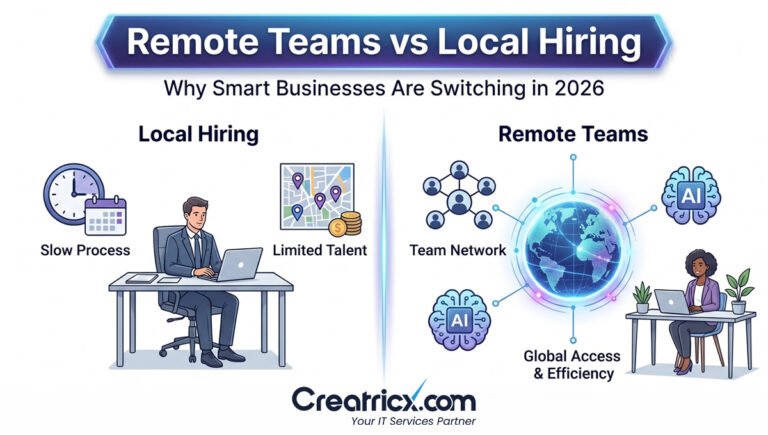


A dedicated remote team is a group of professionals, developers, designers, marketers, whoever the role calls for, who work exclusively for your business from a remote location, managed day to day by the provider but directed by you on priorities and roadmap. A freelancer juggles other clients at the same time; this team doesn't. Staff augmentation puts an individual under your direct daily management; a dedicated team stays under the provider's management instead.
Key Takeaways
- A dedicated remote team works only for your business, managed by the provider, but taking direction from you on priorities, roadmap, and quality standards
- Around 60% of companies that outsource software development choose the dedicated team model over staff augmentation or freelance hiring, according to industry research
- A five-person dedicated development team typically costs $22,500 to $42,500 a month in Latin America, against $60,000 to $75,000 for an equivalent US-based team, savings of 40 to 60%
- The model breaks even against staff augmentation somewhere around the nine to twelve month mark; for anything shorter, augmentation is usually cheaper and faster to start
- Team assembly for a dedicated team takes two to four weeks, slower than staff augmentation's one to two weeks, because the provider is matching several roles at once, not just one
Table of Contents
Three Models, Three Different Deals
- A freelancer sells you their time, split across however many other clients they're juggling that week. No long-term commitment, no deep investment in your business specifically, just a deliverable in exchange for payment.
- Staff augmentation is different again: an individual specialist joins your team directly, reports to your manager, sits in your meetings, and works exactly like an employee except payroll and HR sit with someone else.
- A dedicated remote team is neither. It's a full, self-contained group, developers, a lead, QA, whatever the work needs, that works only for you, but runs its own internal management and processes rather than reporting into your org chart. You set the direction. They run the delivery.
The simplest way to remember the difference: with a freelancer you're buying an outcome, with staff augmentation you're buying a person, with a dedicated team you're buying a working unit that happens to sit outside your building.
What You're Actually Paying For
| Cost Component | Dedicated Remote Team | US In-House Equivalent |
| 5-person team, Latin America | $22,500-$42,500/month | $60,000-$75,000/month |
| Recruitment and onboarding | Handled by the provider | 2-4 weeks lost productivity, $8k-$15k per hire |
| Management overhead | Absorbed by the provider's own structure | 15-25% of a manager's time per person |
| Knowledge loss on departure | Provider manages continuity across the team | Walks out the door with the individual |
That 40-60% savings figure is real, but it only holds if the team is actually integrated properly. A dedicated team that never gets clear direction, or is treated as a black box nobody checks in on, tends to drift off course quietly, and the savings disappear into rework nobody budgeted for.
The Three Signs You Actually Need One
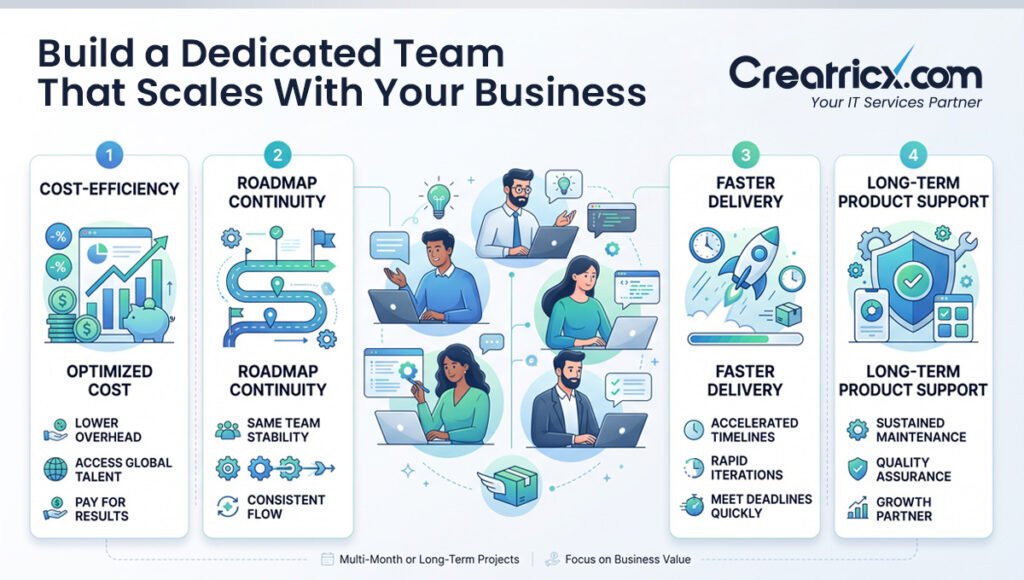
- Your roadmap runs for months, not weeks. A six-week project doesn't justify the ramp-up time a dedicated team needs; you'd spend most of the engagement onboarding rather than shipping.
- You need a self-contained unit, not an extra pair of hands. If you already have strong internal leads and just need more people executing under them, staff augmentation is the better fit. A dedicated team makes more sense when you want a group that can own a whole product area without your team managing them day to day.
- You're building something that needs continuity. Institutional knowledge of your product, your customers, your codebase, compounds over time with a dedicated team in a way it simply can't with rotating freelancers or short-term contractors.
None of this is permanent or exclusive. Many growing businesses start with staff augmentation to move fast on an urgent gap, then graduate to a dedicated team once the roadmap and scope justify the longer setup. Others run both at once, a stable dedicated team for the core product, with augmented specialists brought in for short bursts like a security audit or a performance push.
Dedicated Team Vs Staff Augmentation, Side By Side
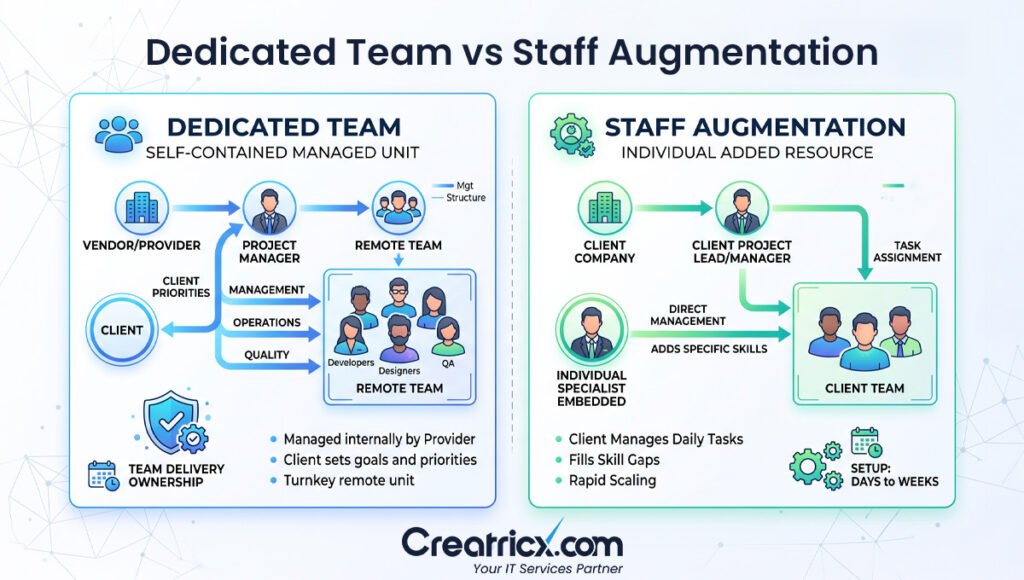
| Factor | Dedicated Team | Staff Augmentation |
| Who manages daily work | The provider (example: Creatricx) | You, directly |
| Best for | Long-term, evolving product work | Filling a specific, defined skill gap fast |
| Setup time | 2-4 weeks | 1-2 weeks |
| Ideal engagement length | Months to years | Weeks to a few months |
| Institutional knowledge | Compounds within a stable team | Resets when the contractor's engagement ends |
Businesses using dedicated teams for genuinely long-running product work consistently report the model paying for itself well before the two-year mark, since the cost of rebuilding institutional knowledge from scratch, again and again, is what actually erodes the savings of cheaper short-term alternatives.
What This Looks Like In Practice
The pattern shows up repeatedly across companies that scale this way.
A healthcare platform embedding vetted specialists into an in-house team cut development time by 40% while handling millions of records under strict regulatory constraints, a staff augmentation case, not a dedicated team one, since the work needed tight integration with existing compliance processes.
A wealth management platform, by contrast, ran a dedicated offshore team for more than two years, with a stable group holding the domain knowledge behind portfolio management and trading logic the whole time.
That continuity is exactly what a dedicated team is built to provide, and it's precisely what would have been lost with a rotating cast of short-term contractors. The difference between these two examples isn't which company made a better choice, it's that each was solving a genuinely different problem.
Where Creatricx Fits In
Frequently Asked Questions
What is a dedicated remote team?
A group of professionals who work exclusively for one business from a remote location, managed by the provider but directed by the client on priorities, roadmap, and quality standards.
How is a dedicated remote team different from staff augmentation?
Staff augmentation places individual specialists under your direct daily management. A dedicated team is a self-contained unit managed by the provider, which you direct at a strategic level rather than day to day.
How much does a dedicated remote team cost compared to hiring in-house?
A five-person dedicated team typically costs $22,500 to $42,500 a month from Latin America, compared to $60,000 to $75,000 for an equivalent US-based in-house team, savings of 40 to 60%.
How long does it take to set up a dedicated remote team?
Typically two to four weeks, since the provider needs to match multiple roles simultaneously and establish the team's internal working structure.
When does a dedicated team make more sense than staff augmentation?
When the work is a sustained, multi-month commitment requiring a self-contained unit, rather than a short-term gap that just needs an extra pair of hands under your own management.
Can a business use both staff augmentation and a dedicated team at once?
Yes. A common pattern is running a stable dedicated team for core product work while using staff augmentation for short-term specialist bursts, such as a security audit.
What's the biggest risk with a dedicated remote team?
Treating it as a hands-off black box. The cost savings depend on genuine integration and clear direction; teams left without regular check-ins tend to drift, and that drift erodes the savings.
How does Creatricx help decide between a dedicated team and other models?
By assessing project length, if the work needs a self-contained unit or individual specialists, and how much internal management capacity already exists, before recommending a specific structure.
Disclaimer
This article reflects general 2026 industry data on dedicated remote team models and Creatricx's published service model. Costs and timelines vary by region, role, and provider. Always confirm current pricing directly with Creatricx before committing to a specific engagement model.
Please check Creatricx portfolio: https://creatricx.com/portfolio/
In Summary
A dedicated remote team sits in a specific spot between hiring a freelancer and embedding individual contractors into your own team: a self-managed group that works only for you, built for sustained work rather than a quick task. It's not automatically the right choice, a six-week project doesn't need one, but for a business building something over months or years, the continuity it offers usually outweighs the slightly longer setup time. Get the fit right, and the savings hold up. Get it wrong, treat it as a black box, or use it for work that was really a short-term gap, and the numbers stop adding up fast.