

To use SEO keywords, research the terms your audience searches for, match them to the right pages, and place your main keyword in the title, URL, first paragraph and headings. Then weave it and related terms naturally through the content — never forced or repeated to the point of stuffing.
Table of Contents
Key Takeaways
- SEO keywords are the words and phrases people type into search engines to find content.
- Choose one primary keyword per page and support it with related terms.
- Place your main keyword in the title, URL, H1, opening lines and headings.
- Match each keyword to search intent and to the right type of page.
- Write for people first — natural language beats repetition every time.
- Avoid keyword stuffing, which can harm both readability and rankings.
What Are SEO Keywords?
SEO keywords are the words and phrases that describe what your content is about and that people use when they search online. When your pages use the same terms your audience searches for, search engines can match your content to those queries and show it in the results.
For example, a fitness coach writing about home workouts might target keywords such as "home workout routine" or "exercises without equipment". Those phrases tell search engines what the page covers, and they connect the page to people looking for exactly that information.
Keywords are not about cramming terms onto a page. They are about understanding the language of your audience and reflecting it clearly in your content.
Types of SEO Keywords
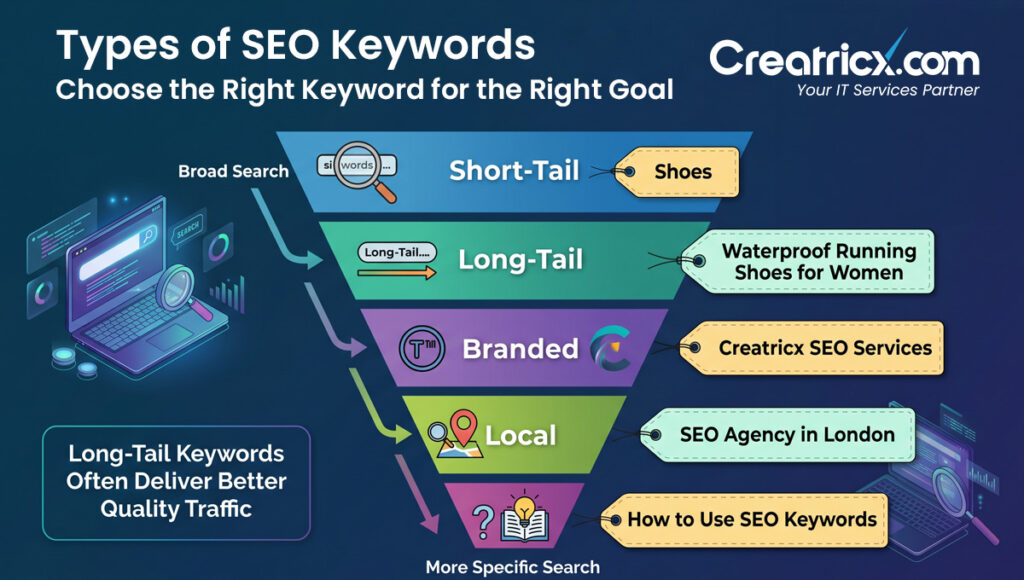
Not all keywords work the same way. Knowing the main types helps you choose the right ones for each page:
| Keyword Type | Example | Best Used For |
| Short-tail (head) | "shoes" | Broad reach, but high competition |
| Long-tail | "waterproof running shoes for women" | Specific intent and easier ranking |
| Branded | "Creatricx SEO services" | Capturing searches for your brand |
| Local | "SEO agency in London" | Local and near-me searches |
| Informational | "how to use SEO keywords" | Blogs, guides and how-to content |
| Transactional | "buy running shoes online" | Product and sales pages |
Long-tail keywords are often the most valuable for growing sites. They face less competition and attract people who know what they want, which usually means better-quality traffic.
Why Keyword Strategy Matters
A few well-established search trends shape how keywords should be used:
- Most searches are long and specific – The majority of queries are detailed phrases rather than single words, so long-tail keywords matter.
- Intent beats volume – A keyword that matches what a searcher wants will outperform a high-volume term that does not.
- Conversational search is growing – Voice and natural-language searches reward content written the way people actually speak.
- Relevance is rewarded – Search engines increasingly focus on topics and meaning, not just exact-match words.
(Search behaviour varies by industry and changes over time, so treat these as directional insights rather than fixed figures.)
Why Using Keywords Correctly Matters
Using keywords well is one of the foundations of search engine optimisation. Done properly, it delivers real benefits:
- Better visibility – Your pages appear for the searches that matter to your business.
- More qualified traffic – You attract people actively looking for what you offer.
- Clearer relevance – Search engines understand your content and rank it appropriately.
- Higher click-through rate – Keyword-aligned titles and descriptions earn more clicks.
- Stronger content – Keyword research keeps your writing focused on what your audience needs.
Used badly, keywords have the opposite effect. Overusing them makes content hard to read and can signal low quality to search engines.
How to Use SEO Keywords (Step-by-Step)
Follow this process for any page or blog post:
- Research your keywords – Find the terms your audience uses, along with related phrases and questions.
- Understand search intent – Decide what the searcher wants: information, a product, or a local service.
- Group keywords by topic – Cluster related terms so each topic maps to a clear page.
- Assign one primary keyword per page – Pick a main term for each page, plus a few supporting keywords.
- Place the primary keyword in key spots – Add it to the title, URL, H1 and opening lines.
- Add keywords naturally in the body – Use the main term and its variations where they fit the writing.
- Optimise supporting elements – Include keywords in the meta description, image alt text and internal links.
- Review and refine – Track performance over time and update content to keep it relevant.
Common Keyword Mistakes
Avoid the errors that hold pages back:
- Keyword stuffing – Repeating a keyword unnaturally makes content look spammy.
- Keyword cannibalisation – Targeting the same keyword on several pages makes them compete with each other.
- Ignoring search intent – A keyword that does not match the page's purpose attracts the wrong visitors.
- Chasing volume only – High-traffic terms are often too competitive and too broad to convert.
- Forgetting variations – Using only the exact phrase, with no synonyms, reads awkwardly and limits reach.
Where to Place SEO Keywords on a Page
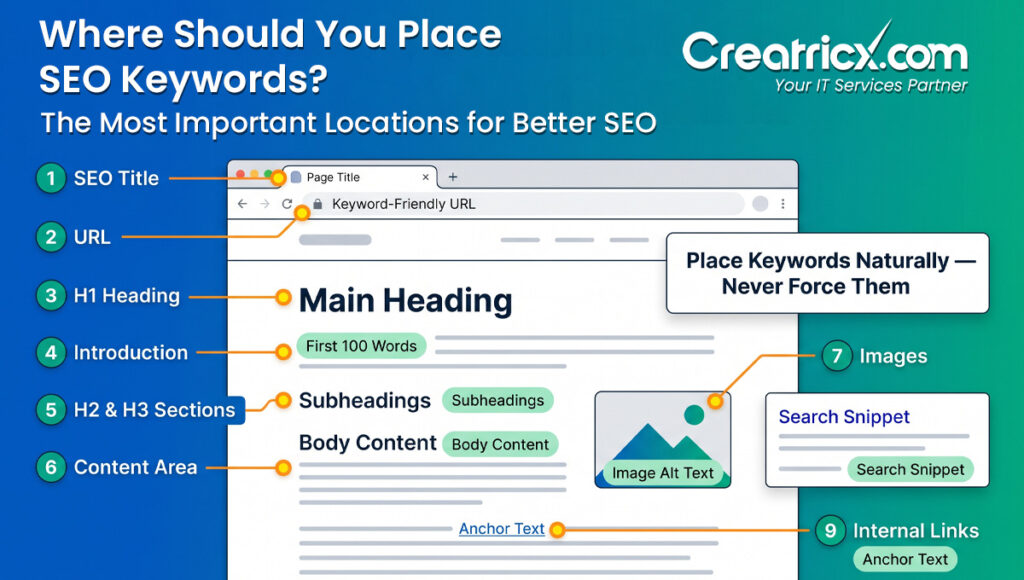
Placement is the heart of using keywords well. Search engines pay more attention to some areas than others, so put your primary keyword where it counts:
| Where to Place the Keyword | Why It Matters |
| Page title (SEO title) | The strongest on-page signal and the headline shown in search results |
| URL slug | Short, keyword-rich URLs are clearer for users and search engines |
| H1 heading | Confirms the page's main topic |
| First 100 words | Signals the subject early to readers and search engines |
| Subheadings (H2, H3) | Reinforce structure and supporting topics |
| Body content | Repeats the theme naturally through related terms |
| Image alt text | Supports image search and accessibility |
| Meta description | Improves relevance and encourages clicks |
| Internal link anchor text | Passes topic context to the pages you link to |
The golden rule is balance. Each placement should feel natural. If a keyword makes a sentence read strangely, rewrite the sentence rather than forcing the term in.
Benefits of Using SEO Keywords Well
- Higher rankings for the searches that matter to your business.
- More targeted, qualified traffic that is likelier to convert.
- Content that aligns closely with what your audience wants.
- Improved click-through rate from search results.
- Long-term organic growth that compounds over time.
Best Practices for Using SEO Keywords
Keep these principles in mind for every page:
- One primary keyword per page – Give each page a clear focus.
- Use natural variations – Include synonyms and related phrases, not just the exact term.
- Match intent to page type – Informational keywords suit guides; transactional keywords suit product pages.
- Lead with the keyword where it counts – Place it early in titles and headings.
- Write for humans first – Readable content keeps visitors engaged and supports rankings.
- Add keywords to supporting elements – Alt text, internal links and descriptions all help.
- Refresh content regularly – Update pages as search trends and your offering change.
Write for Humans First
Search engines reward content that genuinely helps people:
- Helpful, natural writing performs better than keyword-packed text.
- Keyword stuffing can trigger spam filters and damage rankings.
- Synonyms and related terms read better and broaden your reach.
- Content that matches intent keeps visitors on the page and builds trust.
Why Creatricx Can Help With Your SEO Keywords
Researching keywords, mapping them to pages and using them correctly across a whole site takes time and expertise. At Creatricx, we help businesses grow without the cost of building large in-house teams, and our remote experts become an extension of your team.
Our keyword and on-page work includes:
- Keyword research that uncovers the terms your customers actually use.
- Intent mapping so the right keywords land on the right pages.
- Natural, optimised copy that ranks well and reads well.
- Technical accuracy so keywords are used correctly in titles, URLs and metadata.
- Ongoing optimisation as search trends and your goals evolve.
To put your keywords to work, explore our SEO services, our wider digital solutions services, or our web development services for sites built with SEO in mind.
Ready to grow your search traffic? Get a Quote for your project, contact the Creatricx team, or book a free consultation to talk through your goals. You can also reach us any time through our contact page.
Frequently Asked Questions
What are SEO keywords?
SEO keywords are the words and phrases people type into search engines. Using them in your content helps search engines match your pages to relevant searches and show them in the results.
How do I find the right SEO keywords?
Start with the terms your audience uses, then expand into related phrases and questions. Focus on keywords that match your content and the searcher's intent, and favour specific long-tail terms where you can.
How many keywords should I use on a page?
Use one primary keyword per page, supported by a few closely related terms and natural variations. Trying to target too many keywords on a single page dilutes its focus.
Where should I place my main keyword?
Place it in the page title, URL, H1 heading, first 100 words and a subheading or two. Then use it and its variations naturally through the body, alt text and internal links.
What is keyword stuffing?
Keyword stuffing is repeating a keyword unnaturally to try to manipulate rankings. It harms readability and can trigger search engine spam filters, so it is best avoided entirely.
What is search intent and why does it matter?
Search intent is the reason behind a search — to learn, to buy, or to find a local service. Matching your keywords and content to that intent brings in the right visitors and improves results.
What is the difference between short-tail and long-tail keywords?
Short-tail keywords are broad, one or two-word terms with high competition. Long-tail keywords are longer, specific phrases that are easier to rank for and attract more targeted traffic.
How long does it take for SEO keywords to work?
SEO is a long-term strategy. Improvements can take weeks or months to show, depending on competition, content quality and how established your site is.