
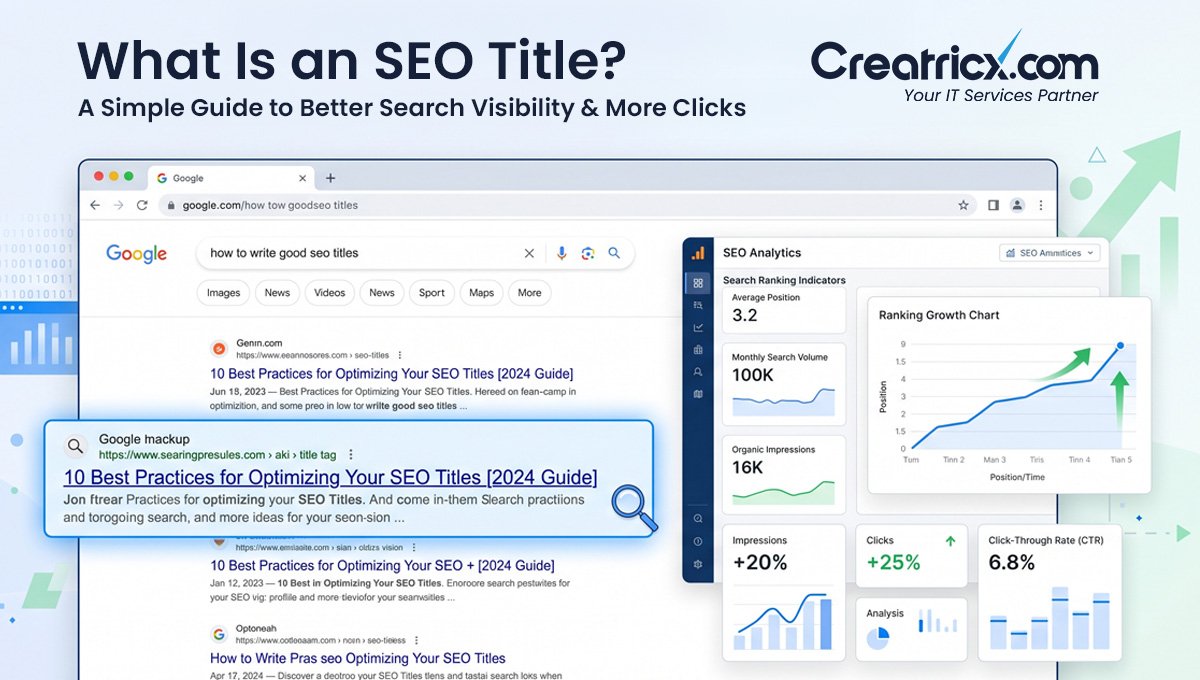
An SEO title, also called a title tag, is the clickable headline that represents a web page in search engine results. It tells search engines and users what the page is about, and it strongly influences both your rankings and how many people click through to your site.
Table of Contents
Key Takeaways
- An SEO title (title tag) is the headline shown for your page in search results and browser tabs.
- It is one of the most important on-page SEO elements for both rankings and click-through rate.
- Keep titles to roughly 50–60 characters so they are not cut off in search results.
- Place your main keyword near the start and make the title clear and compelling.
- Every page needs a unique title — duplicates confuse search engines and users.
- Google sometimes rewrites titles, so keep yours accurate, relevant and on-topic.
What Is an SEO Title?
An SEO title is the text that defines the headline of a page for search engines. In code, it sits inside the HTML <title> tag in the head of the page, like this:
<title>What Is an SEO Title? A Simple Guide</title>
That single line does a lot of work. It appears as the blue, clickable link on a Google results page, as the label on a browser tab, and as the headline when someone bookmarks or shares your page. For most people searching online, the SEO title is the very first thing they read about your website.
A real-world example makes it clear. Imagine a local bakery with a page about custom birthday cakes. A weak title might simply say "Home" or "Page 1". A strong SEO title would say "Custom Birthday Cakes in Leeds | Fresh Daily". The second version tells search engines exactly what the page offers, includes a keyword people search for, and gives users a clear reason to click.
SEO Title vs Title Tag vs H1 — What Is the Difference?
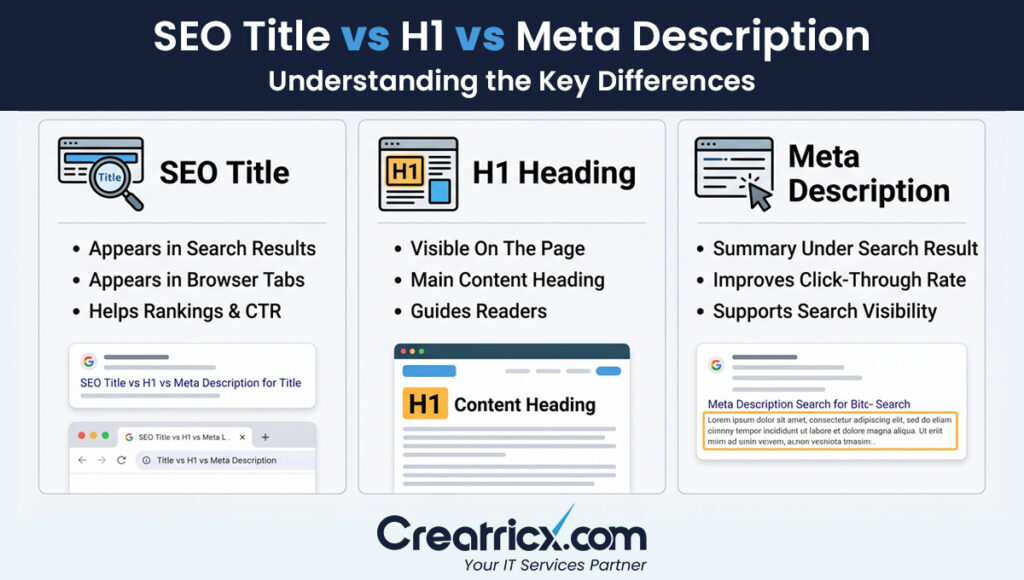
These three terms cause a lot of confusion, so it helps to separate them clearly:
| Element | Where It Lives | What It Does |
|---|---|---|
| Title tag / SEO title | In the page's HTML <title> code | Shows in search results and browser tabs |
| H1 heading | On the visible page, at the top | The main on-page headline readers see |
| Meta description | In the page's HTML code | The short summary text under the title in search results |
The title tag and the SEO title are the same thing — "SEO title" is just the friendlier name many tools and plugins use. The H1 is separate: it is the heading on the page itself. They can match, but they do not have to. A page might use a punchy H1 for readers and a slightly different, keyword-focused title tag for search engines.
Why SEO Titles Matter
The SEO title is small, but its impact is large. Here is why it deserves attention:
- First impression – It is usually the first thing a searcher sees about your page.
- Ranking signal – Search engines use the title to understand a page's topic and relevance.
- Click-through rate – A clear, appealing title encourages more people to click your result over a competitor's.
- User experience – It labels browser tabs and bookmarks, helping people find your page again.
- Sharing – Many platforms pull the title when a link is shared, shaping how your page looks elsewhere.
A page can rank well and still lose traffic if its title is dull or confusing. Improving titles is one of the quickest ways to win more clicks from the visibility you already have.
SEO Title Length
Search engines display titles based on width, not just character count:
- Around 50–60 characters is the safe range before a title is likely to be cut off.
- Pixel width matters more than exact characters — Google truncates titles at roughly 600 pixels, so wide letters take up more space.
- Front-load the important words so your keyword and message survive even if the end is trimmed.
- Mobile and desktop differ slightly, so aim for concise titles that read well on both.
(Display limits can vary by device and search engine, so treat these as practical guidance rather than fixed rules.)
What Makes a Good SEO Title?
A strong SEO title balances search engines and human readers. The best ones share a few qualities:
- Keyword near the start – Lead with the main term people actually search for.
- Within the length limit – Keep it concise so it is not truncated in results.
- Unique to the page – No two pages on your site should share the same title.
- Matched to search intent – Reflect what the searcher is looking for on that page.
- Clear and specific – Vague titles get ignored; specific ones earn clicks.
- Brand where it helps – Adding your brand name can build recognition and trust.
- Written for humans – It should read naturally, not like a list of stuffed keywords.
How to Write an SEO Title (Step-by-Step)
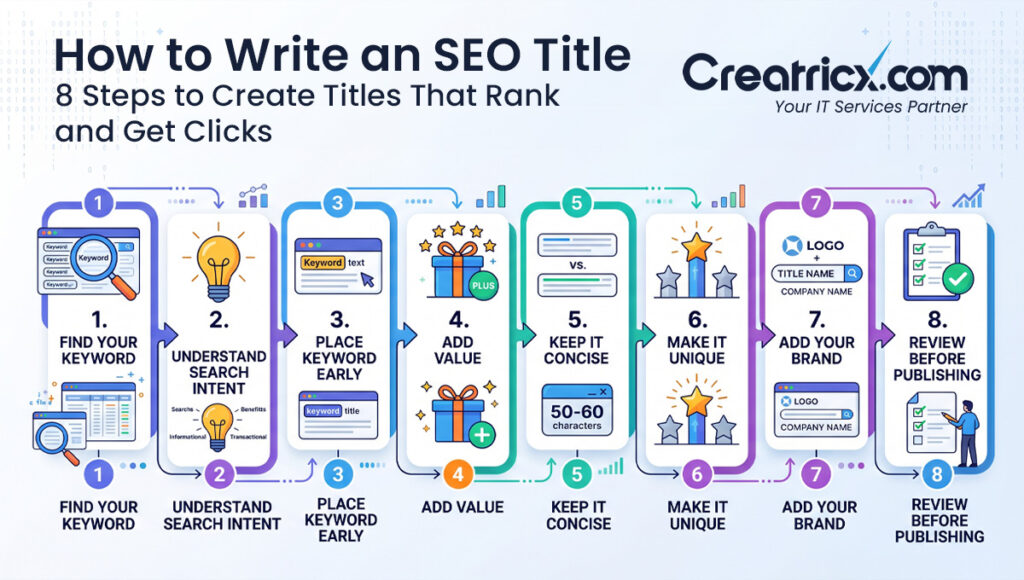
Follow this simple process for any page:
- Identify the main keyword – Find the primary term the page should rank for.
- Understand the search intent – Work out what someone wants when they search that term.
- Place the keyword early – Put the main keyword near the front of the title.
- Add a supporting phrase – Include a benefit, location or detail that adds value.
- Keep it within length – Trim the title to around 50–60 characters.
- Make it unique – Check that no other page uses the same or a very similar title.
- Add your brand – Append your brand name with a separator if there is room.
- Read it aloud – Confirm it sounds natural and would tempt you to click.
Common SEO Title Mistakes
Steer clear of the errors that quietly cost rankings and clicks:
- Keyword stuffing – Repeating the same keyword makes titles look spammy.
- Duplicate titles – Using one title across many pages confuses search engines.
- Titles that are too long – Important words get cut off in results.
- Being too vague – Generic labels like "Home" or "Services" tell users nothing.
- Ignoring intent – A title that does not match what the page delivers loses trust and traffic.
Good vs Bad SEO Title Examples
Seeing the difference side by side makes the rules stick:
| Weak SEO Title | Stronger SEO Title |
|---|---|
| Services | Affordable SEO Services for Small Businesses |
| Welcome to Our Site | Custom Web Development in London | Creatricx |
| Blog Post | What Is an SEO Title? A Simple Guide for Beginners |
| Products Page | Handmade Leather Bags — Free UK Delivery |
The stronger versions are specific, lead with meaning, and give the reader a clear reason to click.
Benefits of a Well-Optimised SEO Title
- Higher click-through rate from search results.
- Better alignment between your page and what searchers want.
- Clearer relevance signals to search engines.
- More recognisable links when shared on other platforms.
- A simple, low-cost win that improves traffic from existing rankings.
SEO Title Best Practices Checklist
Run every important page through this quick checklist:
- Primary keyword included and placed near the start.
- Length kept to roughly 50–60 characters.
- Unique title on every page.
- Intent match between the title and the page content.
- Readability — it sounds natural and compelling.
- Brand name added where space allows.
- No duplication of keywords or other pages' titles.
Google May Rewrite Your Title
Even a perfect title is not guaranteed to appear exactly as written:
- Search engines can replace titles with text they consider more relevant to a query.
- Accurate, descriptive titles are far less likely to be rewritten.
- Avoid misleading or keyword-stuffed titles, which make rewrites more likely.
- Keep titles aligned with on-page content so search engines trust your version.
Why Creatricx Can Help With Your SEO Titles
Writing strong SEO titles across an entire website takes time, consistency and an understanding of how people search. At Creatricx, we help businesses grow without the cost of building large in-house teams, and our remote experts become an extension of your team.
Our approach to on-page SEO includes:
- Keyword-led titles that target the terms your customers actually search.
- Site-wide consistency so every page has a unique, optimised title.
- Intent-focused copy that improves both rankings and click-through rate.
- Technical accuracy so titles are implemented correctly in your site's code.
- Ongoing optimisation as your goals, content and search trends evolve.
If you want titles that earn more clicks, explore our SEO services, our wider digital solutions services, or our web development services for sites built with SEO in mind.
Ready to improve your search performance? Get a Quote for your project, contact the Creatricx team, or book a free consultation to talk through your goals. You can also reach us any time through our contact page.
Frequently Asked Questions
What is an SEO title?
An SEO title, or title tag, is the clickable headline that represents a page in search results. It tells search engines and users what the page is about and influences both rankings and clicks.
Is an SEO title the same as a title tag?
Yes. "SEO title" is the everyday name for the HTML title tag. Many SEO tools and content plugins label the field "SEO title" to make it easier to understand.
How long should an SEO title be?
Aim for around 50–60 characters. Search engines display titles by width rather than exact characters, so keep the important words near the start to avoid them being cut off.
Is the SEO title the same as the H1?
No. The SEO title appears in search results and browser tabs, while the H1 is the main heading on the visible page. They can match, but they often differ slightly.
Where do I add an SEO title?
In most website platforms and content management systems, there is a dedicated SEO title field for each page or post. Behind the scenes, it is added to the page's HTML title tag.
Does the SEO title affect rankings?
Yes. It is an important on-page signal that helps search engines understand your page. A clear, relevant title also improves click-through rate, which supports overall performance.
Why did Google change my title in search results?
Search engines sometimes rewrite titles when they think a different version better matches a search. Accurate, descriptive titles that match your page content are less likely to be changed.
Can every page have a different SEO title?
Yes, and it should. Every page needs a unique title that reflects its specific content. Duplicate titles make it harder for search engines to tell your pages apart.