
Is Staff Augmentation the Same as IT Staffing?
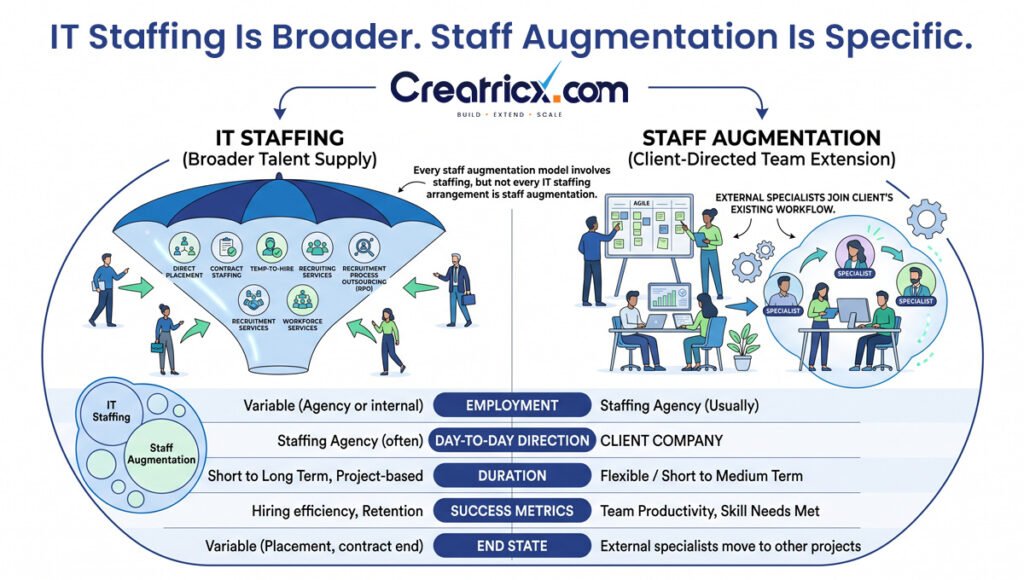
No, not exactly. IT staffing is the broader category of finding and supplying IT talent, while staff augmentation is a specific way of using external talent inside an existing team. In staff augmentation, outside professionals usually join your workflow, take priorities from your managers, and fill a temporary capacity or skill gap. IT staffing can also include direct permanent hiring, temp-to-hire, long-term contract placements, and other recruiting models.
The confusion is understandable because the terms overlap heavily in the real world. The Texas Department of Information Resources calls its category IT Staffing Services, while saying those services are delivered through IT Staff Augmentation Contracts that provide temporary IT resources on an as-needed hourly basis. North Carolina’s Department of Information Technology likewise describes its Short-Term IT Staffing Contract as providing short-term IT staffing augmentation.
So if a procurement team uses the words almost interchangeably, it is not necessarily using them incorrectly. The more useful distinction is this: IT staffing describes the talent-supply category. Staff augmentation describes the operating relationship after the person is supplied.
Table of Contents
The One-Sentence Difference
Use This Definition
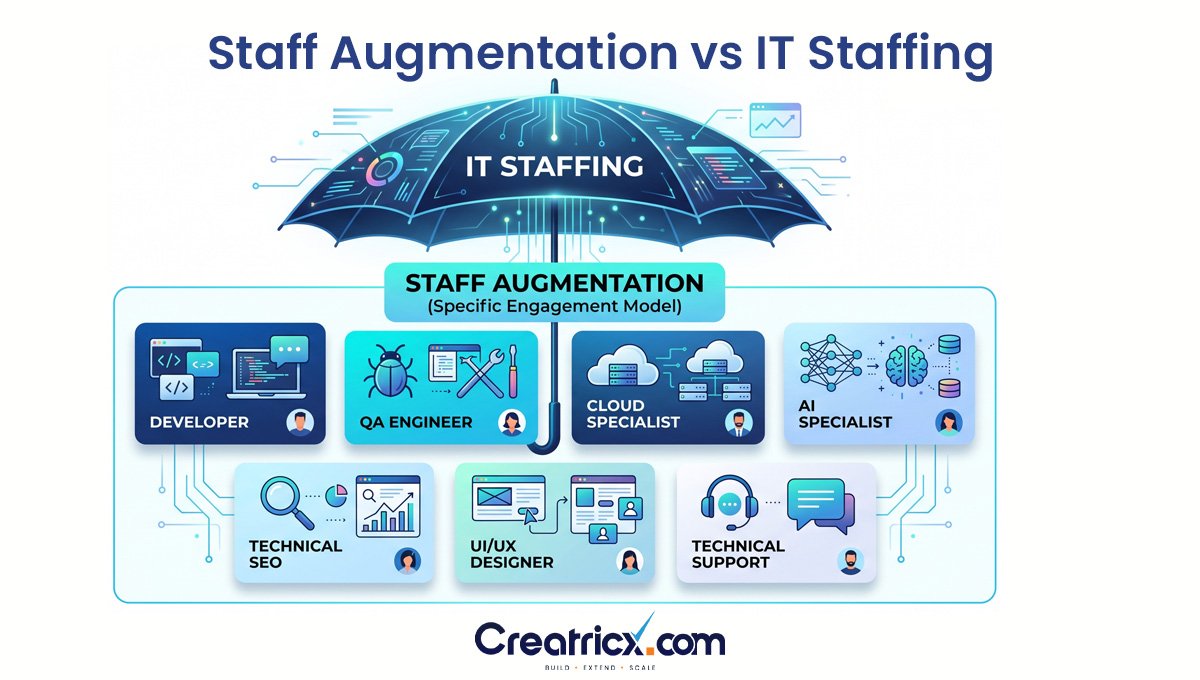
IT staffing is the broader practice of sourcing or placing IT workers. Staff augmentation is a specific engagement model where external specialists supplement an existing team and usually work under the client’s day-to-day direction.
Another way to remember it: every staff-augmentation engagement involves staffing, but not every IT staffing engagement is staff augmentation.
Why the Terms Get Used Interchangeably
The staffing market evolved around overlapping buyer language rather than a single academic taxonomy. Procurement departments often care less about the vocabulary than the practical arrangement: temporary IT resources, hourly or monthly billing, interviews, and a defined assignment.
Texas DIR is a clean example. Its page is titled IT Staffing Services, yet it says IT Staff Augmentation Contracts provide temporary IT staff resources on an as-needed hourly basis. North Carolina’s Department of Information Technology similarly describes its short-term staffing contract as providing IT staffing augmentation.
So a vendor can legitimately call itself an IT staffing company and sell staff augmentation. The problem begins only when the buyer assumes that every IT staffing service includes the same management, employment, duration, or delivery model.
Umbrella Model
IT Staffing Is the Umbrella. Staff Augmentation Is One Way to Use It.
Candidate becomes a permanent employee of the client.
Trial assignment may become permanent employment.
Time-bound IT resource for a project, shortage, vacancy, or specialist need.
External specialist joins the client team and works inside its delivery system.
Provider finds and screens candidates for an employer.
What IT Staffing Can Include
The American Staffing Association’s definitions are useful because they separate staffing services from occupational categories. ASA treats Information Technology as an occupational category, while staffing services can include direct placement, long-term and contract help, temporary help, temp-to-hire, payrolling, managed services, RPO, and other workforce solutions.
- Direct placement: a staffing firm finds a candidate who becomes a permanent employee of the client.
- Long-term / contract help: the staffing firm recruits workers to supplement the client workforce on longer assignments.
- Temporary help: workers are assigned for special projects, busy periods, temporary vacancies, or specialist expertise.
- Temp-to-hire: a staffing employee works for a trial period before a possible permanent employment relationship.
- Recruitment and workforce services: sourcing, screening, payrolling, MSP/VMS, RPO, and related services can all sit around the staffing ecosystem.
That breadth is the strongest reason not to treat IT staffing and staff augmentation as perfect synonyms. A direct-hire Java developer placed by a recruiting firm is clearly IT staffing, but it is not staff augmentation.
What Staff Augmentation Usually Means
Staff augmentation starts with an existing operating team. The business already has the product, backlog, managers, systems, and delivery process, but it lacks enough capacity or a particular specialist skill.
Client-Directed Team Extension
The Candidate Starts. The Operating Model Becomes the Real Test.
The external professional joins the client’s existing tools, meetings, codebase, workflow, or operating system.
The client usually decides what gets worked on and what comes first.
The person may be employed by the provider while working day to day with the client team.
The need is often flexible: a migration phase, product push, specialist gap, seasonal backlog, or temporary capacity shortage.
Success is judged by how well the specialist contributes to delivery, not simply whether a vacancy was filled.
This is why staff augmentation is more than candidate placement. The provider still has to source and vet the person, but the engagement succeeds or fails inside the client’s delivery system.
Staff Augmentation vs IT Staffing: 8 Practical Differences
Comparison Matrix
The Biggest Difference Appears After the Candidate Starts
| Dimension | Staff augmentation | IT staffing |
|---|---|---|
| Primary question | How do we add capability to our existing team? | How do we find or place IT talent? |
| Scope | Specific engagement model | Broader workforce / recruiting category |
| Employment | Often provider-employed specialist or contractor | Can be temporary, contract, temp-to-hire, or permanent |
| Day-to-day direction | Usually the client | Depends on the staffing arrangement |
| Duration | Often temporary, project-linked, or scalable | Can be short-term, long-term, trial, or permanent |
| Commercial focus | Capacity and specialist access | Placement, fill, recruiting, or workforce supply |
| Success metric | Contribution, throughput, quality, integration | Fill quality, time-to-fill, retention, or assignment success |
| End state | External capacity may scale down or leave | May end in a permanent hire or another staffing outcome |
Three Examples That Make the Difference Obvious
Example 1
Permanent cybersecurity hire
A staffing or recruiting company finds a senior security engineer. The company interviews the candidate and hires them permanently onto payroll. That is IT staffing / recruiting, not staff augmentation.
Example 2
Six-month backend capacity gap
A SaaS company has a working engineering team but needs two senior backend developers for a migration and backlog. The developers join Slack, GitHub, sprint planning, code review, and the client’s engineering priorities for six months. That is both IT staffing and staff augmentation.
Example 3
Provider owns the support function
A vendor agrees to operate cloud support or a service desk against defined SLAs, staffing the function however it chooses. External IT professionals are involved, but the arrangement is closer to managed services because the provider owns the function and operating outcome.
The Creatricx View: Start With the Gap, Not the Job Title
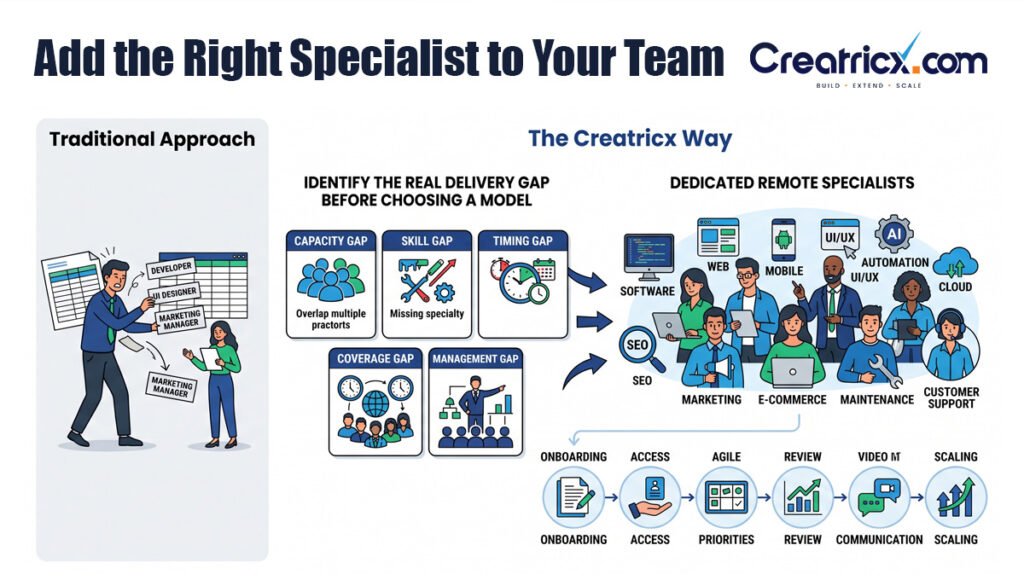
At Creatricx, the useful question is not “Do you need an IT staffing vendor?” It is “What is preventing the team from delivering what the business needs?” A role title is only the final output of that diagnosis.
Delivery-Gap Diagnostic
The Role Title Comes After the Bottleneck
Capacity gap
The right skills exist internally, but the workload exceeds available time.
Skill gap
The team lacks a specialist capability such as mobile, cloud, QA, AI automation, UI/UX, or technical SEO.
Timing gap
Permanent hiring will arrive too late for an active project, migration, release, or backlog.
Coverage gap
One person has become the bottleneck or single point of failure.
Management gap
The business lacks clear priorities, ownership, or review. Adding staff will not repair that problem.
This is the experience layer that a glossary definition misses. A staffing company can successfully fill the role and the delivery can still fail if nobody can explain the product, approve work, review code, or unblock decisions.
The 30-Day Staff Augmentation Readiness Test
Before Day 1
Prepare the system
Prepare access, product context, role ownership, security permissions, working hours, and a first bounded task.
Days 1–5
Transfer context
Explain the product, users, architecture, current priorities, review rules, and who makes which decisions.
Days 6–15
Run real work
Move real work through the normal review process and observe where the specialist becomes blocked.
Days 16–30
Measure integration
Measure blocked time, review speed, quality, communication, and whether the original skill or capacity gap is actually shrinking.
Experience note
Do not evaluate an augmented engineer only by raw speed in the first week. Complex codebases and undocumented products have learning costs. A better early signal is whether access, context, decision-making, and review friction are improving each week.
What Practitioners Say About Team Integration
Public engineering forums are anecdotal rather than controlled research, but they are useful for seeing the problems that appear after a person has been “successfully staffed.” The recurring themes are less glamorous than hiring decks: onboarding, documentation, decision rights, review latency, and accountability.
Practitioner Pulse
These discussions are operational signals, not market statistics.
Onboarding quality changes ramp-up time
Experienced-developer discussions repeatedly describe access, codebase context, domain knowledge, and documentation as major parts of the productivity curve. A strong hire cannot instantly infer a product that nobody documented.
Technical authority is not product authority
A staff-engineer discussion separates technical influence from product and business priorities. That distinction matters in augmentation: a specialist can own implementation decisions without automatically owning the roadmap.
Measure what the specialist can influence
If an augmented engineer is blocked by product decisions, access, or a twelve-hour review queue, raw output is a poor performance measure. Responsibility and measurement should follow the part of the system the person can actually control.
Current Market Context: Why the Distinction Still Matters in 2026
The wider staffing market remains active. In its July 2026 Staffing Index report, the American Staffing Association reported that staffing jobs for the week of July 13–19 were 3.7% higher than the same period in 2025. Temporary and contract staffing employment over the four weeks ending July 19 was 5.2% higher year over year.
ASA also describes the U.S. staffing, recruiting, and workforce solutions industry as providing work opportunities to roughly 11 million employees per year.
Remote technical work is also normal enough that “external” no longer automatically means “outside the team.” In the 2025 Stack Overflow Developer Survey, the United States had the highest share of fully remote developers among the top-reporting countries at 45%.
Those facts do not prove staff augmentation is better than permanent hiring. They do show why businesses need to distinguish among permanent recruiting, contract staffing, augmentation, and managed delivery instead of treating every external technology worker as the same category.
IT Staffing, Staff Augmentation, Managed Services, and RPO Are Different Problems
| Model | What you buy | Day-to-day owner | Best fit |
|---|---|---|---|
| IT staffing / recruiting | Find and place IT talent | Depends on placement | Open role / workforce demand |
| Staff augmentation | Add capacity or a skill to an existing team | Client | Backlog, project phase, specialist gap |
| Managed service | Operate a defined function | Provider | Outcome / SLA / ongoing operations |
| RPO | Operate part or all of recruitment | Provider manages recruiting process | Permanent hiring volume / recruiting system |
| Project outsourcing | Deliver a defined project or deliverable | Provider | Scope, timeline, deliverable |
Do You Need IT Staffing or Staff Augmentation?
Decision Rule
Start With the Bottleneck. The Job Title Comes Later.
Use staff augmentation when…
Work already exists, the internal team can direct it, and the missing piece is capacity or specialist expertise.
Use broader IT staffing / recruiting when…
The main problem is filling an IT position, especially when the desired end state is a permanent employee.
Use managed services / project outsourcing when…
You do not want to manage the added people directly and expect the provider to own the service or deliverable.
When Staff Augmentation Is a Better Fit
- A release, migration, or product roadmap needs more engineering capacity now.
- You need a specialist capability for a defined phase rather than forever.
- Your team has product and technical leadership already in place.
- The external person needs to work inside your tools, backlog, standards, and review process.
- You want the option to scale the team up or down as workload changes.
When Traditional IT Staffing or Recruiting Is a Better Fit
- The goal is a permanent employee rather than flexible external capacity.
- The vacancy is stable, long-term, and central enough to justify internal employment.
- You want a staffing firm mainly for sourcing, screening, and candidate access.
- A temp-to-hire arrangement is useful because both sides want a trial period before permanent employment.
- Your HR team wants recruiting support but the final employee should belong entirely to your organization.
When Neither Model Fixes the Real Problem
More people will not fix unclear product ownership, contradictory priorities, no code review, missing QA, slow approvals, or a technical architecture nobody understands. Those are operating-system problems. Staffing can make them more visible, but it cannot make them disappear.
The management test
If the new person joined tomorrow, could someone give them access, explain the product, choose the first priority, answer questions, review the work, and decide when it is done? If not, repair the delivery system before buying more capacity.
How Creatricx Positions Staff Augmentation
Creatricx positions dedicated remote experts as an extension of the client team across software, web, e-commerce, marketing, AI automation, cloud, and customer support. The practical value is flexibility: a company can add one specialist or combine several roles without creating a full internal department first.
For a staff-augmentation-style engagement, the cleanest model is usually client-directed: the business keeps the roadmap and priorities, while Creatricx supplies specialist capacity and supports continuity around the engagement.
That capacity can support web development, mobile app development, UI/UX, cloud and DevOps work, QA, automation, or wider product delivery. For a larger long-term structure, the Creatricx Offshore Development Center model can combine engineering, mobile, product/UI/UX, QA, DevOps/cloud, AI/data, growth, and operational support around one roadmap.
For work where the business wants Creatricx to own a broader deliverable or ongoing function, a managed or project-based model may be more appropriate. The commercial label should follow the responsibility model, not the other way around.
Frequently Asked Questions
Is staff augmentation the same as IT staffing?
Not exactly. IT staffing is the broader practice of sourcing and placing IT professionals. Staff augmentation is a specific engagement model in which external specialists supplement an existing team and usually work under the client’s day-to-day direction.
Why do companies use the terms IT staffing and staff augmentation interchangeably?
Because staff augmentation is commonly sold through IT staffing programs. Texas DIR, for example, calls the category IT Staffing Services while delivering temporary resources through IT Staff Augmentation Contracts. In everyday procurement, the overlap is therefore substantial.
Is a contract developer staff augmentation?
It can be. If the contractor joins your existing team, works within your priorities, and fills a temporary skill or capacity gap, the arrangement is usually staff augmentation. A contractor working independently on a defined deliverable may instead be project outsourcing.
Is a permanent IT hire staff augmentation?
No. A staffing or recruiting firm can help source a permanent IT employee, but once the candidate joins your payroll as a normal permanent hire, that is IT recruiting or direct placement rather than staff augmentation.
Who manages staff augmentation professionals?
Usually the client. The client typically sets priorities, manages the backlog, reviews work, and decides what should happen next. The provider may handle employment, sourcing, HR, replacement, and engagement support.
What is the difference between staff augmentation and managed services?
Staff augmentation adds people to a delivery system the client still manages. Managed services transfer responsibility for a defined function or service to the provider, usually with agreed service levels or outcomes.
How long does staff augmentation usually last?
There is no universal duration. It can last a few weeks, several months, or longer. The right duration should follow the real capacity or skill gap rather than an arbitrary contract period.
Is staff augmentation only for software developers?
No. IT staff augmentation can include developers, QA engineers, DevOps, cloud specialists, security professionals, data engineers, analysts, architects, technical project roles, and other IT specialists. Creatricx also uses remote-team models across adjacent digital functions such as UI/UX, SEO, AI automation, and marketing.
What should I ask a staff augmentation provider before hiring?
Ask how candidates are vetted, who employs them, whether they are dedicated, how replacements work, what time-zone overlap is available, what security controls apply, who manages daily work, how performance is reviewed, and how the engagement can scale or end.
How can I tell whether I need staff augmentation or IT recruiting?
If work already exists and you need more capacity or a specialist inside the current team, staff augmentation is usually the closer fit. If the goal is to fill a permanent role on your payroll, IT recruiting or direct placement is usually more appropriate.
Sources and Evidence Quality
- American Staffing Association — Definitions of Staffing Solutions and ServicesUsed to distinguish direct placement, long-term / contract help, temporary help, temp-to-hire, managed services, RPO, and related staffing models.
- Texas Department of Information Resources — IT Staffing ServicesPrimary government example showing IT staffing and IT staff augmentation terminology used together in procurement.
- North Carolina DIT — Short-Term IT Staffing ContractGovernment example describing short-term IT staffing augmentation on an hourly basis.
- American Staffing Association — July 2026 Staffing IndexUsed for current July 2026 year-over-year temporary and contract staffing context.
- American Staffing Association — Staffing Industry StatisticsUsed for the staffing industry’s approximately 11 million employees-per-year context.
- Stack Overflow Developer Survey 2025 — WorkUsed for current remote-work context, including the 45% U.S. remote share among top-reporting countries.
- ExperiencedDevs — onboarding discussionAnecdotal practitioner context on onboarding, documentation, and the cost of missing product context.
- ExperiencedDevs — staff engineer decision rightsAnecdotal practitioner context separating technical influence from product and business authority.
- Creatricx — Dedicated Remote Teams & IT OutsourcingUsed for current Creatricx positioning around remote experts, IT outsourcing, development, digital services, and team extension.
- Creatricx — Offshore Development Center ServicesUsed for current capability coverage across engineering, mobile, product/UI/UX, QA, DevOps/cloud, AI/data, growth, and operational support.
Final Takeaway
Staff augmentation and IT staffing are close enough that the same provider may sell both, and public procurement programs sometimes use the language almost interchangeably. But they are not the same concept.
IT staffing describes the broader market for finding and placing IT people. Staff augmentation describes a particular operating model: external professionals are added to an existing team, usually for flexible capacity or specialist skills, while the client retains day-to-day control.
If you are comparing providers, stop at the contract boundary and ask who employs the person, who sets priorities, who reviews the work, what happens when the engagement ends, and whether the final goal is temporary capacity or permanent headcount. Those answers are much more useful than whichever label appears in the sales deck.