
What Is the Difference Between Staff Augmentation and RPO?
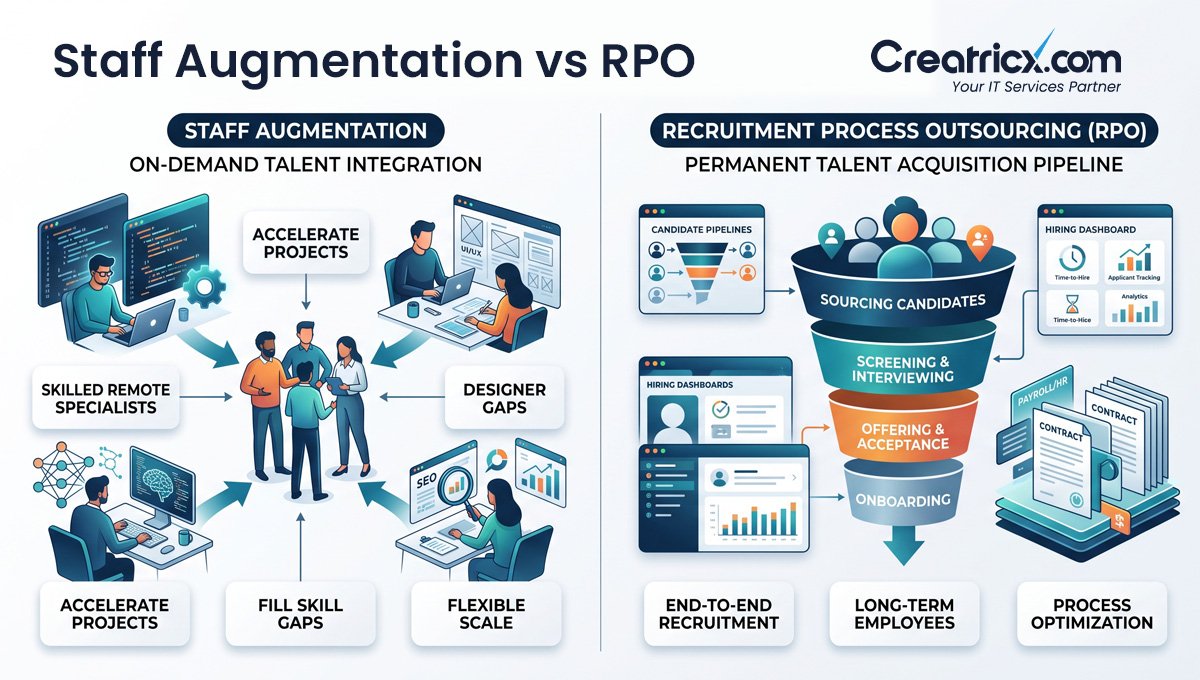
The difference between staff augmentation and RPO comes down to what you are actually outsourcing: staff augmentation gives you the people, while RPO gives you the hiring process itself. With staff augmentation, a provider supplies skilled professionals who work under your direction and remain on the provider side of the employment relationship. With RPO, the provider takes ownership of all or part of recruitment and the successful hires become your permanent employees. One adds capability to the work now. The other changes how you build permanent workforce capacity.
Table of Contents
Key Takeaways
Signal 01
Outsourced object
Staff augmentation outsources access to capability. RPO outsources a recruitment process.
Signal 02
Daily control
You direct augmented professionals. An RPO provider directs the recruiting workflow.
Signal 03
Employment destination
Augmented specialists remain with the provider. RPO hires join your payroll.
Signal 04
Time horizon
Augmentation flexes with workload. RPO is designed to build permanent workforce capacity.
Signal 05
Success metric
Augmentation should improve delivery. RPO should improve hiring outcomes and workforce acquisition.
Why Staff Augmentation and RPO Get Confused in the First Place
Staff augmentation and RPO get lumped together constantly, and our view at Creatricx is that the confusion is understandable but avoidable.
- Both involve an external provider.
- Both involve people who were not on your team last month.
- Both are often filed under the vague heading of "outsourcing."
That is roughly where the similarity ends, and treating them as interchangeable leads businesses to buy the wrong thing for the problem in front of them.
The cleanest way to separate them is to ask a single question: are you trying to get work done, or trying to fix how you hire? If you need skilled people delivering on a project, that is a staff augmentation question.
If your recruitment function itself is the bottleneck, too slow, too inconsistent, unable to keep up with hiring volume, that is an RPO question. They solve genuinely different problems, and the rest of the differences follow from that one distinction.
A simple analogy
A simple analogy we use: staff augmentation is like bringing in an experienced contractor to help build the house. RPO is like handing someone your entire hiring department and asking them to recruit, train, and permanently employ the builders you will use for years. The first gets the work done now. The second changes how your organisation acquires people going forward.
The Outsourcing Object Map
Outsourcing Object Map
The Contract Makes More Sense When You Circle the Thing Being Outsourced
STAFF AUGMENTATION
You outsource access to people.
The provider finds, employs and supports the specialist. Your business still decides what the specialist works on and how that work fits the project.
RPO
You outsource a hiring process.
The provider operates sourcing, screening, process design and related recruitment activities. The people eventually hired become employees of your organisation.
What Staff Augmentation Actually Is
Staff augmentation is a flexible model where a provider supplies skilled professionals who slot into your existing team and work under your day-to-day management. You keep control of priorities, direction, and quality. The provider handles sourcing, onboarding, HR, infrastructure, and continuity behind the scenes, so you get the specialist without the recruitment cycle or the payroll commitment.
The defining features are worth stating plainly, because they are exactly what set it apart from RPO. The people are external and remain employed by the provider. You manage their daily work directly, as if they were part of your team, because functionally they are. The engagement is flexible in duration, scaling up or down as your needs change. And critically, when the work is done, the professionals leave and the relationship simply winds down, with no redundancy process and no permanent headcount to unwind.
This is the model built for a specific and very common situation: you have work that needs doing now, you need particular skills to do it, and you do not want to spend three months recruiting a permanent employee before anyone writes a line of code or designs a single screen.
A useful public-sector reference comes from the Texas Department of Information Resources, which currently describes IT staff augmentation as temporary IT resources acquired as needed. That supports the article’s core distinction: the organisation is obtaining people with skills, not outsourcing the design and management of a recruitment function.
Why this model exists
Staff augmentation fits businesses that already know how work should be directed but need more capacity or a missing skill without immediately adding permanent payroll and recruitment overhead.
What RPO Actually Is
The Recruitment Process Outsourcing Association defines RPO as a form of business process outsourcing where an employer transfers all or part of its recruitment processes to an external provider. The defining distinction is that the RPO provider assumes ownership of recruitment-process design and management and responsibility for results.
Read that definition carefully, because the important word is ownership. An RPO provider does not hand you candidates and collect a fee. It takes over the machinery of hiring itself, sourcing, screening, interview coordination, offer management, onboarding, often operating under your own employer brand so candidates experience it as your internal recruiting team. The people it hires become your permanent employees, on your payroll, for the long term. The provider's job is not to do the work your business does; it is to build the workforce that does that work.
This makes RPO fundamentally a recruitment transformation, not a capability top-up. It suits organisations hiring at scale, across multiple roles or locations, whose internal recruitment function cannot keep pace and needs rebuilding into something faster, more consistent, and more measurable.
RPO is not simply candidate supply
A distinction worth being careful about: RPO is not the same as a staffing agency sending you CVs. A staffing agency fills one vacancy at a time for a per-placement fee and owns none of your process. RPO takes ownership of the recruitment function itself and is accountable for its outcomes. Confusing the two leads businesses to expect strategic recruitment transformation from what is really just candidate supply.
The 2026 RPO Maturity Monitor
2026 RPO Maturity Monitor
RPO in 2026 Is Being Judged on Hiring Outcomes, AI Disruption and Candidate Risk
The Recruitment Process Outsourcing Association’s 2026 Buyer Trends Study surveyed 998 employers, including 454 active RPO users. The report describes a market moving beyond “fill seats” delivery toward measurable business impact, technology, analytics and fraud mitigation.
69%
of employers reported positive ROI from their RPO partnership
61%
said hiring metrics had improved
64%
encountered candidate misrepresentation at least occasionally
58%
wanted RPO partners to help with fraud and risk mitigation
The public summary of the 2026 RPO Buyer Trends Study reports 69% positive ROI, 61% improved hiring metrics and a growing expectation that RPO providers help employers address AI-enabled candidate fraud and measurable business impact.
2026 Recruitment Risk Layer
AI Changes the RPO Problem More Than It Changes the Staff-Augmentation Definition
The current RPO conversation includes candidate fraud, AI-assisted sourcing, assessment quality and data governance because an RPO provider owns part of the hiring machinery. The RPOA’s 2026 study says candidate fraud is now a major buyer concern. A staff-augmentation buyer still needs strong technical vetting, but the service model itself is not a recruitment-transformation programme.
How do you verify identity, detect candidate misrepresentation and use AI without reducing hiring quality?
How are specialists technically assessed, onboarded, retained and replaced if the fit is wrong?
Public recruiting communities in 2026 are also debating which AI recruiting tasks help and which simply automate weak judgement. Those discussions are anecdotal, but they reinforce the value of work samples, structured scorecards and human review.
The Core Differences Between Staff Augmentation and RPO
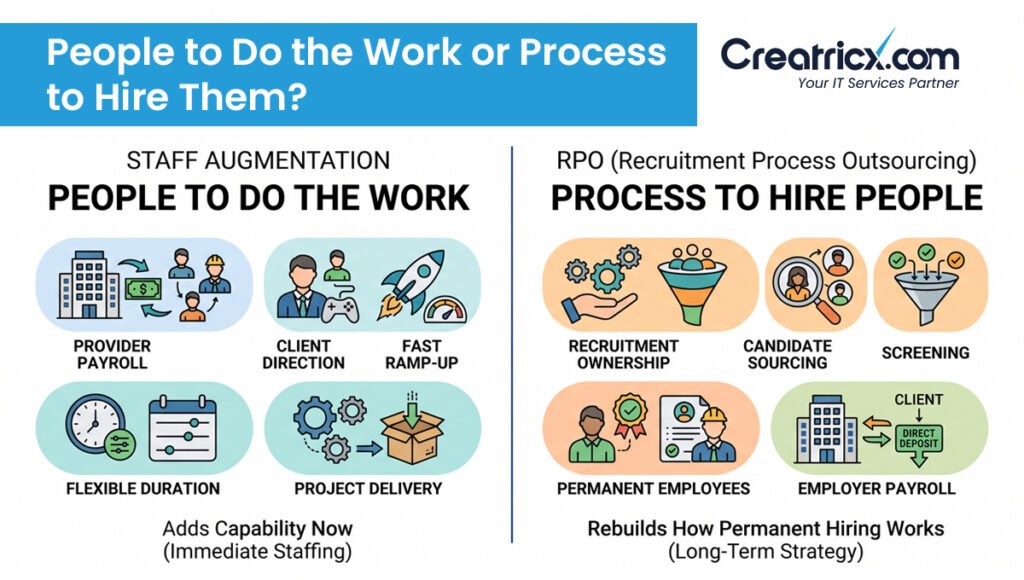
The distinctions become clearest when placed directly against each other. This is the comparison we walk clients through when they are unsure which conversation they are actually having.
| Factor | Staff Augmentation | RPO |
|---|---|---|
| What you get | Skilled people to do the work | A managed recruitment process |
| Who manages the work | You do, day to day | The provider owns the hiring process |
| Employment | People stay on the provider's payroll | Hires become your permanent employees |
| Primary purpose | Add capability and capacity fast | Transform and scale how you recruit |
| Typical speed to start | Around three to five days | Weeks to establish the process |
| When it ends | People leave, engagement winds down | Employees remain permanently with you |
| Best fit | Project work needing specific skills now | High-volume or ongoing permanent hiring |
Neither model is automatically better
Neither model is better in the abstract; they answer different questions. The mistake is choosing based on which sounds more comprehensive rather than which matches your actual need. A business that needs three developers for a six-month build does not need a recruitment transformation, and a business drowning in permanent hiring across five locations will not fix it by augmenting one team.
The Ownership Chain
Ownership Chain
Follow the Person From Need to End State
| Stage | Staff Augmentation | RPO |
|---|---|---|
| Need identified | Client identifies delivery gap | Client identifies hiring-volume/process problem |
| Provider action | Sources and supplies specialist | Operates recruitment workflow |
| Daily owner | Client manager / product / technical lead | RPO recruitment team within agreed governance |
| Worker status | Provider-employed / contracted specialist | Candidate becomes client employee |
| End state | Capacity leaves or changes with engagement | Permanent employee remains with client |
The Speed Reality Check
Speed Reality Check
“Days vs Weeks” Is Directionally Useful, but Do Not Turn It Into a Universal Promise
Staff augmentation can ramp faster when a provider already has suitable vetted capacity, but the actual time depends on role rarity, interviews, security checks, access and onboarding. RPO takes longer to establish because the service itself includes process design, governance, technology, sourcing and hiring operations. Compare the sequence, not one suspiciously precise marketing number.
The Employment Destination Map
Employment Destination Map
Follow Where the Person Sits After the Provider Has Done Its Job
STAFF AUGMENTATION
Provider → Specialist → Client Work
The specialist remains on the provider side of the employment relationship while working within the client’s priorities and delivery process.
RPO
Provider Process → Candidate → Client Employee
The RPO provider runs recruitment, but the successful candidate ultimately joins the client’s permanent workforce and payroll.
The Cost Logic Board
Cost Logic Board
Compare What the Money Is Paying For, Not Which Invoice Looks Smaller
| Cost Layer | Staff Augmentation | RPO |
|---|---|---|
| Primary commercial object | Access to professional capacity | Recruitment process / hiring outcomes |
| Client management cost | Higher: client manages the work | Higher HR governance, lower direct recruiting execution |
| Long-term payroll | No client payroll for the augmented specialist | Yes, successful hires become client employees |
| Technology / process cost | Usually limited to provider staffing operations | Can include recruiting tech, analytics, workflow and programme management |
| Scaling logic | Increase or reduce specialist capacity | Increase recruiting throughput / improve permanent hiring system |
| Exit logic | Engagement or role ends | RPO programme may end, but employees remain |
Which Model Fits In Which Situation
The right choice follows directly from what problem you are solving, and in our experience the decision is usually clearer than businesses expect once the question is framed properly.
Choose staff augmentation when you need specific skills applied to work that exists now. A project with a deadline, a skills gap on an existing team, a temporary surge in demand, or a specialist capability you need for months rather than years. You want people delivering quickly, under your direction, without the cost and delay of permanent recruitment. This is the far more common need for most businesses, particularly in technology, where project timelines rarely wait for a ninety-day hiring cycle.
Choose RPO when the problem is your hiring function itself. You are recruiting at volume, across many roles or geographies, and your internal process cannot keep up, or lacks the consistency and data you need. You are not trying to get a specific project done; you are trying to build a permanent workforce more effectively over the long term. This is a strategic, higher-commitment decision that reshapes how your organisation acquires people.
Some larger enterprises genuinely use both, RPO to build permanent teams over time and staff augmentation for immediate capacity while those hires ramp up. But for most businesses facing a concrete need, it is one or the other, and the deciding question remains the same: people to do the work, or a process to build your workforce?
The Decision Router
Decision Router
Five Questions That Route the Business to the Right Model
Do you already have work waiting?
Yes → staff augmentation becomes more likely.
No, the problem is filling many permanent roles → RPO becomes more likely.
Can your managers direct the added person?
Yes → augmentation fits the operating model.
No, but recruitment itself needs outside ownership → look at RPO or another managed model.
Should the person become your employee?
No → augmentation.
Yes → RPO may be the hiring infrastructure.
Is the requirement temporary or workload-linked?
Yes → augmentation.
No, you are building permanent headcount repeatedly → RPO deserves consideration.
What should the provider be accountable for?
Providing and supporting suitable specialists → augmentation.
Recruitment process design, execution and results → RPO.
The Hybrid Bridge
Hybrid Bridge
Large Organisations Can Use Staff Augmentation While RPO Builds Permanent Capacity
NOW
Augmented capacity
Specialists keep delivery moving while permanent roles are being built.
LONGER TERM
Permanent workforce
RPO improves and scales the process that recruits people onto the client payroll.
How Creatricx Approaches This
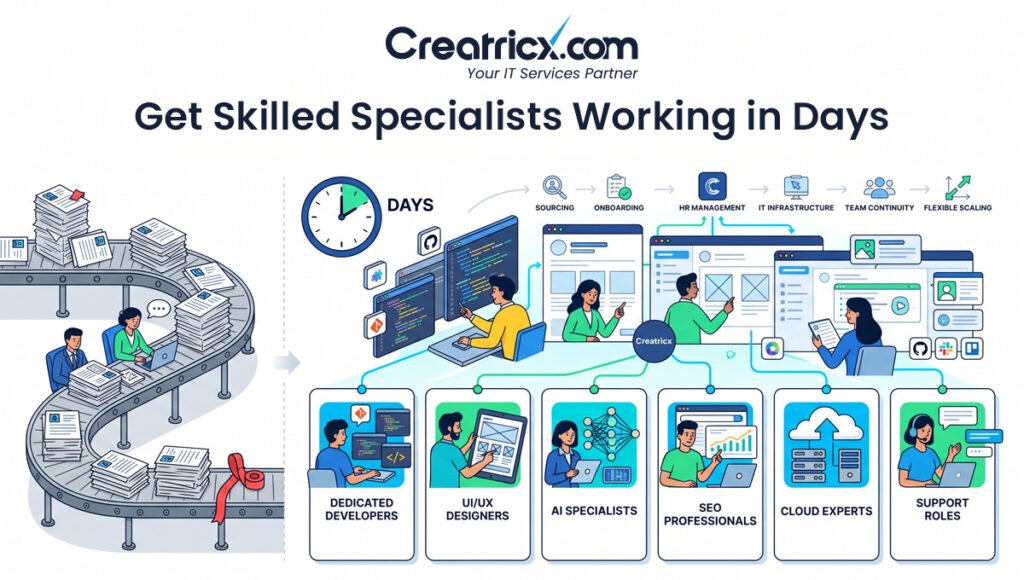
At Creatricx, staff augmentation sits at the heart of what we do, because it answers the need we see most often: businesses that require skilled, specific capability quickly, without taking on a permanent recruitment burden they did not ask for. When you augment your team through Creatricx, you add dedicated developers, designers, AI specialists, SEO professionals, or other specialists who work within your tools and under your direction, while we handle sourcing, onboarding, HR, infrastructure, and continuity in the background. You get the person, not the paperwork.
Our honest position is that most businesses asking "staff augmentation or RPO" are really asking how to get capable people onto their work without a hiring overhaul, and for that, staff augmentation is almost always the more direct answer. It ramps in days, flexes with your needs, and carries none of the permanent-headcount commitment that makes recruitment such a slow and expensive process to begin with.
If your need genuinely is large-scale permanent recruitment transformation, RPO is the right tool and we would tell you so. But if what you actually need is skilled people delivering now, that is precisely the gap our staff augmentation model is built to close, and we would rather match you to the right model than sell you a heavier one than your situation calls for.
Workforce Architecture Field Notes
Workforce Architecture Field Notes
Most Model Confusion Disappears When You Ask Where the Bottleneck Actually Lives
Do not solve a delivery backlog with a recruitment transformation
If the work exists today and the leadership system already works, change capacity first.
Do not solve a broken hiring engine with three contractors
If twenty permanent roles are open across locations and internal recruiting cannot keep up, the bottleneck is acquisition.
Employment destination is the fastest contract sanity check
Ask whose payroll the worker is expected to be on after the provider has finished its part.
A staffing agency and RPO are not interchangeable
Candidate supply can be transactional. RPO should own defined recruitment-process design and results.
Avoid universal speed promises
Availability, screening, access and onboarding affect augmentation speed. Process transfer, governance and technology affect RPO launch time.
In hybrid models, define the handoff
If augmented people are temporary bridges while RPO fills permanent roles, decide what knowledge, ownership and work transfers when permanent hires arrive.
Practitioner Pulse: Recruiting Teams and AI
Practitioner Pulse: Recruiting Teams Are Re-Evaluating What AI Should Actually Own
These are public forum discussions and therefore anecdotal, not benchmark research. They are useful because RPO in 2026 increasingly touches recruiting technology, automation and assessment quality.
Recruiters report AI helping admin more reliably than judgement
In a 2026 r/recruiting discussion, practitioners describe useful AI applications in notes, research, scheduling and follow-up, while remaining skeptical of automated sourcing, screening and culture-fit decisions.
Work samples are being used to recover signal from noisy candidate pools
Another recruiting discussion argues for small work samples that mirror real job responsibilities instead of long unpaid projects or superficial resume filtering. That is relevant whether the hiring process is internal or operated through RPO.
Frequently Asked Questions
What is the main difference between staff augmentation and RPO?
Staff augmentation supplies skilled people who work under your management to get specific work done. RPO takes ownership of all or part of the recruitment process and ultimately delivers permanent employees onto your payroll. One adds capability; the other changes how you hire.
Is staff augmentation faster than RPO?
Staff augmentation can be faster because a provider may already have vetted specialists available, but there is no universal three-to-five-day rule. The actual timeline depends on role availability, interviews, security checks, access and onboarding. RPO usually takes longer to establish because the recruitment process, technology, governance and operating model must be defined.
Do staff augmentation workers become my employees?
No. Augmented professionals remain employed by the provider and work under your direction for the duration of the engagement, then move on when it ends. RPO, by contrast, results in permanent employees hired directly onto your payroll.
When should a business choose RPO over staff augmentation?
Choose RPO when the bottleneck is your recruitment function itself, typically when hiring permanent staff at volume across multiple roles or locations and your internal process cannot keep pace. Choose staff augmentation when you need specific skills applied to existing work quickly.
Is RPO the same as a staffing agency?
No. A staffing agency fills individual vacancies for a per-placement fee and owns none of your process. RPO assumes ownership of the design, management, and results of your recruitment function, operating as an extension of your internal team, often under your employer brand.
Can a business use both staff augmentation and RPO?
Yes, and some larger enterprises do, using RPO to build permanent teams over time while using staff augmentation for immediate capacity as those hires ramp up. For most businesses with a single concrete need, though, one model clearly fits better than the other.
Which model is more cost-effective?
It depends on the need. Staff augmentation is more cost-effective for defined, shorter-term capability because it avoids permanent hiring costs, while RPO can deliver economies of scale for organisations recruiting permanent staff at high volume over the long term.
How does Creatricx staff augmentation work?
Creatricx supplies dedicated specialists, developers, designers, AI, SEO, and more, who join your team and work under your day-to-day management, while Creatricx handles sourcing, onboarding, HR, infrastructure, and continuity. You keep control of the work; we handle everything behind it.
Does RPO mean the provider employs the people it recruits?
Usually no. The RPO provider operates the recruitment process, but the successful candidates are hired into the client organisation and become its employees. That employment destination is one of the clearest differences from staff augmentation.
Can staff augmentation be used while RPO is hiring permanent employees?
Yes. A larger organisation can use staff augmentation to provide immediate project capacity while an RPO programme builds permanent workforce capacity. The transition should define which work, knowledge and ownership moves when permanent hires arrive.
How should I evaluate an RPO provider in 2026?
Look beyond recruiter headcount. Ask about process ownership, analytics, hiring metrics, candidate experience, technology governance, AI use, identity and fraud controls, compliance, reporting and how the provider proves business impact. The RPOA’s 2026 research shows buyers increasingly expect help with AI disruption and candidate risk.
How should I evaluate a staff augmentation provider?
Ask how specialists are sourced and vetted, how quickly realistic roles can be matched, who employs them, how replacements and continuity work, what security and onboarding support is included, and whether the provider can add adjacent skills as the project changes.
Sources and Evidence Quality
- Recruitment Process Outsourcing Association — RPO Definition Current industry-association definition: RPO transfers all or part of recruitment processes and assumes ownership of process design, management and results.
- RPOA 2026 Buyer Trends Study Study based on 998 employers including 454 active RPO users; used for current partnership and market context.
- RPOA 2026 Study Release Public summary of 2026 findings on positive ROI, hiring metrics, candidate fraud and risk mitigation.
- Texas DIR — IT Staffing Services Current public-sector staff-augmentation model based on temporary IT resources acquired as needed.
Disclaimer
This article reflects current industry definitions and market information available in August 2026. RPO programme design, staff-augmentation terms, employment structures, pricing and onboarding timelines vary by provider, role and jurisdiction. The original draft’s Newxel 83% continuation statistic was not retained because a current first-party source supporting that exact attribution was not located during review. Always confirm current terms directly with the provider and obtain appropriate legal or employment advice for the jurisdictions involved.
In Summary
The difference between staff augmentation and RPO becomes simple once you identify the thing being outsourced. Staff augmentation gives the business external capability inside a delivery system it already controls. RPO outsources all or part of the recruitment system used to build permanent headcount.
That distinction drives the rest. In staff augmentation, the specialist remains with the provider and the client directs the work. In RPO, the provider owns agreed recruitment processes and successful candidates become client employees. Augmentation is usually the cleaner answer for a current project or skill gap. RPO becomes more relevant when permanent hiring volume, recruiting consistency, technology or process ownership is the real bottleneck.
Ask one question before comparing vendors: do you need people to do the work, or a process to build the workforce? A surprisingly large amount of outsourcing jargon becomes harmless once somebody is forced to answer that sentence.