
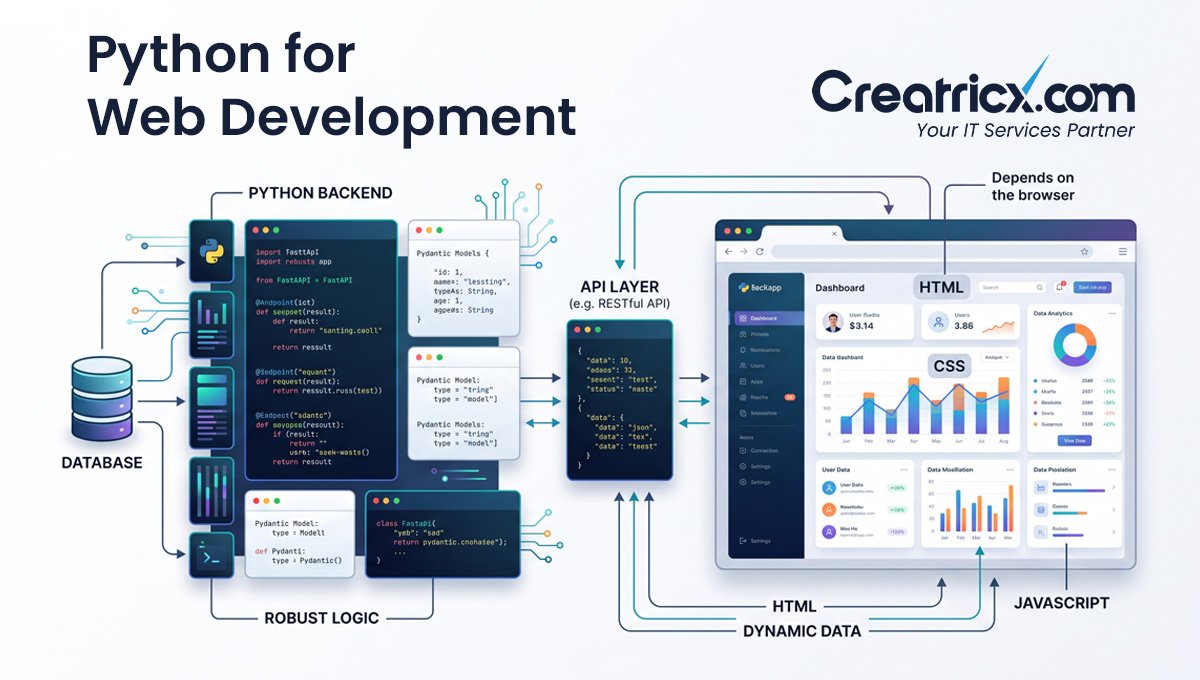
Yes, Python is used for web development at a serious scale, and has been for two decades. Instagram, Spotify, and Dropbox all run substantial Python backends. The genuinely useful caveat, which most answers skip, is that Python only handles the server side. It cannot run in a browser, so every Python web project is really Python plus HTML, CSS, and JavaScript. That single fact shapes almost every practical decision that follows.
Key Takeaways
- Python is a backend language for the web; browsers run JavaScript, so a Python web build always involves both
- 46% of Python developers use the language for web development, according to the most recent JetBrains Python Developers Survey
- FastAPI reached 38% adoption in that survey, ahead of Django at 35% and Flask at 34%, having climbed from 29% two years earlier
- Our reading is that this ranking is widely misinterpreted; it reflects a demographic shift in who writes Python, not evidence that one framework beats another at the same job
- Python 3.14 made free-threaded builds officially supported rather than experimental, which meaningfully weakens the oldest objection to Python on the web
- The strongest practical reason to choose Python is often team fluency, which we would argue is a legitimate engineering decision rather than a compromise
Table of Contents
Why People Ask This About Python And Almost Nothing Else
Nobody asks if JavaScript can be used for web development. Nobody asks it about PHP. The question gets asked about Python specifically, and our view at Creatricx is that the question itself is the interesting part.
It gets asked because Python arrived in most people's awareness through a different door. Data analysis, scripting, automation, machine learning. So there is a lingering sense that Python is a visitor to web development rather than a resident, borrowing the space rather than belonging in it. That impression is roughly fifteen years out of date. Django was released in 2005 and Instagram has run on it since the beginning, through the entire journey from small startup to a platform serving hundreds of millions of people.
That said, we would not dismiss the instinct behind the question entirely. There is something real underneath it, just not what most people think. The real limitation is not maturity or scale. It is where Python can and cannot run.
The short version of our position: Python is unambiguously a production-grade web language, and has been for years. The question worth asking is not "can it" but "should I, for this specific thing", and the answer to that genuinely varies. Anyone answering the second question with an unqualified yes is selling you something.
The Fact Most Answers Skip: Python Stops At The Browser
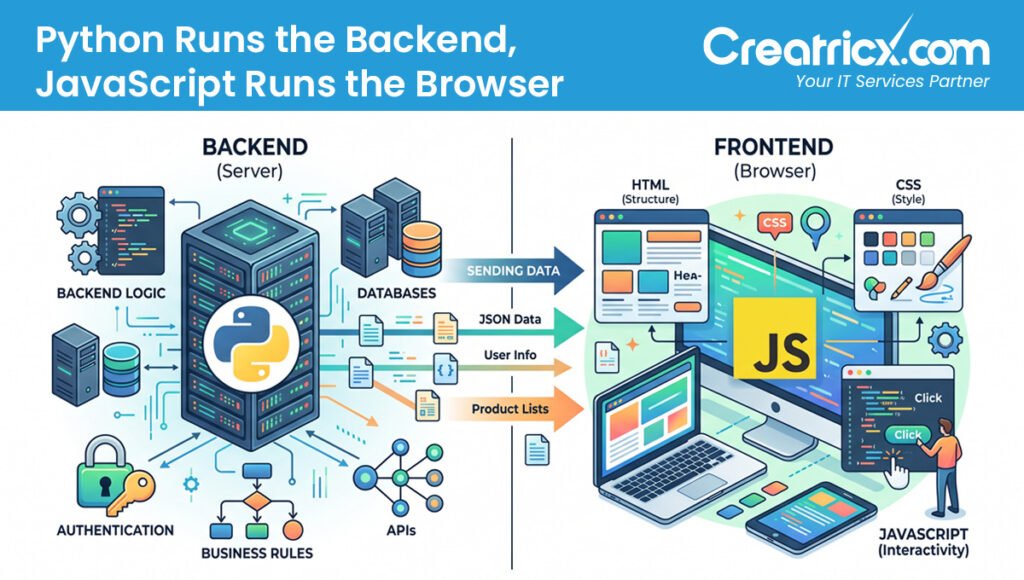
Here is the practical detail that matters more than any framework comparison, and the one we find causes the most confusion among people commissioning their first web project.
Python runs on the server. It cannot run inside a web browser in any mainstream production sense. Browsers execute JavaScript, and that has not changed. Experimental projects exist that compile Python to WebAssembly and run it client-side, and they are genuinely interesting, but treating them as production-ready in 2026 would be a mistake for a commercial project.
What this means concretely: when somebody says they are building your website in Python, they mean the server-side logic is Python. The interface a visitor actually sees and clicks is still HTML, CSS, and JavaScript. Python generates and serves it, handles the database, processes the business logic, and manages authentication. It does not handle the dropdown animating on your homepage.
We flag this because it affects hiring, budgets, and timelines. A "Python developer" who cannot write competent JavaScript can build you half a web application. On smaller projects, that gap frequently goes unnoticed until the front end needs to do something more than display content, at which point the budget discovers a second specialist it had not planned for.
If a developer or agency presents Python as a complete web solution without mentioning JavaScript at all, treat that as a scoping red flag rather than a technical one. It usually means the front end has not been thought about properly yet, and unscoped front-end work is one of the more reliable sources of budget overrun we see.
Our Take On The "Python Is Slow" Objection
This is the most common argument against Python for web work, and our position is that it is mostly wrong, and wrong for reasons that are worth understanding rather than just dismissing.
Python is genuinely slower than compiled languages at raw computation. That is true and not in dispute. The error is assuming raw computation speed is what determines how fast a web application feels. In our experience it very rarely is. Web applications spend most of their time waiting: waiting on a database query, waiting on an external API, waiting on disk, waiting on the network. During all that waiting, the speed of the language executing the surrounding code is close to irrelevant.
When a page loads slowly, the cause is almost never the language. It is an unindexed database query, an N+1 query pattern quietly firing hundreds of requests, an uncompressed image, a blocking third-party script, or a missing cache layer. We have reviewed a fair number of "we need to rewrite this in a faster language" situations that turned out to be a missing database index. The rewrite would have cost months. The index took an afternoon.
| Commonly Blamed | Usually The Actual Cause | Typical Fix Effort |
|---|---|---|
| The programming language | Unindexed or inefficient database queries | Hours to days |
| Server hardware | N+1 query patterns in the ORM | Days |
| Framework overhead | No caching layer for repeated work | Days |
| Python itself | Unoptimised images and front-end assets | Hours |
| Architecture | Blocking calls to slow external APIs | Days, using async |
There is one place the speed objection has held real weight: CPU-heavy work inside request handling, such as high-volume data serialisation, where Python's Global Interpreter Lock historically prevented using multiple cores within a single process. This is precisely what changed recently, and it is the most underreported Python development of the past two years.
What Changed In 2026, And Why It Matters More Than The Framework Debate
For roughly three decades, Python could not run threads in true parallel within one process, because of the Global Interpreter Lock. Python 3.13 introduced an experimental build with that lock removed. Python 3.14, under PEP 779, moved free-threaded builds from experimental to officially supported, which the official Python documentation now confirms.
The practical effect is that Python can genuinely use multiple CPU cores within a single process for the first time. Reported benchmarks show meaningful multi-core speedups, and the single-threaded penalty that made the 3.13 build impractical, around 40%, has fallen to roughly 5 to 10% in 3.14.
Our honest assessment is that this matters less for the average business website than the excitement suggests, and considerably more for anything doing heavy processing inside requests. If you are running a content site or a booking system, this changes nothing you will notice. If you are serving AI model inference, processing large payloads, or handling high-throughput serialisation, it removes the main architectural reason teams used to abandon Python.
One caveat worth stating plainly, because it is frequently omitted: C extension libraries that have not opted in will silently re-enable the lock. Anyone planning to rely on free-threading in production needs to verify their specific dependencies rather than assume.
The Framework Numbers, And Why We Think They Are Misread
The most recent JetBrains Python Developers Survey put FastAPI at 38%, Django at 35%, and Flask at 34%, with FastAPI having climbed from 29% two years earlier. This has been widely reported as FastAPI overtaking Django.
We would push back on that interpretation, and this is probably our least conventional view in this article.
Those three frameworks are not competing for the same work. Django is a full-stack framework for building complete web applications, with an admin interface, authentication, and an ORM included. FastAPI is designed for building APIs, particularly asynchronous ones. Saying FastAPI overtook Django is a bit like observing that more people bought screwdrivers than lawnmowers and concluding screwdrivers are winning at gardening.
What we think the numbers actually show is a change in who writes Python. The same survey data indicates roughly half of Python developers have under two years of professional experience, and a large share of new arrivals come from AI, machine learning, and data backgrounds. Those developers overwhelmingly need one thing: an API endpoint sitting in front of a model. That is precisely FastAPI's purpose, and it was never Django's. The ranking is measuring a demographic shift in the Python population, not a verdict on framework quality.
The practical implication for anyone commissioning work: pick based on what you are building, and treat popularity rankings as close to irrelevant to that decision.
| Framework | Genuinely Best For | We Would Avoid It For |
|---|---|---|
| Django | Full web applications, content platforms, anything needing admin, auth, and an ORM out of the box | Lightweight single-purpose APIs where most of it goes unused |
| FastAPI | APIs, AI and model-serving backends, async-heavy services | Full websites needing admin interfaces and user management built from scratch |
| Flask | Small services, existing systems, teams wanting to assemble their own stack | New projects in 2026, where FastAPI generally does the same job better |
The Reason To Choose Python That Nobody Wants To Admit
Here is a position we hold that runs against most technical writing on this subject: if your team already knows Python well, that is on its own a strong and legitimate reason to build your web application in Python.
Developers are often made to feel this is intellectually lazy, that the correct approach is to select the theoretically optimal tool for each job independent of who will use it. We think that is wrong, and expensively so. A team fluent in a language ships faster, debugs faster, makes fewer errors, and can maintain what they built two years later. A team using a marginally superior framework they are learning as they go will lose all of that advantage and more.
We see this play out most often in small businesses that already use Python for data work or internal automation. When they need a customer-facing tool, the honest answer is frequently that Django will serve them well and their existing team can maintain it. Advising them to adopt an unfamiliar JavaScript stack because a benchmark somewhere favours it would be technically defensible and practically poor advice.
The pattern we have found most reliable: the best stack is usually the intersection of what suits the problem and what your team can maintain confidently without outside help. Projects that ignore the second half tend to work well right up until the person who built it becomes unavailable.
Where We Would Steer You Away From Python
Honest advice includes the cases against, so here are the situations where we would recommend something else.
Real-time heavy applications.
Live chat, collaborative editing, multiplayer functionality, anything with thousands of persistent simultaneous connections. Python can do this, and async frameworks have improved substantially, but Node.js, Go, and Elixir were built with this shape of problem in mind and it shows.
Simple marketing and brochure sites.
If a site is essentially content with a contact form, a Python backend is usually more machinery than the job requires. A well-configured content platform will be cheaper to build and easier to hand over.
Teams with no Python experience building something modest.
The learning curve is real and rarely justified for a small project. Build it in what your people know.
Front-end-dominant products.
If the interface is doing most of the interesting work, your architectural centre of gravity is JavaScript, and Python's role shrinks to serving an API. Still valid, but the stack decision should follow the front end rather than lead it.
How We Would Approach The Decision
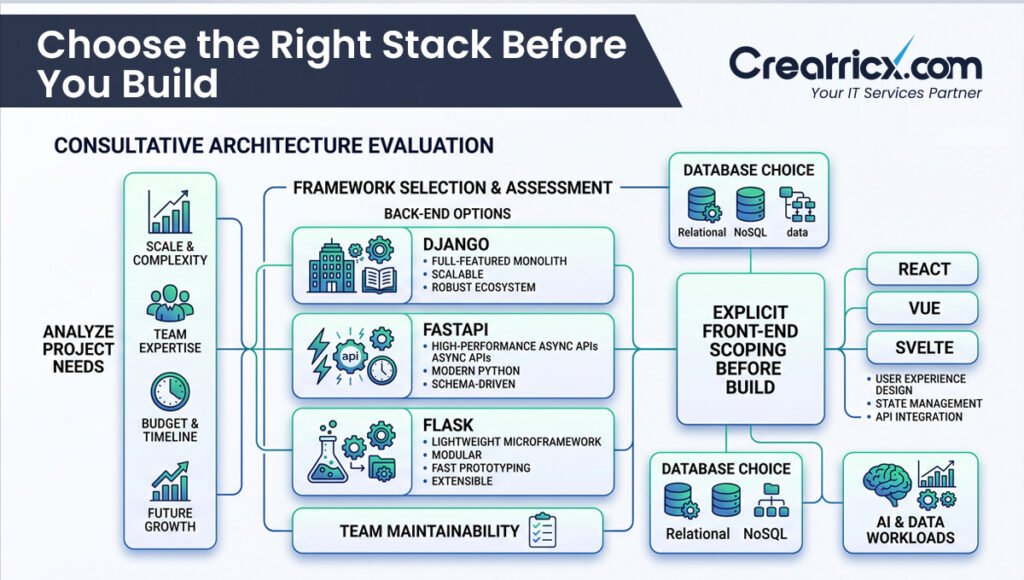
Step 1: Describe The Problem Before Naming Any Technology
Write down what the application must do and who uses it. Any conversation that opens with a language or framework has skipped the only step that determines the right answer.
Step 2: Establish Where The Complexity Actually Lives
If the difficulty sits in data, logic, integrations, or AI, Python is strongly positioned. If it sits in a rich interactive interface, the front end should drive the decision instead.
Step 3: Audit What Your Team Can Maintain
Be honest about who will maintain this in two years. A stack nobody in-house understands is a recurring cost, not a one-off decision.
Step 4: Match The Framework To The Shape Of The Work
Full application with users and admin needs suggests Django. API or model-serving backend suggests FastAPI. Ignore adoption rankings; they answer a different question than yours.
Step 5: Confirm The Front-End Plan Explicitly
Since Python does not run in the browser, agree who is building the interface and using what, before work begins rather than midway through.
How Creatricx Handles This
We take a deliberately unromantic view of language choice at Creatricx. Python is excellent for a large class of web work, particularly anything data-heavy or involving AI, and we build in it regularly. We also tell clients when it is the wrong fit, because inheriting an ill-suited stack is a cost that lands on them long after the build is finished.
Our approach is to establish what the application needs to do, where the genuine complexity sits, and what the client's own team can realistically maintain, before recommending anything. Where Python is the right answer, we scope the front-end work explicitly rather than leaving it as an assumption, since that gap is where Python projects most reliably run over budget. Where a different stack fits better, we say so, and we would encourage anyone commissioning web work to be suspicious of a provider whose recommended technology never changes regardless of the brief.
Frequently Asked Questions
Can Python be used for web development?
Yes. Python is widely used for server-side web development through frameworks such as Django, FastAPI, and Flask, and runs in production at Instagram, Spotify, and Dropbox among many others. It handles the backend; browsers still require HTML, CSS, and JavaScript for the interface.
Can Python run in a web browser?
Not in any mainstream production sense. Browsers execute JavaScript. Experimental WebAssembly-based projects allow Python to run client-side, but they are not appropriate for commercial projects in 2026.
Is Python fast enough for a production website?
For the overwhelming majority of web applications, yes. Web performance is usually dominated by database queries, external API calls, and front-end assets rather than language execution speed. Slow pages are far more often caused by missing indexes or caching than by Python.
Which Python framework should I choose?
Django for complete web applications needing admin, authentication, and an ORM; FastAPI for APIs and AI or model-serving backends; Flask mainly for existing systems. Choose based on what you are building rather than on adoption rankings.
Did FastAPI really overtake Django?
It ranked higher in the most recent JetBrains survey at 38% against Django's 35%, but our view is that this reflects an influx of AI and data developers building API endpoints, work Django was never intended for, rather than one framework outperforming another at the same task.
What changed with Python's Global Interpreter Lock?
Python 3.14 moved free-threaded builds from experimental to officially supported under PEP 779, allowing genuine multi-core parallelism within a single process. This matters most for CPU-heavy request processing, and C extensions that have not opted in will silently re-enable the lock.
Do I need a JavaScript developer as well as a Python developer?
Usually yes, at least for part of the project. Python cannot render interactive interfaces in the browser, so unless the front end is very simple, the work requires both skill sets. This should be scoped before the project starts.
When is Python the wrong choice for a web project?
Real-time applications with many persistent connections, simple brochure sites where a content platform would suffice, teams with no Python experience building something modest, and products where the interface carries most of the complexity.
Disclaimer
This article reflects framework adoption data from the most recent JetBrains Python Developers Survey, Python release information published in the official Python documentation, and Creatricx's own assessment approach, all current at the time of writing. Language and framework landscapes change; verify version-specific details against official documentation before making architectural decisions.
In Summary
Python can absolutely be used for web development, and the question is really a leftover from an era when Python was mainly a scripting and data language. What deserves more attention than the yes is the shape of the yes. Python owns the server and stops at the browser, so every Python web project is a two-language project and should be budgeted as one. The speed objection is largely a misdiagnosis, and the one place it held genuine weight has just been addressed by free-threading becoming officially supported in Python 3.14. The framework rankings that dominate discussion are measuring who writes Python now rather than which tool suits your project. And the least fashionable reason to choose Python, that your team already knows it well, remains one of the best reasons there is.