
A growing company doesn’t always need another permanent employee, sometimes it simply needs the right person for the work sitting in front of it.
A software team may need another backend developer for 6 months. A company preparing a product launch may need a UI/UX designer and QA engineer. An internal marketing department may have a solid strategy but lack the technical SEO capacity to execute it.
Staff augmentation was made for situations like this.
You bring in outside specialists on a temporary basis and add them to your existing team, rather than hiring a full-time employe or handing a whole project over to another company. They work with your people, they follow your priorities and they fill the gap in capability or capacity you currently have.
Table of Contents
What Does Staff Augmentation Mean?
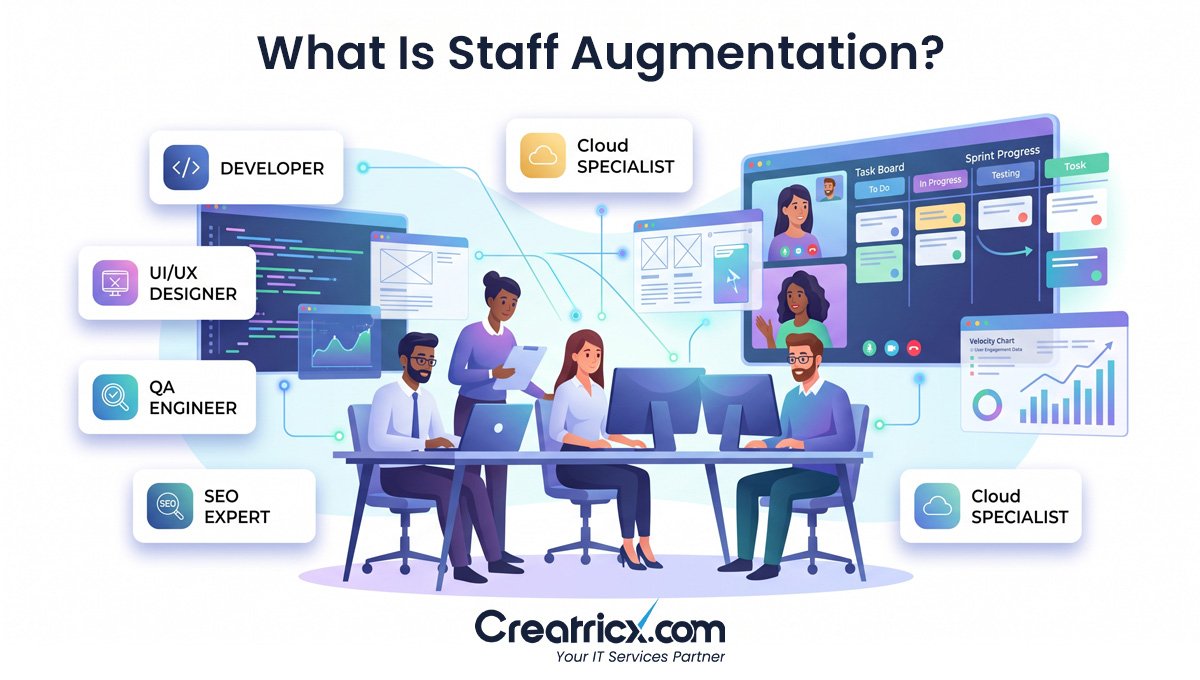
Staff augmentation is a flexible hiring model where a business adds external professionals to its team to fill a specific skill, workload, or time gap. The client normally manages the work directly, while the provider helps supply the required talent without the business having to recruit every role permanently.
The easiest way to understand it is this:
The simplest definition
You keep the team you already have. You add the people you’re missing.
That sounds simple, but the important part is who remains in control.
With staff augmentation, your company usually continues deciding what needs to be done, which tasks come first, how work is reviewed, and what success looks like. The external specialist becomes part of that working structure.
Need more technical capacity without building another permanent department? Creatricx can provide remote dedicated specialists to work together with your existing team and adjust to your project, tools, priorities and workflow.
A Simple Staff Augmentation Example
Imagine yourself, you run a SaaS (Software as a Service) company with an internal product manager, technical lead, and three developers.
You have a new mobile app on your roadmap, but no one on your current team has the mobile development experience to do it right.
You could spend months advertising, interviewing, negotiating, and hiring another permanent employee.
Or you could bring in an experienced mobile developer through staff augmentation.
Your product manager still owns the roadmap. Your technical lead still makes important architecture decisions. Your existing developers continue handling the platform. The augmented developer joins that system and contributes the missing expertise.
When the mobile project changes, grows, or finishes, the team can be adjusted again.
That flexibility is one of the model's main advantages.
But flexibility is useful only when the company understands what it actually needs.
Staff Augmentation Should Start With the Gap, Not the Job Title
Businesses often begin with something like:
“We need two developers.”
Our first question would be: why two?
Sometimes two developers are exactly what the project needs. Other times, the real problem is something different.
Perhaps development is slowing down because nobody is testing releases properly. In that case adding a QA engineer may create more progress than hiring another developer.
Maybe several developers are already working but requirements keep changing and technical decisions take too long. That may be a leadership or planning gap, not a code gap.
This distinction matters.
At Creatricx, we prefer to look at the work, existing team, bottlenecks, responsibilities, and expected outcome before deciding which roles should be added. Headcount should come after the problem is understood, not before it.
Otherwise, a company can end up with five people being very busy while the original problem remains strangely healthy.
Gap Radar
Diagnose the Constraint Before You Request the Role
Capacity Gap
The right people exist internally, but there is more work than the team can absorb.
Skill Gap
The team lacks a specific capability such as mobile, cloud, QA, SEO, data or UI/UX.
Timing Gap
The need is real now, but permanent recruitment would arrive too late.
Coverage Gap
Delivery depends too heavily on one person or one discipline, creating a bottleneck.
Quality Gap
More developers would not help because the missing capability is testing, review or specialist oversight.
Leadership Gap
Priorities, requirements or technical decisions are unclear. This is usually not a staff-augmentation problem.
| Observed Problem | Likely Added Capability | Check Before Hiring |
|---|---|---|
| Slow feature delivery | More developers only if coding capacity is actually the bottleneck | Check requirements, review queues and QA first |
| Release defects | QA / test automation specialist | Adding feature developers can make the defect queue worse |
| Cloud migration | Cloud / DevOps specialist | Often intense during migration, lighter after stabilisation |
| Mobile roadmap gap | iOS / Android / cross-platform developer | Useful when product leadership and backend ownership already exist |
| Weak product flows | UI/UX designer | Best added before development rework becomes expensive |
| Technical search backlog | SEO specialist + developer support | Needs implementation capacity, not only an audit |
| Campaign execution backlog | Digital marketing specialist | Works best when strategy, approvals and tracking are clear |
| Support volume spike | Customer support specialists | Define service standards, escalation and knowledge access first |
The Staff Augmentation Fit Gate
Before adding anyone, test whether the business is actually ready to use extra capacity. Staff augmentation performs best when the work has an owner, the product has direction and the specialist can enter a functioning review system.
Management Readiness Gate
Staff Augmentation Works Best When the Client Can Actually Manage the Added Capacity
If several answers are “no,” adding people may increase coordination faster than delivery.
Do you know the outcome?
The team can explain what the added specialist is expected to move or complete.
Is there an internal owner?
Someone can assign priorities, answer questions, review work and make decisions.
Can you provide context?
The specialist can access the product, documentation, standards and reasons behind the work.
Is the need flexible or time-bound?
The requirement changes with roadmap, workload or a specialist phase rather than representing a stable permanent role forever.
Can work be reviewed?
The team has code review, design review, QA, analytics or another meaningful quality loop.
Can you onboard quickly?
Accounts, permissions, environments, project tools and decision paths can be ready without a two-week scavenger hunt.
How Does Staff Augmentation Work?
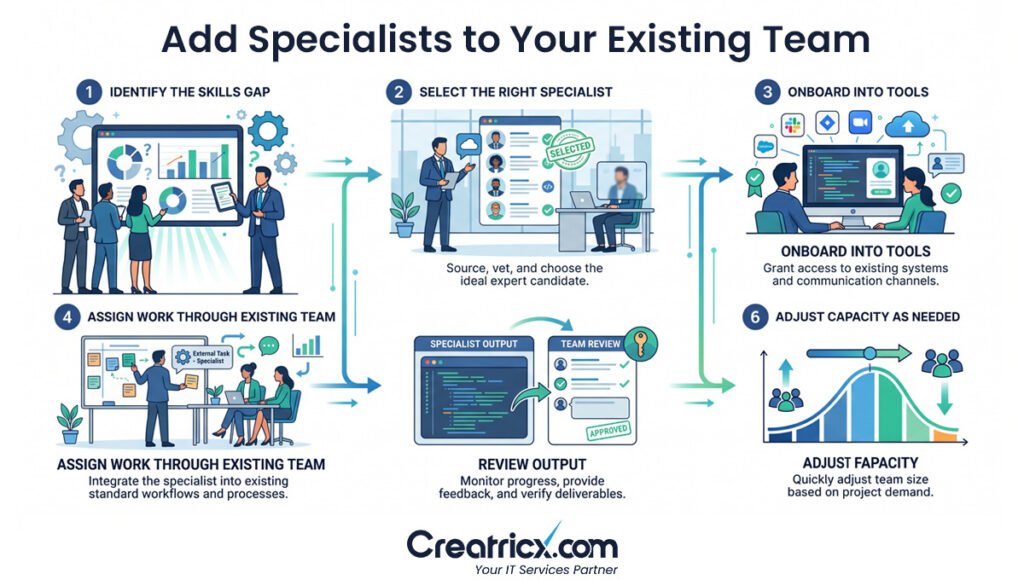
The process doesn’t need to be complicated.
First, the business defines what it is trying to accomplish and where the current team is struggling. That might mean additional development capacity, a specialist technology, temporary design support, testing, cloud expertise, SEO knowledge, or another skill.
The required professional is then selected based on the actual work rather than a generic job title.
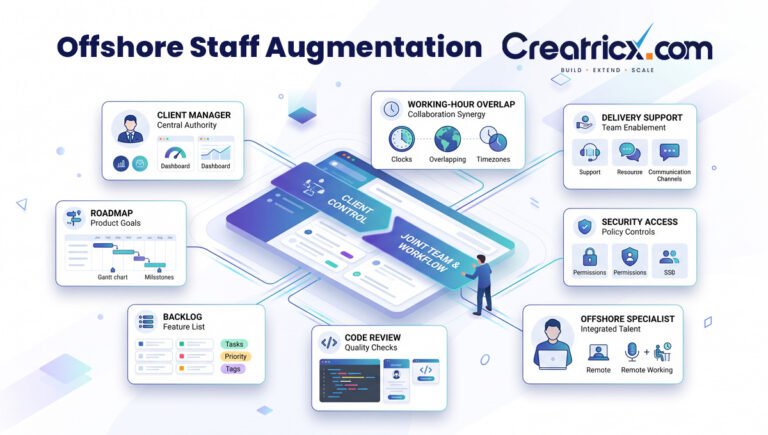
Once onboarded, the external specialist works within the client's normal delivery system. They may join meetings, use the same project-management platform, communicate through existing channels, follow internal development standards, and report to the client's manager or technical lead.
The important point is that the augmented specialist isn’t operating somewhere outside the project waiting to receive occasional instructions.
The best arrangements make them part of the working team.
Define the gap
Write down the blocked outcome, current bottleneck and what success looks like before naming a role.
Set decision rights
Name who owns priorities, architecture, approvals, quality and escalation.
Prepare access
Provision accounts, repositories, documentation, environments, analytics and project tools before day one.
Give product context
Explain users, business goals, constraints, standards and why the work matters, not only which ticket is next.
Create review loops
Use code review, design review, QA, demos, analytics or another clear mechanism to validate output.
Measure throughput
Track completed outcomes, cycle time, defects and blocked time, not how many hours someone appears green in a chat app.
Adjust capacity
Add, reduce or change specialist roles as the workload changes instead of preserving the original staffing plan out of habit.
Offboard cleanly
Transfer documentation, credentials, decisions and unfinished work so the team keeps the capability after the engagement changes.
Staff Augmentation Isn’t Traditional Project Outsourcing
These two models are frequently mixed together.
Suppose you want to build a customer portal.
With traditional project outsourcing, you might give a provider the complete requirement and ask them to plan, design, build, test, and deliver the portal.
With staff augmentation, you might already have your own project manager, designer, and technical lead. What you lack are two developers and a QA specialist.
You add those people to your team while keeping project ownership internally.
That difference affects communication, responsibility, pricing, and the amount of management required from your side.
Staff augmentation gives you capacity and expertise.
It doesn’t automatically give you a complete management system.
Staff Augmentation, Outsourcing and Managed Services Compared
| Model | Who Directs Delivery? | Best Fit | Main Trade-Off |
|---|---|---|---|
| Permanent hire | Client | Stable, long-term capability | Slowest to add; strongest internal continuity |
| Staff augmentation | Client | Skill/capacity gaps inside an existing team | Client retains day-to-day control and management |
| Project outsourcing | Provider | Defined project or outcome | Provider owns more planning and delivery |
| Managed service | Provider | Ongoing function with agreed service responsibility | Less day-to-day management for the client |
Control is the dividing line
Staff augmentation usually adds capacity to a system the client still directs. Project outsourcing and managed services transfer more delivery responsibility to the provider. Choosing the wrong model creates predictable frustration: clients expect management they did not buy, or providers take control the client intended to keep.
When Does Staff Augmentation Make Sense?
Staff augmentation works particularly well when the company already has a functioning team but needs to strengthen it.
A product company may have more features than its developers can deliver on schedule. An agency may win a larger project and require additional engineering capacity for several months. A business may need a specialist in a technology its internal team rarely uses.
It is also useful when the requirement is likely to change.
Instead of committing permanently to every skill you might need, you can build the team around the current workload and adjust it as the project develops.
This makes the model useful for product development, website projects, mobile applications, migrations, QA, UI/UX work, cloud projects, and other areas where workloads do not remain conveniently identical forever.
Human organisations, for reasons nobody has managed to correct, tend to change their plans.
When Staff Augmentation May Not Be the Best Choice
The model becomes harder to use when the business has nobody capable of managing the external specialists.
If requirements are not sure, priorities constantly conflict, nobody reviews the work, and decisions remain unresolved for weeks or even months, adding another developer will not magically create project leadership.
In that situation, the company may need a more managed delivery model where a provider takes responsibility for planning and coordinating a wider part of the work.
Before choosing staff augmentation, ask:
Do we know what needs to be done, and do we have someone who can guide the people doing it?
If the answer is yes, staff augmentation can be very effective.
If the answer is no, fix the management gap first.
The management test
If nobody can resolve priorities, review work or make decisions, the business probably needs managed delivery, stronger product leadership or process repair before it needs more people.
The Real Value Isn’t Just Lower Hiring Overhead
Staff augmentation is often promoted entirely around cost. That misses much of its value.
Permanent recruitment can make sense for stable, long-term roles. But not every capability needs to become another permanent position.
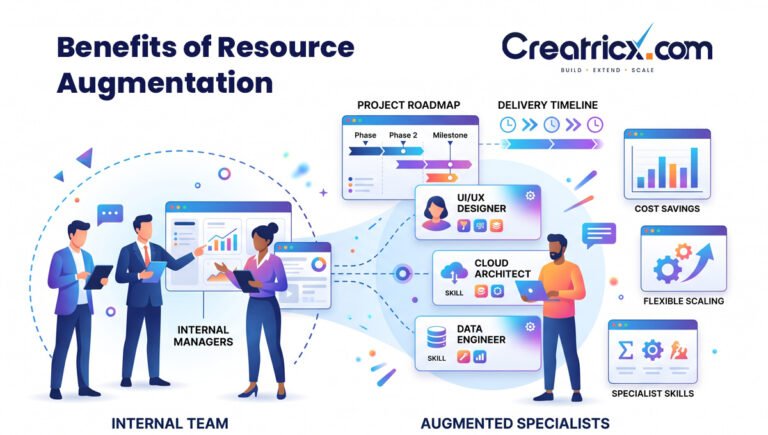
A business might need a DevOps specialist intensively during a cloud migration and only occasionally afterward. It may need several developers while building a new product version, then fewer once the product enters maintenance.
Staff augmentation allows the team structure to follow the workload more closely.
It also gives businesses access to people with specialised experience without expecting every internal employee to know every framework, platform, infrastructure system, and emerging technology.
That expectation produces some extraordinary job descriptions, usually seeking one individual with twelve professions and seven years of experience in software released three years ago.
Building or extending a technical team? Creatricx can help identify the roles you actually need and provide dedicated specialists who integrate with your existing delivery process instead of forcing your project into a fixed staffing package.
The 2026 Flexible Talent Context
2026 Flexible Talent Context
External Specialists Are Becoming More Normal, Which Makes Workforce Design More Important
Upwork’s July 2026 Future Workforce Index reports that 38% of surveyed U.S. skilled knowledge workers freelance, up from 28% a year earlier. Its SMB research also found that confident small businesses were more likely to use independent talent for specialised skills. A separate 2026 Wingspan survey of 500+ finance, HR and operations leaders reported that 84% said contractors now perform work once reserved for employees. These are platform/vendor studies rather than a census, but they point in the same direction: external talent is increasingly part of normal workforce planning.
That every contractor model is cheaper, faster or better than hiring.
That businesses need a deliberate way to decide which capabilities to build, buy or borrow.
McKinsey’s 2026 talent guidance warns against overreliance on borrowed talent for critical capabilities when that creates a fragile operating model.
The useful workforce question is therefore not “employees or contractors?” in the abstract. It is which capabilities the business should build internally, which should be added for a specific period, and which outcomes are better assigned to a provider. Upwork’s 2026 workforce research and McKinsey’s current talent framework both reinforce that workforce design is becoming more flexible, while also making governance more important.
What Makes Staff Augmentation Work Well?
The relationship works best when both sides are clear about how work will happen.
The external specialist should understand the product, priorities, responsibilities, tools, communication process, and quality expectations.
The client should know who manages the specialist, how progress is reviewed, which hours require collaboration, and where technical or project decisions are documented.
Treating augmented professionals as genuine members of the delivery team also matters.
If they receive only disconnected tickets without context, they can execute tasks but struggle to contribute useful ideas. When they understand the product and why they're doing the work they can see risks and challenge assumptions and suggest better ways of doing things.
That is when staff augmentation becomes more than temporary labour.
It becomes a useful additional capability.
The Coordination Tax
Coordination Tax
Six Ways Extra Capacity Quietly Turns Into Extra Waiting
Waiting for access
The specialist is hired but cannot open the repository, environment, analytics or design files.
Waiting for decisions
Tickets sit because the client has not decided the requirement, priority or architecture.
Relearning context
External people receive isolated tasks without product context and repeat questions the team has already answered elsewhere.
Review bottlenecks
One internal lead becomes the only person able to approve everything, so added capacity queues behind one calendar.
Missing documentation
Architecture, standards and decisions exist mostly in conversations, forcing each new person to reverse-engineer the team's habits.
Wrong success metric
Utilisation looks high while lead time, defects, missed releases or stakeholder frustration remain unchanged.
What to measure instead of utilisation
Measure blocked time, cycle time, completed outcomes, defects, handoff quality and whether the original bottleneck is shrinking. A person being busy is not the same thing as the team getting faster.
A Practical 30-Day Onboarding Plan
Before Day 1
Access and context ready
Accounts, environments, documentation, role owner, communication norms and first priorities are prepared.
Days 1-5
Learn the system
Product walkthrough, architecture, users, standards, current bottlenecks and a small first task.
Days 6-15
Contribute with review
Real work enters the normal review process while gaps in access and documentation are corrected.
Days 16-30
Measure integration
Review throughput, blocked time, quality, communication and whether the original gap is actually shrinking.
Onboarding is part of the capacity plan
A new specialist needs enough context to make safe decisions. Expecting day-one peak velocity on a complex codebase, product or campaign usually means the onboarding cost was ignored rather than eliminated.
How Creatricx Approaches Staff Augmentation
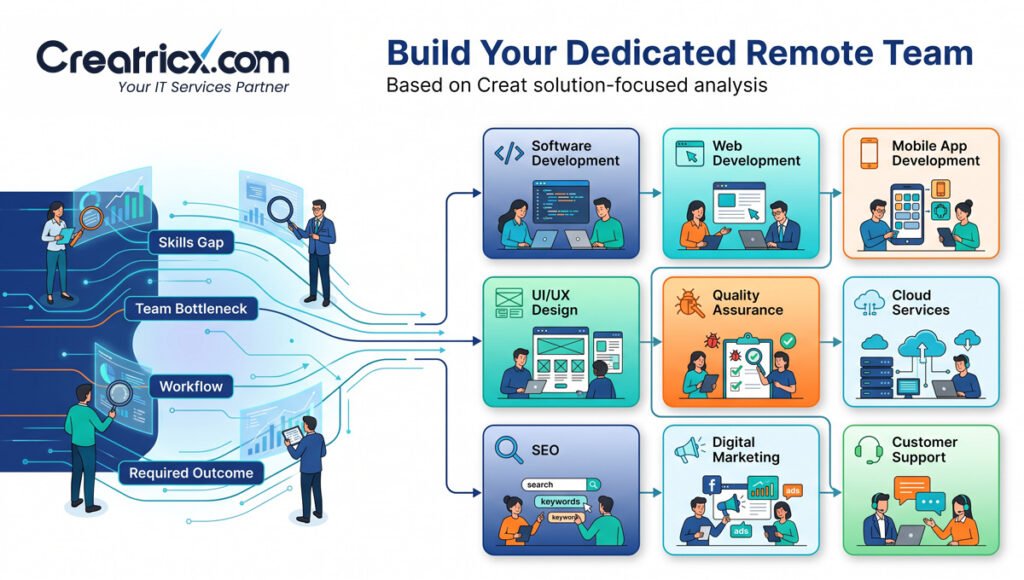
At Creatricx, we see staff augmentation as team extension rather than profile placement.
The starting point is not simply finding someone whose CV contains the correct technology names. We first look at what the client is building, what the existing team already handles well, where delivery is slowing down, and who will manage the added capacity.
From there, the team can be structured around the actual requirement.
That might mean one specialist joining an established department. It may involve several dedicated professionals working together. As the work changes, additional capability can be introduced without forcing the client to rebuild the entire team structure.
The objective is straightforward: the external specialist should make the existing team stronger, not create another layer that requires constant coordination.
Practitioner Pulse: What Team Integration Problems Look Like in the Wild
Practitioner Pulse: What Team Integration Problems Look Like in the Wild
These public forum discussions are anecdotal, not controlled evidence. They are useful because they show the operational friction that staffing brochures tend to leave out, presumably because “waiting three days for access” is a less glamorous hero section.
New engineers need context before velocity
An ExperiencedDevs discussion describes a senior engineer taking roughly two weeks just to understand a new project structure before being expected to deliver at full speed. The lesson for augmentation is obvious: onboarding time is part of capacity planning, not evidence that the specialist is failing.
Undocumented design decisions become review friction
Another ExperiencedDevs thread shows how code-review feedback becomes inefficient when the system’s design rules exist mainly in people’s heads. External specialists amplify that weakness because they have less historical context to fall back on.
Documentation and ownership reduce contractor risk
In an embedded-contracting discussion, an experienced contractor recommends frequent communication plus creating notes and documentation in the client’s own system so the knowledge remains with the business. Anecdotal, yes. Also painfully sensible.
Frequently Asked Questions on Staff Augmentation
What does staff augmentation mean?
Staff augmentation is a process of hiring outside professionals to augment your existing workforce when you need more capacity or a specific skill. Usually this means your company still runs the job, but the outside experts work side-by-side with your people.
What is the difference between staff augmentation and outsourcing?
With staff augmentation, you typically still manage the project and deal with the off-site professionals yourself. In traditional outsourcing a provider is usually responsible for delivering a larger project, service or a specific result.
When should a company use staff augmentation?
Staff augmentation is best when your internal team knows the project but you need more people, specialized expertise, or temporary help. Great for development, QA, UI/UX, cloud projects, migrations and busy times.
Is Staff Augmentation Only for Software Developers?
No. While staff augmentation is very common in software development, it can also be applied to UI/UX designers, QA engineers, cloud specialists, SEO professionals, marketers, customer support staff, and other skilled roles. It’s not about the job title, it’s about how the professional joins your team.
How long does staff augmentation last?
There is no universal duration. Some businesses add a specialist for a few months to complete a defined phase; others keep dedicated professionals for much longer. The duration should follow the workload and capability need rather than an arbitrary contract length.
Does the client have control over augmented staff?
Usually yes. In staff augmentation the client normally controls priorities, tasks, deadlines and day-to-day direction. If the company cannot provide that management, a managed service or managed development model may be a better fit.
What are the primary advantages of staff augmentation?
Among the key benefits are faster access to skills, flexibility in team size, lower overhead from permanent recruiting, and direct control of the work. It also allows a company to add specialist capability without having to hire every role permanently.
What is the biggest mistake companies make about staff augmentation?
One of the biggest mistakes is to assume that more people will automatically fix slow delivery. If the real problem is fuzzy requirements, weak leadership, missing QA, or bad communication, then adding developers may just add more coordination. Before the team is expanded, the problem should be diagnosed.
Can staff augmentation work with an in-house team?
Yes. That is actually one of its strongest uses. Augmented experts can plug into your existing workflows, tools, meetings, development standards and reporting structure . If done right, onboarding should make them an extension of the internal team rather than a separate external group.
What is staff augmentation from Creatricx?
Creatricx first analyzes the client’s project, existing team, skills gaps, responsibilities and delivery process. We then build the required remote support around the real workload and don't just offer generic profiles. Clients can retain control of their existing workflow and employ dedicated professionals for Software Development, Web, Mobile, UI/UX, QA, Cloud, SEO, Digital Marketing and other Digital Functions.
Staff Augmentation vs Managed Services: Which Option is Best for Me?
Use staff augmentation if you have the leadership and process to manage the work but need more capability. Managed services are chosen when you wish the provider to assume more responsibility for delivering a specified function, managing delivery, and meeting agreed service expectations.
How quickly should an augmented specialist become productive?
It depends on the complexity of the product and role. A specialist joining a mature codebase, regulated workflow or complex product will need onboarding time for access, architecture, users, standards and review expectations. Good teams measure the reduction in blocked time over the first weeks rather than expecting instant peak velocity.
Sources and Evidence Quality
- Upwork Future Workforce Index 2026 Survey of 2,400 U.S. skilled knowledge workers; reports the rise in skilled freelancing from 28% to 38%.
- Upwork In-Demand Skills 2026 Platform hiring data showing strong demand for human expertise alongside rapidly growing AI-enabled skills.
- Upwork SMB Reinvention Research Small-business research connecting specialized independent talent with more adaptive workforce strategies.
- McKinsey: Rewiring Talent to Value in the Age of AI Current buy/build/borrow framing and a warning against creating fragile models through overreliance on borrowed talent for critical capabilities.
- Wingspan Future of Flexible Work 2026 Vendor-sponsored survey of 500+ finance, HR and operations leaders on contractor use and workforce operations.
Final Thoughts
Staff augmentation works when a business has a real capability or capacity gap inside a team that already knows how to direct the work. Its advantage is not simply that external people can be added faster than permanent employees. The deeper value is that team shape can follow the workload instead of forcing every temporary need into a permanent job description.
The model fails when headcount is used to hide a different problem: unclear requirements, missing QA, slow decisions, weak documentation or nobody owning delivery. More people do not repair those conditions. They merely create additional places for the confusion to sit.
A strong staff-augmentation setup therefore begins with diagnosis, assigns clear decision rights, provides context and access, measures outcomes rather than activity, and adjusts capacity as the work changes. That is what turns external talent into an extension of the team rather than another vendor relationship.