
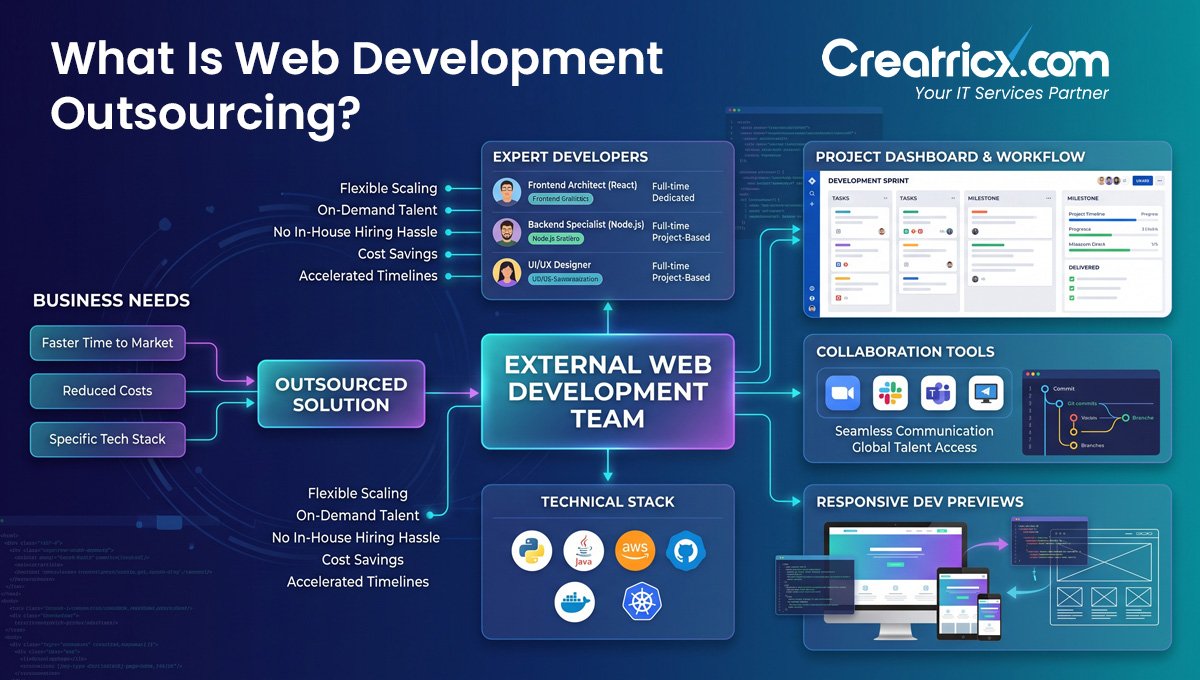
Outsourcing in web development means hiring an external developer, agency, or dedicated remote team to build, improve, or maintain a website or web application. Businesses use it when they need technical skills, faster delivery, flexible capacity, or ongoing support without hiring full-time in-house developers.
Key Takeaways
- Web development outsourcing means working with external developers, agencies, or remote teams instead of relying only on in-house staff.
- It can be used for full website builds, redesigns, e-commerce development, web apps, integrations, maintenance, speed fixes, and security improvements.
- Businesses usually outsource when they need specialist skills, faster delivery, flexible support, or lower hiring pressure.
- Outsourcing works best when the project scope, timeline, deliverables, access rights, and communication process are clear from the start.
- The right model depends on the project. A freelancer may suit small tasks, while an agency or dedicated remote team is better for larger or ongoing work.
- Good outsourcing doesn’t mean losing control. The business should still guide goals, approvals, brand direction, and customer priorities.
Table of Contents
What Does Outsourcing Mean in Web Development?
Outsourcing in web development means giving part or all of a website project to an outside specialist instead of handling everything with an internal team.
This outside support could be a freelance developer, a web development agency, or a dedicated remote development team. They may build a new website, redesign an old one, create custom features, fix technical issues, connect third-party tools, or maintain the site after launch.
Outsourcing can cover a full project from planning to launch, or it can be used for specific tasks. For example, a business may outsource only front-end development, WordPress fixes, Shopify changes, speed optimization, or API integration while keeping strategy and approvals in-house.
The main point is simple: the business gets web development skills without having to recruit, train, and manage full-time developers for every technical need. Sensible, really, which is rare enough to deserve a small plaque.
What Web Development Tasks Can Be Outsourced?
A business can outsource almost any web development task, as long as the work is clearly defined and the right team has access to the tools, files, and requirements they need. That last part matters, because “just fix the website” isn’t a project brief. It’s a cry for help.
Common outsourced web development tasks include:
- Website development: Building business websites, landing pages, service pages, blogs, and company websites.
- Front-end development: Turning designs into responsive pages using HTML, CSS, JavaScript, and modern front-end frameworks.
- Back-end development: Creating server-side features such as user accounts, databases, dashboards, admin panels, and secure data handling.
- CMS development: Customizing WordPress, Shopify, WooCommerce, Webflow, or other platforms so the website is easier to manage.
- E-commerce development: Building product pages, carts, checkout flows, payment gateways, shipping settings, and order systems.
- Custom web app development: Creating portals, booking platforms, SaaS tools, customer dashboards, internal systems, or business applications.
- API integrations: Connecting the website with CRMs, payment systems, email platforms, analytics tools, chat systems, or automation software.
- Website maintenance: Handling updates, bug fixes, backups, plugin checks, testing, and long-term technical support.
- Performance and security fixes: Improving page speed, mobile performance, Core Web Vitals, access control, form security, and technical stability.
The best tasks to outsource first are usually the ones delaying growth, creating technical risk, or taking too much time from the internal team.
5 Types of Web Development Outsourcing
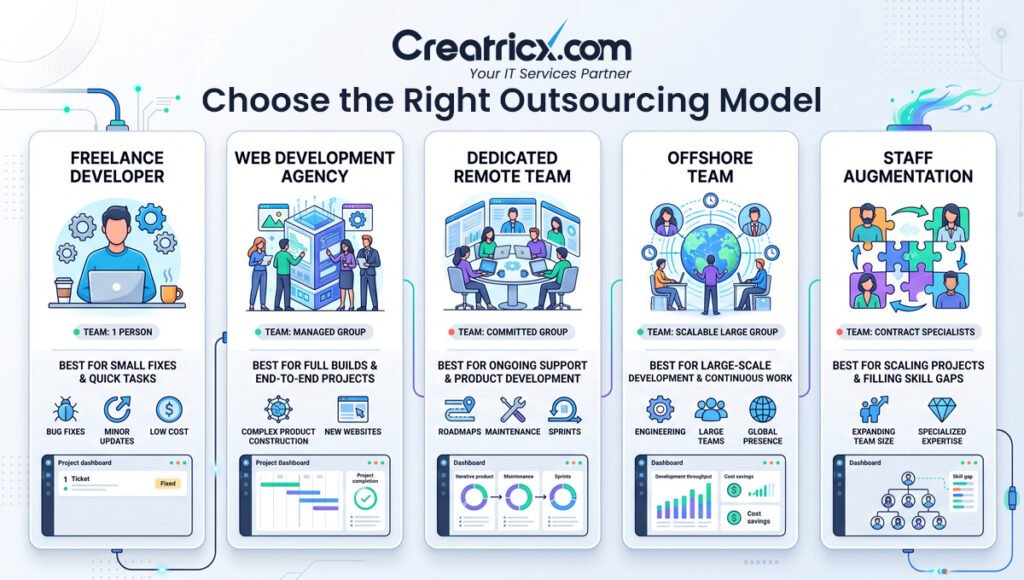
Web development outsourcing can work in different ways. The right model depends on how much work you need, how long the project will run, and how much control you want over the development process.
| Outsourcing Type | Best For | How It Works |
|---|---|---|
| Freelance developer | Small fixes, simple websites, one-off tasks | You hire an independent developer for a specific job or short project. |
| Web development agency | Full website builds, redesigns, and e-commerce projects | An agency manages planning, design support, development, testing, and launch. |
| Dedicated remote team | Ongoing development, maintenance, and scaling | You work with a regular remote team that supports your website or web app over time. |
| Offshore development team | Cost-effective development with wider talent access | You hire developers from another country, often to reduce costs or expand capacity. |
| Staff augmentation | Supporting an existing internal team | External developers join your current team to fill skill gaps or handle extra workload. |
For a small technical fix, a freelancer may be enough. For a complete website or e-commerce project, an agency is usually more structured. For long-term updates, new features, integrations, and maintenance, a dedicated remote team often makes more sense.
The model matters because outsourcing isn’t only about finding someone who can code. It’s about choosing a setup that matches the project’s risk, timeline, budget, and future support needs.
Why Do Businesses Outsource Web Development?
Businesses outsource web development when they need reliable technical support without building a full internal development department. It’s a practical choice when a website, store, or web app needs more skill, time, or capacity than the current team can provide.
The main reasons are simple:
- Access to specialist skills: A business may need front-end, back-end, CMS, e-commerce, API, performance, or security expertise that it doesn’t have internally.
- Faster project delivery: An external team can often start sooner than a new in-house hire, especially when the project has a clear scope.
- Lower hiring pressure: Recruiting, onboarding, and managing developers takes time. Outsourcing can reduce that burden when the business needs support quickly.
- Flexible capacity: Companies can increase or reduce development support based on workload instead of keeping permanent staff for occasional needs.
- Wider technical coverage: One internal developer may not cover every platform, framework, integration, or testing requirement. Because apparently websites now need to connect with every tool humanity has ever invented.
- Ongoing support: Outsourcing can cover updates, bug fixes, maintenance, landing pages, new features, and performance improvements after launch.
For many businesses, outsourcing isn’t about replacing the internal team. It’s about adding the right development capacity when the work becomes too large, too technical, or too urgent to manage alone.
When Should You Outsource Web Development?
You should outsource web development when the work needs more technical skill, time, or consistency than your current team can handle. It’s usually a good move when delaying the project costs more than bringing in outside support.
Outsourcing makes sense in situations like these:
You don’t have in-house developers
If your team doesn’t have technical staff, outsourcing gives you access to web development skills without starting a long hiring process from zero.
Your current team is overloaded
Internal teams often handle daily updates, support tasks, campaigns, and fixes already. Adding a full website build or redesign on top can slow everything down, because apparently humans still haven’t solved the problem of having finite hours.
You need specialist skills
Some projects need skills your team may not have, such as custom WordPress development, Shopify work, back-end systems, API integrations, web app development, speed optimization, or technical security fixes.
You’re launching something new
A new business website, e-commerce store, portal, SaaS platform, or web application often needs structured planning, development, testing, and launch support.
Your website is holding back growth
If the site is slow, outdated, hard to update, poorly structured, or difficult for users to navigate, outsourced developers can help rebuild or improve the technical foundation.
You need long-term support
Outsourcing is also useful when your website needs regular updates, new landing pages, maintenance, integrations, bug fixes, and performance improvements, but not enough work to justify hiring a full internal team.
The best time to outsource is before technical problems start damaging sales, leads, user experience, or internal productivity. Waiting until everything breaks is an option, technically. Just not a smart one.
Outsourcing vs In-House Web Development
The choice between outsourcing and hiring in-house depends on how often you need development work, how much control you want, and whether the workload justifies a permanent team.
| Area | In-House Web Development | Outsourced Web Development |
|---|---|---|
| Best fit | Businesses with constant daily development needs | Businesses with projects, updates, or specialist tasks |
| Team control | More direct control over priorities and daily work | Control depends on scope, communication, and reporting |
| Skill range | Limited to the people you hire | Can access different developers, designers, testers, and technical specialists |
| Setup time | Hiring and onboarding can take longer | Work can start faster if scope and access are ready |
| Cost structure | Salaries, benefits, tools, training, and management | Project-based, hourly, monthly, or dedicated team pricing |
| Scalability | Scaling means hiring more people | Support can increase or decrease based on workload |
| Long-term value | Strong when development is central to daily operations | Strong when flexibility and specialist support matter more |
In-house development is useful when the website or platform needs constant product work every day. Outsourcing is usually better when the business needs expert support for a build, redesign, integration, maintenance plan, or scaling phase without creating a full internal department.
For many companies, the practical answer is a hybrid setup. Keep strategy, ownership, approvals, and product knowledge inside the business, then outsource specialist development work when the internal team needs extra capacity. Astonishingly, not every problem requires hiring five people and buying everyone a project management subscription.
7 Risks of Outsourcing Web Development
Outsourcing web development can work well, but it isn’t risk-free. The problems usually start when the project is vague, access is uncontrolled, or nobody agrees on what “done” actually means. A classic human tradition: avoid clarity, then act surprised.
Common risks include:
- Unclear project scope: If the features, pages, integrations, and deliverables aren’t defined early, the project can stretch, cost more, or produce something nobody fully wanted.
- Poor communication: Slow replies, unclear feedback, missing updates, and scattered messages can delay progress and create avoidable mistakes.
- Hidden costs: Extra revisions, plugin licences, hosting upgrades, third-party tools, urgent fixes, and post-launch support can increase the final cost if they aren’t discussed upfront.
- Weak quality control: A website may look finished but still have broken forms, slow pages, mobile issues, missing redirects, or messy code behind the scenes.
- Time-zone delays: Offshore or remote teams can work well, but without agreed overlap hours, simple questions can take too long to resolve.
- Security and access issues: Developers may need access to hosting, CMS, databases, analytics, or code repositories. That access should be controlled, documented, and removed when no longer needed.
- IP ownership confusion: Contracts should clearly state who owns the code, design files, content, assets, and final website after the project ends.
Most outsourcing risks can be reduced before the project starts. Clear scope, written agreements, access rules, regular updates, testing, and ownership terms make the difference between a useful development partnership and a technical mess wearing a project timeline.
Web Development Outsourcing Statistics Worth Knowing
Outsourcing is no longer limited to small technical fixes or back-office support. It has become a major part of how companies access technology skills, manage workloads, and scale digital operations.
Statista projects worldwide IT outsourcing revenue to reach US$634.18 billion in 2026, with growth expected to continue after that. This matters for web development because website builds, web apps, e-commerce platforms, cloud systems, integrations, and maintenance all sit within the wider IT outsourcing market.
Grand View Research estimated the global IT services outsourcing market at US$744.62 billion in 2024 and expected it to reach US$807.91 billion in 2025. The same source projects the market to grow at a compound annual growth rate of 8.6% from 2025 to 2030.
Deloitte’s 2024 Global Outsourcing Survey found that 80% of executives planned to maintain or increase investment in third-party outsourcing, while 50% used outsourced services for front-office capabilities such as sales, marketing, and R&D. This shows outsourcing is increasingly used for growth, flexibility, and specialist support, not only cost reduction.
Gartner predicted in 2025 that by 2028, 90% of enterprise software engineers will use AI code assistants, up from less than 14% in early 2024. For businesses outsourcing web development, this makes quality control, testing, architecture review, and human oversight even more important. AI can support developers, but it doesn’t replace clear scope, secure access, code review, and business understanding.
These statistics don’t mean every business should outsource web development blindly. They show that outsourcing is common because companies need faster access to skills, flexible capacity, and reliable technical support. The right decision still depends on project scope, budget, communication, security needs, and whether the external team can deliver the work properly.
How to Outsource Web Development Safely
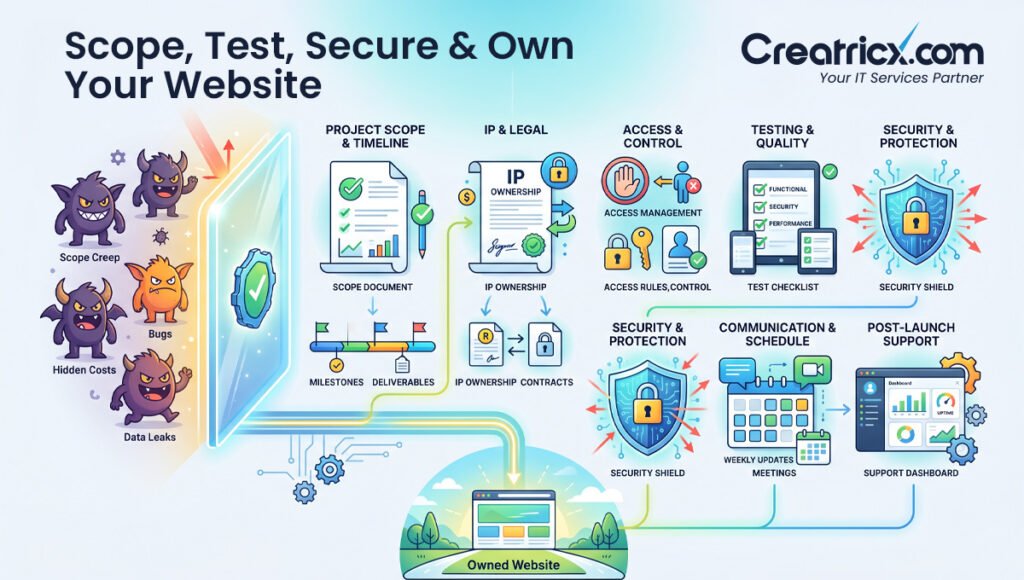
Outsourcing web development works best when the process is controlled from the start. The goal isn’t just to find someone who can build a website. The goal is to protect your time, budget, data, access, and final ownership.
Use these steps before and during the project:
- Define the scope clearly: List the pages, features, integrations, forms, user roles, payment flows, CMS needs, and technical requirements before work begins.
- Check relevant experience: Review similar websites, e-commerce stores, web apps, or platform projects the team has built. A nice portfolio is useful, but relevant project experience matters more.
- Agree on deliverables and milestones: Break the project into stages such as discovery, design review, development, testing, revisions, launch, and post-launch support.
- Confirm ownership in writing: Make sure the contract explains who owns the code, design files, content, assets, domains, hosting access, and final website after payment.
- Control access properly: Give developers only the access they need. Use separate accounts where possible, avoid sharing master passwords, and remove access after the project ends.
- Set communication rules: Agree on update frequency, meeting times, feedback channels, response expectations, and who approves changes. Otherwise, everyone gets to enjoy the classic sport of chasing messages across five apps.
- Test before launch: Check mobile layouts, forms, checkout, page speed, broken links, tracking, redirects, browser compatibility, and admin functions before the site goes live.
- Plan support after launch: Decide who handles bug fixes, updates, maintenance, backups, security checks, and future improvements once the website is live.
Safe outsourcing comes down to clarity. When the scope, access, ownership, testing, and support process are clear, the project is much less likely to become a technical mess with a launch date attached.
How Much Does Web Development Outsourcing Cost?
Web development outsourcing cost depends on the project size, technical complexity, team location, platform, timeline, integrations, and post-launch support. A small website update costs far less than a custom e-commerce store, SaaS platform, or web application with user accounts and payment systems.
Agency Benchmark
Clutch’s June 2026 web development pricing guide says many listed web development agencies charge $25–$49 per hour, and many web development projects on its platform cost under $10,000. That gives a useful starting point, but it shouldn’t be treated as a fixed quote for every project.
Freelancer Benchmark
Upwork’s 2026 web developer hiring page says freelance web developers on its platform typically charge $15–$50 per hour, depending on experience, skill level, and project scope. Freelancers may be cost-effective for smaller tasks, but larger business websites often need wider support across planning, development, testing, SEO basics, security, and maintenance.
As a practical guide:
- Small fixes or simple updates usually cost less because the scope is limited.
- Business websites cost more when they need custom layouts, CMS setup, forms, tracking, and responsive development.
- E-commerce websites cost more because product pages, carts, checkout, payments, shipping, taxes, and inventory features add complexity.
- Custom web applications usually cost the most because they may need dashboards, databases, user roles, APIs, security rules, and ongoing development.
- Maintenance plans are usually priced monthly or hourly, depending on updates, monitoring, fixes, backups, and support needs.
The cheapest option isn’t always the best one. A low quote can become expensive if the work needs to be rebuilt, security is weak, or the website launches with broken forms, slow pages, and missing tracking. Tiny detail, but businesses usually prefer websites that work after payment.
FAQs About Outsourcing in Web Development
What is outsourcing in web development?
Outsourcing in web development means hiring an external developer, agency, or dedicated remote team to build, improve, or maintain a website or web application. It helps businesses access technical skills without hiring full-time developers for every project.
Is outsourcing web development a good idea?
Yes, outsourcing can be a good idea when your business needs specialist skills, faster delivery, flexible support, or ongoing maintenance. It works best when the scope, timeline, communication process, ownership terms, and testing steps are clear from the start.
What web development tasks can be outsourced?
Businesses can outsource website development, front-end development, back-end development, CMS work, e-commerce development, web app development, API integrations, speed optimization, security fixes, bug fixes, and website maintenance.
Is outsourcing cheaper than hiring developers?
Outsourcing can be more cost-effective than hiring in-house developers, especially for short-term projects or mixed technical needs. But the cheapest option isn’t always the safest. Poor work can lead to rebuilds, delays, security risks, and extra support costs. Lovely little trap, really.
What’s the difference between outsourcing and hiring a freelancer?
Hiring a freelancer usually means working with one independent professional for a task or project. Outsourcing can be broader and may involve an agency, offshore team, or dedicated remote team with developers, designers, testers, project managers, and support staff.
How do I choose a web development outsourcing company?
Choose a company with relevant project experience, clear communication, transparent pricing, defined deliverables, testing processes, security awareness, and post-launch support. Also check who owns the code, design files, hosting access, and final website after the project ends.
Can I outsource website maintenance?
Yes, website maintenance is commonly outsourced. This can include updates, backups, bug fixes, plugin checks, security monitoring, speed improvements, form testing, landing page updates, and technical support after launch.
Who owns the website code after outsourcing?
Ownership depends on the contract. Before starting, the agreement should clearly state who owns the website code, design files, content, assets, domain, hosting access, and any custom features after payment. Don’t leave this vague unless you enjoy legal fog.
Final Thoughts
Outsourcing in web development is a practical way for businesses to access technical skills without building a full internal development team. It can help with website builds, redesigns, e-commerce projects, web applications, integrations, maintenance, and long-term support.
The best results come from clear planning. Businesses should define the scope, choose the right outsourcing model, protect access, confirm ownership, test properly, and keep business goals in-house while the external team handles technical execution.
Outsourcing isn’t about losing control. Done properly, it gives your business extra development capacity, specialist skills, and a more flexible way to build and improve digital products.