

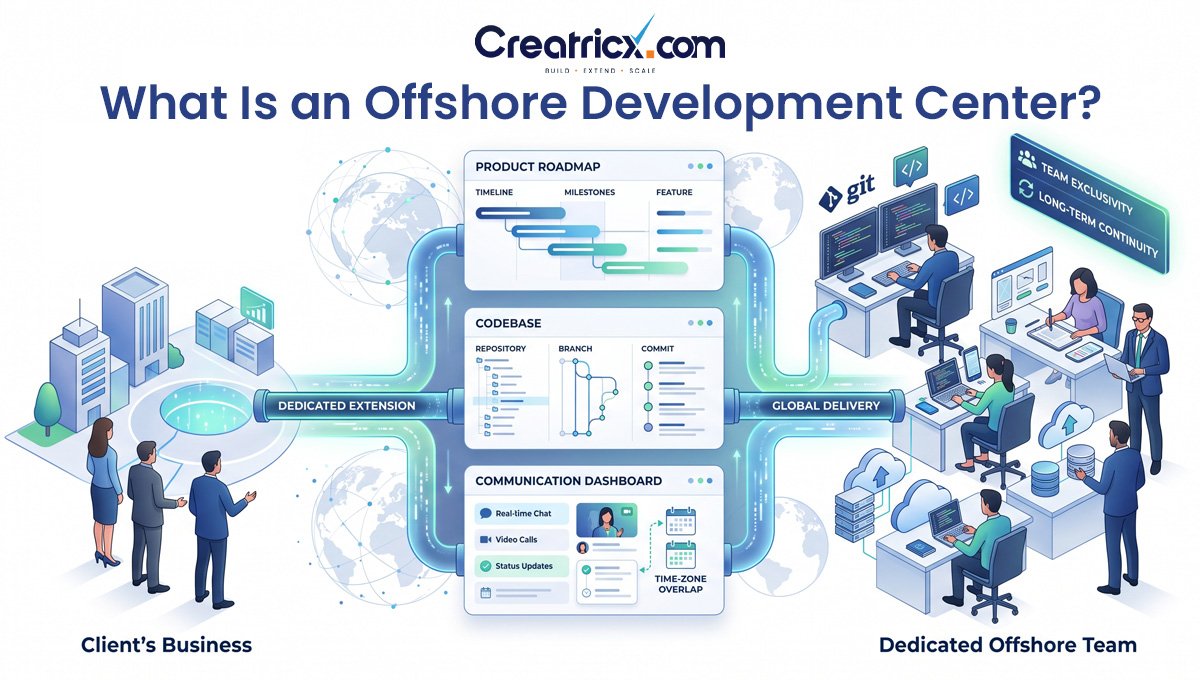
What Is an Offshore Development Center?
An Offshore Development Center (ODC) is a dedicated offshore team or operating unit built for one business to provide long-term technology capacity. The client usually keeps strategic direction and product priorities, while the ODC structure provides dedicated people, processes, infrastructure and operational support in another country. Unlike ordinary project outsourcing, the goal is continuity: a team that learns the product and remains part of the delivery system.
The phrase sounds more complicated than the underlying idea. An ODC is what happens when a company decides that occasional contractors or isolated outsourced projects are no longer enough, but opening and operating a complete overseas subsidiary would be unnecessarily heavy.
It sits between those extremes. The company builds a stable offshore capability around its own roadmap, while some or all of the local operating burden can be handled by a specialist partner.
That distinction matters because an ODC is not defined by the country, the building, or the number of developers sitting in it. It is defined by dedication, continuity, governance and operating responsibility.
Table of Contents
The Fastest Way to Understand an ODC
Start with one question: who owns the delivery system?
In a classic outsourced project, a business gives a provider a defined scope and expects a result. The provider typically decides how to organize the delivery team and carries more responsibility for producing the agreed output.
In an ODC, the business is building long-term capability instead. The offshore team becomes part of the company's continuing delivery structure. The client may keep product ownership, architecture standards, priorities and acceptance decisions, while the ODC partner handles the operating machinery needed to keep the offshore unit functioning.
The One-Line Model Test
Are You Buying an Outcome, a Team, or an Overseas Company?
Outsourcing
Buy an outcome
A provider owns more of the project delivery and organizes the team around a defined scope.
ODC
Build a team
A dedicated offshore unit accumulates product knowledge and operates as persistent capacity around your roadmap.
GCC / Captive
Build an overseas company
The enterprise creates or owns the offshore entity and carries the legal, employment and operating structure itself.
ODC vs Outsourcing vs GCC
Model Selector
The Label Matters Less Than the Responsibility Boundary
| Decision factor | ODC | Project outsourcing | GCC / captive center |
|---|---|---|---|
| What you are building | Long-term dedicated capability | Defined deliverable or service | Owned offshore organization |
| Strategic direction | Usually client-led | Shared or provider-led inside scope | Client-owned entity |
| Team continuity | Core design goal | Depends on project/provider | Core design goal |
| Local operating burden | Can be shared with ODC partner | Mostly provider | Mostly client |
| Setup complexity | Moderate | Low to moderate | High |
| Best fit | Ongoing roadmap and scalable team | Bounded outcome | Large strategic offshore footprint |
These are operating-model distinctions, not universal legal definitions. Contracts can move responsibility in either direction, so always read the governance and ownership terms rather than trusting the label on the proposal.
This is also why an ODC should not be confused with staff augmentation. Staff augmentation usually adds individual specialists to an existing team. An ODC creates a broader offshore operating unit that may include leadership, QA, DevOps, product support, infrastructure and continuity processes around those people.
What Actually Sits Inside an Offshore Development Center?
An ODC is not simply a group of developers with a different time zone. A mature center combines talent with the systems required to keep that talent useful over time.
ODC Architecture
Think in Layers: People, Delivery, Control, Continuity
Dedicated roles
Developers, QA, UI/UX, DevOps, cloud, data, AI, technical leadership and other roles matched to the roadmap.
One working system
Backlog, repositories, environments, review standards, testing, release routines, documentation and escalation.
Clear governance
Roadmap authority, technical decision rights, access permissions, security requirements, performance review and reporting.
Operational resilience
Recruitment pipeline, onboarding, HR coordination, retention, replacements, knowledge transfer and scaling plans.
Creatricx's current ODC model follows this layered approach. Its ODC service can combine engineering, mobile, product and UI/UX, QA, DevOps and cloud, AI and data, growth, and customer or operational support under one governance structure.
That cross-functional structure matters because products rarely fail along job-description boundaries. A web platform can require development, UI/UX, QA, infrastructure and cloud support in the same release cycle. An ODC can keep those capabilities connected instead of making the client assemble a new vendor chain every time the work changes.
Why Companies Build ODCs in 2026
Cost is still part of the case for offshoring, but treating an ODC as a labour-discount mechanism is increasingly incomplete.
India's capability-center ecosystem illustrates the shift. NASSCOM community reporting describes more than 1,700 GCCs in India, with the model moving beyond basic cost arbitrage toward product ownership, AI, cloud, cybersecurity and other strategic capabilities. That is not proof that every company needs a captive center. It does show that offshore delivery has matured into a long-term capability strategy rather than a temporary cost trick.
For a growing company, an ODC can solve four different constraints at once:
Talent depth
Access roles that are hard to build locally
Specialist engineering, QA, cloud, mobile, data and AI capacity can be assembled around the product rather than one local hiring market.
Continuity
Keep product knowledge inside a stable unit
Long-lived teams learn architecture, customers, business rules and release history in ways short project rotations rarely can.
Scale
Add capability without rebuilding the operating model
Once governance, security and onboarding work, the center can add roles or delivery pods more deliberately.
Operating leverage
Share the offshore setup burden
A managed ODC can absorb recruitment, HR coordination, infrastructure and continuity work that would otherwise require a local entity and operating team.
AI changed the skill mix, not the need for engineering judgment
AI-assisted development can accelerate coding, documentation and testing, but it also increases the value of architecture, review, security, product reasoning and accountability. An ODC built around cheap code production alone is therefore solving yesterday's problem. The stronger model is a team that can use modern tooling while still owning engineering decisions and verification.
What Does an ODC Really Cost?
There is no credible universal monthly price for an ODC because the number changes with country, role mix, seniority, team size, office model, compliance requirements, security controls, management structure and provider margin.
That is precisely why comparing a single offshore salary with a single US salary is a poor business case.
Current commercial market guides put Indian offshore developer billing across a wide range, from lower-cost junior capacity to much higher senior, architecture and specialist rates. The useful planning principle is not to memorize one rate. It is to model total cost of useful delivery.
Several current offshore cost analyses suggest stress-testing the final landed cost at roughly 1.4× to 1.8× the headline labour rate once management, ramp-up, rework, tooling and other overhead are included. Some ODC analyses model high-overhead environments closer to 1.8× to 2.5×. Those are planning ranges, not accounting standards, but they are a useful antidote to pretending the rate card is the whole budget.
The ODC Cost Iceberg
Total Cost Control Room
The Rate Card Is the Visible Part. Delivery Economics Live Underneath It.
VISIBLE COST
People / provider fee
Salary, monthly resource fee or hourly billing. Easy to compare, therefore dangerously easy to overvalue.
RAMP COST
Context before velocity
Product learning, architecture, local setup, access, domain knowledge and review calibration all consume paid time.
FRICTION COST
Management and rework
Slow decisions, vague requirements, review queues and misunderstood scope can erase a cheap rate faster than procurement would like to admit.
CONTROL COST
Security and compliance
Contracts, payroll, data protection, access controls, devices, audit requirements and employment compliance need real ownership.
CONTINUITY COST
Attrition and replacement
A departure is not just another recruitment task. It reopens onboarding, review and knowledge-transfer costs.
PLATFORM COST
Tools and infrastructure
Secure environments, licences, hardware, connectivity, monitoring and collaboration systems are recurring operating lines.
The right comparison is therefore loaded cost against loaded cost. Compare the total cost of the offshore operating model with the total cost of recruiting, employing, equipping and retaining equivalent capability in the market where you would otherwise hire.
That calculation may still favour offshore significantly. The point is simply to make the saving real instead of manufacturing it by leaving half the expenses outside the spreadsheet.
India's Labour Codes Changed the 2026 Cost Model
Any 2026 ODC guide that discusses India using a pre-2025 payroll model is already behind the regulatory environment.
India's four Labour Codes came into effect on 21 November 2025, according to the Ministry of Labour & Employment and the Press Information Bureau. For ODC buyers, the Code on Wages matters because its wage definition can change the compensation components used for statutory calculations.
2026 Regulation Watch
The “50% Wage Rule” Is More Nuanced Than a Salary-Split Shortcut
Under the Code on Wages definition, specified remuneration components can be excluded from “wages,” but when those exclusions exceed the statutory 50% threshold, the excess is added back for the wage calculation. Ministry FAQs published in 2026 clarify how items such as overtime and certain statutory components are treated.
Practical implication: do not model an India ODC using old salary structures or reduce the rule to “basic salary must always equal exactly 50%.” Have payroll and legal professionals calculate the current treatment for the actual employment structure and state involved.
For a managed ODC, this is one of the operational reasons to care about the provider rather than only the team. Regulation changes underneath the engagement. Someone has to update payroll, contracts, policies and compliance processes without turning every change into a client-side research project.
Official references: Ministry of Labour & Employment Labour Codes and the February 2026 PIB implementation update.
The Continuity Problem: Attrition Is a Delivery Risk
When an engineer leaves an ODC, the damage is not measured only by recruitment cost. Product context leaves too.
The replacement has to learn the architecture, business rules, decisions, exceptions, deployment habits and the peculiar little corners of the product that were never important enough to document until the person who understood them resigned.
That makes retention and knowledge design financial controls, not HR decoration.
Continuity Moat
Design the Center So One Resignation Does Not Reboot the Product
Architecture and product decisions need a durable home outside chat history.
Critical systems should have review or backup knowledge beyond one engineer.
Ask providers about tenure, replacement process, handover rules and retention support rather than accepting a vague promise of “low attrition.”
Scaling and replacement are easier when the provider is continuously active in the relevant talent market.
Time Zones Can Create a Relay or a Queue
The same time-zone difference can either extend the working day or add a 24-hour delay to every question.
The difference is not geography. It is workflow design.
A useful ODC identifies which decisions require live overlap and which work can move asynchronously. Architecture discussions, blockers, release decisions and ambiguous requirements often benefit from real-time contact. Routine development, testing, documentation and prepared handoffs can continue without forcing everyone into the same workday.
Follow-the-Sun Relay
Use Overlap for Decisions. Use Handoffs for Progress.
| Activity | Best mode | What must be visible |
|---|---|---|
| Architecture / major trade-off | Live overlap | Options, constraints, decision owner |
| Blocked requirement | Live escalation | Exact question and business impact |
| Feature implementation | Async-friendly | Acceptance criteria, branch, tests |
| Code review | Mixed | PR context, reviewer ownership, response window |
| Daily handoff | Async | Current state, blocker, review request, next action |
| Release / incident | Live when risk is high | Owner, severity, rollback, communication route |
The ODC Readiness Index
An ODC is not automatically the next step just because the company has a large backlog. Before building one, test whether the organization can actually absorb a persistent offshore team.
ODC Readiness Index
Score the Operating System Before You Add the Offshore Headcount
Do you have at least several months of ongoing work that benefits from accumulated context?
Can someone decide what matters first and resolve contradictory requirements?
Can architecture, security and engineering standards be approved quickly?
Will code, QA and acceptance work move without one senior person becoming the permanent queue?
Are repository, staging, VPN, cloud and data permissions designed rather than improvised on day one?
Are you prepared to integrate the center into planning and decisions instead of treating it as a remote ticket factory?
If several answers are “no,” more people may amplify the existing bottleneck. Repair the operating model first, or choose a project / managed-service structure where the provider owns more of the delivery problem.
A Practical 90-Day ODC Launch Map
A serious ODC launch should feel less like a bulk hiring campaign and more like standing up a new delivery capability.
Days 0–15
Design the operating model
Define roles, reporting lines, roadmap ownership, security, working hours, environments, metrics and the first delivery pod.
Days 16–35
Recruit and prepare
Assess named candidates, prepare devices and access, establish HR processes, document architecture and select bounded first work.
Days 36–60
Run the real workflow
Move production-shaped work through planning, development, review, QA and release. Record every recurring blocker.
Days 61–90
Stabilize before scaling
Review blocked time, review latency, defects, knowledge gaps, communication and whether the original capacity problem is actually shrinking.
Common ODC Failure Modes
Most failed offshore centers are not destroyed by one dramatic event. They decay through small operating mistakes that compound quietly.
Buying the center on rate alone
A low rate can coexist with slow reviews, weak retention, poor security and expensive rework. Procurement saved money on the wrong variable.
Treating the ODC as a ticket factory
If the offshore unit receives tasks but no product context, it can execute efficiently while still building the wrong thing.
One reviewer becomes the border crossing
If every PR, access request and decision waits for one onshore lead, the team has designed a queue and then blamed the timezone.
Scaling before the first pod works
Headcount increases the cost of broken onboarding and broken review systems. Stabilize the flow before adding more people to it.
No exit or knowledge-transfer plan
A center that cannot hand over documentation, access, ownership and product context creates dependency rather than capability.
Assuming the provider owns every risk
Managed does not mean magical. Product decisions, acceptance, data responsibilities and governance still need named owners on both sides.
How Creatricx Runs a Managed ODC
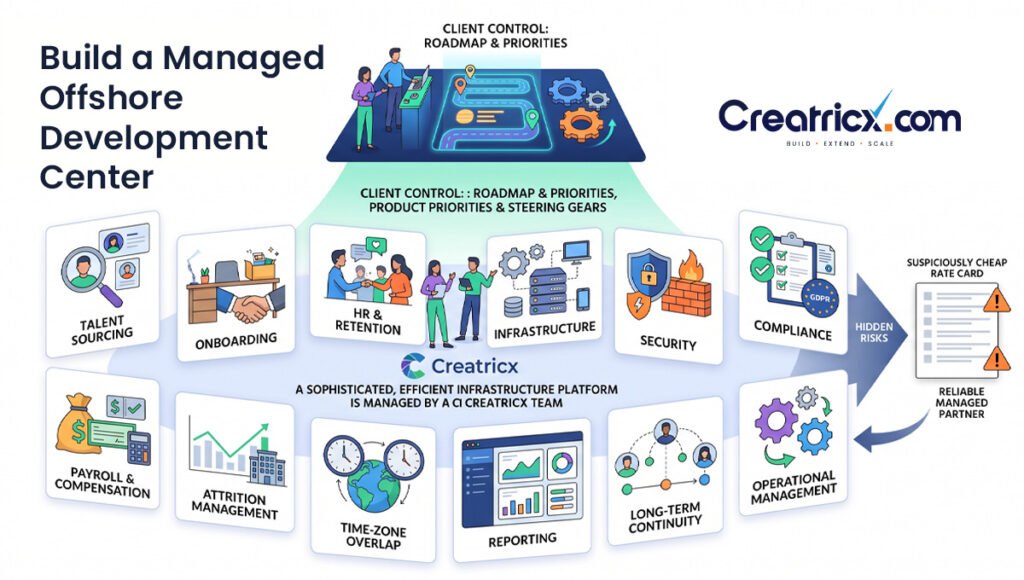
Creatricx positions its Offshore Development Center service for businesses that need a stable, scalable offshore capability without creating and operating every part of the overseas structure themselves.
The model can support team architecture, recruitment and onboarding, leadership and governance, infrastructure and security coordination, HR continuity, reporting, and scaling. The client retains strategic direction and product priorities, while the operating responsibilities are agreed during ODC design.
Responsibility Matrix
Separate Strategic Direction From the Operating Burden
| Area | Typical client ownership | Creatricx / shared support |
|---|---|---|
| Business roadmap | Goals, priorities, commercial decisions | Delivery implications and team planning |
| Team architecture | Required capability and internal interfaces | Role mix, seniority and pod design |
| Recruitment | Interview / approval where agreed | Sourcing, assessment and onboarding coordination |
| Technology standards | Architecture and product constraints | Engineering execution within agreed standards |
| Infrastructure & access | Client systems and data permissions | Devices, workspace / tooling coordination and access-process support |
| HR & continuity | Performance input and role expectations | Attendance, local HR coordination, retention and replacement planning |
| Scaling | Budget and roadmap decision | Recruitment pipeline, pod expansion and operating support |
The center can include web engineering, mobile development, QA, product and UI/UX, DevOps and cloud, AI and data, plus adjacent growth or support capabilities where the operating model requires them.
The important part is not the number of services in the catalog. It is whether the center is designed around one actual business roadmap instead of assembled as a collection of unrelated remote job titles.
Frequently Asked Questions
What is an Offshore Development Center (ODC)?
An Offshore Development Center is a dedicated offshore team or operating unit built for one business to provide long-term technology capacity. The client usually retains strategic direction and product priorities, while the ODC model provides dedicated people, delivery processes, infrastructure and operational support in another country.
What is the difference between an ODC and outsourcing?
Project outsourcing usually means buying a defined outcome from a provider that owns more of the delivery method. An ODC builds persistent capability around the client’s roadmap. The dedicated team stays longer, accumulates product knowledge and becomes part of the ongoing delivery system.
What is the difference between an ODC and a GCC?
An ODC can be operated through a service partner and does not necessarily require the client to own a separate overseas legal entity. A GCC or captive center is typically a more fully owned offshore operation established by the enterprise itself. The exact terminology varies by market and contract.
How much does an Offshore Development Center cost?
There is no universal ODC price. Cost depends on country, seniority, role mix, team size, security, infrastructure, management and compliance. Buyers should compare total loaded cost rather than the labour rate alone and budget for onboarding, management, rework, tooling, continuity and regulatory overhead.
What are the hidden costs of an ODC?
Common hidden or under-modelled costs include onboarding and ramp-up, client management time, rework, attrition and replacement, legal and payroll compliance, security controls, devices, software licences, infrastructure, travel and knowledge transfer.
How do India's Labour Codes affect ODCs in 2026?
India's four Labour Codes took effect on 21 November 2025. The Code on Wages changes how wages are defined for statutory purposes, including a 50% threshold for certain excluded remuneration components. Businesses should use current payroll and legal advice rather than older compensation assumptions.
Is an ODC only for software developers?
No. An ODC can include software engineers, mobile developers, QA, DevOps, cloud, data, AI, UI/UX, product, technical leadership and other digital or operational specialists depending on the roadmap and governance model.
When is an ODC a bad fit?
An ODC is usually a poor fit for a small one-off project, a requirement that needs an immediate finished outcome with no long-term team need, or an organization that cannot provide product ownership, access, review and management attention. Project outsourcing or a managed service may fit those cases better.
How quickly should an ODC become productive?
There is no universal ramp-up period. Productivity depends on codebase complexity, domain knowledge, documentation, access readiness and review speed. Early progress is better measured by decreasing blockers, faster review, growing product understanding and reliable delivery rather than expecting full velocity in the first week.
Does Creatricx set up managed Offshore Development Centers?
Yes. Creatricx provides an Offshore Development Center model that can support team design, recruitment, onboarding, leadership, HR coordination, infrastructure, access controls, reporting, continuity and scaling while the client retains strategic direction over its roadmap and priorities.
Sources and Evidence Quality
- India Ministry of Labour & Employment — Labour CodesPrimary government source for the Code on Wages, implementation documents, 2026 rules and official FAQs.
- Press Information Bureau — Labour Codes implementationGovernment confirmation that the four Labour Codes took effect on 21 November 2025.
- NASSCOM Community — India's GCC landscapeIndustry context for India's 1,700+ GCC ecosystem and the shift from cost arbitrage toward strategic capability.
- Creatricx — Offshore Development CenterCurrent Creatricx service positioning, operating components, role categories and ODC-vs-other-model guidance.
- Hitek — Offshore Software Development 2026Commercial practitioner source used only for a planning view of loaded-cost multipliers and hidden-cost categories; not treated as a universal benchmark.
- Inductus — Hidden Costs of ODCsCommercial ODC analysis used to stress-test higher-overhead total-cost scenarios; presented as a market planning perspective, not a formal standard.
Final Takeaway
An Offshore Development Center is best understood as a long-term capability model. It creates a dedicated offshore unit around your roadmap, rather than treating technology delivery as a sequence of disconnected outsourced projects.
The model works when the client is ready to provide direction, decisions and integration, and when the offshore operating layer is strong enough to handle recruitment, access, continuity, compliance, communication and scaling without constant reinvention.
Cost can still be an advantage, but the rate card is not the business case. Model the loaded cost. Treat retention as delivery risk. Design the time-zone handoff. Use current employment and payroll rules. Start with a small unit that can prove the operating model, then expand after review and communication are stable.
That approach is less exciting than announcing a 40-person offshore center after two vendor calls. It is also much less likely to become an expensive organizational archaeology project six months later.