
How Much Does It Cost to Hire a Developer for a Website?
In 2026, there is no useful single price for hiring a website developer. Current Clutch data shows most web-development companies charge $25–$49 per hour overall, while common listed rates are $100–$149/hour in the U.S. and Canada, under $25/hour in India, $25–$49/hour in Ukraine, and $50–$99/hour in Poland. Most reviewed web-development projects on Clutch cost under $10,000, but larger custom projects push the overall average much higher. Your actual price is driven mainly by scope, custom functionality, design depth, integrations and who carries project risk.
That answer is less tidy than “a developer costs $X,” but it is considerably more useful.
A five-page WordPress site using an established design system and a custom customer portal with authentication, payments, dashboards, APIs, user roles and reporting are both technically “websites.” Comparing their prices as if they were the same purchase is how budget conversations become performance art.
The reliable approach is to normalize the scope first, then compare the people and pricing model.
Table of Contents
Why One Website Price Is Almost Meaningless
The word “website” compresses too many different purchases into one category.
One buyer needs a clean service website with existing brand guidelines, six pages, a contact form and a manageable CMS. Another needs custom UI/UX, account creation, subscriptions, payment flows, a dashboard, CRM integration, analytics events, permissions, an admin interface and an API layer.
The second project is not an expensive version of the first. It is a different software system.
This explains why giant online cost ranges feel useless. They are often mathematically correct and commercially unhelpful at the same time, which is a surprisingly popular achievement in pricing content.
The Website Cost Anatomy
Cost Anatomy
Seven Variables Create Most of the Budget
01 · STRUCTURE
Pages and content types
Five static pages are different from services, locations, resources, products, case studies and dynamic templates.
02 · DESIGN
Template or bespoke UI
Existing theme configuration is cheaper than wireframes, design systems, custom components and responsive states built from scratch.
03 · FUNCTION
What the website actually does
Forms, search, accounts, bookings, payments, calculators, portals and dashboards turn content sites into application work.
04 · INTEGRATIONS
Systems that must connect
CRM, ERP, inventory, payments, email, analytics, booking tools and APIs add configuration, error handling and testing.
05 · RISK
Security and reliability
Revenue-critical stores, sensitive data, role permissions, uptime requirements and migrations require more control than a brochure site.
06 · DELIVERY
Who manages the project
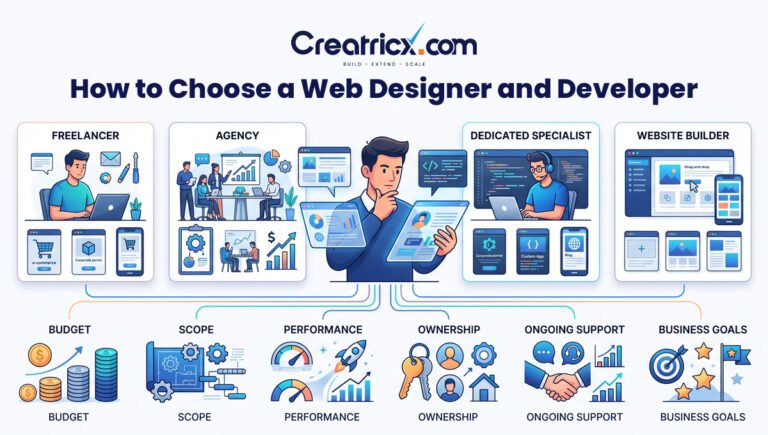
A solo developer assumes you will absorb more planning and QA. A full team prices management, design, testing and coordination into the engagement.
07 · CONTINUITY
What happens after launch
Hosting, updates, security, backups, bug fixes, content support and future changes belong in the budget conversation.
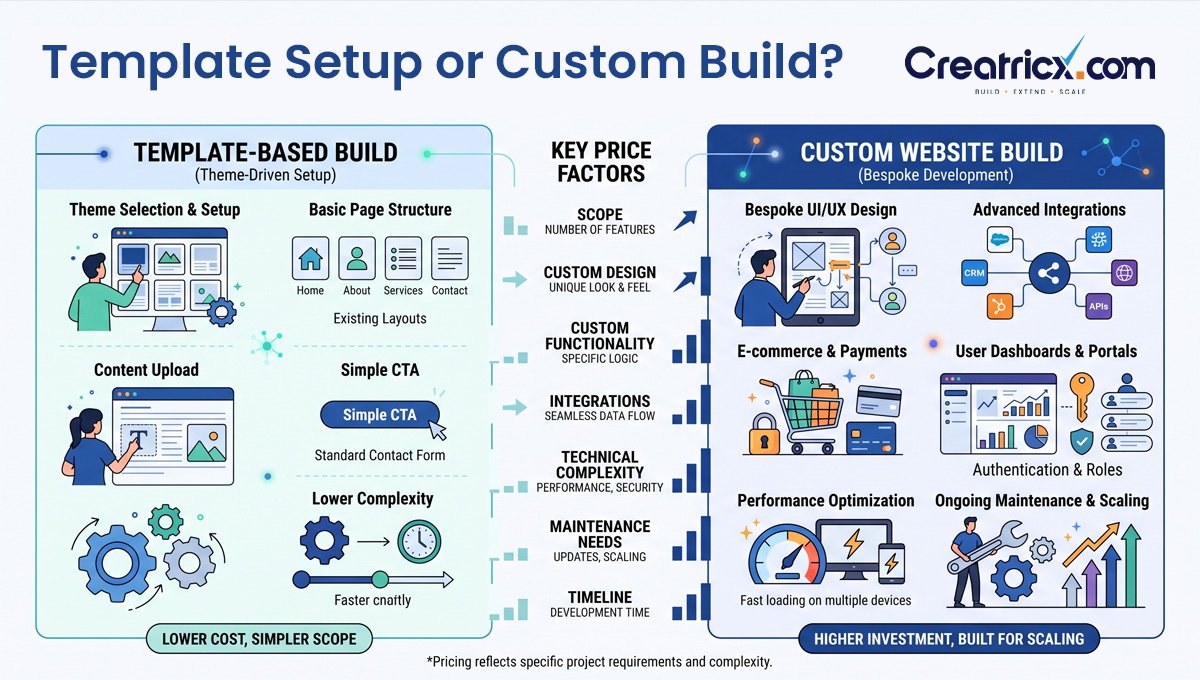
Template Setup vs Custom Build
This is the fastest way to explain why two honest quotes can differ by a factor of five or ten.
Build-Type Split
Same Word. Very Different Amount of Original Work.
TEMPLATE-LED
Configuration-heavy
- Existing theme or component system
- Standard page layouts
- Mostly existing CMS functionality
- Content entry and light styling
- Basic forms and tracking
- Limited custom logic
CUSTOM
Creation-heavy
- Original information architecture and UI system
- Custom responsive components
- Application logic or workflows
- Third-party APIs and integrations
- Accounts, payments, dashboards or permissions
- Broader QA, performance and maintenance demands
Neither approach is automatically better. A local service business may waste money commissioning a bespoke application architecture when a well-built WordPress site would do the job perfectly. A SaaS startup may create technical debt by forcing its product into plugins that were never designed for the workflow.
The budget should follow the problem, not the prestige of the technology.
A Practical 2026 Budget Ladder
Because project scope varies wildly, use these as planning categories rather than universal quotations.
Budget Ladder
Categorize the Project Before You Try to Price It
| Project type | Typical scope pattern | Budget behavior |
|---|---|---|
| Landing page / small brochure site | Few pages, existing brand, light CMS work, basic form | Lower end of market; often freelancer or small-team territory |
| Business CMS website | Custom page structure, reusable sections, forms, analytics, migration | Often several-thousand-dollar project territory |
| Custom marketing website | Bespoke UI/UX, animation, content systems, integrations, performance work | Can move well beyond simple-site budgets |
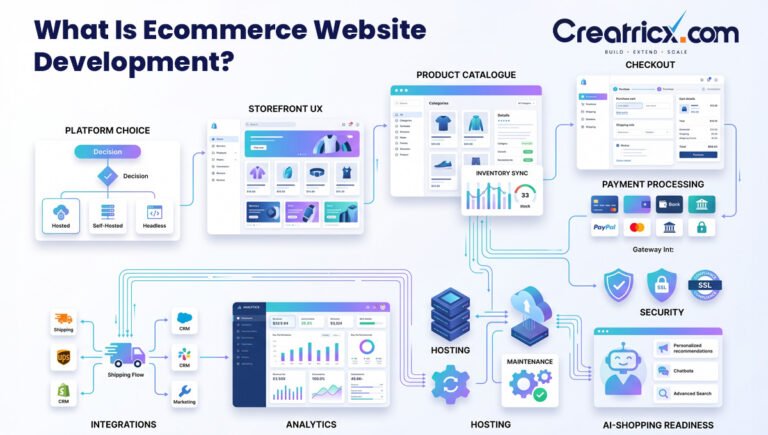
| E-commerce build | Catalog, checkout, payments, shipping, apps, product data, tracking | Price rises with catalog complexity and system integrations |
| Web application / portal | Accounts, permissions, workflows, dashboards, databases, APIs | Software-development budget rather than ordinary website budget |
| Ongoing product development | Continuous roadmap, iterations, maintenance, new features | Dedicated developer, retainer or managed team often fits better |
Current Clutch data says most reviewed web-development projects are under $10,000, while its average project cost is much higher because larger engagements pull the mean upward. That is exactly why project type and scope are more useful than one industry-wide average.
How to Normalize Two Website Quotes
If one developer quotes $4,000 and another quotes $14,000, do not start by asking which person is overpriced. First ask whether both numbers include the same work.
Quote Normalizer
Compare Deliverables Line by Line Before You Compare Totals
| Check | What must be explicit | Why the price changes |
|---|---|---|
| Design | Template, customization or bespoke UI/UX? | Original design adds discovery, wireframes and responsive states. |
| Pages | Exact page count and reusable templates? | Ten unique layouts cost more than ten pages using three templates. |
| Content | Who writes, edits, uploads and formats it? | Content production can become a separate project. |
| Functionality | Forms, search, bookings, accounts, calculators, portals? | Custom logic introduces development and testing effort. |
| Integrations | Which CRM, payment, email, ERP or APIs? | Every dependency creates setup and failure scenarios. |
| SEO foundation | Redirects, metadata structure, schema, crawlability, performance? | A launch can preserve or destroy existing search equity. |
| QA | Browsers, devices, forms, payments, accessibility checks? | “We tested it” is not a test plan. |
| Post-launch | Warranty, maintenance, backups, updates, response times? | Support may be excluded from the build quote entirely. |
The dangerous combination: low fixed price + vague scope
Fixed pricing is useful when the work is defined. It becomes hazardous when nobody agrees what “done” contains. The missing scope reappears later as exclusions, compromises or change requests. Ask what is excluded before admiring the total.
Hourly vs Fixed Price vs Retainer
The pricing model decides where uncertainty lives.
Risk Transfer Board
Choose the Pricing Model That Matches How Certain the Work Actually Is
HOURLY
You carry more scope risk
Best for maintenance, debugging, evolving backlog and work that cannot honestly be estimated yet.
Control: weekly caps, visible time, frequent review.
FIXED PROJECT
Provider carries more estimate risk
Best when deliverables, acceptance criteria, dependencies and exclusions are clear enough to price.
Control: signed scope and change process.
RETAINER / DEDICATED
You buy continuing capacity
Best when the roadmap continues after launch and priorities change faster than separate quotes can keep up.
Control: capacity, priorities and performance metrics.
How Location Changes Developer Cost
Location remains one of the clearest rate levers, particularly when buying from agencies or managed development companies.
August 2026 Rate Board
Current Clutch Web-Development Company Rate Bands
United States
$100–$149/hr
Canada
$100–$149/hr
India
<$25/hr
Ukraine
$25–$49/hr
Poland
$50–$99/hr
These are Clutch's current common company rate bands, not a guarantee of individual freelancer pricing. Seniority, specialist skill, provider model and project complexity still move the number substantially.
A lower offshore rate is only cheaper when the delivery system preserves the advantage. Poor requirements, slow answers, weak review and rework can consume the entire rate difference.
That is why the meaningful comparison is not “local developer versus cheapest offshore profile.” It is total cost of reliable output under two different delivery models.
Has AI Made Website Development Cheaper?
AI has made many development tasks faster. It has not made engineering judgment disappear.
The 2025 Stack Overflow Developer Survey found that 84% of respondents were using or planning to use AI tools in development, and 51% of professional developers used AI tools daily. But the same survey found more developers actively distrusted AI output accuracy than trusted it: 46% versus 33%.
AI Cost Reality
Faster Code Generation Does Not Equal Free Architecture
Boilerplate, documentation drafts, test scaffolding, repetitive code and research.
Product trade-offs, architecture, data responsibility, security risk, QA strategy or long-term maintainability.
How generated code is reviewed, tested, secured and documented before it reaches production.
The correct expectation is therefore selective efficiency, not an automatic percentage discount on every website. A developer who uses AI well may deliver faster. A developer who accepts generated output uncritically may simply create tomorrow's maintenance invoice earlier.
The Cost After Launch
A build budget that stops on launch day is incomplete.
Websites accumulate operational work: CMS and plugin updates, hosting changes, security fixes, backups, performance issues, analytics updates, content changes, API changes and new browser behavior. E-commerce and application sites carry even more moving parts.
Maintenance Reserve
Budget for the Website You Will Still Own in Year Two
CMS, framework, plugin and dependency updates.
Backups, access reviews, vulnerability response and restoration planning.
Images, scripts, database growth, Core Web Vitals and hosting changes.
New services, pages, integrations, tracking requirements and conversion improvements.
A small brochure site may need only a light support allowance. An e-commerce store or custom web application may justify dedicated monthly capacity. Quote maintenance against actual responsibilities rather than a generic number.
Website Quote Red Flags
No written scope
A number without deliverables is not a price. It is a future disagreement formatted as currency.
“Custom” is never defined
Ask what is designed and coded specifically for you versus configured from existing themes, plugins or components.
No QA or acceptance criteria
If nobody defines browsers, devices, forms, payments or acceptance, defects become subjective after launch.
You do not own the accounts
Domains, hosting, analytics, repositories and critical third-party accounts should have clear client ownership and handover rules.
Maintenance is “we'll discuss later”
Know what support exists after launch and what response, update or warranty work is included.
Rate is the entire sales pitch
A cheap hour is not valuable if the project buys many more hours through weak architecture, rework or poor communication.
How Creatricx Prices the Problem
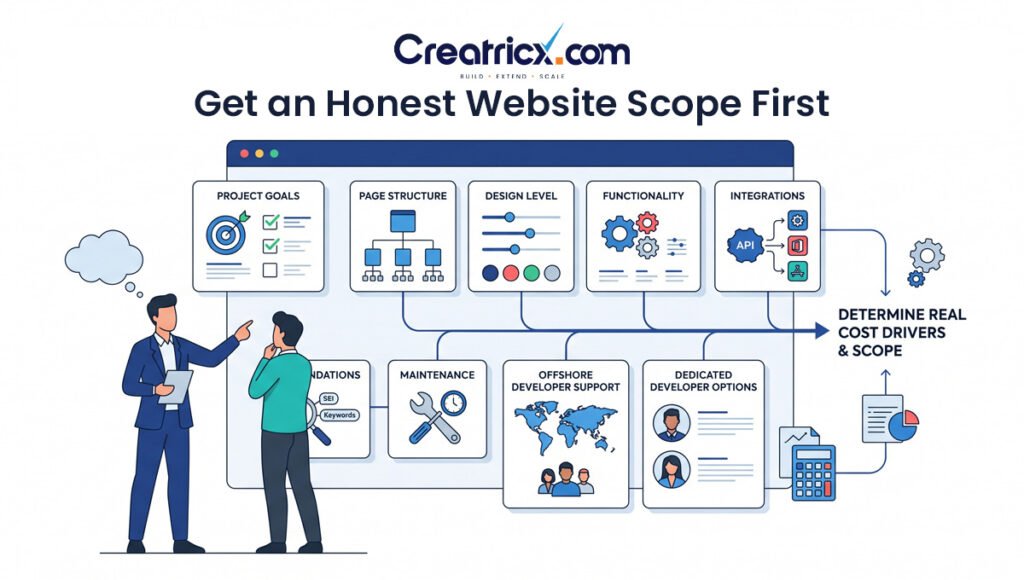
Creatricx's current web development service starts with requirement discovery, planning and strategy before development. That sequence matters because the quote becomes more reliable after the sitemap, content structure, UI level, functionality and platform choices are visible.
A business website may need a scoped project covering design, CMS, forms, performance and launch. A commerce build may need product architecture, checkout, payments and integrations. A continuing backlog may be better served by dedicated remote development capacity rather than repeatedly turning every improvement into a new fixed quote.
Creatricx also supports UI/UX design, cloud services and broader development work, which matters when the “website” eventually reveals itself to be a product with interfaces, infrastructure and application logic. Software has a habit of doing that once people begin describing what they actually want.
Creatricx Scoping Blueprint
Turn “I Need a Website” Into Something a Developer Can Price Properly
Lead generation, sales, information, customer portal, campaign or product?
Pages, templates, content types, navigation and CMS structure.
Theme-led, customized system or bespoke UI/UX?
Forms, ecommerce, accounts, search, dashboards, bookings or custom workflows.
CRM, analytics, email, payments, ERP and third-party APIs.
Migration, QA, SEO preservation, backups, support and future capacity.
Frequently Asked Questions
How much does it cost to hire a developer for a website in 2026?
There is no single reliable price because website scope varies dramatically. Current Clutch data shows most web-development companies charge $25–$49 per hour overall, while common listed U.S. and Canadian rates are $100–$149 per hour and Indian rates are often below $25 per hour. Most reviewed web-development projects on Clutch cost under $10,000, but custom applications and larger builds can cost much more.
Why do website development quotes vary so much?
Quotes often describe different amounts of work. A template-based CMS setup, a bespoke marketing website, an e-commerce store and a custom web application may all be called websites, but their design, functionality, integrations, QA and maintenance requirements are very different.
What is the biggest factor affecting website developer cost?
Scope is the biggest factor, especially the amount of custom design and custom functionality. Accounts, payments, dashboards, integrations, search, booking systems, APIs and bespoke UI components add significantly more work than configuring an existing theme or CMS.
Should I hire a freelancer or a web development agency?
A freelancer can be efficient for a focused project that one person can realistically own and that the client can help manage. An agency or managed team is often a better fit when the project needs design, development, QA, project management, integrations, security or continuing support. Compare responsibilities, not only hourly rates.
Is hourly or fixed-price web development better?
Fixed pricing works best when the scope, deliverables, dependencies and acceptance criteria are clear. Hourly pricing is better for open-ended maintenance, debugging or evolving requirements. Retainers or dedicated developers fit ongoing roadmaps where priorities change continuously.
How much cheaper is offshore web development?
Current Clutch rate bands show a substantial regional difference: U.S. and Canadian web-development companies commonly list $100–$149 per hour, India is often below $25, Ukraine $25–$49 and Poland $50–$99. The real saving depends on quality, communication, management and rework, so compare total delivery cost rather than rate alone.
Has AI made web developers cheaper?
AI can reduce time on repetitive coding, documentation and testing tasks, but it does not remove architecture, product decisions, security, review or QA. Stack Overflow's 2025 survey found 84% of respondents use or plan to use AI development tools and 51% of professional developers use them daily, while more developers distrust AI output accuracy than trust it.
What website costs continue after launch?
Ongoing costs can include hosting, CMS or framework updates, plugin and dependency updates, backups, security fixes, performance work, content changes, analytics, integrations and developer support. The correct maintenance budget depends on how complex and business-critical the website is.
What should be included in a website development quote?
A useful quote should define pages or templates, design scope, functionality, integrations, content responsibilities, CMS, responsive behavior, QA, browser and device testing, analytics, SEO migration requirements, launch, ownership, exclusions, change requests and post-launch support.
How does Creatricx help estimate website development cost?
Creatricx begins with requirement discovery and planning. The project is scoped around business goals, sitemap, UI level, functionality, integrations, CMS, launch requirements and ongoing support before a quote is finalized, helping the budget reflect the actual work rather than a generic website package.
Sources and Evidence Quality
- Clutch — Web Development Company Pricing Guide 2026 Updated August 18, 2026. Used for current project-cost context, general company hourly rates and country rate bands.
- Clutch — Web Design Company Pricing Guide 2026 Used as supporting context for design-agency pricing and the effect of scope, design complexity and platform choice.
- Stack Overflow Developer Survey 2025 — AI Primary developer-survey source for AI-tool adoption, daily professional use and trust in AI output.
- Upwork — Front-End Developer Cost Guide Marketplace context showing how scope, experience and location affect freelancer pricing. Not treated as a universal 2026 benchmark because the page is older than the Clutch dataset.
- Creatricx — Web Development Services Used for current Creatricx website-development scope, process, CMS, e-commerce, landing-page, performance and maintenance positioning.
Final Takeaway
The cost of hiring a developer for a website cannot be reduced to one reliable hourly rate because the word “website” contains too many different jobs.
Current 2026 market data confirms that geography creates major rate differences, but scope still decides how many hours, disciplines and risks you are actually buying. A template-led CMS site, custom marketing experience, e-commerce platform and web application need different budgets even when the same developer is capable of building all four.
Normalize the scope before comparing quotes. Separate template configuration from custom work. Identify integrations. Decide who owns QA and project management. Pick hourly, fixed or dedicated capacity according to how certain the work is. Budget for the website after launch, not only the launch itself.
Do that and a quote becomes something you can audit. Skip it and the cheapest number on the first spreadsheet may spend the next six months explaining why it was never actually the cheapest.