
Table of Contents
Key Takeaways
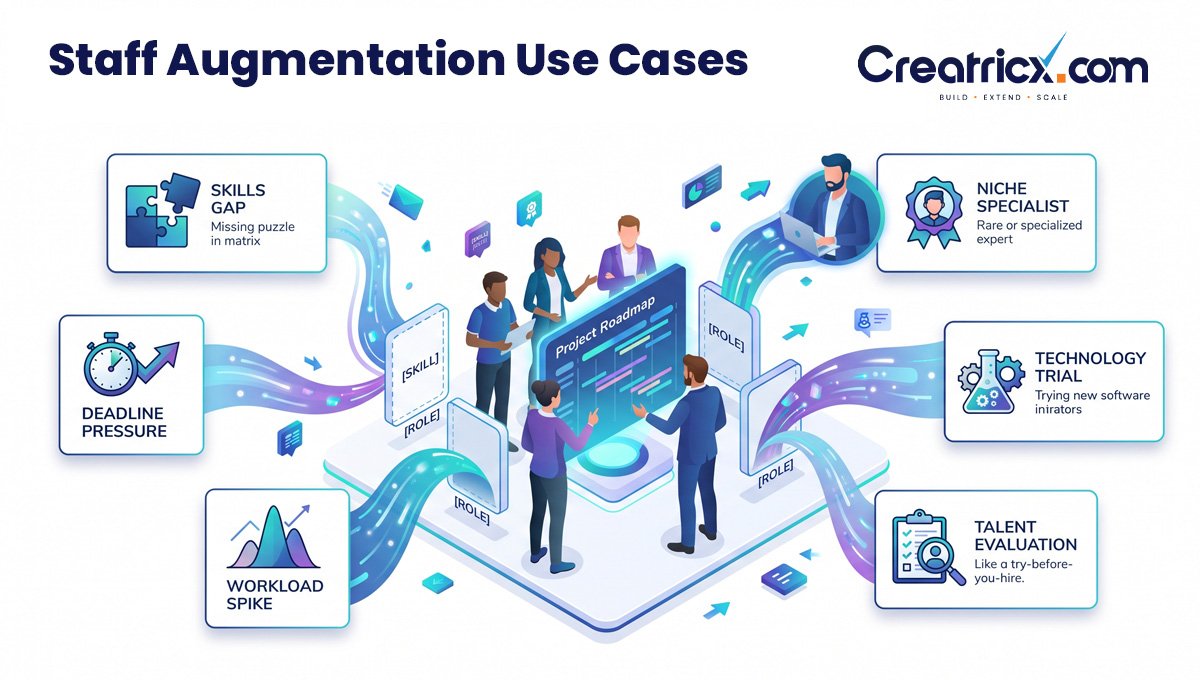
Staff augmentation adds skilled people to your existing team under your direction, and its use cases all share one trigger: you need a capability now that permanent hiring cannot deliver fast enough
The strongest use cases are driven by a real bottleneck, a deadline, a skills gap, a demand spike, or a niche specialism, rather than by a vague wish to "add resource"
Reported outcomes are significant: providers cite roughly 75% faster time-to-productivity versus full-time hiring and 40 to 65% savings on total employment cost, with most companies seeing positive ROI within two to three months
The 2026 reality has raised the bar: augmentation now routinely involves compliance obligations like SOC 2, PCI DSS, HIPAA, and the EU AI Act, and providers who cannot produce audit-ready documentation no longer clear procurement
The single biggest determinant of success is not the model but the clarity of ownership: augmentation rewards teams that know exactly what they need done and struggles where responsibility is fuzzy
What Actually Triggers A Staff Augmentation Decision
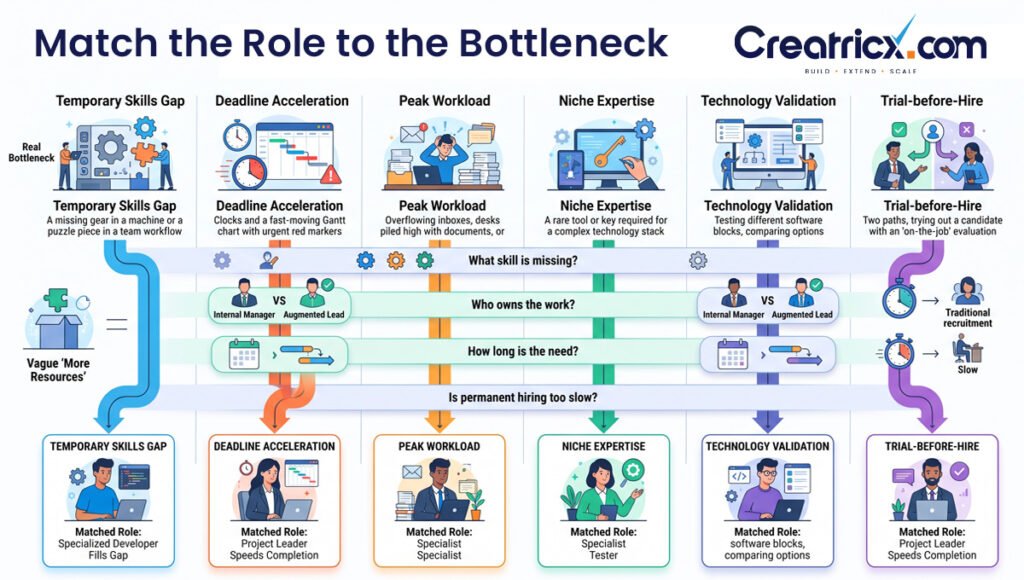
Most articles list staff augmentation use cases as if they were unrelated scenarios. In our experience at Creatricx, they are all the same decision wearing different clothes.
A business hits a point where it needs a capability it doesn’t currently have, can’t build fast enough internally, and doesn’t want to commit to permanently. That is the trigger, every time. The specific scenario just tells you which skill and for how long.
Understanding this matters because it changes how you evaluate your own situation. The useful question is not "is my situation on someone's list of use cases," it is "do I have a genuine bottleneck that a specific skill would clear, and is that need temporary or uncertain enough that a permanent hire would be the wrong commitment."
If the answer is yes, augmentation almost certainly fits, whatever label the scenario carries. If the answer is no, no amount of matching your situation to a use case will make it work. We have watched businesses succeed with augmentation in scenarios nobody would put on a list, and fail with it in textbook scenarios, and the difference was always the presence of a real, well-defined need underneath.
Use Case #1: Clearing A Skills Gap You Don’t Need Permanently
This is the most common and most straightforward reason businesses reach for augmentation. Your internal team is strong on general capability but lacks one specific skill a project requires, and crucially, you will not need that skill permanently once the project ships.
The scenario looks like this. A company begins a project that needs a specialism its people do not have, an AWS migration, a Kubernetes implementation, an SAP configuration, a specific framework nobody in-house has worked in.
Building that skill internally would take months of training the team does not have time for. Hiring permanently for it makes no sense, because the need disappears when the project ends. So the business brings in a specialist for the duration, the specialist does the work and often leaves the team better than they found it, and when the project completes, the engagement simply ends. No redundancy, no permanent salary line for a skill you no longer use.
This is exactly where a single dedicated specialist earns their place. Wherever the gap sits, a developer, a designer, an AI engineer, or an SEO specialist, the pattern holds: you needed one specific capability, for a defined stretch, without the overhead of making it permanent. Creatricx supports this directly through individual specialist placements, from dedicated developers through to dedicated AI specialists, matched to the exact gap rather than a generic role.
Use Case #2: Hitting A Deadline The Current Team Cannot Reach Alone
The second major use case is time, not skill. Your team has the right capability, but not enough of it to hit a deadline that genuinely matters, and the deadline will not move.
Picture a software company that needs to ship a major product update to stay competitive, with a testing and release phase that its core team simply cannot complete in the window available without dropping everything else. Rather than burning out the internal team or slipping the date, the business adds experienced developers through augmentation to accelerate the testing and release, without pulling the core team off the other work that still needs doing.
The augmented people absorb the surge, the deadline holds, and the core team keeps the rest of the roadmap moving. The same pattern covers a retailer preparing a new app feature for the holiday shopping season, where the need is intense, time-bound, and gone once the season passes.
The reason augmentation suits this so well is speed. Providers cite roughly 75% faster time-to-productivity than full-time hiring, precisely because the whole point is dropping a ready specialist into an existing rhythm rather than recruiting and onboarding from scratch. When the constraint is a deadline, the months a permanent hire takes to find and settle are months you do not have.
Use Case #3: Absorbing Peaks Without Over-hiring For The Average
Software and technology work does not arrive at a constant rate. It comes in peaks, around launches, migrations, funding rounds, seasonal demand, and the teams that handle those peaks best are rarely the ones that are hired permanently for them.
This is the capacity use case, and it is subtly different from the deadline one. Here the issue is not a single hard date but a recurring pattern of demand that rises and falls.
If you hire permanently for your peak, you carry that cost through every trough. If you hire for your average, every peak overwhelms you.
Augmentation resolves the tension: you staff your core team for the steady-state work and flex up with augmented specialists when demand spikes, then flex back down when it subsides. This is why most mature engineering organisations now run both models in parallel, a stable permanent core absorbing the baseline and augmented capacity absorbing the peaks, rather than trying to make one headcount number serve two very different demands.
Use Case #4: Accessing A Niche Specialism That Barely Existed A Decade Ago
Some of the most valuable modern use cases involve skills so specialised, and so new, that building them internally is simply not realistic for most businesses. This is where augmentation has grown fastest in 2026.
The clearest example is the cybersecurity talent shortage. Rather than trying to hire permanently into one of the tightest talent markets in technology, companies increasingly meet the need through augmentation, because the skills mature faster than internal training programmes can keep up with.
The same is true for AI engineering, DevSecOps, and cloud cost optimisation, roles that barely existed as job titles a decade ago and that most businesses cannot justify or fill as permanent positions. A financial services company preparing for a security audit needs deep cybersecurity expertise for a defined period, not forever.
A traditional business modernising onto a cloud platform needs cloud specialists to lead the migration and upskill the internal team, then hand back control. In each case the specialism is real, scarce, and temporary to that business, which is the exact profile augmentation is built for.
Creatricx addresses these newer specialisms directly. Where a business needs applied AI expertise, dedicated AI specialists can be embedded into the team for practical implementation rather than theory. Where the need is search visibility or technical SEO for a specific push, dedicated SEO specialists fill it. The model is the same across all of them: rare skill, defined need, your control retained.
Use Case #5: Testing A New Technology Before Committing To It
A quieter but genuinely smart use case is validation. Before a business commits its roadmap to a new technology, framework, or architectural pattern, augmentation lets it bring in someone who has already done it, so the decision is grounded in real implementation rather than speculation.
If a team wants to validate a new language for a service layer, or trial a different deployment pattern, or prototype an AI feature before betting the roadmap on it, an augmented specialist who has built it before turns an abstract debate into a concrete test. This is far cheaper than the alternative, which is committing internally, discovering the problems the hard way months in, and unwinding the decision at cost.
The augmented specialist brings the scars of having done it already, which is exactly the knowledge you cannot get from a proof of concept run by people learning as they go.
Use Case #6: Evaluating Talent Before A Permanent Commitment
Finally, augmentation serves as a low-risk path to permanent hiring. Rather than committing to a full-time employee on the strength of interviews alone, a business can work with an augmented specialist on real work and see how they actually perform, communicate, and fit before making any permanent offer.
This "try before you commit" pattern is increasingly common, and it runs both ways. The business gets to evaluate genuine working performance rather than interview performance, which are famously different things. The specialist gets to understand the business before committing to it.
Where the fit is strong, many augmentation engagements convert to permanent roles, one documented case saw five augmented engineers converted to full-time remote hires after they had proven themselves on a compliance project. Where the fit is not right, the engagement simply ends without the cost and disruption of a failed permanent hire.
Either outcome is cheaper and less risky than betting on an interview.
The 2026 Shift Most Use-case Guides Ignore: Compliance
Here is something the standard use-case lists almost never mention, and it now shapes the model as much as any scenario above. In 2026, staff augmentation is no longer just about skills and speed. It is about compliance.
Augmentation contracts now routinely carry obligations around data residency, AI governance, PCI DSS scope, HIPAA handling, SOC 2 evidence trails, and increasingly the EU AI Act. This has quietly reshaped how businesses choose providers. A staff augmentation firm that cannot produce audit-ready documentation of where your data sits and who touched it doesn’t clear procurement anymore, however good its engineers are.
For any business in a regulated sector, this turns compliance from a footnote into a primary selection criterion, and it is the reason a cheap, undocumented arrangement that looked fine five years ago is now a genuine liability.
We regard this as one of the most important developments in the space, because it separates providers who treat augmentation as body-shopping from those who treat it as a professional, accountable service.
When Staff Augmentation Is The Wrong Answer
Honest advice includes the cases against, and there are several, because augmentation is genuinely not right for every situation. Being straight about this matters more than another benefit paragraph.
Augmentation is the wrong call when ownership is fuzzy. If nobody internally owns the work, adding an external specialist doesn’t fix the problem, it adds a skilled person to a leaderless effort and usually produces frustration on both sides. It is the wrong call when you need a complete outcome rather than added capacity, in which case full project delivery, where a provider takes responsibility for the result, fits better than augmenting a team that then has to manage the work.
It is the wrong call when the need is genuinely permanent and stable, where building a dedicated team or hiring directly serves you better over time than a series of individual engagements. And it is the wrong call when you are not prepared to invest any management attention, because augmented specialists work under your direction, and direction that never comes produces drift regardless of how good the person is.
None of this diminishes the model. It sharpens it. Augmentation is a precise tool for a precise situation, added capability under your control for a defined or flexible need, and knowing when not to use it is exactly what makes it work when you do.
How Creatricx Delivers Staff Augmentation Across These Use Cases
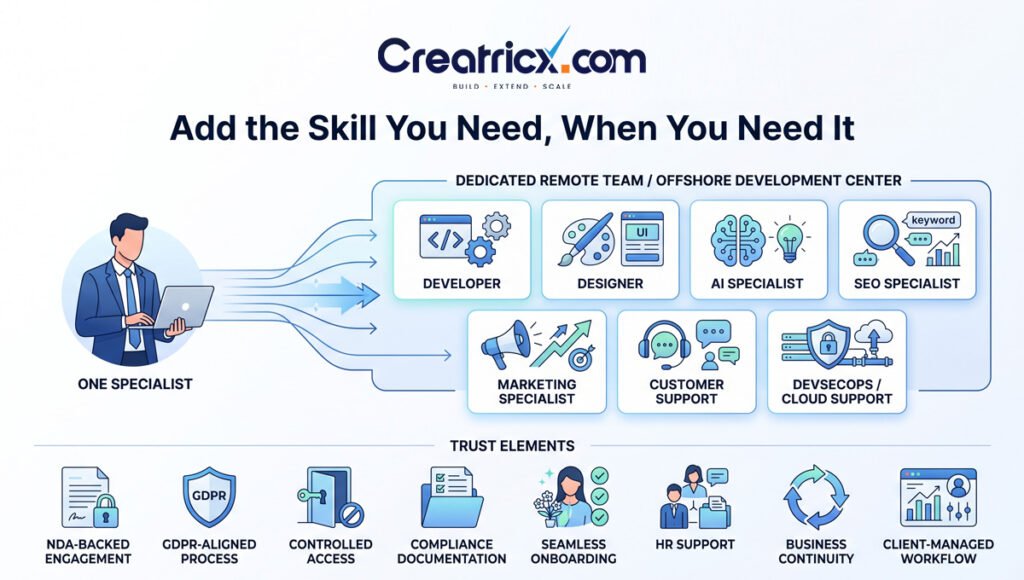
Everything above reflects how we approach augmentation at Creatricx, because the model only delivers when it is matched honestly to the need rather than sold as a universal answer. When you augment your team through us, you add individual specialists who work within your tools, follow your processes, and report to your managers, exactly as an internal team member would, while we handle talent sourcing, onboarding, HR, infrastructure, and continuity in the background. You keep control of priorities, roadmap, and outcomes. We carry the operational weight.
What lets us serve the full range of use cases above is breadth of specialism under one accountable relationship.
The skills-gap use case might call for a dedicated developer or designer; the AI validation use case for a dedicated AI specialist; the visibility push for a dedicated SEO specialist; the growth spike for a dedicated marketing team; the support surge for dedicated customer support or website support specialists.
Because these all sit with one partner, a business can move between them, or combine them into a dedicated remote team, or scale a successful engagement into a full offshore development center, without restarting the relationship each time.
And because our engagements are NDA-backed and GDPR-aligned by default, the compliance reality that now gates provider selection is built in rather than bolted on.
Our honest position is the one running through this whole article: augmentation is the right answer when you have a real bottleneck, a clear owner, and a need that permanent hiring cannot serve well.
Where that describes your situation, we would rather place exactly the specialist you need than push a larger engagement than the situation calls for. And where a dedicated team or full project delivery would genuinely serve you better, we will tell you that too, because matching the model to the need is the entire point.
Frequently Asked Questions
What is staff augmentation used for?
Staff augmentation is used to add specific skilled professionals to an existing team quickly, without permanent hiring. The most common use cases are filling a temporary skills gap, meeting a deadline the current team cannot reach alone, absorbing peaks in workload, accessing niche specialisms like AI or cybersecurity, testing a new technology, and evaluating talent before a permanent offer.
What are the most common staff augmentation use cases?
The leading use cases are covering a non-permanent skills gap (such as a cloud migration or specific framework), accelerating a deadline-bound project, flexing capacity up and down around demand peaks, accessing scarce specialisms like DevSecOps or AI engineering, validating a new technology before committing, and trialling a specialist before hiring them permanently.
When should a company use staff augmentation instead of hiring?
When the need is project-specific or time-bound, when a specialised skill is needed only temporarily, when permanent hiring timelines are too slow for the deadline, when you want to evaluate performance before committing, or when workforce flexibility matters more than permanent team building. If the need is genuinely permanent and stable, a dedicated team or direct hire usually fits better.
How quickly can staff augmentation deliver results?
Faster than permanent hiring by a wide margin. Providers cite roughly 75% faster time-to-productivity, because the model drops a ready specialist into an existing team rather than recruiting from scratch, and most companies report positive ROI within two to three months through increased velocity and avoided hiring delays.
Is staff augmentation only for software development?
No. While software and engineering are the most common areas, augmentation applies wherever a specific skill is needed temporarily, including design, AI and automation, SEO, digital marketing, and customer support. Creatricx provides specialists across all of these under a single engagement model.
When is staff augmentation the wrong choice?
When ownership of the work is unclear, when you need a complete delivered outcome rather than added capacity, when the need is genuinely permanent and stable, or when you cannot commit any management attention. Augmented specialists work under your direction, so the model requires a clear internal owner to succeed.
How does compliance affect staff augmentation in 2026?
Significantly. Augmentation engagements now routinely involve data residency, PCI DSS, HIPAA, SOC 2, and EU AI Act obligations, and providers who cannot produce audit-ready documentation no longer pass procurement in regulated sectors. Confirming a provider's security and documentation practices is now a primary selection criterion, not an afterthought.
How does Creatricx handle staff augmentation?
Creatricx places vetted specialists into your team, working on your tools and roadmap under your management, while handling sourcing, onboarding, HR, infrastructure, and continuity. Engagements are NDA-backed and GDPR-aligned, span developers, designers, AI, SEO, marketing, and support specialists, and can scale into a dedicated team or offshore development center as needs grow.
In Summary
The many use cases for staff augmentation come down to one recurring situation: a business needs a specific capability now, cannot build it internally fast enough, and does not want to commit to it permanently. However it shows up, as a skills gap, a deadline, a demand peak, a scarce specialism, a technology trial, or a hire-with-confidence evaluation, the underlying trigger is identical, and so is the answer. Add the right skill under your own control, for exactly as long as you need it. What separates success from disappointment is never the scenario, it is the presence of a real bottleneck, a clear owner, and a genuine reason permanent hiring would not serve. Get those right, match the role to the actual problem rather than the buzzword, and choose a provider whose compliance and accountability clear the bar 2026 now sets. Do that, and staff augmentation stops being a stopgap and becomes one of the most flexible advantages a growing business can hold.