

Choose an outsourced web development company by checking three things before anything else: does it run a genuine discovery process instead of jumping to mockups, will the same team member stay on your project start to finish, and does its portfolio hold up when you actually click through to the live sites, not just the screenshots.
Key Takeaways
- Roughly two-thirds of large technology projects end in partial or total failure, according to Standish Group research, which makes vendor selection the highest-leverage decision in the whole process
- The average outsourced web project costs around $66,500 and takes about nine months, so getting the choice wrong is an expensive mistake to walk back from
- Around 27% of outsourced code requires rework and 42% of outsourcing clients report communication problems, both traceable to weak vetting at the selection stage
- A portfolio of screenshots proves nothing; clicking through to the actual live sites and testing load speed, mobile behaviour, and navigation tells you far more
- The single most revealing test you can run is asking a moderately complex question about your project and watching if the company slows down to think or just agrees with everything you say
The Test That Matters More Than The Portfolio
Most businesses evaluate outsourced web development companies the way they'd evaluate a restaurant: look at the pictures, check the reviews, pick the one that feels right. That approach misses the thing that actually predicts project outcomes.
Ask any shortlisted company a moderately complex question about your specific project, something with no obvious right answer, and pay attention to how they respond.
A company worth hiring slows down, asks a clarifying question back, and sometimes pushes back on an assumption you made. A company that agrees instantly with everything you say isn't being agreeable, it's not thinking, and that pattern tends to continue once the contract is signed.
If a detailed proposal lands in your inbox within 24 hours of first contact, with no discovery call and no questions about your business model or target audience, that proposal wasn't written for you. It's a template with your company name dropped in.
Why This Decision Carries More Risk Than It Looks Like
The scale of the risk here is easy to underestimate. Research from the Standish Group puts the failure rate for large technology projects at around two-thirds ending in partial or total failure, and separate industry data finds that roughly 27% of outsourced code requires rework after delivery, with 42% of outsourcing clients reporting communication breakdowns during the project. None of this means outsourcing is a bad idea, plenty of businesses get excellent results, but it does mean the selection stage deserves more rigour than most businesses give it, since the average project runs around $66,500 and takes close to nine months to complete.
Watch specifically for developer turnover mid-project. A company that rotates which developer is assigned to your build loses institutional knowledge with every handoff, and each handoff typically costs weeks in re-explaining context that was already established. Ask directly: will the same person who starts this project finish it?
What A Portfolio Actually Proves, And What It Doesn't
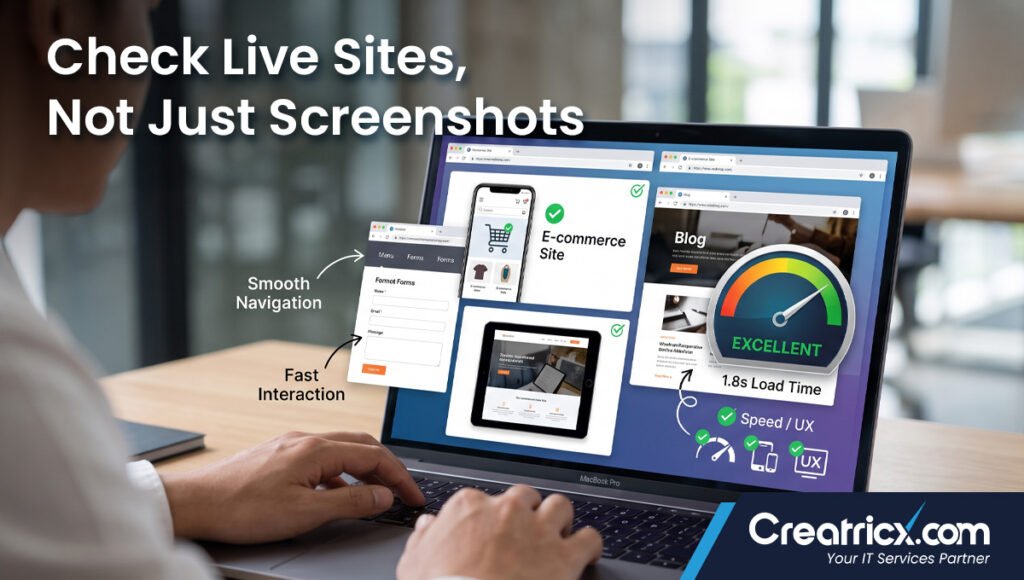
A polished set of screenshots tells you a company can produce something that photographs well. It doesn't tell you if the sites actually load quickly, work properly on mobile, or hold up under real traffic. Before shortlisting any company, open two or three of their actual live projects, not the case study page, the real site, and check load speed, mobile responsiveness, and if navigation makes sense to someone who's never seen it before. A company confident in its work will encourage exactly this kind of scrutiny rather than steering you back toward curated case studies.
A portfolio that all looks visually similar isn't automatically disqualifying, some agencies simply have a strong house style, but it should prompt more questions about how they'd approach something outside that style, rather than being taken at face value.
Questions Worth Asking Before You Ever See A Proposal

| Question to Ask | What the Answer Reveals |
| Will the same developer start and finish this project? | Continuity of institutional knowledge versus costly mid-project handoffs |
| How do you handle scope changes once work begins? | If cost surprises get documented and approved, or simply appear on the final invoice |
| Can I see a project that didn't go as planned? | Honesty and problem-solving under pressure, which a polished portfolio never shows |
| Who owns the code and design files at completion? | If you retain full ownership or the company holds leverage over your own site |
| What does support look like in the first 90 days after launch? | If the relationship ends at delivery or continues through the period when most bugs surface |
| SUCCESS: Companies that answer these five questions specifically and without hesitation, rather than in vague reassurances, consistently correlate with smoother project delivery in the research on this topic. The specificity of the answer matters more than the answer itself. |
A Practical Shortlisting Sequence
Step 1: Shortlist on Substance, Not Just Style
Pick three to five companies based on live site quality (not screenshots), then confirm each has handled a project similar in scope to yours.
Step 2: Run the Discovery Call as a Two-Way Test
A genuine discovery call should include the company asking about your business goals, customers, and what success looks like in six months, not just you asking about price and timeline.
Step 3: Ask the Five Questions Directly
Request written, specific answers to code ownership, scope-change handling, developer continuity, a failed-project example, and post-launch support terms.
Step 4: Check the Proposal Against the Conversation
A strong proposal reflects what was actually discussed on the call. A generic proposal that could apply to any business is a sign the discovery conversation didn't inform the plan.
Step 5: Confirm the Contract Matches the Verbal Promises
Before signing, verify that IP ownership, timeline, and support terms in the written contract match everything discussed verbally. Anything promised only in conversation and missing from the contract isn't actually agreed.
Frequently Asked Questions
What's the most important thing to check before hiring an outsourced web development company?
A genuine discovery process that asks about your business goals before jumping to design, rather than a generic proposal presented immediately.
How reliable is a company's portfolio as a selection criterion?
Screenshots alone prove very little. Clicking through to the actual live sites and checking load speed, mobile behaviour, and navigation tells you far more than curated case studies.
What questions should I ask before signing a contract?
Ask who owns the code and files at completion, how scope changes are handled, if the same developer stays on the project throughout, what post-launch support includes, and for an example of a project that didn't go as planned.
Why does developer continuity matter so much?
Every handoff between developers loses institutional knowledge of your project, typically costing weeks in re-establishing context that was already understood by the previous developer.
How common is project failure in web development outsourcing?
Research from the Standish Group puts failure rates for large technology projects at around two-thirds ending in partial or total failure, which underscores how much selection quality matters.
Is a low quote from an outsourced web development company a red flag?
It can be. Unrealistically low quotes often rely on inexperienced teams, template code presented as custom work, or scopes that expand significantly once work begins.
What does good post-launch support actually look like?
A defined warranty period covering bug fixes, typically 30 to 90 days, followed by clearly scoped ongoing support with defined response times, rather than support that simply stops at launch.
How does Creatricx handle code and IP ownership?
Code and design ownership terms are made clear from the outset of every engagement, so clients retain full ownership of their deliverables.
Disclaimer
This article reflects general 2026 industry research on web development outsourcing and Creatricx's published service model. Individual outcomes vary by company, project scope, and industry. Always confirm current terms and pricing directly with any provider before signing a contract.
In Summary
The businesses that choose well aren't the ones with the biggest shortlist or the longest checklist, they're the ones who ran a genuine test: watching how a company responds to a hard question, checking the live sites instead of the screenshots, and getting specific answers on ownership, continuity, and support before any contract was signed. Given how often these projects go wrong industry-wide, the extra hour spent vetting properly is small compared to the months it saves if it steers you away from the wrong partner.