
How Much Does It Cost to Build a Mobile App?'
That is the market answer. Our Creatricx answer is slightly different: do not budget “an app.” Budget the smallest product that can prove the business case and survive real users.
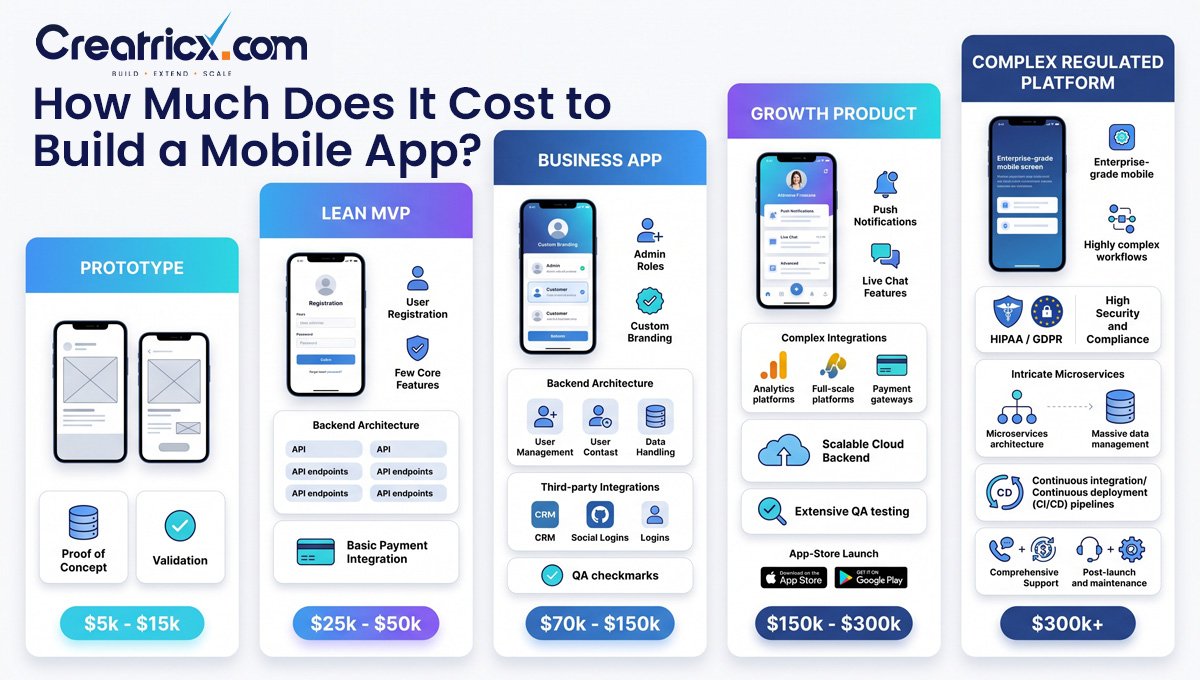
For a remote-team build, our planning bands usually start lower than large U.S. agency budgets because the team structure is different. We would roughly plan $10,000–$20,000 for a lean cross-platform MVP, $20,000–$45,000 for a stronger business app, $45,000–$90,000 for a growth-stage product, and $90,000–$180,000+ for complex or regulated products. These are educational budgeting ranges, not a public fixed rate card or quote.
Table of Contents
Have an app idea but no reliable budget yet? Creatricx can define users, workflows, platform choice, integrations, MVP scope, launch risks and a realistic development route before you commit to the full build. |
|---|
The Quick 2026 Cost Breakdown
| App level | Rough cost | Usually includes | Meaning |
|---|---|---|---|
| Prototype / clickable concept | $2,500–$6,000* | Discovery, UX flows, clickable prototype, technical direction | Not a full production app |
| Lean MVP | $10,000–$20,000* | Core workflow, auth, simple backend, analytics, cross-platform release path | Validate product demand |
| Business app | $20,000–$45,000* | Custom UI, APIs, admin, payments/booking, notifications | Commercial product with real backend |
| Growth product | $45,000–$90,000* | Multi-role users, richer integrations, real-time features, advanced analytics | Scaling user and operational complexity |
| Complex / regulated | $90,000–$180,000+* | Fintech/health/AI, offline sync, enterprise integrations, stronger security | Higher-risk product |
| Clutch reviewed projects | $10,000–$49,999 | Most reviewed projects in Clutch’s Aug 2026 guide | Broad market anchor |
| GoodFirms advanced / enterprise | $100,000–$500,000+ | Survey-based high-complexity and enterprise ranges | Broad global market anchor |
*Creatricx planning bands are editorial guidance for a coordinated remote-team model. Final pricing depends on scope, platforms, integrations, data sensitivity, quality requirements and launch responsibility.
Users, roles and workflows
Backend, data and integrations
Security, QA and compliance
Launch, monitoring and support
Why App Cost Estimates Are So Wide
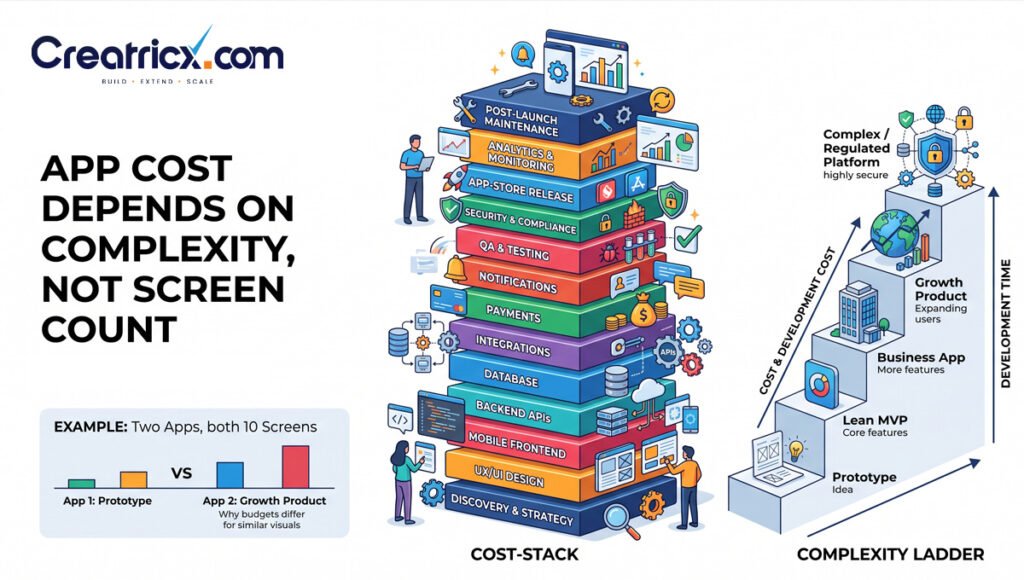
An app can be a six-screen booking utility or a multi-sided marketplace with customer accounts, provider accounts, payments, messaging, maps, live location, ratings, admin tools and fraud controls. Both are called mobile apps. Their engineering burden is not remotely similar.
User roles: one customer role is cheaper than customer + vendor + driver + admin + support permissions.
Backend logic: static content is cheap; custom workflows, pricing rules, inventory, messaging and synchronisation are not.
Integrations: payments, CRM, ERP, maps, identity, analytics, booking, logistics and AI services add both build work and failure cases.
Real-time behaviour: live chat, live tracking, feeds and presence require architecture that keeps data consistent while many users act at once.
Offline behaviour: storing and reconciling data after a device reconnects is more complex than ordinary online-only flows.
Security and privacy: authentication, permissions, encryption, sensitive data and third-party SDKs add real work.
Quality bar: a prototype and a production app expected to handle thousands of transactions require different QA and operational readiness.
What Public 2026 Research Says
Clutch’s August 2026 mobile app pricing guide says most reviewed mobile development projects usually fall between $10,000 and $49,999, with many app development companies listing hourly rates around $25–$49.
GoodFirms publishes a much wider 2026 range after collecting input from 267 mobile app development companies: roughly $15,000–$40,000 for basic apps, $40,000–$120,000 for mid-level apps, $100,000–$250,000+ for advanced apps, and $250,000–$500,000+ for enterprise-level products.
Those sources are not contradictory. Clutch is describing where many reviewed projects land. GoodFirms is modeling the wider complexity spectrum. The sensible conclusion is not to average them. It is to decide which product class your idea belongs to.
A useful sanity check If somebody quotes $4,000 for a multi-role marketplace with payment flows, live chat, location tracking, admin tools and production launch, the bargain is probably being financed by missing scope. |
|---|
Creatricx Cost Model: Price the Product in Five Levels
1. Prototype: about $2,500–$6,000
This is where we test the product idea before funding production engineering. The output can include user journeys, wireframes, a clickable prototype, technical assumptions and an MVP roadmap. We choose this route when the risky question is not “can we code it?” but “will users understand it, use it or pay for it?”
2. Lean MVP: about $10,000–$20,000
A lean MVP should contain the smallest production-quality workflow that proves the business case: sign-in, one or two core user journeys, a simple backend, basic analytics and a release-ready mobile experience. The dangerous version of MVP is “build everything badly.” Our version is “build fewer things properly.”
3. Business app: about $20,000–$45,000
This is where many serious SME app conversations start: custom design, user accounts, a backend, admin controls, notifications, third-party integrations, payments or booking logic, analytics and proper QA.
4. Growth product: about $45,000–$90,000
The app now behaves more like a product platform. Multiple roles, richer integrations, real-time behaviour, advanced permissions, experimentation, reporting, subscriptions or operational workflows increase architecture and QA cost.
5. Complex or regulated platform: $90,000–$180,000+
Fintech, healthcare, high-scale marketplaces, logistics, AI-heavy products and enterprise integrations require deeper architecture, security, test coverage, documentation and monitoring. A complex product can exceed these ranges; GoodFirms’ 2026 enterprise band reaches $250,000–$500,000+.
How Features Change the Budget
| Feature | Budget pressure | What creates the cost |
|---|---|---|
| Email / social login | Low–Medium | Auth flows, reset, verification, sessions, account edge cases |
| Push notifications | Low–Medium | Simple notifications are easy; segmentation and behaviour triggers add backend work |
| Payments / subscriptions | Medium–High | Gateway, webhooks, receipts, failure states, refunds, store rules |
| Maps / geolocation | Medium–High | Permissions, map SDK, routing, location accuracy, background behaviour |
| Real-time chat | High | Realtime backend, delivery states, moderation, notifications, storage |
| Marketplace roles | High | Buyer/seller/provider/admin logic, status transitions, payouts, disputes |
| Offline mode | High | Local storage, sync, conflict resolution, retry logic |
| AI features | Medium–Very High | Model/API integration, prompts, evaluation, privacy, fallback and cost monitoring |
| Video / live streaming | High–Very High | Encoding, delivery, bandwidth, moderation, device performance |
| Enterprise systems | High | ERP/CRM auth, data contracts, errors, security and organisational dependencies |
Native vs Cross-Platform: Does iOS + Android Double the Cost?
Not automatically, but maintaining two separate native codebases creates more duplicated development, testing and release work than maintaining one main cross-platform codebase.
Clutch currently shows similar hourly bands for iOS, Android and cross-platform app development companies. That makes sense: the developer’s hourly price may not change much. The total project cost changes because of how much work must be built twice.
Flutter’s current documentation says teams can build iOS and Android from a single codebase. GoodFirms’ 2026 survey estimates cross-platform development can reduce initial cost by around 20–40% in suitable cases. We treat that as a planning possibility, not a guaranteed discount.
What Does an In-House Mobile App Team Cost?
A U.S. in-house team can be much more expensive than the project quote because an app rarely needs only one developer.
BLS May 2025 wage data lists average annual wages of about $148,100 for software developers, $111,490 for software QA analysts/testers and $117,490 for web and digital interface designers. Together, that is about $377,000 in wages before a product manager, backend specialist, cloud cost or recruiting expense.
Using the broad BLS March 2026 private-industry compensation split as a rough planning proxy, where wages represented 69.9% of compensation, those three roles imply more than $539,000 in total employer compensation. This is not a mobile-specific payroll calculator, but it explains why many companies outsource a defined app project before building an entire internal mobile department.
Our interpretation If mobile software is a permanent strategic capability and the roadmap is large, an in-house team can be the right investment. If the business needs to validate one product or build a defined release, funding a full local department before product-market proof is often the expensive route. |
|---|
Freelancer vs Agency vs Dedicated Remote Team
| Model | Cost signal | Best fit | Trade-off |
|---|---|---|---|
| Freelancer | Upwork mobile developer median rates around $18–$39/hour | Basic MVP, specialist feature, existing team with management capacity | Client coordinates design, backend, QA and continuity |
| App development company | Clutch commonly lists $25–$49/hour companies; project totals vary widely | Defined product where one vendor should coordinate multiple disciplines | Higher project fee, stronger delivery structure |
| U.S. in-house team | Hundreds of thousands per year for multiple roles | Long-term product company with permanent roadmap | Highest fixed overhead, strongest internal continuity |
| Creatricx remote app team | Project / monthly pricing scoped by product and team* | MVP to growth app where product, design, engineering, QA and support work as one flow | Final price after discovery |
What Creatricx Thinks a Good App Estimate Should Include
We do not think a serious quote should be a single line that says “Mobile app development — $18,000.” A useful estimate explains what assumptions make that number true.
Target users and roles.
Exact core workflows included in the first release.
What is excluded from the quote.
iOS, Android or cross-platform architecture.
Backend, database, admin and API work.
Third-party integrations and whether external fees are separate.
UI/UX deliverables and important states, not only screen count.
QA responsibility, devices, regression and acceptance.
Security / privacy expectations and sensitive data.
App Store and Google Play preparation.
Source-code ownership, repository access and handover.
Warranty, maintenance and change-request model after launch.
Red flag If the cheapest quote is dramatically lower but also has dramatically less written detail, do not assume the team found a revolutionary programming language called 'efficiency'. Compare scope before price. |
|---|
First-Year Costs People Forget
Store fees themselves are small compared with development. Apple’s Developer Program is currently $99 per year in the U.S., while Google Play charges a $25 one-time registration fee.
The larger post-launch costs are operational: backend hosting, transactional email/SMS, map usage, analytics, error monitoring, media storage, support, security updates, SDK upgrades and feature work.
GoodFirms’ 2026 survey uses 15–25% of original development cost as a broad annual maintenance planning range. We prefer to translate that into the actual change cadence instead of automatically charging a percentage.
| Support level | Creatricx planning band | Typical work |
|---|---|---|
| Light maintenance | $500–$1,500/month* | Compatibility updates, small bugs, store releases, monitoring |
| Active product | $1,500–$4,000/month* | Regular releases, analytics, feature improvements, integrations |
| High-change / critical product | $4,000–$10,000+/month* | Frequent roadmap work, incident support, security, performance, multiple environments |
*Planning guidance, not a public fixed maintenance rate card.
Security Is a Cost Driver Because It Is Part of the Product
Apps that handle personal, financial, health or operational data need security and privacy decisions early. OWASP’s Mobile Application Security Verification Standard provides a structured baseline for mobile application security verification.
Apple requires apps to publish privacy information and explain data collection, sharing and retention practices. Google Play requires a Data safety declaration and makes the developer responsible for data collected through third-party SDKs as well as first-party code.
This is why adding identity, payments, sensitive data, permissions or many analytics SDKs increases cost. Security is not a line item we sprinkle on the week before App Store submission.
Rough Cost by App Type
| App type | Creatricx planning range | Typical cost drivers |
|---|---|---|
| Booking / appointment app | $12,000–$25,000* | Accounts, availability, booking, reminders, admin |
| Customer portal / SaaS companion | $20,000–$45,000* | Auth, account data, API integration, notifications, support |
| E-commerce companion app | $18,000–$40,000* | Catalog, cart, checkout integration, account, order history |
| Marketplace / on-demand service | $35,000–$75,000* | Multiple roles, payments, status flows, messaging, admin |
| Logistics / field operations | $30,000–$70,000* | Location, jobs, route/status, offline considerations, backend |
| AI-enabled mobile product | $35,000–$90,000+* | App + backend + AI workflow + evaluation + analytics |
| Fintech / healthcare | $60,000–$150,000+* | Higher security, data, compliance, permissions and test burden |
*Editorial scoping bands for an offshore/remote-team delivery model. Final quotes require discovery.
When We Would Tell You Not to Build a Mobile App Yet
An app is not automatically a better business because it can sit on a home screen. Sometimes the correct first product is a responsive website, PWA, customer portal or clickable prototype.
The main requirement is simply making an existing website easier to use on phones.
The product has no mobile-specific value such as push notifications, device access, location, camera, offline use or frequent on-the-go workflows.
You have not validated whether customers want the product at all.
Your current web funnel, CRM or operating system is broken and the app would merely create another front end for the same problem.
You cannot explain what a successful first release should prove within three months.
Our product test If a well-designed mobile web experience can validate most of the business idea for a fraction of the commitment, validate first. Build the native or cross-platform app when mobile behaviour becomes part of the product advantage. |
|---|
A Practical Creatricx App Delivery Model
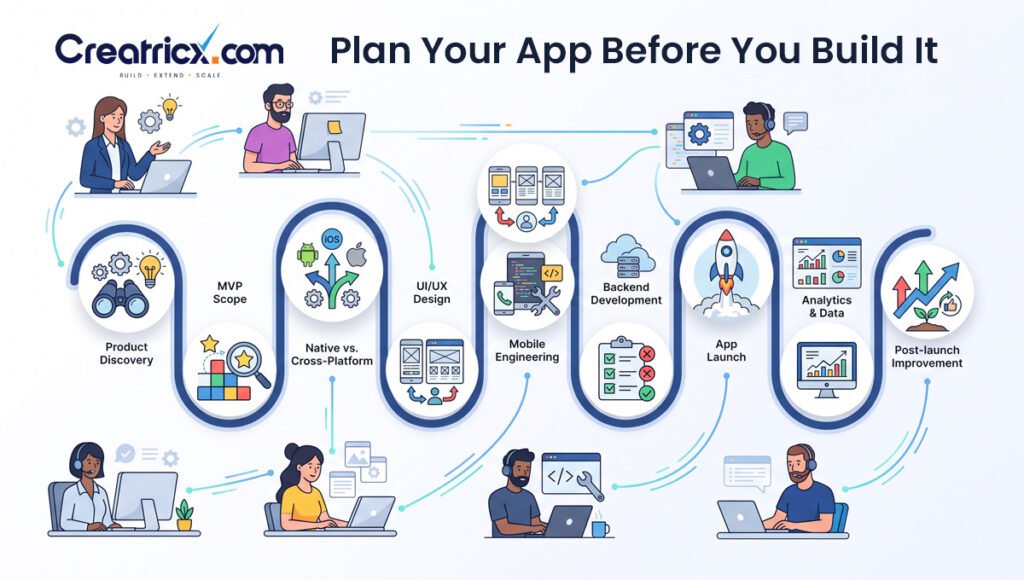
Discovery: define user roles, commercial outcome, critical workflows, risks, integrations and success measures.
MVP architecture: choose native or cross-platform, backend approach, data model, analytics and release constraints.
UX mapping: design journeys and edge states before engineering starts multiplying them.
Delivery sprints: mobile frontend, backend, integrations and QA move together rather than through isolated handoffs.
Release readiness: device testing, privacy, store requirements, analytics, access control, production configuration and support ownership.
Post-launch improvement: use real behaviour, errors, conversion data and customer feedback to choose the next release.
This aligns with Creatricx’s current mobile app positioning: product discovery, UI/UX, iOS/Android or cross-platform development, API integration, QA, store preparation, launch and ongoing improvement through a coordinated remote team.
Build the smallest app that can prove the business case Creatricx can help you scope an MVP, compare native vs cross-platform, estimate backend and integration work, and assemble the product, design, development and QA roles around the first release. |
|---|
How to Compare Mobile App Quotes
Normalize scope first. Make every provider price the same user roles, workflows and integrations.
Ask which backend and admin work is included.
Check whether UI/UX, QA and store release are part of the quote or separate.
Ask who owns source code, cloud accounts, app-store accounts and third-party subscriptions.
Ask for the change-request rate and process before changes exist.
Confirm the warranty period and post-launch support model.
Ask what the team would cut first if the budget had to fall by 25%. Good product teams can prioritize; weak quotes simply remove testing.
The question we like Ask every vendor: “What assumption in this estimate is most likely to change the price?” The answer tells you whether the estimate is based on real product thinking or merely a sales spreadsheet. |
|---|
Frequently Asked Questions
How much does it cost to build a mobile app in 2026?
Many professional app projects fall around $10,000–$50,000, while complex products can cost $50,000–$150,000+ and enterprise or highly regulated platforms can exceed $250,000. The exact cost depends on backend logic, user roles, integrations, platforms, security and QA.
How much does a simple mobile app cost?
Public 2026 research from GoodFirms places basic apps around $15,000–$40,000. In Creatricx's remote-team planning model, a lean MVP can sometimes be scoped around $10,000–$20,000 when the core workflow, backend and platform requirements remain focused.
How much does an app MVP cost?
A production MVP commonly requires more than a clickable prototype. Our planning band is roughly $10,000–$20,000 for a focused cross-platform MVP with authentication, a simple backend, analytics and one core workflow. A prototype used only for validation can cost much less.
How much does it cost to build an iOS and Android app?
The total depends on whether you build two separate native apps or use a cross-platform framework. Flutter and React Native can share substantial code across iOS and Android, reducing duplicated engineering where the product is suitable.
Is Flutter cheaper than native app development?
It can be. Flutter supports iOS and Android from one codebase, and GoodFirms' 2026 research estimates cross-platform builds can reduce initial cost by roughly 20–40% in suitable projects. The saving is not automatic because platform-specific integrations, device QA and store release still remain.
How much do mobile app developers charge per hour?
Upwork currently shows mobile app developer median rates around $18–$39/hour. Clutch says many app development companies list $25–$49/hour. Senior specialists and companies in high-cost markets can charge substantially more.
How much does it cost to maintain an app?
GoodFirms uses 15–25% of initial build cost as a broad annual maintenance planning range. We prefer explicit support bands based on release cadence, from light compatibility and bug-fix support to active product development and critical operations.
What are the App Store and Google Play fees?
Apple's Developer Program currently costs $99 per year in the U.S. Google Play charges a $25 one-time developer registration fee. These fees are small compared with development, backend, support and ongoing product work.
Why do some mobile app quotes differ so much?
Quotes often include different things. One vendor may include discovery, UI/UX, backend, admin tools, QA and launch; another may price only the mobile frontend. Compare assumptions, ownership, integrations, quality and post-launch support before comparing totals.
Can AI reduce mobile app development cost?
AI-assisted development can accelerate prototyping and repetitive implementation, but it does not remove product decisions, architecture, security, QA, integration risk or ownership. AI-powered features can also increase backend, evaluation, privacy and monitoring requirements.
Is it cheaper to outsource mobile app development?
It can be, especially compared with building a full U.S. in-house product team. BLS wage data shows that even a basic software developer + QA + interface design trio represents hundreds of thousands of dollars in annual wages before benefits.
How much would Creatricx charge to build a mobile app?
Creatricx prices projects after the app's users, workflows, platforms, integrations, backend, design, security and release requirements are understood. This article provides rough planning bands, not a fixed public rate card. A discovery session is the right way to turn the idea into a realistic quote.
Final Takeaway
If you want one number, $10,000–$50,000 is a useful 2026 starting range for many professionally built MVP and business-app projects. But that number becomes useless the moment the product needs multiple user roles, heavy backend logic, real-time workflows, regulated data, offline sync or complex integrations.
Our Creatricx approach is to price the risky parts of the product first. Define what the app must prove, choose the smallest release that can prove it, use a shared codebase when it genuinely reduces duplicated work, and keep backend, QA, security and post-launch ownership visible in the estimate.
A cheap app that needs to be rebuilt is expensive. A focused first release that produces real evidence can be one of the cheapest ways to make the next product decision.
Need a real app budget, not a calculator estimate? Creatricx can review your app idea, core workflows, platform choice, integrations, MVP scope and post-launch roadmap, then recommend a delivery model and realistic budget range. |
|---|
Research & Evidence Notes
The public article is original Creatricx editorial content. External sources anchor market ranges, current store fees, workforce cost, platform capability and security requirements. The Creatricx pricing bands are labelled as planning guidance rather than published fixed prices.
1. Clutch — Mobile App Pricing Guide 2026 — Updated August 6, 2026. Used for the $10,000–$49,999 reviewed-project range and $25–$49/hour company-rate context.
2. GoodFirms — How Much Does It Cost to Develop an App in 2026? — Updated May 29, 2026; based on insights from 267 mobile app development companies. Used for broad complexity, phase and maintenance ranges.
3. Upwork — Mobile App Developer Hourly Rates — Used for the marketplace median rate range of about $18–$39/hour.
4. U.S. BLS — Occupational Employment and Wages, May 2025 — Used for software developer, QA analyst/tester and web/digital interface designer wage anchors.
5. U.S. BLS — Employer Costs for Employee Compensation, March 2026 — Used for the broad 69.9% wages / 30.1% benefits private-industry compensation split.
6. Apple Developer — Program Enrollment — Used for the current U.S. Apple Developer Program fee of $99/year.
7. Google Play Console — Get Started — Used for the current $25 one-time Play Console registration fee.
8. Flutter — Development — Used to verify that Flutter supports building iOS and Android from a single codebase.
9. React Native — Official Site — Used for current cross-platform native-development context.
10. OWASP MASVS — Used as the mobile app security verification baseline reference.
11. Apple — App Review Guidelines — Used for privacy-policy and review context.
12. Google Play — Data Safety — Used for Play Store data-safety and third-party SDK disclosure requirements.
13. Creatricx — Mobile App Development Services in UK — Used for current Creatricx product planning, UI/UX, iOS/Android, cross-platform, MVP, integration, QA, launch and support positioning.
14. Creatricx — IT Outsourcing & Dedicated Remote Teams — Used for the broader Creatricx remote-team positioning.
From Idea to Defensible Estimate
Need a Real App Budget, Not a Calculator Estimate?
Creatricx can review your users, core workflows, platform choice, integrations, MVP scope, backend responsibility and post-launch roadmap, then recommend a realistic delivery model and budget range.