
To outsource IT services, define your business needs and project scope, then choose a suitable engagement model. Shortlist vetted providers based on technical expertise, security standards and client reviews, sign an NDA and contract, run a small pilot project, and scale the partnership once the results meet your expectations.
Key Takeaways
- Start by mapping the exact tasks, gaps and goals you want an external team to cover.
- Pick an engagement model (project-based, dedicated team or staff augmentation) that matches your workload.
- Judge partners on proven expertise, security posture and real client feedback, not price alone.
- Always sign an NDA and a clear contract before sharing systems or data.
- Run a low-risk pilot first, set measurable KPIs, then scale gradually.
- GDPR alignment, access control and secure workflows protect your business and your customers.
Table of Contents
What Does It Mean to Outsource IT Services?
Outsourcing IT services means hiring an external company or remote team to handle technology work that you would otherwise manage in-house. The provider takes ownership of agreed tasks, brings its own skilled people and tools, and delivers results against a clear brief.
That work can be one-off or ongoing. It might cover building software, running cloud infrastructure, handling day-to-day IT support, securing systems or automating manual processes. You stay in control of strategy and priorities, while a specialist partner carries out the technical delivery.
A simple real-world example: a growing online retailer needs a custom stock-management tool but has no developers on staff. Instead of recruiting, onboarding and paying a full engineering team, the retailer hands the project to an outsourcing partner. The partner scopes the build, develops the tool, tests it and supports it after launch. The retailer gets the software it needs, on time, without the long-term cost of permanent hires.
Why Businesses Outsource IT Services
Companies of every size outsource IT for practical, commercial reasons. The main drivers tend to be the same across industries:
- Cost reduction – You avoid salaries, recruitment fees, training, office space and software licences for a permanent team.
- Access to global talent – You tap into specialists and niche skills that may be hard to find or afford locally.
- Faster delivery – Experienced teams already have the processes and tools to move quickly from brief to launch.
- Scalability – You add or reduce capacity as projects grow or shrink, without the friction of hiring and redundancies.
- Focus on core business – Your internal people spend their time on the work that drives revenue, not on routine technical upkeep.
IT Outsourcing Growth
IT outsourcing has moved from a cost-cutting tactic to a core growth strategy. A few well-established industry trends are worth keeping in mind:
- Steady, sustained demand – Outsourcing continues to expand as more small and mid-sized firms adopt models that were once used mainly by large enterprises.
- Cloud and AI are accelerating it – Rising demand for cloud management, automation and data work is pushing companies to bring in outside expertise rather than build it from scratch.
- Productivity benefits – Delegating routine and specialist technical tasks frees internal teams to concentrate on product, customers and revenue.
- Cost savings – Many businesses report meaningful reductions in operating costs after shifting fixed in-house overheads to flexible, on-demand support.
Step-by-Step Guide on How to Outsource IT Services
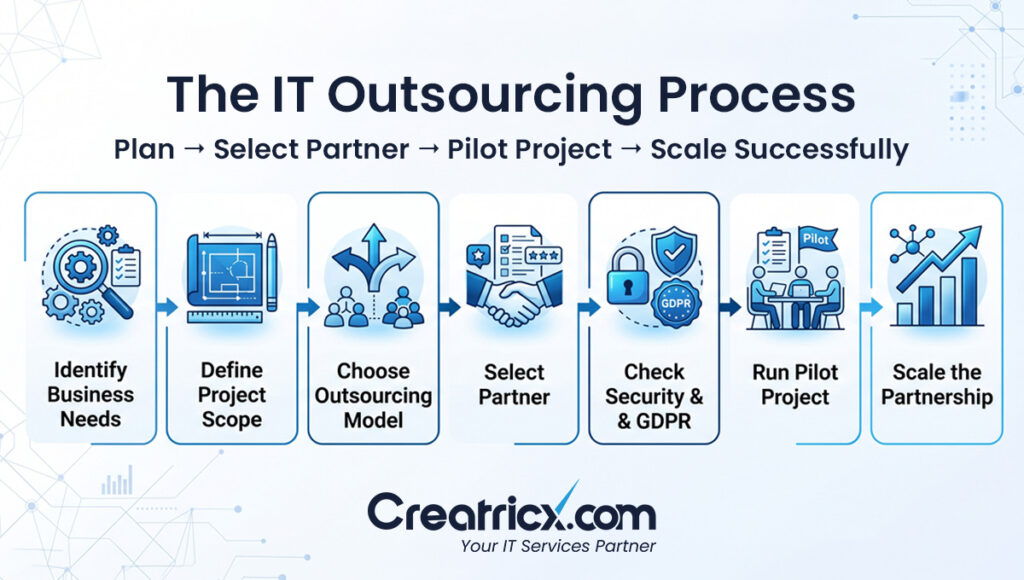
Use this sequence to move from "we need help" to a working, productive partnership.
- Identify business needs – List the problems you want solved and the outcomes you expect. Be specific: a slow website, no in-house developers, weak security, or manual tasks that eat time.
- Define project scope – Document deliverables, timelines, budget and the technologies involved. A clear scope prevents misunderstandings and scope creep later.
- Choose an outsourcing model – Decide what fits the work. Project-based suits a defined one-off build; a dedicated team suits ongoing development; staff augmentation suits adding skills to your existing team.
- Select an outsourcing partner – Build a shortlist of providers with relevant experience in your domain and technology stack.
- Evaluate technical expertise – Review portfolios, case studies and team profiles. Ask how they handle code quality, testing and project management.
- Check GDPR and security compliance – Confirm how the partner stores data, controls access and meets data-protection obligations before any information is shared.
- Sign an NDA and agreements – Put confidentiality, ownership of work, payment terms and service levels in writing.
- Start a pilot project – Begin with a small, well-defined task to test communication, quality and reliability at low risk.
- Scale gradually – Once the pilot proves the partner can deliver, expand the scope, add team members and take on larger projects.
Choosing the right model in step 3 shapes the whole engagement. Here is a quick comparison:
| Outsourcing Model | Best For | How You Pay |
| Project-based | A defined, one-off build with clear deliverables | Fixed price per project |
| Dedicated team | Ongoing development and long-term roadmaps | Monthly retainer per team |
| Staff augmentation | Adding specific skills to your existing team | Per person, per hour or month |
Common Mistakes in IT Outsourcing
Avoid the errors that derail most outsourcing relationships:
- Choosing the cheapest vendor only – The lowest quote often hides weak quality, hidden costs or poor support.
- Ignoring data security – Skipping checks on how a partner protects your data exposes you to breaches and compliance risk.
- Poor communication setup – No agreed channels, time zones or reporting routines leads to delays and frustration.
- No KPIs or tracking – Without measurable targets, you cannot tell if the partnership is delivering.
Types of IT Services You Can Outsource
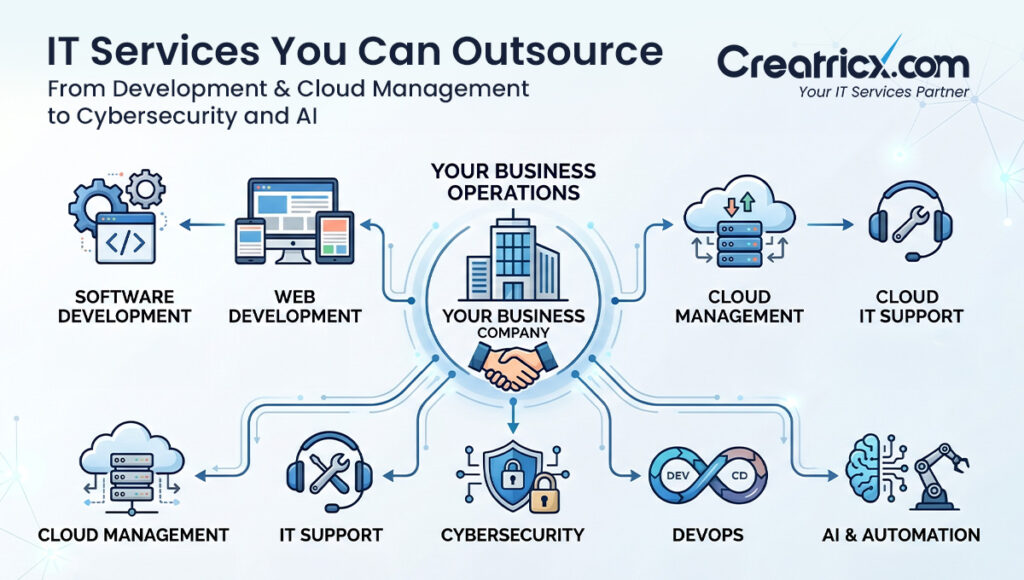
Almost any technology function can be delegated to a capable partner. These are the most common areas businesses outsource.
Software Development
Custom applications, internal tools, SaaS products and ongoing feature development. An outsourced team can build from scratch or extend an existing product, covering everything from architecture to testing.
Web Development
Company websites, e-commerce stores, portals and web apps. This includes design, front-end and back-end development, performance optimisation and ongoing maintenance.
Cloud Management
Setting up, migrating and managing cloud infrastructure. A partner can handle hosting, scaling, backups, monitoring and cost optimisation so your systems stay fast and reliable.
IT Support Services
Day-to-day technical support, system monitoring, troubleshooting and maintenance. Outsourced support keeps your tools running and your users productive without a permanent helpdesk.
Cybersecurity
Protecting systems, networks and data from threats. This covers security audits, monitoring, vulnerability testing, access control and incident response.
DevOps Services
Streamlining how software is built, tested and deployed. DevOps specialists set up automation, CI/CD pipelines and infrastructure that speed up releases and reduce errors.
AI & Automation
Building intelligent workflows that remove repetitive manual work. This ranges from automating routine tasks to integrating AI tools that improve efficiency and decision-making.
Benefits of Outsourcing IT Services
- Lower operational cost compared with building and maintaining a full in-house team.
- Faster scaling up or down as your workload changes.
- Access to expert developers and specialists without long recruitment cycles.
- Reduced workload for your internal staff, who can focus on core priorities.
- Improved productivity through proven processes, tools and delivery experience.
How to Choose the Right IT Outsourcing Partner
The partner you pick matters more than the model you choose. Work through this checklist before you commit:
- Portfolio review – Have they delivered similar projects in your industry or technology stack?
- Client reviews – What do past and current clients say about quality, reliability and communication?
- Security standards – Do they follow recognised data-protection and security practices?
- Communication process – Are there clear channels, reporting routines and overlapping working hours?
- Technical expertise – Can their team demonstrate the specific skills your project needs?
Take time on this stage. A short call with references and a review of real work will tell you more than any sales pitch.
GDPR & Security Compliance
When you outsource IT, your data often sits in someone else's hands, so compliance is not optional:
- Data protection importance – Mishandled personal data can lead to heavy penalties and lost customer trust.
- Secure workflows – Insist on encrypted connections, controlled environments and documented processes.
- NDA agreements – A signed non-disclosure agreement protects your confidential information and intellectual property.
- Access control – Partners should grant the minimum access needed and revoke it when work ends.
Why Creatricx Is a Trusted IT Outsourcing Partner
At Creatricx, we help businesses grow without the hassle and cost of building large in-house teams. Our remote experts become an extension of your team, taking on the technical work so you can stay focused on running and growing your business.
Here is what sets our service apart:
- Dedicated remote teams – Skilled specialists who work as part of your team, aligned to your goals and timelines.
- Scalable solutions – Capacity that grows with you, so you only pay for the support you need at each stage.
- A GDPR mindset – Data protection built into how we work, not bolted on afterwards.
- Secure development process – Controlled access, confidentiality agreements and careful handling of your systems and data.
- Cost-effective services – Reliable delivery that lowers your operating costs compared with permanent hiring.
We support the full range of work covered above, from software development services and ongoing IT support services to digital solutions services, cloud management and AI & automation.
Ready to take the next step? Get a Quote for your project, contact the Creatricx team, or book a free consultation to talk through your needs. You can also explore our services or reach us any time through our contact page.
Frequently Asked Questions
What is IT outsourcing?
IT outsourcing is hiring an external company or remote team to handle technology tasks such as development, support, cloud management or security, instead of doing that work entirely in-house.
How much does IT outsourcing cost?
Costs depend on the scope, the engagement model and the skills involved. Most providers charge per project, per hour or through a monthly retainer for a dedicated team. The best way to get an accurate figure is to share your requirements and request a quote.
Is outsourcing IT services safe?
Yes, when you choose the right partner. Sign an NDA, check their data-protection and security practices, use controlled access and start with a pilot project to confirm they can deliver before scaling.
What are the benefits of outsourcing IT?
The main benefits are lower costs, access to specialist talent, faster delivery, flexible scaling and more time for your internal team to focus on core business priorities.
Which IT services can be outsourced?
Common examples include software development, web development, cloud management, IT support, cybersecurity, DevOps and AI and automation. In practice, almost any technology function can be delegated.
How do I choose an IT outsourcing partner?
Review their portfolio and client feedback, confirm their technical expertise and security standards, and check that their communication process fits your team. A trial project is the safest way to test the fit.
Will I lose control of my projects if I outsource?
No. You set the priorities, scope and goals, and a good partner reports progress regularly. Clear KPIs and agreed communication routines keep you in control throughout.
How do I protect my data when outsourcing?
Sign an NDA, insist on secure workflows and encryption, limit access to only what is needed, and work with a partner that takes GDPR and data protection seriously.