

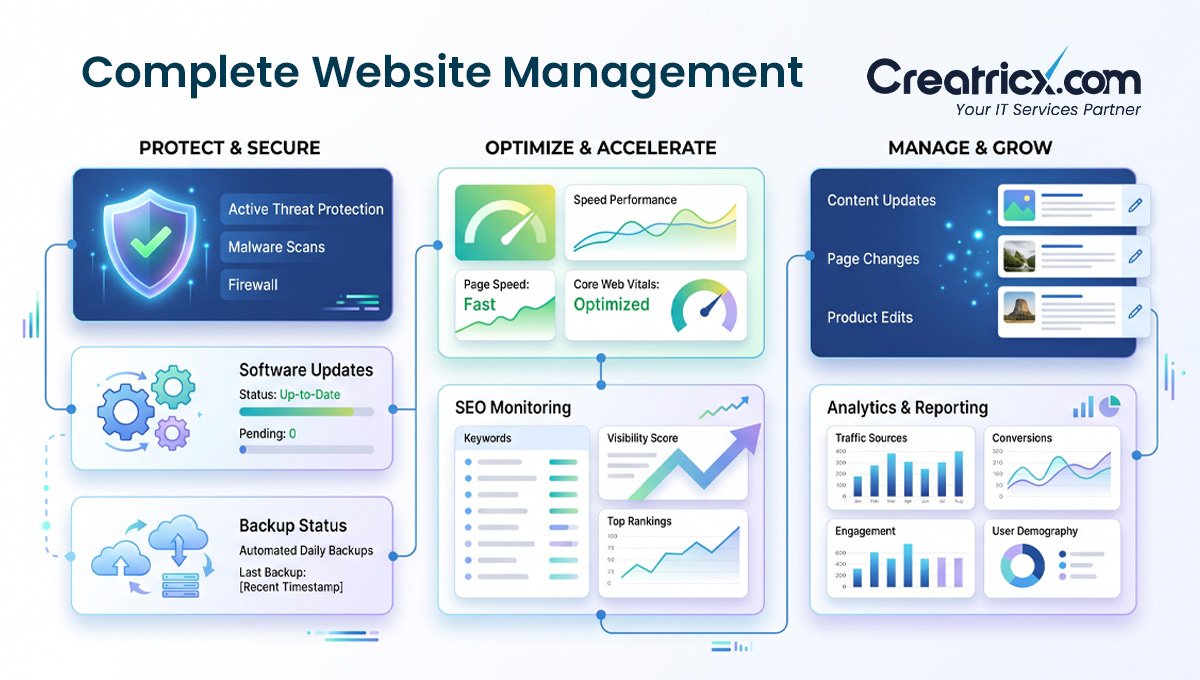
Website management refers to the ongoing process of keeping a live website secure, fast, up-to-date, and aligned with your business goals after it goes live. This includes software updates, security, backups, content, SEO maintenance and performance monitoring. Design and development build the site; management is everything that keeps it working from that day on.
Getting Started
Creatricx manages your website, updates, security, content and performance in one plan so your site stays healthy and you don't have to think about it.
Book a Free Consultation →Key Takeaways
- Website management is ongoing operation of a live site, distinct from design and development, which are one-time build projects
- It's broader than website maintenance: maintenance covers technical hygiene (updates, backups, security), while management adds content, SEO, analytics, and strategy on top
- Widely reported UX research finds 88% of online consumers are less likely to return to a site after a bad experience, which is what neglected management eventually produces
- According to Verizon's Data Breach Investigations Report, roughly 43% of cyberattacks target small businesses, and outdated website software is one of the most common entry points
- Professionally managed plans for most small business sites run $100 to $500 a month in 2026, with DIY costing little in money but a real 8 to 12 hours of the owner's time monthly
Three Different Things People Lump Together
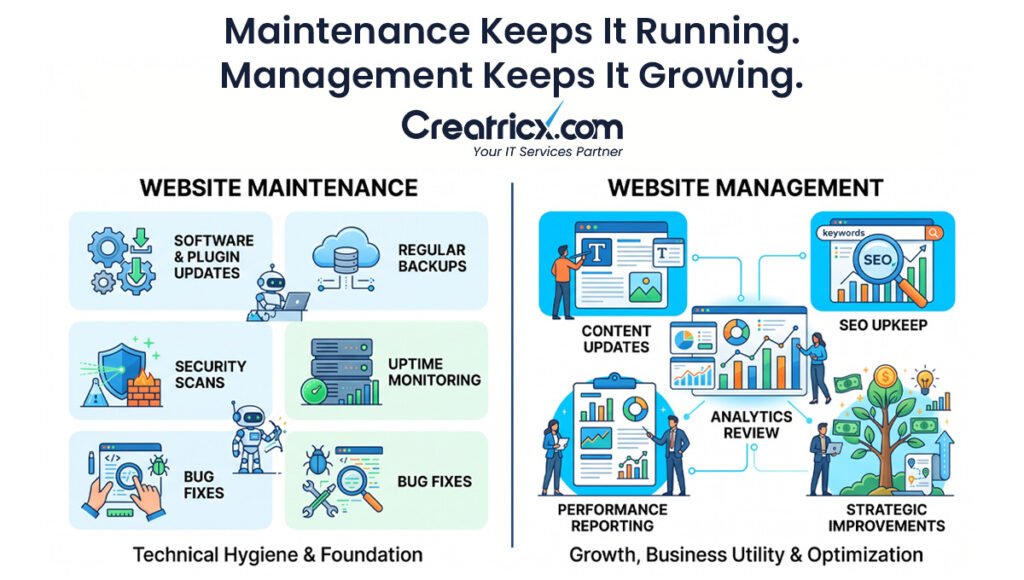
A lot of the confusion around this term comes from three genuinely different jobs getting bundled under one word.
Website design and development is the build: a one-time project that ends at launch.
Website maintenance is the technical hygiene that follows: updating the CMS and plugins, running backups, scanning for malware, monitoring uptime.
Website management is the umbrella over all of it: maintenance, plus content updates, SEO upkeep, analytics review, and the ongoing strategic decisions about what the site should be doing for the business.
Most articles on this topic draw the line between the build and what comes after, but skip the second distinction, and that's the one that actually matters when you're comparing service quotes, because a "management" plan that only covers maintenance tasks is quietly missing half the job.
A quick test to see if you are comparing apples to apples when evaluating providers: if a quoted "website management" plan does not mention content updates, SEO monitoring or analytics reporting anywhere, you are being quoted for maintenance, not management. Neither is wrong, but they're different services with different price points, and knowing what you're buying prevents a mismatch later.
What's Actually In The Job, Framed By What Breaks Without It
The clearest way to understand website management isn't a checklist, it's what happens when each piece gets skipped.
Skip software updates, and your site becomes an easy target. Outdated CMS versions, themes, and plugins are the single most common cause of website compromises, and per Verizon's Data Breach Investigations Report, roughly 43% of cyberattacks target small businesses, precisely because their defences tend to lag.
Visitors leave quietly, and performance work is skipped. Slow load times, broken forms, layout glitches rarely get complained about; people just go elsewhere. The most repeated statistic in UX research is that 88% of consumers are less likely to return after a bad experience, and most of those people don't even bother to tell you why.
Skip content upkeep, and your site starts lying. Old pricing, discontinued services, and stale blog posts don't just look unprofessional, they actively mislead visitors and erode the trust your site exists to build.
If you stop monitoring SEO, rankings will drift. Search algorithms change. Competitors post. Links rot. A site that no one is watching gradually loses visibility, so that by the time somebody notices, months of ground are lost.
Miss a backup and one bad day turns into a disaster. A hack, a bad update, or a hosting failure without a recent backup can mean starting over from zero. The same incident with backups in place is an inconvenience measured in hours.
The costs of neglect don't come a little at a time. A site can be fine for months with unapplied updates piling up, then one exploited vulnerability causes downtime, cleanup costs, and reputation damage all at once. Prevention is boring because it works.
What Website Management Costs
These ranges are cross-checked across multiple independent industry pricing guides published in 2026, not a single vendor's rate card.
| Approach | Typical Monthly Cost | The Honest Trade-off |
| DIY | $0-50 in tools, plus 8-12 hours of your own time | Cheapest in cash, most expensive in attention; easy to deprioritise until something breaks |
| Freelancer | $50-350 | Good for occasional fixes; no proactive monitoring or guaranteed response time |
| Professional managed service | $100-500 for most small business sites | Proactive monitoring, defined response times, one accountable provider |
| E-commerce or complex sites | $300-2,000+ | Transactions, inventory, and higher traffic raise both the stakes and the workload |
What moves the price within these ranges: site complexity, how often content changes, e-commerce functionality, traffic volume, and how much SEO and reporting work is bundled in. Two quotes that look far apart are often covering genuinely different scopes, so compare what's included line by line before comparing the price.
DIY, Hire In-House, Or Outsource: An Honest Way To Decide
The right answer depends on two things: how much your website actually matters to revenue, and who realistically has the time.
If your site is a simple brochure that rarely changes and doesn't drive leads directly, DIY with good automated tools is defensible. Set up automatic backups and updates, check in monthly, and accept the small risk.
If your site generates leads or sales, the calculation changes. Every hour of downtime and every slow page carries a direct cost, and the 8 to 12 hours a month that proper DIY management takes is time most owners end up spending on client work instead, which is exactly how sites drift into neglect. This is the situation where a managed service usually pays for itself, not through anything dramatic, but through the accumulated absence of problems.
Hiring in-house only starts to make sense at genuine scale: multiple sites, daily content changes, or complexity that justifies a full-time salary. For a single business site, a dedicated hire is almost always more capacity than the job needs.
Talk To Us
Not sure which situation you're in? Creatricx will look at your site and give you a straight answer on what it actually needs, even if the answer is that a lighter plan than you expected would do the job.
Talk To Creatricx →Businesses that move from reactive fixes to structured management consistently report the same pattern: fewer emergencies, faster page speeds, steadier search visibility, and, most noticeably, no longer thinking about the website at all, which is what a well-managed site should feel like from the owner's side.
How Creatricx Handles Website Management

Creatricx runs website management as a single accountable service covering the full scope: software updates, security monitoring, backups, content changes, SEO upkeep, and performance reporting, rather than the maintenance-only plans that leave content and search visibility as someone else's problem.
Sites are monitored proactively rather than checked when something breaks, and reporting is delivered in plain language, what was done, what changed, what's next, rather than a dashboard of unexplained metrics.
For businesses whose site has drifted into neglect, engagements start with a health audit that establishes what needs fixing first, before any monthly plan begins.
Frequently Asked Questions
What is website management?
The ongoing work of keeping a live website secure, updated, fast, and aligned with business goals, covering software updates, security, backups, content, SEO upkeep, and performance monitoring after the site launches.
What's the difference between website management and website maintenance?
Maintenance is the technical subset: updates, backups, security, uptime. Management is the broader job that includes maintenance plus content updates, SEO monitoring, analytics, and ongoing strategy.
How much does website management cost in 2026?
Most small business sites pay $100 to $500 a month for a professionally managed service. DIY costs little in cash but roughly 8 to 12 hours a month in time, and complex or e-commerce sites run $300 to $2,000+.
Can I manage my website myself?
Yes, particularly for simple sites that rarely change. The honest constraint is time and consistency: DIY management fails most often not from lack of skill but from being deprioritised when business gets busy.
How often should a website be updated?
Software updates should be applied as they're released, ideally within days for security patches. Content should be reviewed at least quarterly, and analytics monthly at minimum.
What happens if a website isn't managed?
Gradual decay followed by sudden cost: rankings drift, speed degrades, content goes stale, and unpatched software eventually gets exploited, turning months of quiet neglect into downtime and cleanup bills at once.
Does website management include SEO?
Proper management includes SEO upkeep, monitoring rankings, fixing broken links, maintaining technical health. Full SEO campaigns, content strategy, link building, are usually a separate, larger engagement.
What does Creatricx's website management service include?
The full scope: updates, security, backups, content changes, SEO upkeep, and plain-language performance reporting, starting with a site health audit before any monthly plan begins.
Disclaimer
This article reflects industry pricing data and research current at the time of writing, cross-checked across multiple published 2026 sources, alongside Creatricx's published service model. Costs vary by site complexity and provider. Always confirm current pricing directly with Creatricx before committing to a management plan.
Ready When You Are
Get a free website health audit from Creatricx and find out exactly what your site needs, and what it doesn't.
Get Your Free Audit →In Summary
Website management is the unglamorous work that determines what your website is actually worth a year after launch. The build gets the attention, but management is what decides if the site stays fast, secure, accurate, and visible, or quietly decays until a bad day makes the neglect expensive. The decision isn't really DIY versus outsourcing; it's an honest question about how much your site matters to revenue and who genuinely has the hours to look after it. Answer that honestly, and the right arrangement usually picks itself.