
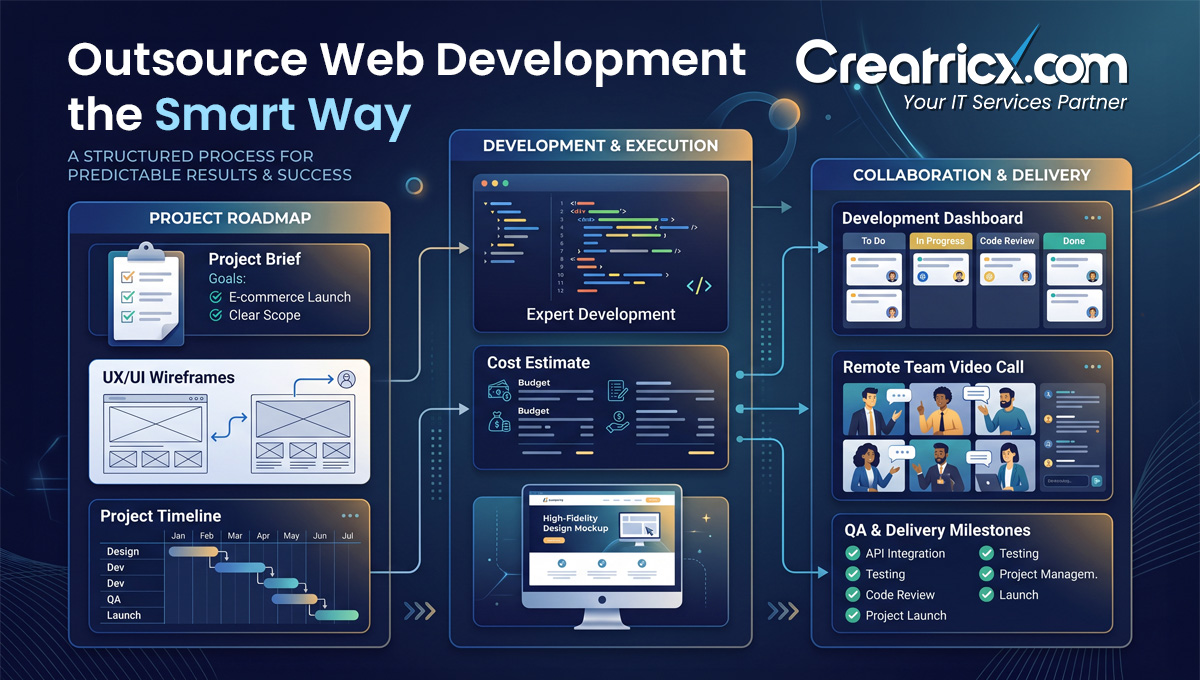
Outsourcing web development means hiring an external team, agency, or dedicated developer to design and build your website instead of using in-house staff. Done well, it cuts cost and timeline significantly; done carelessly, hidden costs and scope creep can erase most of the savings.
Key Takeaways
- A standard small business website typically costs $3,000-$15,000 and takes four to eight weeks with an outsourced team, while e-commerce builds run $15,000-$80,000 and take eight to sixteen weeks.
- Freelance and offshore hourly rates range from roughly $25-$150 depending on region and seniority, but the quoted rate rarely reflects the final invoice.
- Compliance requirements now routinely add $2,000-$20,000 to a project: GDPR cookie infrastructure, ADA/WCAG accessibility, and PCI-DSS for anything handling payment data.
- Skipping a paid discovery phase is the single most reliable way to trigger scope expansion and budget overruns mid-project.
- Ongoing costs don’t stop at launch: hosting, maintenance, and updates typically run $200-$2,000 a month depending on site complexity.
Table of Contents
What A Website Actually Costs, And Why The First Quote Isn’t The Last Number
Most businesses shopping for a web development partner anchor on a single number and then feel blindsided when the final invoice is 30-50% higher. That gap isn’t usually the vendor padding the bill.
It’s almost always one of three things left out of the original scope: content creation (copywriting and image direction, commonly $2,000-$5,000), compliance work (accessibility, cookie consent, and data handling infrastructure), or third-party integrations, each of which typically adds $1,000-$10,000 depending on complexity.
A useful gut check before requesting quotes: if a proposal doesn’t explicitly list content creation, SEO setup, and compliance work as line items, assume none of it is included and budget separately for it.
The Part Of The Process That Determines If You Stay On Budget
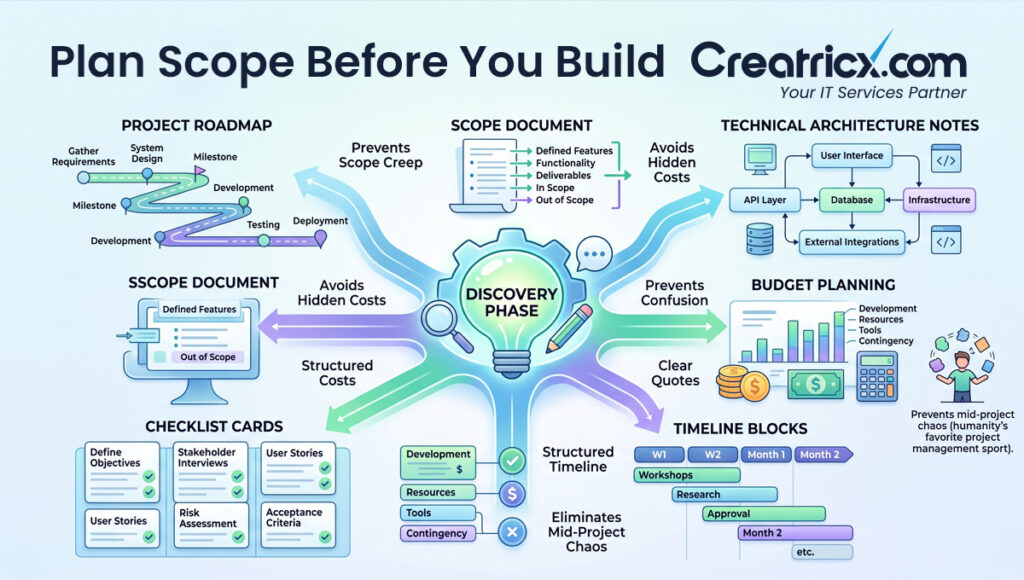
Scope expansion is the top cause of outsourced web projects running over time and over budget, and it rarely looks dramatic at the moment. A twenty-page marketing site quietly picks up a blog section, then a case studies page, then two more integration requests, and by the time anyone totals it up, the scope has roughly doubled without a single conversation about the budget changing.
Vendors who run a proper paid discovery phase before development starts, producing a defined scope, a technical architecture recommendation, and a documented timeline, are structurally protected against this in a way that vendors who start coding from a two-paragraph brief are not.
Watch for vendors willing to start development from an undefined brief with no discovery phase. It looks like a faster start, but undefined requirements typically add 20-35% to the final project cost once the inevitable scope conversations happen mid-build instead of before it.
Matching The Vendor Type To The Actual Size Of The Job
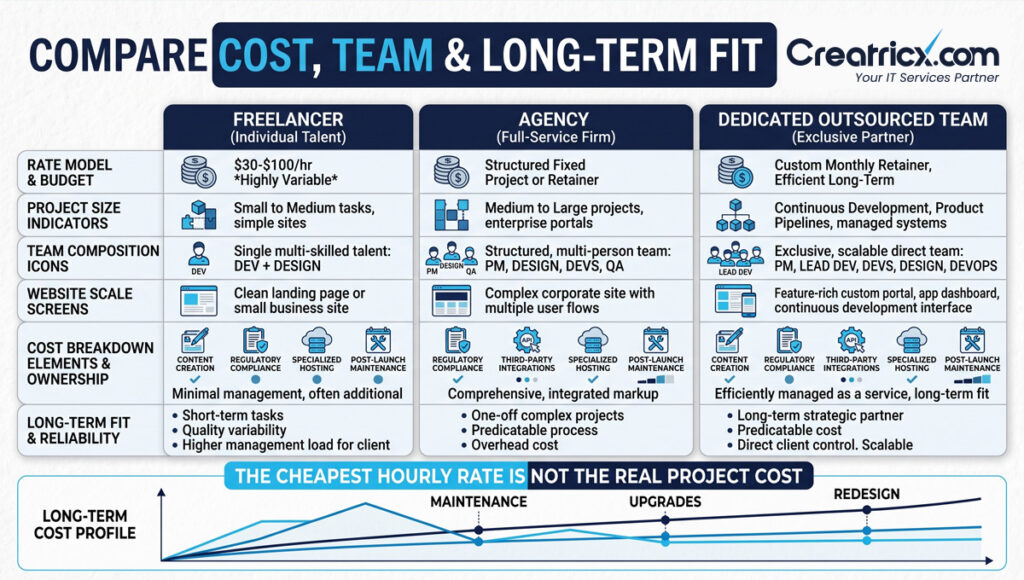
Not every project needs the same kind of partner, and choosing the wrong type is a common source of frustration on both sides.
| Vendor Type | Best Fit | Typical Budget Range |
| Freelancer | Clearly defined deliverable, someone in-house can review output | Under $10,000 |
| Agency | Full delivery needed, multiple disciplines (design, front-end, back-end) in parallel | $15,000-$50,000+ |
| Dedicated Outsourced Team | Ongoing product, institutional knowledge matters, longer-term relationship | $12,000-$22,000/month for a small team |
These ranges reflect typical market conditions at the time of writing and vary by region, project complexity, and vendor experience level. Treat them as a starting point for budgeting conversations, not a fixed quote.
A Realistic Sequence From First Brief To Live Site
Step 1: Write the Brief Before Contacting Anyone
List core pages, required features, integrations, budget range, and timeline. Vague briefs produce vague quotes, and vague quotes are where scope creep begins.
Step 2: Run or Request a Paid Discovery Phase
A proper discovery phase should output a defined scope document, a technical architecture recommendation, and a realistic timeline, not just a sales conversation dressed up as planning.
Step 3: Choose the Platform Before Choosing the Design
Decide on a CMS your own team can manage independently after launch. A beautiful design built on a platform nobody in-house can update becomes a recurring cost the moment the site goes live.
Step 4: Build With Change Control in Place
Agree on the number of revision rounds and how additional requests will be priced before development starts, not after the first invoice for “extra work” arrives.
Step 5: Budget for What Happens After Launch
Set aside an ongoing budget for hosting, security updates, and content changes. A site that performs well in year two requires investment that doesn’t stop at the launch date.
Businesses that insist on a documented discovery phase before development starts consistently report fewer budget surprises and shorter overall timelines than those who skip straight to build, even though discovery adds a small amount of time upfront.
The Line Items That Show Up After The Contract Is Signed
A handful of costs consistently catch businesses off guard because they rarely appear in an initial quote: GDPR and CCPA compliance infrastructure (cookie consent, data processing documentation) typically runs $500-$3,000; ADA and WCAG accessibility work runs $2,000-$8,000; and PCI-DSS compliance for any site handling payment data directly can add $3,000-$10,000.
None of these are optional extras in most markets now, they’re baseline legal requirements, which is exactly why a vendor who doesn’t mention them upfront is a vendor who hasn’t scoped the project properly.
It’s worth asking any vendor directly, in writing, which of these apply to your project and if they’re already included in the quote or billed separately later, since the answer to that single question reveals more about a vendor’s scoping discipline than almost anything else in the sales conversation.
Frequently Asked Questions
How much does it typically cost to outsource a website build?
A standard small business site runs $3,000-$15,000, while e-commerce builds typically fall between $15,000-$80,000, depending on features, integrations, and design complexity.
Why did my final invoice come in higher than the original quote?
This is almost always due to scope items that were not included in the original proposal, such as third-party integrations, compliance requirements, or content creation that were not clearly called out as line items.
Should I hire a freelancer, an agency, or a dedicated team?
It depends on project size and duration. Freelancers suit small, clearly defined deliverables; agencies suit full multi-disciplinary builds; dedicated teams suit ongoing products where institutional knowledge matters over time.
What does a discovery phase actually include?
A proper discovery phase produces a defined scope document, a recommended technical architecture, and a realistic project timeline, agreed before development begins.
What compliance costs should I budget for?
If the site takes payment data directly, you’ll typically need to add on GDPR/CCPA cookie and data infrastructure, ADA/WCAG accessibility work, and PCI-DSS compliance, bringing the total to $2,000-$20,000 depending on scope.
How long does a typical outsourced website project take?
A small business site generally takes four to eight weeks; e-commerce builds run eight to sixteen weeks; complex custom applications can take three to six months or longer.
What ongoing costs continue after the site launches?
Hosting, security updates, and content maintenance typically run $200-$2,000 a month, depending on site complexity and how frequently content changes.
How does Creatricx help avoid scope creep on a web development project?
Through a paid discovery phase that documents scope, architecture, and timeline before development starts, and by flagging content and compliance costs as line items upfront rather than after the contract is signed.
In Summary
The businesses that outsource web development successfully aren’t the ones who found the cheapest hourly rate. They’re the ones who insisted on a proper discovery phase, got content and compliance costs itemised upfront, and picked a platform their own team can actually manage after launch. The businesses that get burned almost always skip one of those three things to save a week at the start of the project, then pay for it many times over by the end.