
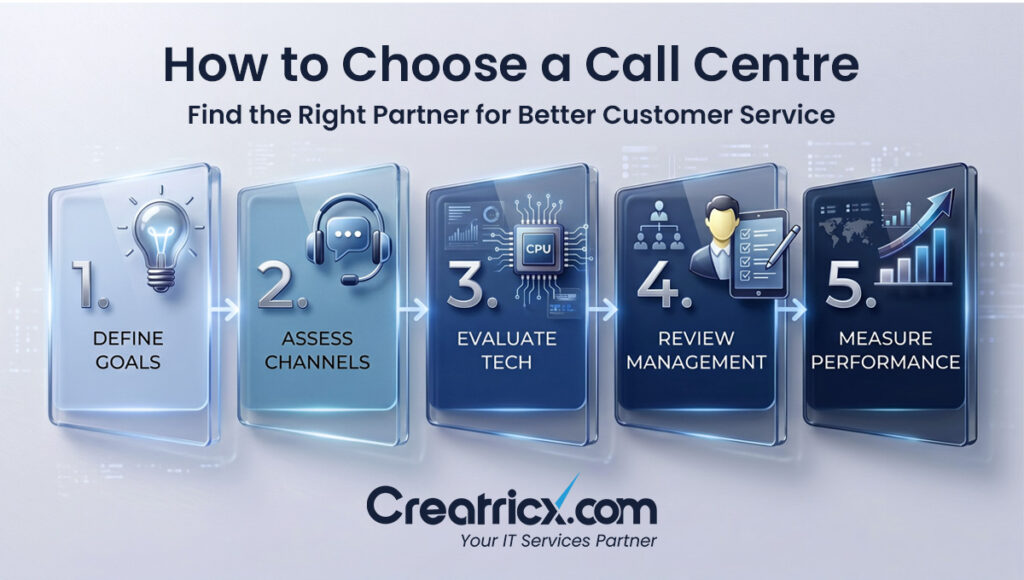
To choose a call centre, define your needs first — inbound or outbound, call volume, hours and languages. Then set a budget, shortlist providers with relevant experience, check their technology, security and GDPR compliance, review their SLAs and agent training, and run a short pilot before committing long term.
Table of Contents
Key Takeaways
- Start by defining your call type, volume, hours and language needs.
- Decide between an in-house and an outsourced call centre, and which location model suits you.
- Judge providers on experience, technology, security and agent quality — not price alone.
- Insist on clear SLAs, KPIs and regular reporting before you sign.
- Check GDPR and data-security standards, especially for recorded calls and customer data.
- Run a pilot to test quality and fit before scaling the partnership.
What Is a Call Centre?
A call centre (also written “call center”) is a team that handles phone calls and customer interactions on behalf of a business. Modern call centres often go beyond calls to cover email, live chat, social media and messaging — which is why many are now described as contact centres.
There are two core functions. Inbound call centres handle incoming contact, such as customer support, enquiries and order processing. Outbound call centres make calls out, for sales, surveys, appointment setting and follow-ups. Many handle both.
Choosing the right one matters because the call centre often becomes the voice of your business. The quality of those conversations shapes how customers feel about your brand.
Types of Call Centres
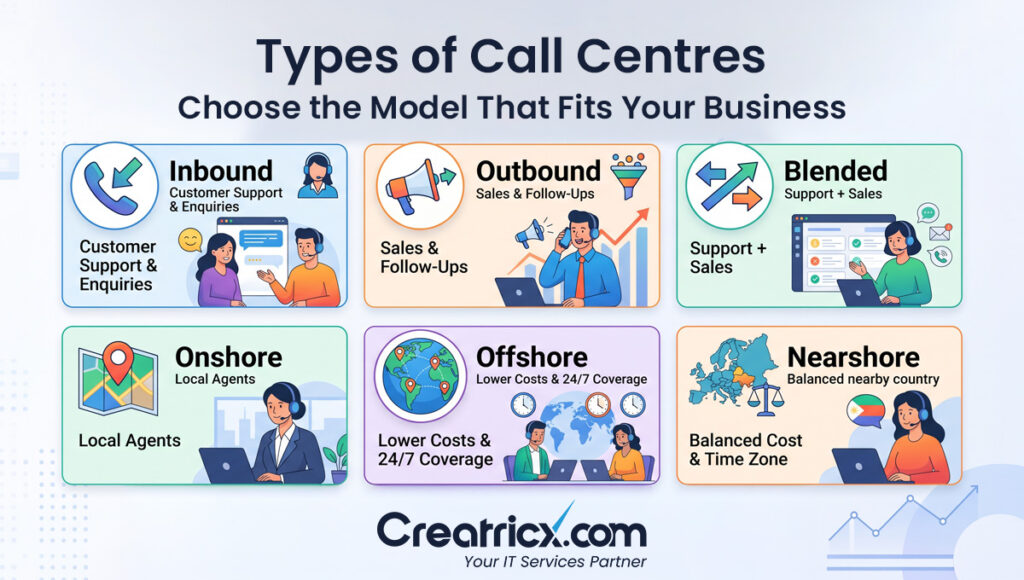
Knowing the main types helps you match a provider to your needs:
| Call Centre Type | What It Handles | Best For |
| Inbound | Incoming calls and queries | Customer support and helpdesks |
| Outbound | Outgoing calls | Sales, surveys and follow-ups |
| Blended | Both inbound and outbound | Mixed support and sales needs |
| Onshore | Agents in your own country | Local accents and regulations |
| Offshore | Agents overseas | Lower cost and round-the-clock cover |
| Nearshore | Agents in a nearby country | A balance of cost and time zone |
The right mix depends on your customers. A premium local brand may prefer onshore agents, while a high-volume operation might value the cost and coverage of offshore or nearshore teams.
Call Centre Trends
A few well-established trends shape how call centres work today:
- Omnichannel is standard – Customers expect support across phone, chat, email and social media, not just calls.
- AI is changing the front line – Chatbots and automated routing now handle routine queries, leaving agents for complex issues.
- Remote and distributed teams – Cloud tools let skilled agents work from anywhere, widening the talent pool.
- Data drives quality – Call recording and analytics help businesses measure and improve service.
Why Choosing the Right Call Centre Matters
The provider you pick affects more than your phone lines. A good choice delivers:
- Better customer experience – Professional, well-trained agents protect your reputation.
- Higher retention – Quick, helpful support keeps customers loyal.
- Lower costs – Outsourcing avoids the expense of building an in-house team.
- Scalability – The right partner handles busy periods without you hiring and training staff.
- Focus – Your team concentrates on core work while support is handled by experts.
A poor choice does the opposite — frustrated customers, lost sales and constant firefighting.
How to Choose a Call Centre (Step-by-Step)
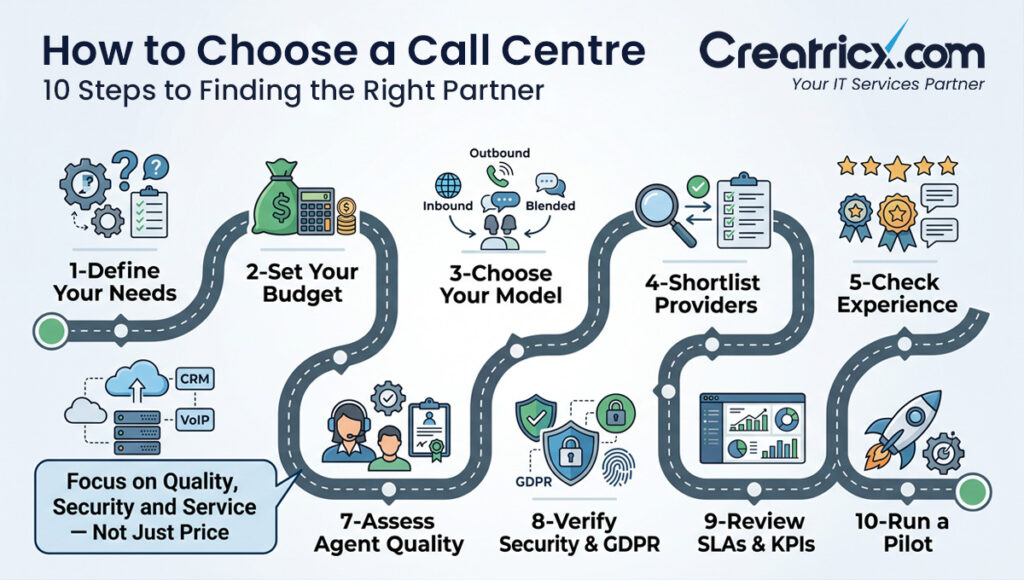
Work through this process to make a confident decision:
- Define your needs – Decide on call type, expected volume, operating hours and languages.
- Set your budget and pricing model – Understand how you want to pay: per hour, per call or per agent.
- Choose your model – Decide between in-house and outsourced, and onshore, offshore or nearshore.
- Shortlist providers – Build a list of call centres with experience in your sector.
- Check experience and references – Ask for case studies and speak to current clients.
- Review their technology – Confirm they use modern systems that integrate with your CRM.
- Assess agent quality – Ask about hiring, training, scripts and staff turnover.
- Check security and GDPR compliance – Confirm how they protect and store customer data.
- Review SLAs and KPIs – Agree response times, quality targets and reporting before signing.
- Run a pilot, then scale – Test the service on a small scale before expanding.
Common Mistakes When Choosing a Call Centre
Avoid the errors that lead to poor service and wasted spend:
- Choosing on price alone – The cheapest option often means weak training and high turnover.
- Ignoring security and GDPR – Handling customer data without proper safeguards is a serious risk.
- Overlooking agent quality – Scripts mean little if agents are poorly trained or constantly changing.
- No clear SLAs or KPIs – Without agreed targets, you cannot hold a provider accountable.
- Poor language or cultural fit – Agents who do not match your customers create friction.
Key Factors to Consider When Choosing a Call Centre
Use this checklist to compare providers side by side:
- Relevant experience – Have they worked with businesses like yours?
- Modern technology – Do their systems integrate with your tools and channels?
- Security and GDPR compliance – Are data protection and call handling up to standard?
- Transparent pricing – Is the cost model clear, with no hidden fees?
- Scalability – Can they grow or shrink with your demand?
- Language and coverage – Do they offer the languages and hours your customers need?
- Reporting and KPIs – Will you get regular, clear performance data?
- Communication and culture – Do they feel like a partner you can work with easily?
In-House vs Outsourced Call Centre
One of the biggest decisions is in-house versus outsourced — building your own team or handing the work to a specialist. Here is how they compare:
| Factor | In-House Call Centre | Outsourced Call Centre |
| Setup cost | High — staff, space and technology | Low — the provider supplies everything |
| Speed to launch | Slow | Fast |
| Scalability | Limited by hiring | Flexible and on demand |
| Control | Full, day to day | Shared, managed through SLAs |
| Best for | Large, stable call volumes | Growing or variable needs |
For most small and mid-sized businesses, outsourcing offers the quickest, most cost-effective route to professional support.
Benefits of the Right Call Centre
- Happier customers and stronger loyalty.
- Lower costs compared with an in-house team.
- Faster response times across channels.
- Easy scaling during busy periods.
- Access to trained, professional agents from day one.
Security and GDPR Considerations
Call centres handle sensitive customer information, so data protection is essential. Before you sign, confirm how a provider keeps that data safe.
GDPR & Data Security
Protecting customer data is both a legal duty and a trust issue:
- Data protection importance – Mishandled data can lead to penalties and lost trust.
- Secure call handling – Calls, recordings and records must be stored and transmitted securely.
- NDA and access control – Agents should sign confidentiality agreements and access only what they need.
- Regulatory compliance – The provider should follow GDPR and any rules specific to your industry.
Why Creatricx Is a Trusted Call Centre Partner
Building reliable customer support without the cost of a large in-house team is exactly what we help businesses do. At Creatricx, our remote experts become an extension of your team, handling customer interactions so you can focus on growth.
Our customer support approach includes:
- Trained, professional agents who represent your brand well.
- Flexible, scalable support that grows with your demand.
- Modern technology that integrates with your existing systems.
- A GDPR mindset with secure handling of customer data.
- Clear SLAs and reporting so you always know how your support is performing.
To explore the options, see our call centre outsourcing services, our AI & automation services for smarter support workflows, or our GDPR compliance approach to data protection.
Ready to improve your customer support? Get a Quote for your project, contact the Creatricx team, or book a free consultation to talk through your needs. You can also reach us any time through our contact page.
Frequently Asked Questions
What is a call centre?
A call centre is a team that handles customer phone calls and, increasingly, other channels such as chat and email. It can handle incoming support (inbound), outgoing calls such as sales (outbound), or both.
How do I choose the right call centre?
Define your needs, set a budget, and shortlist providers with relevant experience. Check their technology, agent training, security and GDPR compliance, agree clear SLAs, and run a pilot before committing.
Should I outsource my call centre or keep it in-house?
Outsourcing suits growing or variable needs, offering lower setup costs and fast scaling. An in-house team gives more control and can suit large, stable call volumes. The right choice depends on your size and goals.
How much does a call centre cost?
Costs depend on the model, call volume, location and service level. Providers usually charge per hour, per call or per agent. Share your requirements with a provider to get an accurate quote.
What is the difference between inbound and outbound call centres?
Inbound call centres handle incoming contact such as support and enquiries. Outbound call centres make calls out, for sales, surveys and follow-ups. Blended centres do both.
Is outsourcing a call centre safe for customer data?
Yes, when you choose a compliant provider. Confirm they follow GDPR, use secure call handling, sign confidentiality agreements and apply proper access controls before sharing any data.
What is an SLA in a call centre?
A service level agreement sets out the standards a provider must meet, such as average response times, resolution rates and quality targets. It lets you hold the provider accountable.
Onshore, offshore or nearshore — which is best?
Onshore offers local accents and regulations, offshore offers lower cost and wider coverage, and nearshore balances cost with a similar time zone. The best fit depends on your customers and budget.